
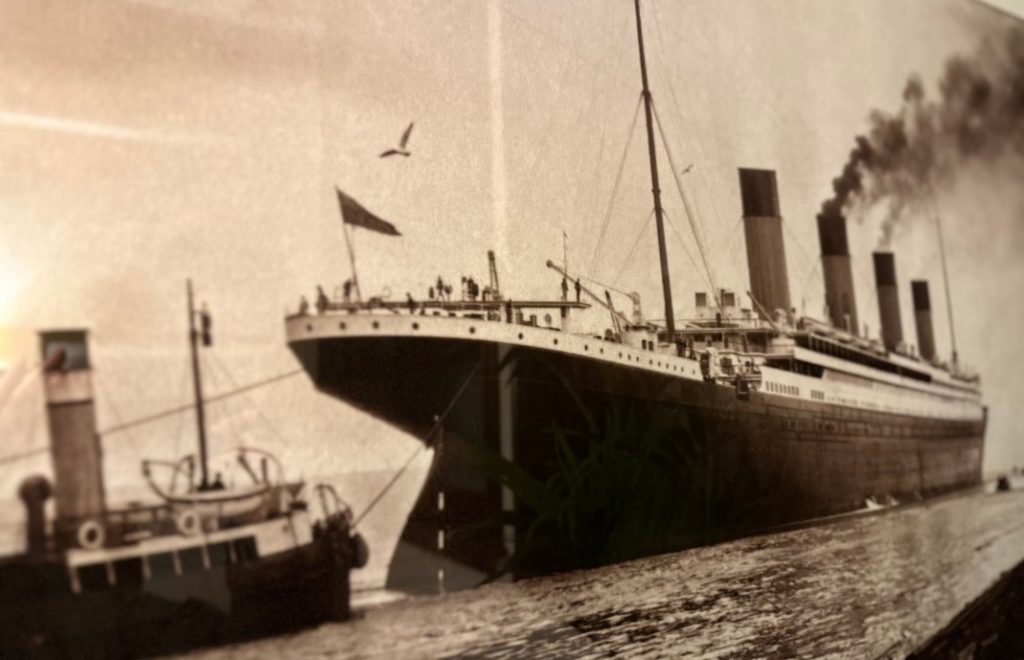
Belfast and the Titanic are forever bound by history. It was here, in this industrious Northern Irish city, that the RMS Titanic was imagined, designed, built, and launched into the world.
In 1912, Titanic wasn’t just the largest ship ever constructed – it was a floating palace of luxury, famously deemed the vessel that “could not sink.” Yet, the ship met its tragic fate on its maiden voyage, sinking beneath the icy Atlantic on April 15th, 1912.
Though it disappeared beneath a starlit sky more than a century ago, the Titanic’s story continues to captivate the world. It’s not just the grandeur of the ship that lingers in our collective memory, but the haunting tales of its passengers and their fateful journey.
Titanic belongs not only to the past, but to the present. The echoes of its first – and last – voyage still resonate deeply.
Today, while the ship rests silently on the ocean floor, its legacy lives on in Belfast. At the heart of the city stands Titanic Belfast, an award-winning museum that tells the full story of the world’s most iconic ship – from the drafting table to the slipway, through the maiden voyage and into the annals of maritime history.
Immersive, poignant, and visually stunning, Titanic Belfast is more than a museum – it’s a journey into one of the most powerful legends of the sea. A must-see for any visitor to Belfast.
The design of Titanic Belfast
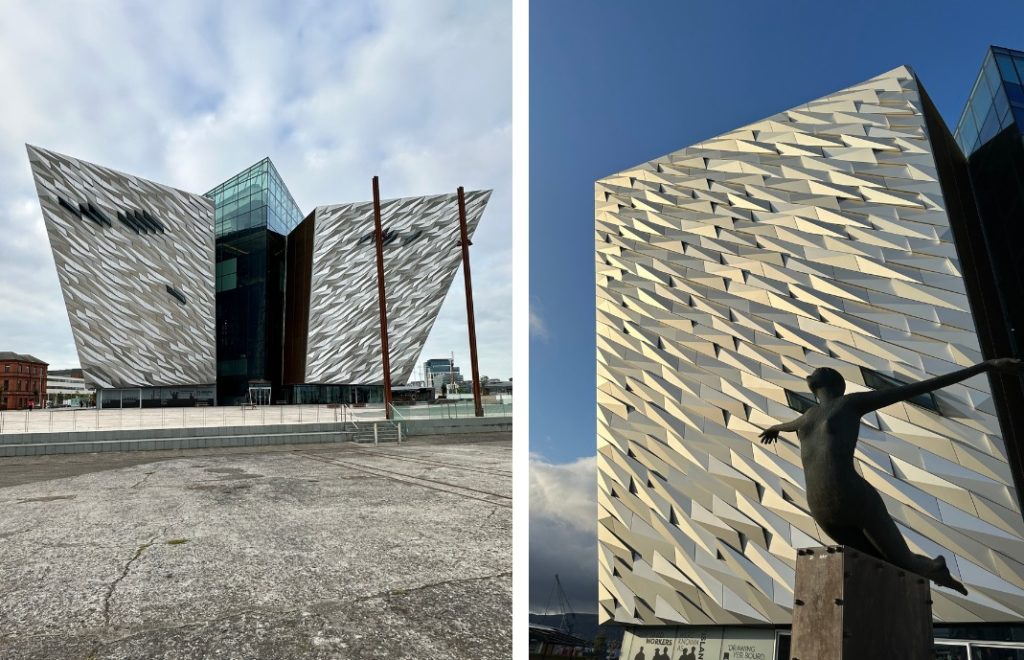
The building that houses Titanic Belfast is a striking architectural marvel – bold, symbolic, and deeply rooted in the city’s shipbuilding heritage. More than just a museum, it stands as a dramatic tribute to Belfast’s storied maritime past.
Designed to resemble a star, the structure pays homage to the White Star Line, the company that owned the Titanic. Its sharp, angular edges evoke the prow of a ship slicing through the sea, while the façade is clad in some 3,000 shimmering silver-toned aluminum panels. Soaring to a height of 38 meters – the same as Titanic’s hull – the building is a modern monument to engineering and ambition.
Standing proudly in front of the entrance is Titanica, a graceful bronze sculpture by Rowan Gillespie. Depicting a female diver, the piece echoes the figureheads that once adorned the bows of great ships. She stretches forward with elegance and purpose, symbolizing hope, courage, and the human spirit that endured beyond the tragedy.
Titanic Belfast is not only a museum – it’s a beacon of remembrance, resilience, and reverence, expressed through breathtaking design.
Your visit to Titanic Belfast
Step into The Titanic Experience – the world’s most immersive and authentic retelling of the Titanic story.
Opened in 2012 on the very site where the legendary ship was built, this award-winning attraction invites you on a deeply moving journey through history, spread across nine interactive galleries. With a powerful blend of imagery, video, soundscapes, scents, and personal stories, the experience is as unforgettable as it is emotional.
Belfast was Titanic’s birthplace – and, in many ways, it remains her home.
Your voyage begins in the Boomtown Belfast gallery, which brings to life the bustling city between 1909 and 1911, during the height of its shipbuilding era. Here, you’ll find original blueprints, architectural drawings, and intricate scale models of the Titanic, offering a glimpse into the immense planning behind her creation.
Next, you’ll enter The Shipyard, where a mini cable car ride takes you high above a recreated shipyard floor. From this unique vantage point, you’ll witness the construction of Titanic’s massive rudder and feel the awe-inspiring scale of the engineering feat.
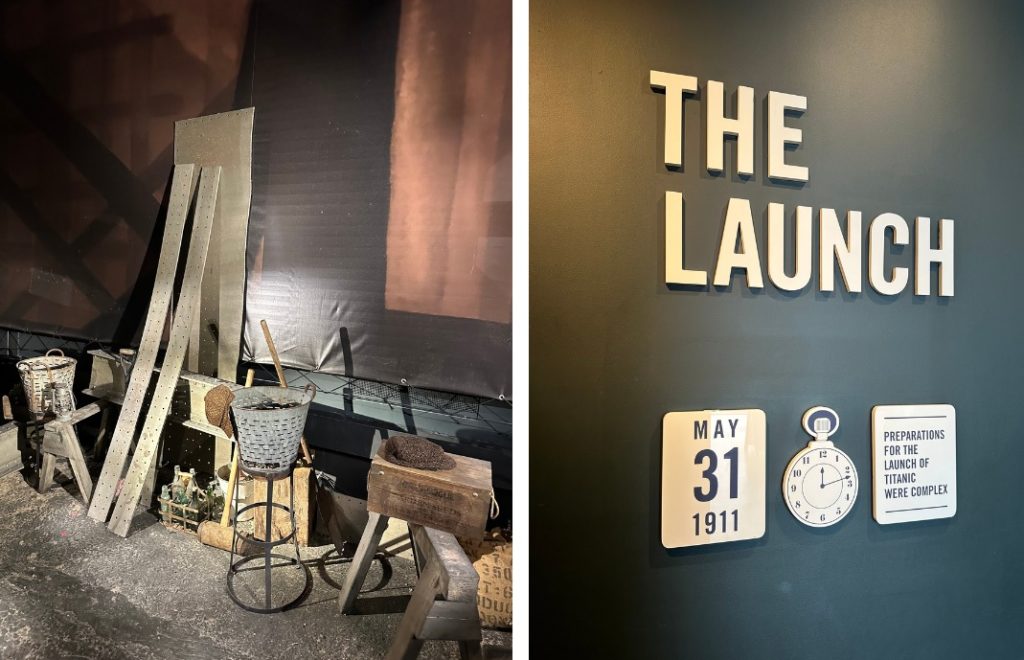
In The Launch, you relive the excitement of May 31, 1911, when over 100,000 spectators gathered to witness Titanic’s majestic descent into the water – a moment of pride, celebration, and history in the making.
Every step through Titanic Belfast brings you closer to the soul of the ship and the people whose lives it forever touched.
Walking in the wake of Titanic
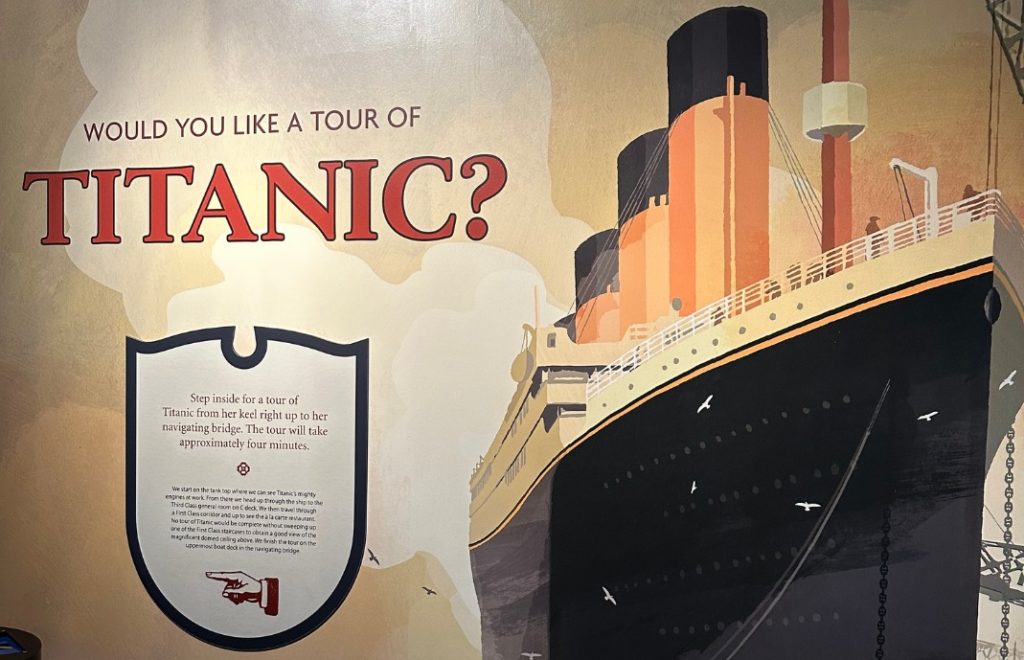
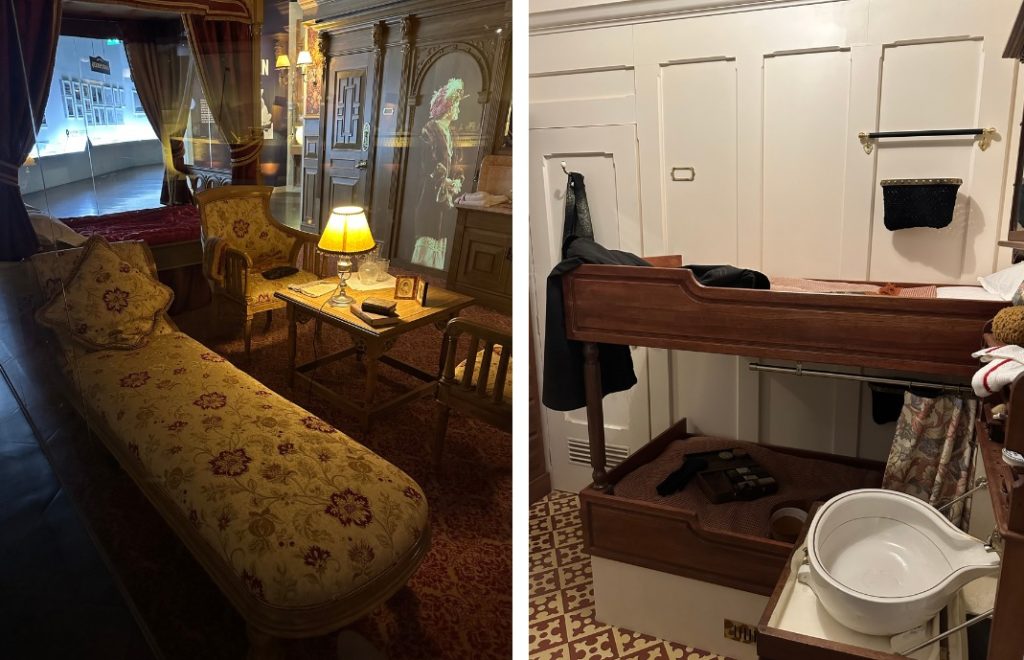
The journey deepens in The Fit-Out, the fourth gallery, where a grand scale model of the Titanic reveals the ship’s opulence and design in meticulous detail. Step into faithfully recreated cabins from first, second, and third class to see the stark contrasts in travel experiences. A stunning 360-degree film immerses you in the ship’s interior – through engine rooms pulsing with power, elegant salons, and even the captain’s bridge, where Titanic’s fate would one day be decided.
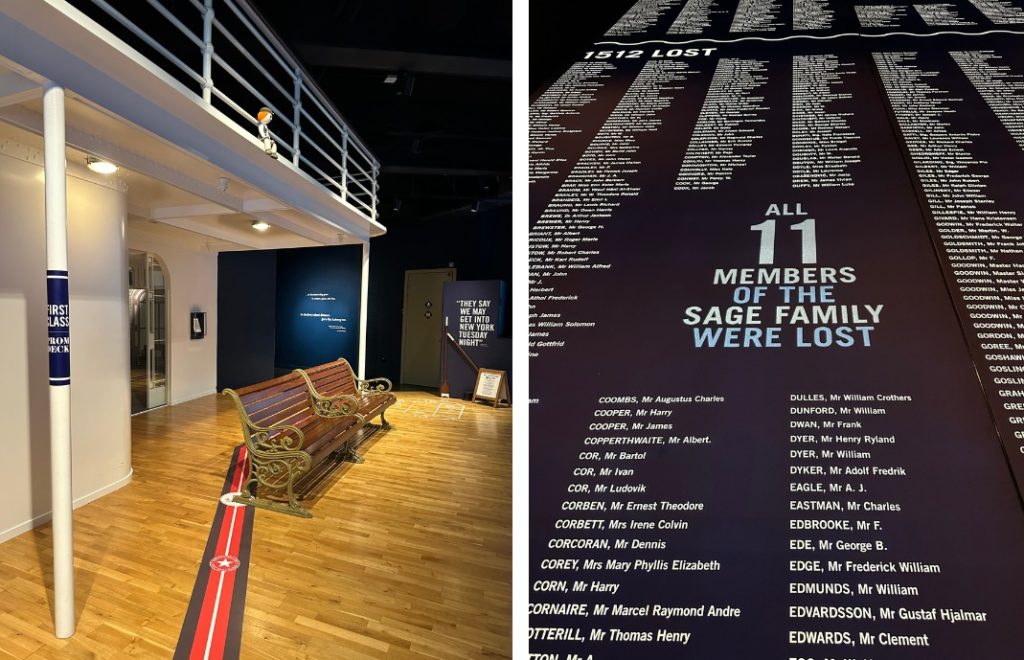
From here, you sail into The Maiden Voyage, which follows the ill-fated journey from Belfast to Southampton, then across to Cherbourg, onward to Cobh, and finally west toward destiny. In this gallery, visitors can walk a full-scale promenade deck, just as Titanic’s first-class passengers once did, surrounded by the elegance of an era gone by.
Here, the human story takes center stage. Whether you identify with the hopeful third-class emigrants bound for a new life, or the wealthy elite wrapped in mahogany, crystal, brass, and fine porcelain – Titanic was a world within a ship, carrying dreams of all kinds.
Then comes the most sobering chapter: The Sinking.
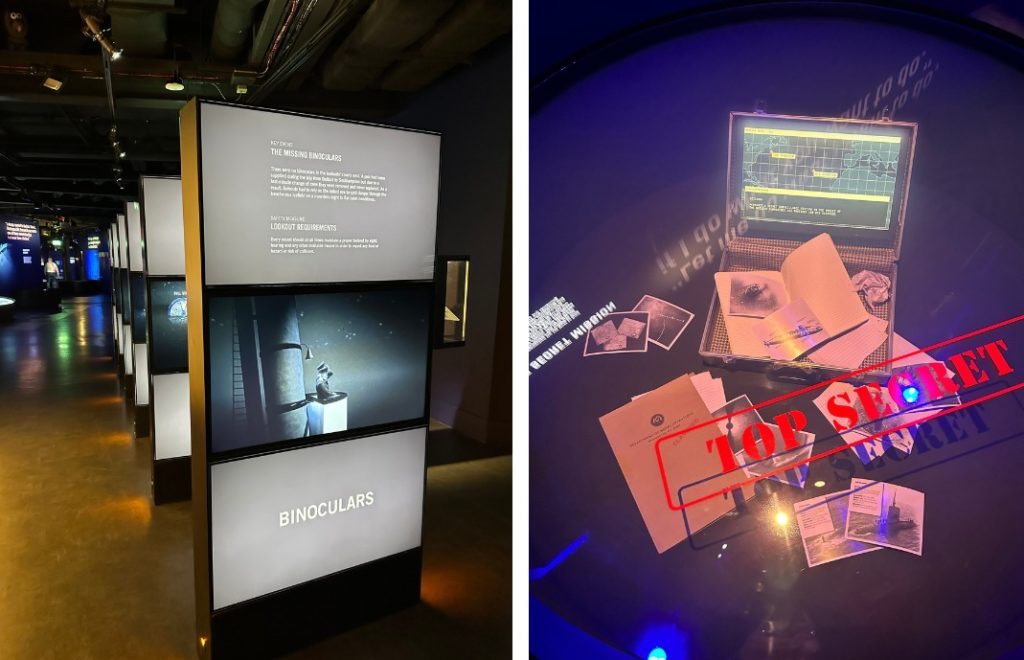
This gallery transports you to that clear, cold night of April 14-15, 1912. The collision, the confusion, and the chaos unfold through haunting visuals and soundscapes. In the background, the desperate tapping of the Morse-code SOS echoes through the gallery. Digital projections reconstruct the events, while powerful survivor testimonies give voice to the human cost.
As you descend the staircase to Gallery Seven, you pass the names of the 1,512 souls who perished – an evocative and solemn moment that reminds us the Titanic is not just a story of steel and sea, but of people, and the legacy they left behind.
The legacy that won’t let go
In the final chapters of The Titanic Experience, the gallery Myths & Legends explores the many stories, symbols, and speculations that have surrounded the Titanic for over a century. Through books, films, artifacts, and the ever-evolving world of the internet, the ship has become not only the most famous vessel in history – but a timeless legend ensuring that the lives of its passengers and crew are never forgotten.
The gallery Titanic Beneath plunges visitors into the dramatic rediscovery of the wreck in 1985, lying 3,800 meters below the Atlantic surface, 600 nautical miles southeast of Newfoundland. Through the lens of Dr. Robert Ballard’s groundbreaking expedition, you’ll witness the moment history was unearthed via immersive video, audio, and original imagery from the ocean floor.
Titanic Belfast is unforgettable – just like Titanic herself.
Best time to visit Titanic Belfast
As one of Northern Ireland’s most celebrated attractions, Titanic Belfast draws large crowds – especially during peak travel periods.
July and August, along with public holidays, mark the high season. If you want to avoid the busiest hours, it’s best to steer clear of visits between 11:00 AM and 3:00 PM.
For a more relaxed experience, aim to arrive right when the museum opens, or plan your visit for after 3:00 PM, when the flow of visitors begins to taper off.
Keep in mind that the last entry is 1 hour and 40 minutes before closing, so allow yourself plenty of time to explore the full experience without rushing.
For the most up-to-date opening hours and visitor information, be sure to check the official Titanic Belfast website before you go.
Practical information
Plan for 1.5 to 2.5 hours to explore Titanic Belfast thoroughly. Tickets are available online or at the entrance.
For an even deeper experience, you can purchase an optional multilingual audio guide.
Thoughtfully designed and fully accessible – including for wheelchair users – this modern museum is a tribute not just to a ship, but to a human story that continues to resonate.
Visitors are welcome to take non-commercial photographs throughout Titanic Belfast, allowing you to capture memories of this unforgettable experience. However, flash photography and video recording are not permitted inside the exhibition.
If you wish to use a tripod, flash, or any professional equipment, you’ll need to obtain written permission in advance.
Titanic Slipway
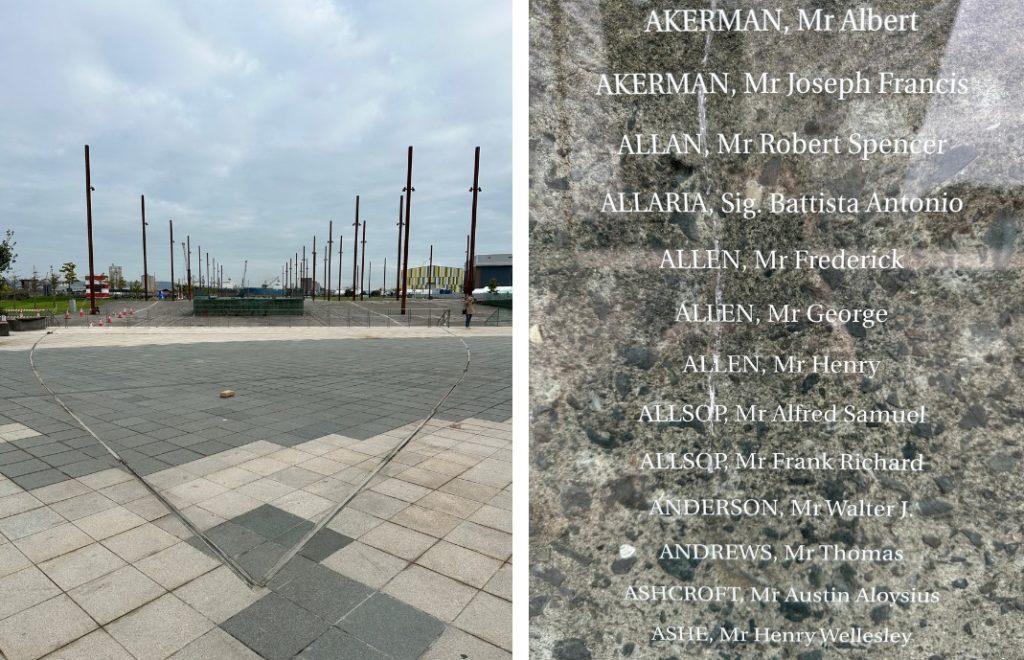
Just behind the museum lies the Titanic and Olympic slipways, where both legendary ships were constructed. Here, you can walk the very ground where Titanic once took shape – outlined full-scale on the surface, giving a powerful sense of the ship’s sheer size.
This open-air space also features a touching memorial, where the names of all those who perished are etched onto glass panels – a quiet, poignant tribute beneath the Belfast sky.
The story of Titanic
RMS Titanic was the second in a trio of nearly identical sister ships commissioned by the White Star Line and built by the famed Harland & Wolff shipyard in Belfast.
The first, Olympic, entered service in 1911. Titanic followed shortly after, slightly larger and even more luxurious, launched on May 31, 1911. The third ship, originally named Gigantic (later renamed Britannic), was completed later and tragically sank while serving as a hospital ship during World War I.
On April 10, 1912, Titanic set sail on her maiden voyage, departing from Southampton with scheduled stops in Cherbourg, France, and Queenstown (now Cobh), Ireland, before heading westward toward New York.
Onboard were 2,435 passengers, spanning every stratum of society:
- 735 in first class
- 674 in second class
- 1,026 in third class.
- An estimated 900 crew members joined them on this monumental crossing
Titanic was not only a marvel of engineering but also a symbol of a gilded age – one that would end in tragedy, forever immortalizing the ship and all who sailed aboard her.
April 14, 1912: The ice warnings and the collision
At 9:00 AM on April 14, Titanic received the first ice warning of the day. Several more followed, with the final message arriving at 10:30 PM. Despite these alerts, the ship maintained a steady speed of 21.5 knots, aiming to push through the ice field swiftly and arrive in New York ahead of schedule.
Captain Edward J. Smith had chosen the southernmost of three transatlantic routes, considered safer due to lower iceberg risk. However, Titanic was sailing 16 kilometers south of even this southern course, as a large number of icebergs had calved and drifted unusually far into the North Atlantic.
Then, just before midnight – at 11:40 PM – lookout Fredrick Fleet spotted an iceberg dead ahead, approximately 400-450 meters away. The binoculars the lookouts should have had were unfortunately locked away on land.
On the bridge, First Officer William Murdoch gave immediate orders: “Hard to starboard,” engines stopped, and full reverse thrust. Titanic veered left, but at 21.5 knots on a calm, windless sea, it was too little, too late. Just 37 seconds after the warning, Titanic’s forward starboard side scraped along the submerged portion of the iceberg.
The impact caused only a slight shudder through the vessel. Many passengers were asleep and didn’t stir. Others felt the jolt but assumed it was minor.
Around midnight, Captain Smith was informed that the ship’s six forward watertight compartments were flooding. Titanic could stay afloat for only about two hours. He immediately ordered the lifeboats to be prepared, the ship’s position calculated, and distress signals sent.
At 12:15 AM on April 15, the first SOS message was transmitted and picked up by Cape Race station in Newfoundland and other nearby ships.
At 12:25 AM, the Cunard Line’s Carpathia received the distress call. The ship immediately turned course toward Titanic – but she was four hours away.
The countdown had begun.
The final hours: Tragedy unfolds
As the reality of Titanic’s fate became clear, Captain Edward J. Smith gave the fateful order: “Women and children first” into the lifeboats.
At 12:45 AM, the first lifeboat was lowered into the water – with only 28 passengers aboard, despite having room for 65. Confusion, disbelief, and lack of urgency led to many boats being launched partially empty. One lifeboat, designed for 40, carried just 12 people. The first distress rocket soared into the night sky, signaling for help.
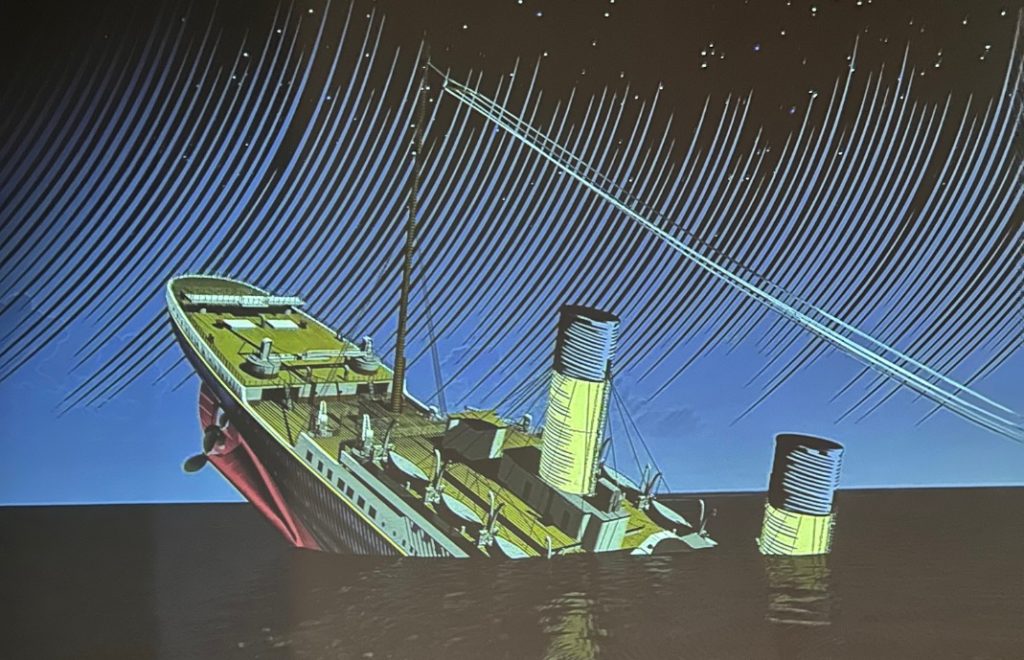
By 1:45 AM, the final flare lit up the darkness, and at 2:05 AM, the last lifeboat was launched.
At 2:17 AM, the final SOS message crackled through the telegraph room. Just three minutes later, at 2:20 AM, the unsinkable ship slipped beneath the waves, swallowed by the icy Atlantic.
The Carpathia, racing through the night, arrived at the scene at 3:30 AM. Thirty minutes later, the crew pulled survivors from the first lifeboat to safety. By 8:30 AM, the last lifeboat was rescued.
At 8:50 AM, Carpathia set course for New York, carrying 705 survivors – 675 of them women and children. Other vessels remained to search the debris field, but found no further survivors.
In total, 328 bodies were recovered, most of whom are now buried in Halifax, Nova Scotia. The rest remain forever with Titanic, entombed in the deep.
Titanic – Never forgotten
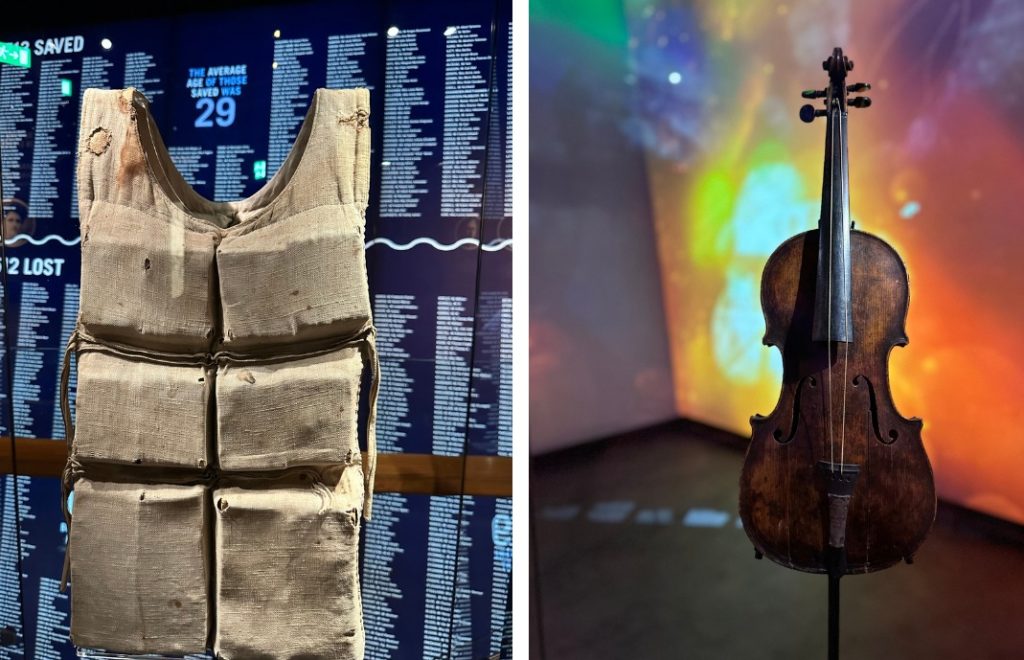
When Titanic slipped beneath the Atlantic waves in the early hours of April 15, 1912, the world lost 1,512 lives – among them Captain Edward J. Smith, and the ship’s lead designer and engineer, Thomas Andrews.
The tragedy sent shockwaves across both sides of the Atlantic. Public outrage and grief led to sweeping changes in maritime safety, and Titanic’s name was forever etched into global memory.
On September 1, 1985, more than 70 years after the disaster, Titanic’s wreck was discovered at a depth of 3,797 meters by a French-American expedition led by Dr. Robert D. Ballard. The discovery made headlines worldwide and reignited global fascination with the ship and its legacy.
In July 1986, cameras mounted on a deep-sea submersible penetrated the ghostly interior. They revealed ornate columns, crystal chandeliers, and gleaming brass fixtures – astonishingly well-preserved, as if untouched by time. Artifacts salvaged from the site have since been exhibited across the world, bringing Titanic’s story to life in museums and galleries.
Today, people from all corners of the globe journey to Titanic Belfast – to remember, to reflect, and to connect with those who perished that night. The museum captures both the opulence of the wealthy and the humble hopes of emigrants seeking a better life in the New World.
Though over a century has passed, Titanic remains a part of our world. Her story endures – not just as a maritime tragedy, but as a timeless symbol of human ambition, hubris, and hope.
She is, without question, the most famous ship in history.
Northern Ireland is a magical place.
Click here for more inspiration
