
It’s the earliest hour of morning. Even the notoriously eager rooster next door has yet to greet the day when our tuk-tuk pulls up to collect us. Darkness wraps around us like a heavy quilt, while the driver rubs sleep from his eyes and offers a quiet “good morning.”
Siem Reap is still fast asleep. Only the rhythmic hum of the tuk-tuk breaks the silence, its engine working tirelessly to propel us through the deserted streets. Headlights glow faintly – like a pair of feline eyes in the dark – guiding us deeper into Cambodia’s jungle.
Five kilometers later, we arrive at the awe-inspiring, sacred wonder of Angkor Wat.
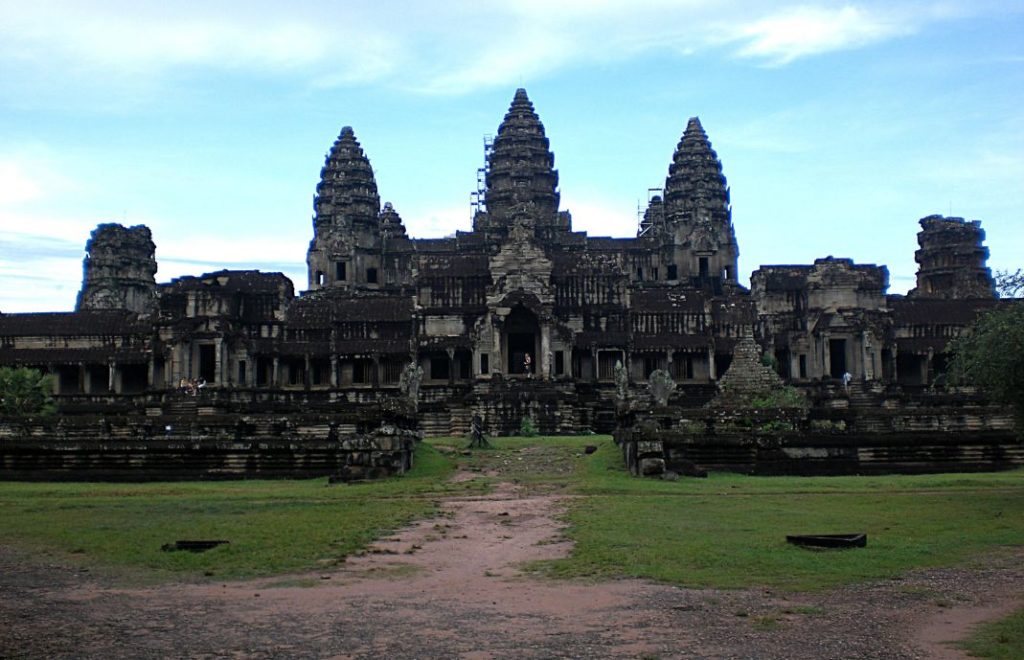
Sunrise at Angkor Wat
The hum of the weary engine fades away as our driver points toward the path ahead before curling up for a nap. Now, only the faint beams of our flashlights cut through the darkness, guiding us across a stone bridge, past the looming shadows of temple walls, and into a ghostly complex that feels frozen in time.
Muted voices confirm we’re in the right place – a vantage point along the outer wall’s eastern edge, where the sunrise reveals its magic. We find two empty chairs, shivering slightly in the crisp pre-dawn air, until a steaming cup of cocoa warms our hands. A grateful smile to the man who offers it, and then, like everyone else, we wait.
We wait for a revelation as breathtaking today as it must have been for those who once walked these sacred halls: sunrise over Angkor Wat.
The inky-black sky resists the encroaching light, as though night itself is reluctant to surrender. Before us, it feels almost like a silent battle between darkness and dawn. Slowly – imperceptibly at first – the sky blushes with deep crimson, then melts into indigo, and finally softens into pale hues of daybreak.
Gradually, the contours of this 800-year-old masterpiece emerge, sharper and more defined with every passing second. And in that moment, there’s no doubt – it was worth rising before the crack of dawn, worth every chilled breath and patient wait. The spectacle unfolding before us is nothing short of sublime.
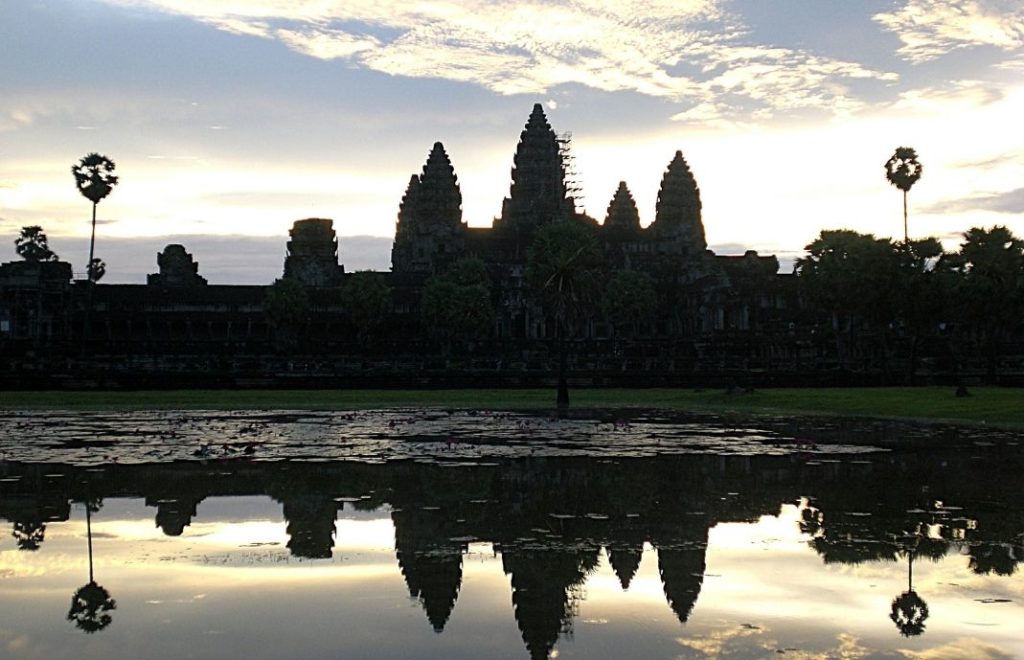
But first, breakfast
My stomach growls for sustenance, and the little café by Tonlé Sap Lake looks impossibly inviting. A smiling girl, no more than twelve, ushers us to a table and hands us menus. Pancakes and fresh juice – an easy choice – and they arrive swiftly, still steaming.
The sweet aroma of pancakes proves irresistible, not just to us. Before we can so much as lift a fork, a tiny dog appears at our side, gazing up with the kind of soulful eyes that could melt the iciest heart. Saying no is impossible. Against what I imagine are the café’s unspoken rules, we sneak him several generous bites of our breakfast.
When the plate is empty and our bellies content, the little beggar makes his move – hopping up onto the table, curling into a perfect ball, and drifting into a deep, satisfied sleep. By the time we leave, he’s snoring like a tiny, furry guardian of the feast.

This is Angkor Wat
In Khmer, Angkor Wat means “the temple of Angkor.” It stands as Cambodia’s most prominent national symbol – a proud emblem of Khmer culture and the Cambodian people. So revered is this sanctuary that its silhouette graces the nation’s flag and currency, an eternal mark of identity.
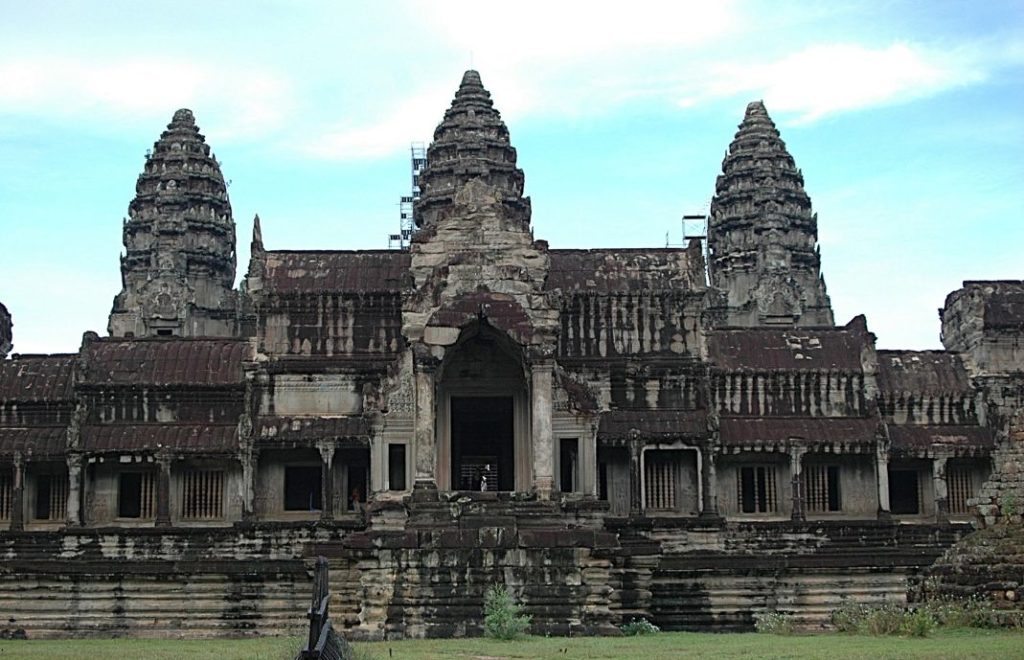
Step onto the vast forecourt, and the grandeur of the temple begins to unfold. Four elegant corner towers rise like sentinels around the central pagoda – the tallest and most commanding of them all. Surrounding structures stretch out in graceful galleries adorned with intricate bas-reliefs, each carving a whisper from centuries past.
From around 800 to 1430, Angkor served as the capital of the Khmer Empire – the mightiest power in Southeast Asia and, at the time, one of the most advanced civilizations in the world. The temple itself was commissioned by King Suryavarman II, who ruled from 1113 to 1159.
Originally conceived as a Hindu sanctuary in honor of Vishnu, Angkor Wat was designed to mirror the Hindu cosmos. By the 14th or 15th century, it had been transformed into a Theravada Buddhist shrine – a role it still largely holds today. The rest of Angkor, however, was abandoned by the 16th century, leaving this temple as the enduring heart of a vanished empire.
Celebrated as the crowning achievement of classical Khmer architecture, Angkor Wat, along with the surrounding Angkor complex, earned a well-deserved place on UNESCO’s World Heritage list in 1992.
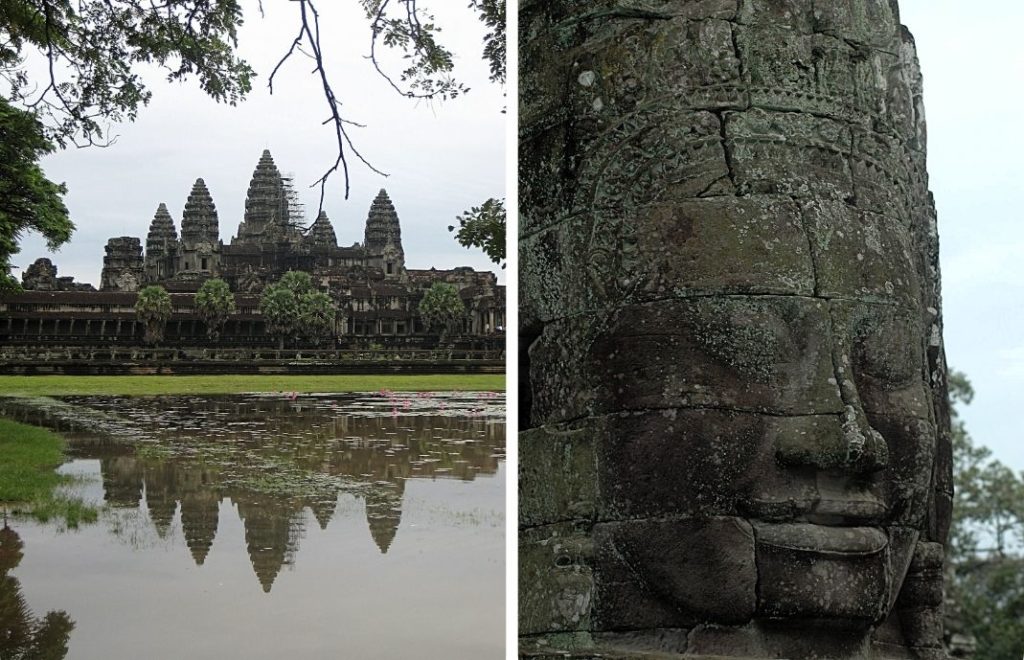
An architectural masterpiece
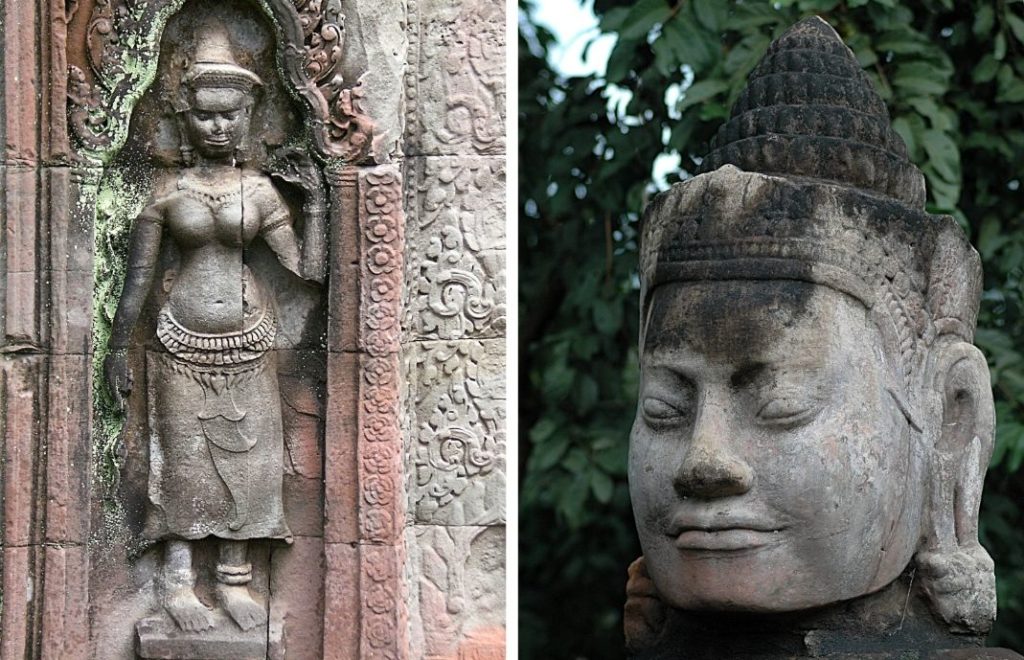
A mesmerizing walk through the complex reveals the harmony of its design – corridors adorned with sweeping bas-reliefs depicting sacred epics, and walls alive with countless devas (benevolent deities), asuras (demonic beings), and graceful apsaras (celestial nymphs).
Angkor Wat fuses two classic Khmer architectural forms: the temple-mountain and the later galleried temple. It was conceived as a symbolic Mount Meru – the mythical axis of the universe and dwelling place of the Hindu gods.
Encircled by a vast moat and an outer wall stretching 3.6 kilometers, the sanctuary shelters three rising galleries, each elevated above the last, culminating in five majestic towers arranged in a quincunx at the heart of the structure. These towers represent the five peaks of Mount Meru, while the walls and surrounding moat evoke the mountain ranges and cosmic ocean encircling it.
In its time, access to the temple’s uppermost tiers was reserved exclusively for priests and royalty, while ordinary worshippers were confined to the lower levels – an architectural hierarchy reflecting the divine order it sought to honor.
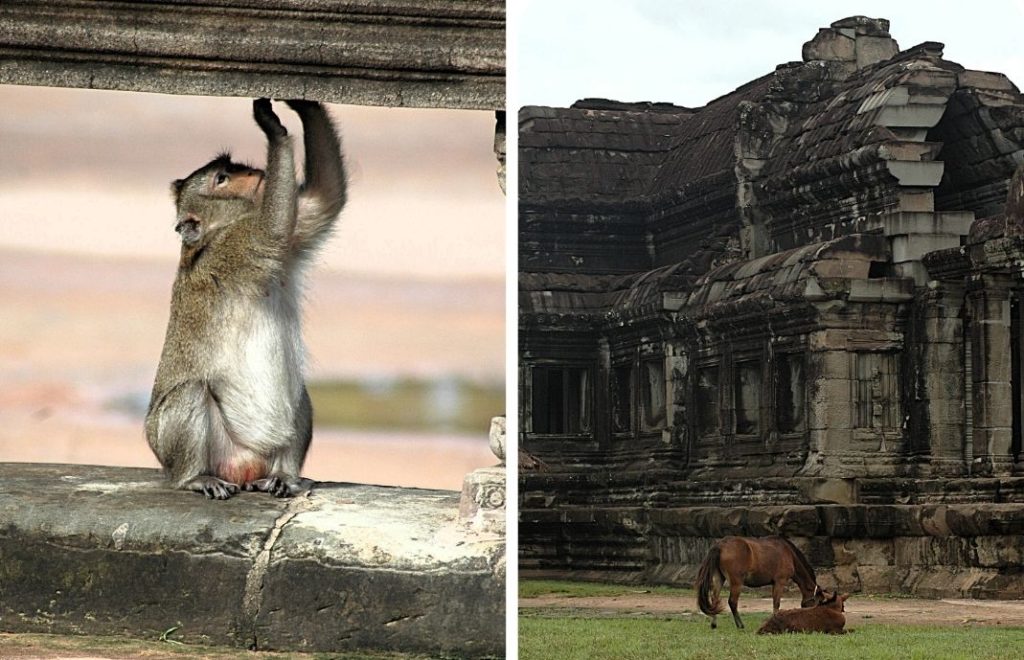
A journey back to the Khmer Empire
Unlike other Khmer temples, Angkor Wat faces west rather than east – a mystery that continues to intrigue scholars. Many believe this unusual orientation suggests that Suryavarman II intended it as a funerary temple. Supporting this theory is the unique arrangement of its bas-reliefs: the stories unfold counterclockwise (prasavya in Hindu terminology), the reverse of the customary sequence.
Whatever the reason behind its design, wandering through this majestic complex is an experience like no other. Angkor Wat remains an active place of worship; saffron-robed monks drift through its galleries alongside awestruck travelers, their presence lending an unmistakable air of sanctity. It is, without question, one of the most profound cultural encounters one can have.
For those willing to delve into its history before arriving, the temple reveals far more than architectural splendor. It tells the story of political intrigue, warring kingdoms, and shifting power across the region.
In the 12th century, Angkor Wat served as the state temple. Yet soon after its completion, the Khmer capital fell and King Suryavarman II was killed by the empire’s archrivals, the Cham of present-day Vietnam.
Jayavarman VII later ascended the throne, reclaiming the city and driving out the Cham. His reign ushered in a golden age marked by the construction of a new capital – Angkor Thom – and numerous resplendent temples. But glory is never eternal: in 1431, Angkor fell to the Siamese (modern-day Thailand), and the Khmer people migrated south to what is now Phnom Penh.
A vast temple complex
Time passed, the temples faded into oblivion, and the jungle slowly swallowed these magnificent structures whole. It wasn’t until the 19th century that Angkor Wat reemerged on the world stage, thanks to French explorer Henri Mouhot. His illustrated work, Monuments of the Angkor Group, remains one of the most widely circulated guides to this day.
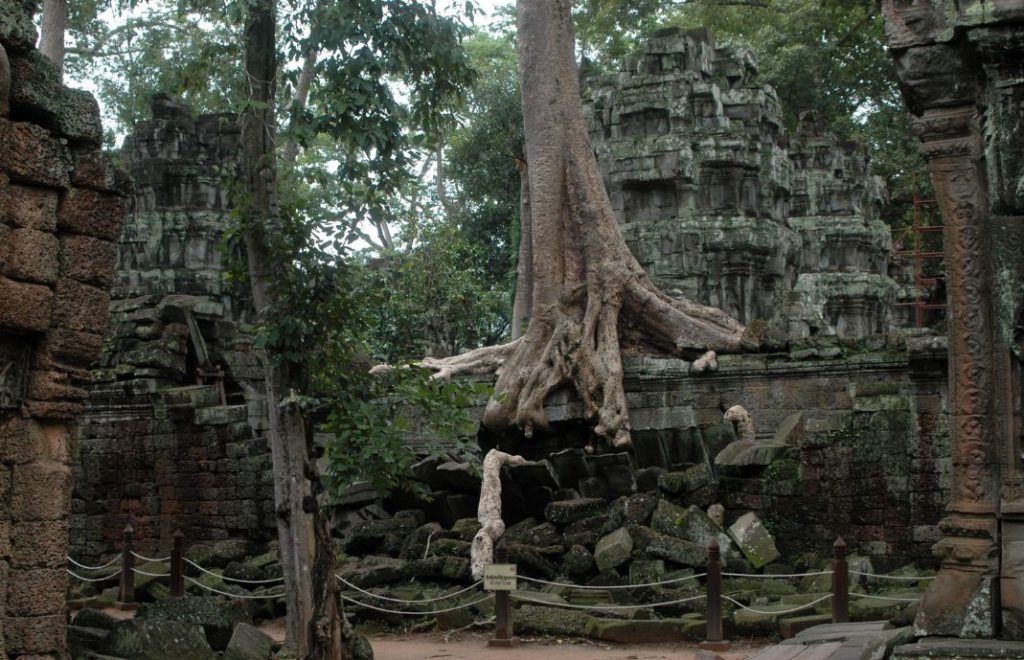
Sadly, centuries of relentless jungle growth have left many temples in a fragile state. Towering roots have pried apart ancient stones, and the ravages of looting and destruction have taken their toll. Today, enormous efforts are underway to preserve what remains of this architectural wonder.
The Angkor region boasts more than a thousand temples, seventy-two of them major monuments. Yet most visitors limit their exploration to the grand Angkor Wat, the once-majestic city of Angkor Thom with its labyrinth of structures, and the overgrown jungle temple of Ta Prohm – made world-famous by its cinematic cameo in Tomb Raider starring Angelina Jolie.
The temples of Bayon and Baphuon
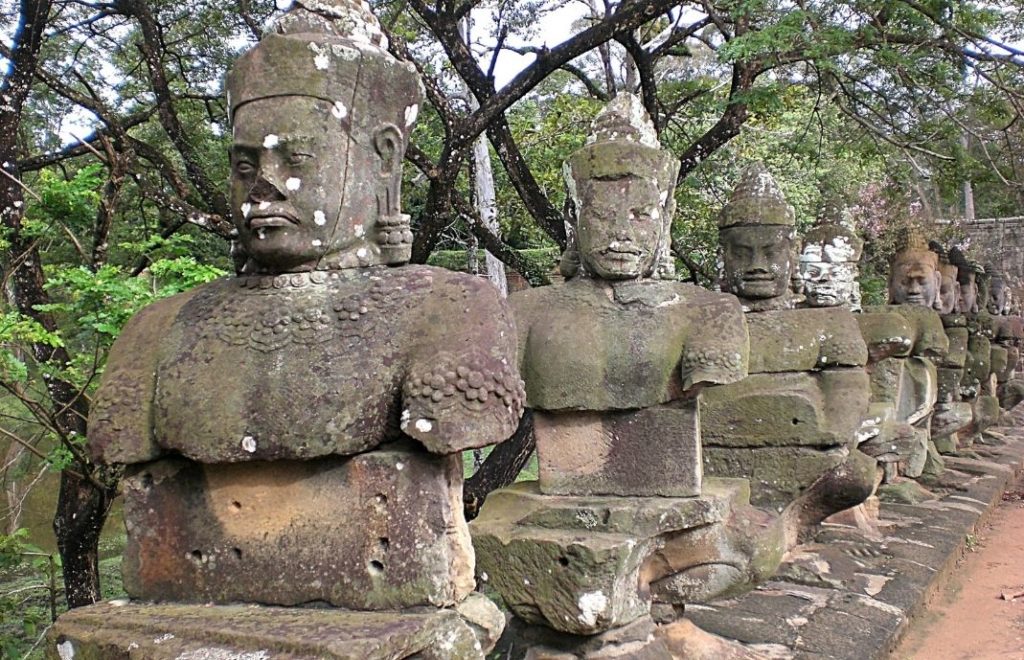
Our tuk-tuk rattles onward toward the sprawling ruins of the ancient city – a metropolis that, in its prime, is believed to have housed nearly one million people. The first sight to greet us is the imposing city gate. If it seems grand today, one can only imagine the awe it must have inspired in those who passed through centuries ago.
The star attraction here is Bayon, the state temple renowned for its forest of towers adorned with over a hundred serene stone faces. Their origin remains a mystery. Scholars suggest the most likely theory: a divine fusion of King Jayavarman VII and the Buddha. Whoever they represent, the faces are profoundly majestic, gazing with an enigmatic calm that lingers in the mind long after you leave.
A short ride away lies Baphuon, a temple that embodies the sacred silhouette of Mount Meru. Astonishingly, just fifty years ago it was on the brink of ruin. Today, thanks to a monumental restoration effort, its grandeur has been resurrected – a feat as impressive as the structure itself.
We continue our journey, the tuk-tuk humming as we glide past the famed Terrace of the Elephants. Legend tells that it was here the king stood to greet his victorious armies. The imagination runs wild – conjuring scenes of the monarch ascending the platform, his warriors lined before him, a spectacle of triumph beneath the Cambodian sun.
Consumed by the jungle
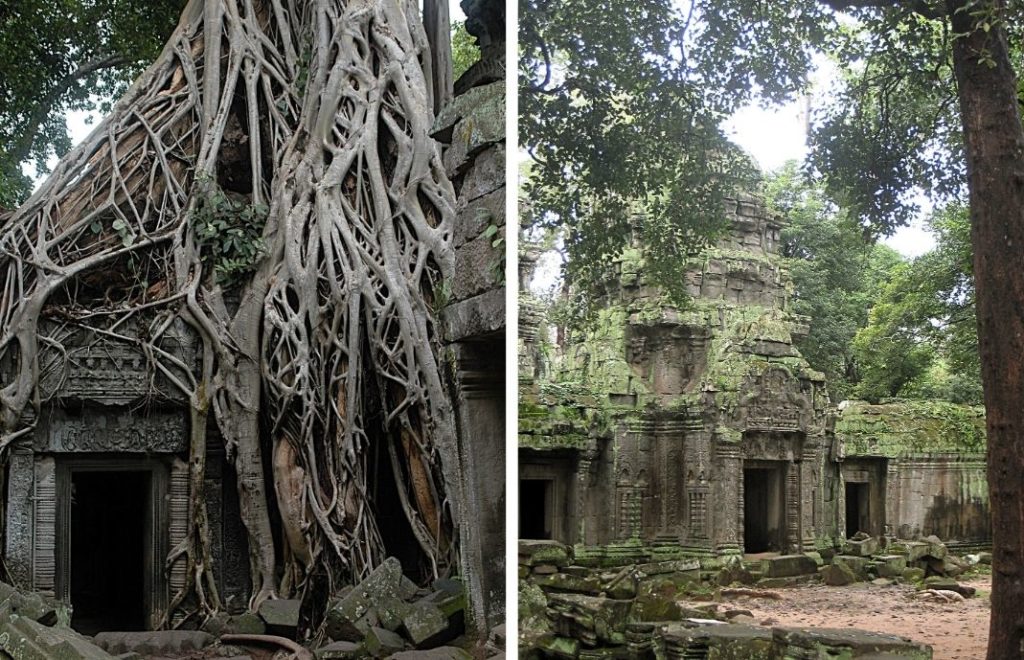
The final stop on our journey through the Khmer Empire takes us deep into the jungle, to the legendary temple of Ta Prohm.
What makes this site so extraordinary is precisely its lack of restoration. While some clearing has been done, the ruins remain entangled in a living labyrinth of colossal roots and dense vegetation. Massive trees have grown intertwined with the ancient stone, their roots gripping the walls like the hands of time itself. In many places, the temple peeks out only slightly, as if reluctant to reveal its secrets. The effect is haunting—and utterly mesmerizing.
Here, nature reigns supreme. Twisted giants tower above the ruins, their vast canopies blocking out the sun and cloaking the site in an ethereal, almost ghostly atmosphere. Fallen blocks of sandstone litter the ground, silent testimony to the relentless power of roots that have wrenched apart the stones over centuries.
This otherworldly sanctuary, once home to nearly 12,000 people, was the creation of the visionary King Jayavarman VII. Today, Ta Prohm stands as an awe-inspiring testament to the fragile, eternal dance between human ambition and the unstoppable force of nature.
Practical information
Location & access
Angkor Wat lies about five kilometers from Siem Reap – a vibrant hub offering accommodations, restaurants, and shops to suit every taste.
When to visit
The temple complex is open year-round. Peak season runs from December to February, when temperatures and humidity are at their most pleasant. From June to August, the monsoon rains arrive, though showers are typically brief rather than constant.
Your guide to visiting Angkor
Passes
Choose between a one-day, three-day, or week-long pass.
Getting around
Most visitors travel by tuk-tuk, with drivers accompanying you throughout the day. Be sure to negotiate the fare before you set off.
Guides
Hiring a guide enriches the experience – book ahead or ask your hotel to arrange one.
Top picks for a day trip
If time is short, prioritize the big three – Angkor Wat, Angkor Thom, and Bayon.
Stay longer
For architecture, history, and culture enthusiasts, it’s well worth spending several days exploring beyond the main highlights.
The temples of Angkor
One of Southeast Asia’s most important archaeological treasures, the Angkor Archaeological Park spans more than 400 square kilometers of forested land, dotted with the remnants of former Khmer Empire capitals that flourished between the 9th and 15th centuries.
Angkor Wat
The crown jewel of the complex – and the best-preserved structure – Angkor Wat is famed for its five soaring towers. Built during the reign of King Suryavarman II (1113-1150), it remains an enduring symbol of Khmer ingenuity and devotion.
Angkor Thom
Once the empire’s grand capital, Angkor Thom was developed over centuries and is dominated by Bayon Temple, with its 37 towers adorned with enigmatic stone faces. The city is also renowned for its monumental gateways, guarded by colossal figures.
Ta Prohm
This former monastic city has been surrendered to the jungle, its ruins cloaked in the sinewy roots of ancient trees. Its atmospheric beauty earned it fame as a backdrop in the film Tomb Raider.
Phnom Bakheng
Constructed more than two centuries before Angkor Wat, this hilltop temple is a favorite spot for sunrise, offering panoramic views over the entire complex.
Banteay Srei
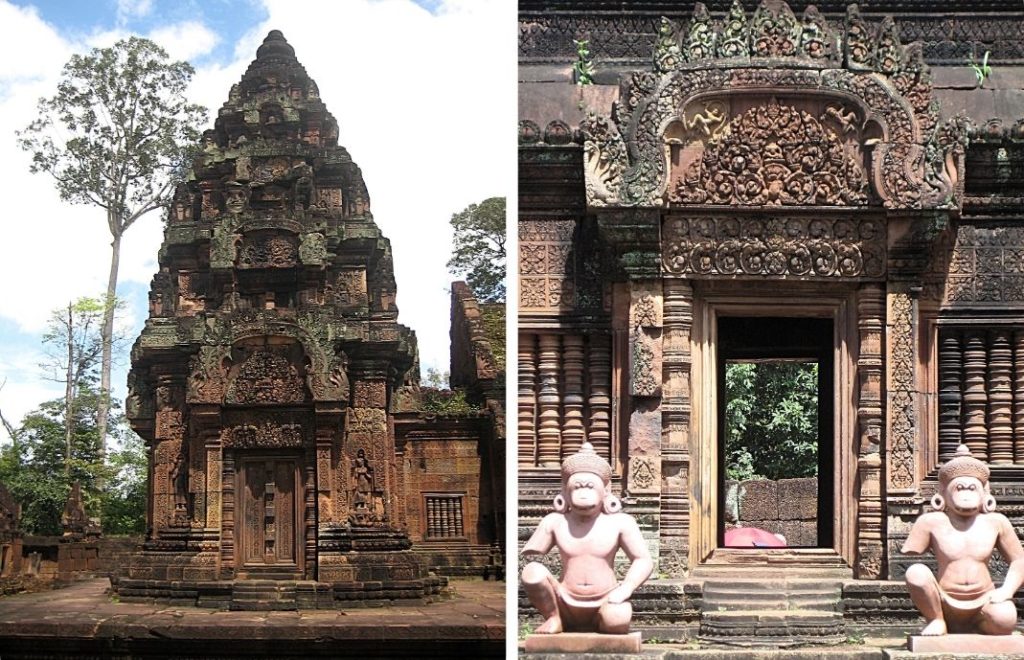
One of Angkor’s smallest yet most exquisite temples, Banteay Srei is celebrated for its elaborate carvings and intricate artistry – a true masterpiece of Khmer decorative design.
More inspiration to Cambodia:
Cambodia – A journey of reflection
