
The wiry little man before me, barely 1.5 meters tall, tilts his head and studies me with deep, coal-black eyes. He’s dressed in traditional attire – a simple loincloth of antelope hide, kudu-skin sandals, and, of course, a bow slung casually over his shoulder. When he greets us in his melodic click language, it feels like music from another world. His broad, toothless grin is pure warmth.
The mercury has surged past 40 degrees. The sun blazes overhead, turning the Kalahari landscape into a shimmering sea of ochre and gold. As we set off on our trek through the desert, I can feel the heat radiating from the ground like an open oven door.
This isn’t just a hike. It’s a journey into the heart of an ancient culture. A chance to learn how the San people, also known as Bushmen, have survived and thrived in this harsh environment for over 20,000 years. Every step we take tells a story.
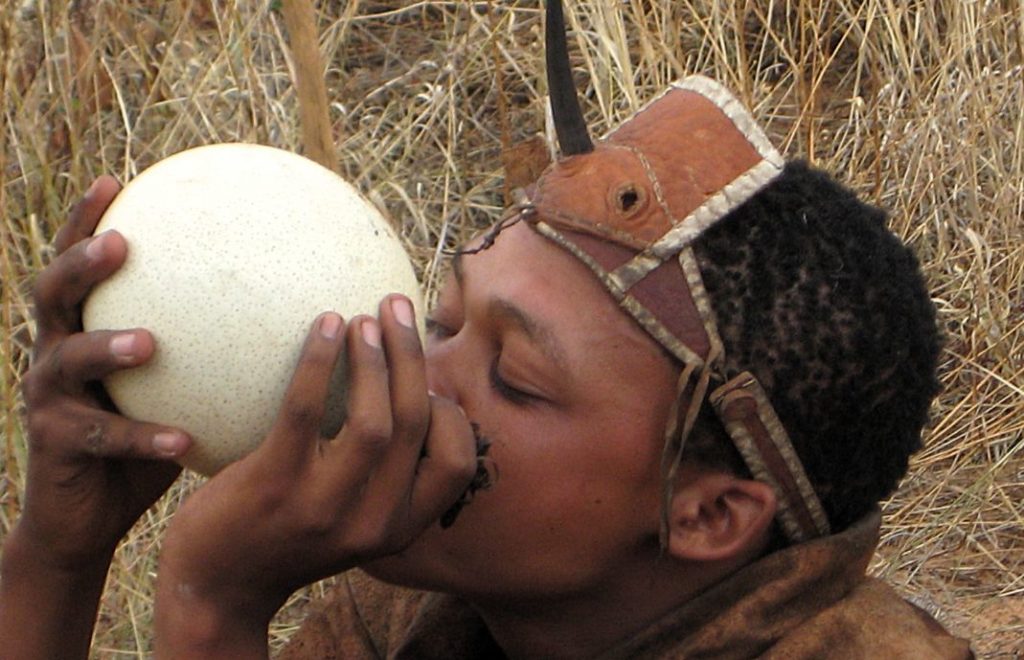
The San People – Guardians of an ancient world
Our guide, Xuma, is the wiry man I just described – a proud member of the San, one of the oldest continuous cultures on Earth. The San have lived in Africa for over 20,000 years, long before borders or modern nations existed.
Xuma speaks only the local click language – a fascinating, melodic tongue punctuated by popping sounds that feel almost impossible to replicate. For us, the translation comes through Chrys, a Botswanan who walks alongside, his voice a bridge between worlds.
Xuma moves like the wind – light, silent, purposeful. His bare feet glide across the Kalahari sand without a sound. It’s easy to understand why: for a hunter-gatherer, stealth isn’t optional; it’s survival.
“There are only about 90,000 San left today, and nearly 60,000 of them live here in Botswana,” Chrys explains somberly. “Their culture and way of life are slowly disappearing.”
Before Dutch colonization began in 1652, the San roamed freely across Southern Africa, their population estimated at 200,000. Then came extermination campaigns, land seizures, and forced assimilation. What remains today is a fraction of a once-vast nation.
Most San now live as herders, laborers, or in the tourism trade. Only a small number still cling to their ancient traditions of hunting and gathering in the most unforgiving regions, like the Kalahari Desert.
As we walk deeper into this sun-scorched wilderness, I can’t shake the thought: I’m not just on a desert trek – I’m stepping into the fading footprints of a culture older than time itself.
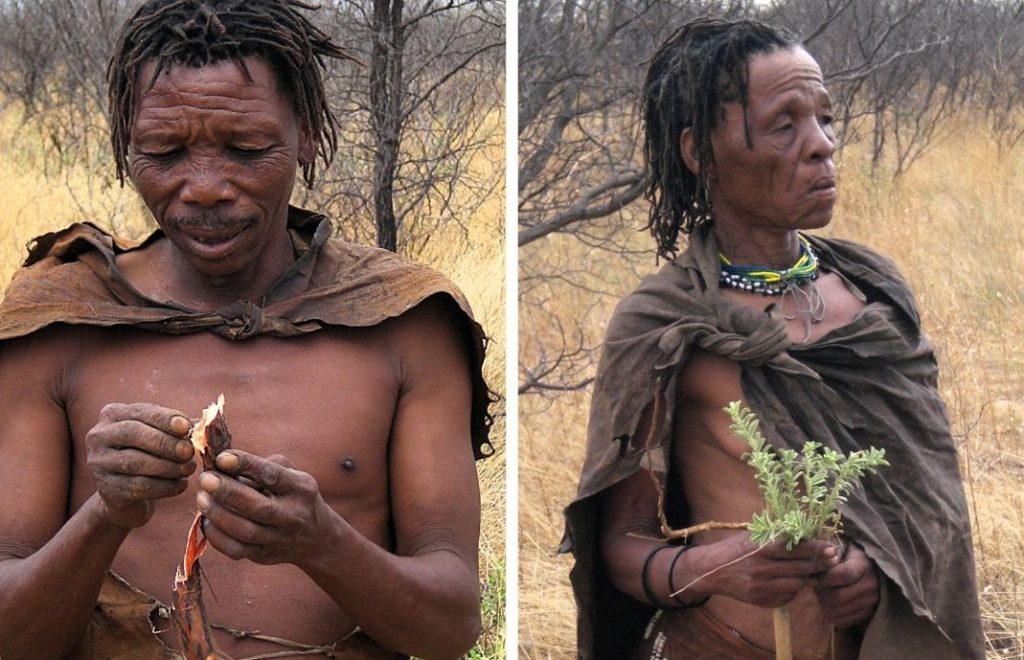
A story etched in time
Curious about his thoughts on the fading of his culture, I ask Chrys to pose the question to Xuma. The reply comes in a cascade of clicks – a language that sounds like the desert wind whispering secrets. Chrys translates softly:
“He says his heart is heavy. But he shares his culture with visitors like you because he hopes the younger generation will carry this knowledge forward to their children.”
Then, with a wide smile and a firm tap on his chest, Xuma adds, “We are proud of who we are, our way of life, and our culture!”
And so they should be.
For thousands of years, the San people have moved with the rhythm of the land, living as true nomads. They follow the seasonal migrations of animals, build temporary shelters from branches and grass, and seek refuge in caves or beneath rocky overhangs when nature turns harsh.
Across Southern Africa, from Botswana to Namibia and South Africa, the San have left behind their stories – not in books, but in stone and pigment. Rock paintings depicting hunters in motion, herds of antelope, and scenes of daily life. They are vibrant, layered, and timeless, echoing the artistry of Europe’s Paleolithic caves. These images are more than art; they are a testament to the resilience and creativity of one of the world’s oldest cultures.
Standing here in the Kalahari heat, I realize something profound: the San’s history isn’t just written in rocks or sand – it’s alive in Xuma’s voice, in his laughter, and in every graceful, silent step he takes.
Xuma’s desert remedy
The San people have always lived in complete harmony with nature – a relationship so intimate it borders on magical. Their knowledge of plants and their uses is nothing short of encyclopedic: they know which roots will heal, which leaves will feed, and which berries will kill.
So when I reach for my trusty tiger balm to soothe a swarm of mosquito bites, Xuma reacts with a dramatic shake of his head. He clicks a sentence so sharp and rapid it sounds like pebbles tapping in a stream, then darts off into the bush before I can even protest.
I’m left standing there like a clueless tourist, while Chrys chuckles knowingly. “He’s going to find medicine,” he explains.
Minutes later, Xuma reappears triumphantly, his hands full of green stems and a large white root. With deft movements, he crushes the plants into a sticky pulp. A gush of milky sap oozes from the root, mixing into the mash until it becomes a thick, greenish-brown paste.
It smells surprisingly fresh – earthy with a hint of something floral – but it looks like something scraped from a compost bin. Without hesitation, Xuma kneels down and gently smears the concoction over my inflamed bites with soft, practiced hands.
The effect is almost instant. The fiery itch subsides, replaced by a cool, tingling relief. No pharmaceuticals. No packaging. Just pure, wild medicine drawn straight from the Kalahari.
As I watch Xuma’s calm precision, I realize this is more than first aid – it’s living proof of a knowledge system that predates modern medicine by millennia.
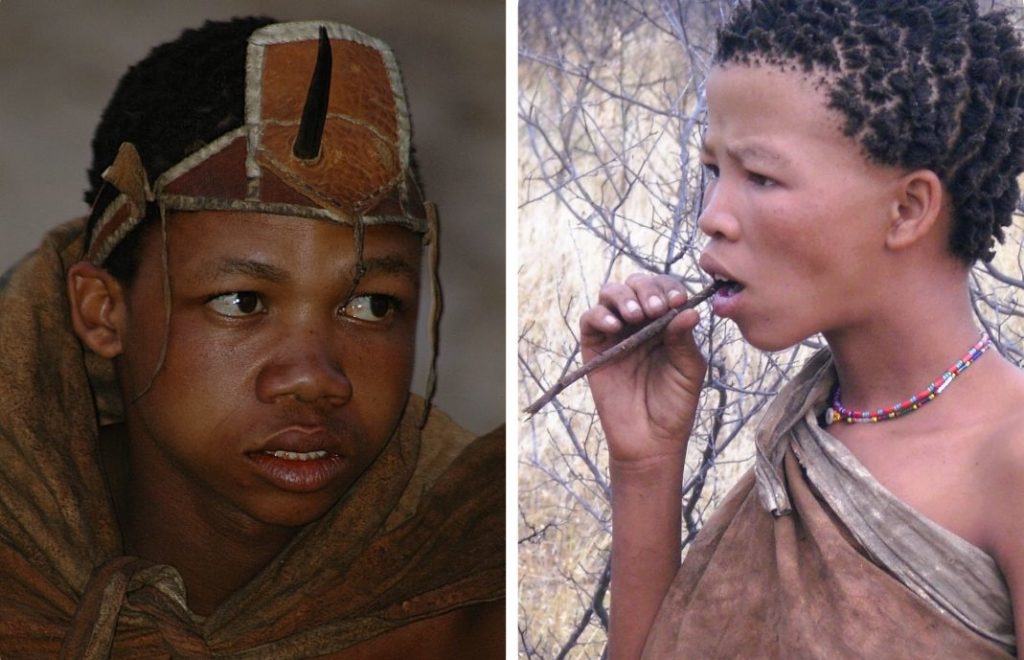
In the heart of nowhere
The brittle scrub doesn’t even twitch. The air hums with heat, shimmering like molten glass. Sweat trickles down my spine, and my throat feels as dry as the Kalahari sands beneath my boots. Then – movement.
Two enormous ears poke through the bush, followed by a startled gaze. A springbok, elegant and taut with muscle, freezes mid-step. For a heartbeat, it stares us down, its wide eyes full of suspicion. Then -poof! – it vanishes into the scrub in a flurry of dust and grace, leaving only silence in its wake.
It’s surreal to think I’m standing in one of Earth’s most remote corners – the Kalahari Desert. Though, truth be told, it’s not a “real” desert like the Namib or Sahara. Here, about 230 millimeters of rain falls each year, making it more of a parched semi-desert. Its vast, flat expanse is dotted with stubborn shrubs, scraggly thorn trees, and the occasional ripple of sand dunes – every inch screaming for water.
Long ago, this arid wilderness was part of the legendary Okavango Delta. Then tectonic forces reshaped the land, leaving behind this stark, haunting beauty.
For the San people, the Kalahari isn’t a barren wasteland – it’s a living pantry. They know every whisper of the wind, every blade of grass, every creature’s trail. They are artists of survival.
Xuma, grinning from ear to ear, decides it’s time to show me why his ancestors thrived here for millennia. He nocks a slender arrow, its tip gleaming faintly with poison drawn from desert plants. Pointing toward a distant tree trunk, he takes aim.
The bowstring hums. The arrow slices through the hot, heavy air. Thunk! Dead center. The shaft quivers in the bark like a tuning fork.
Xuma erupts into a triumphant dance, mimicking the takedown of a lion rather than a hapless tree. His laughter is pure joy, echoing across the empty plains. And in that moment, I understand: this isn’t just skill. It’s heritage. It’s pride. It’s survival distilled into an art form.
How to spark fire in the desert
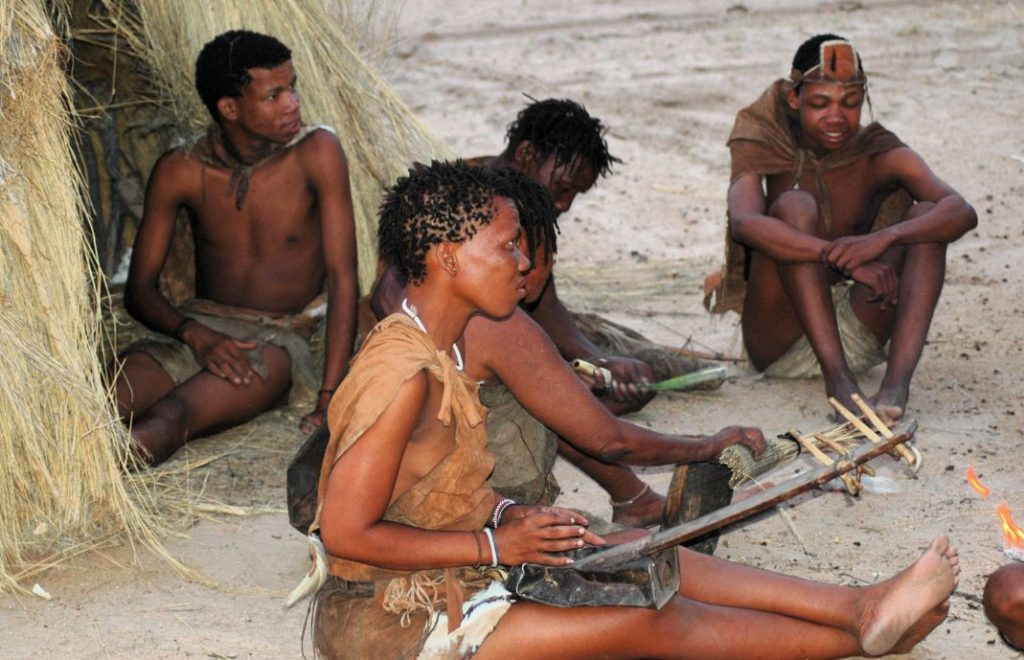
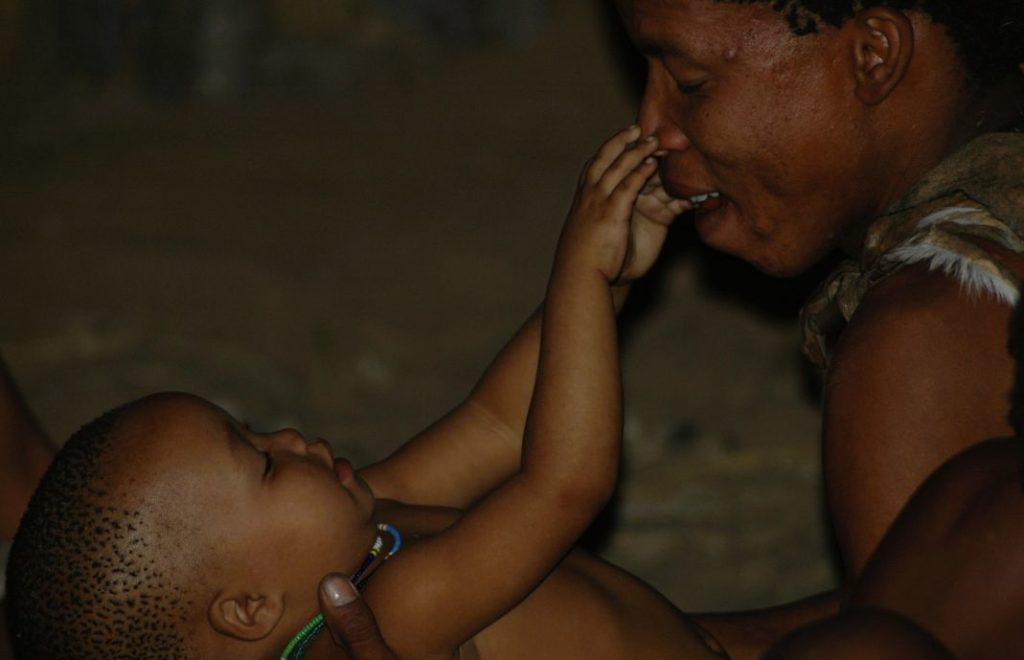
With boundless energy, Xuma leads us into the settlement where life hums in its raw, simple beauty. A cluster of huts hugs the sandy earth, their walls crafted from branches and grass. Half-naked children scamper about, laughing and shrieking in their melodic clicks. Women sit in a circle, weaving baskets and sharing stories in that hypnotic language that sounds like rain falling on dry leaves.
Xuma beams with pride as he ushers me to the heart of his world. Today, I’m to master the most ancient of arts: making fire. And naturally, it will be done the San way – no matches, no lighter fluid, no shortcuts.
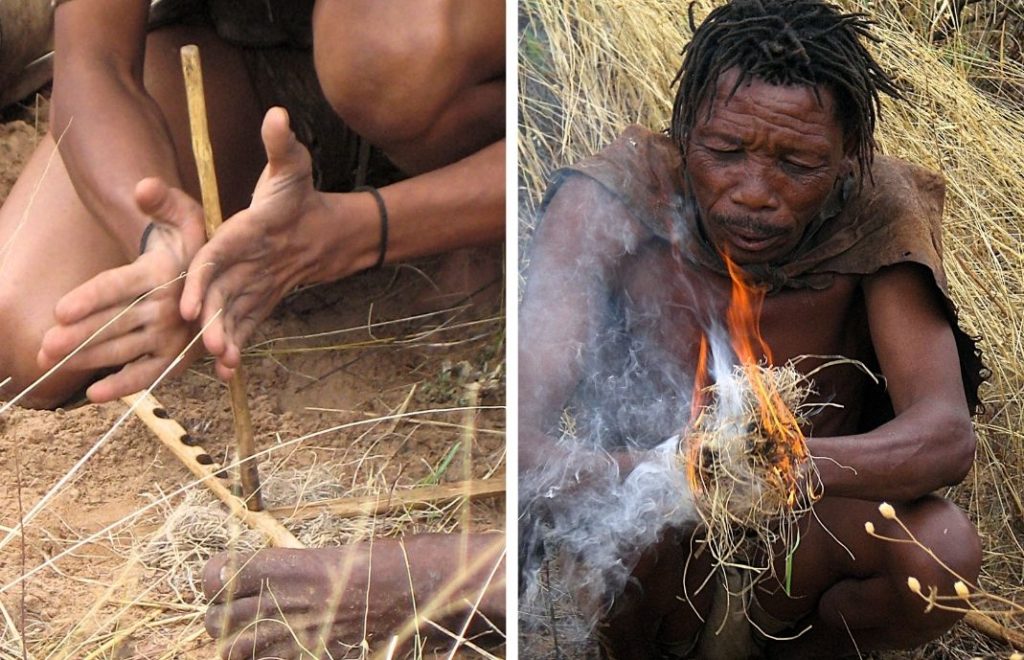
He drops to the ground, picks up two slender sticks, and begins to work. His movements are fluid, almost rhythmic, as if this act is more than survival. It’s a sacred dance handed down through generations. The wooden spindle spins rapidly against the fireboard, his lean arms moving with the precision of a master craftsman.
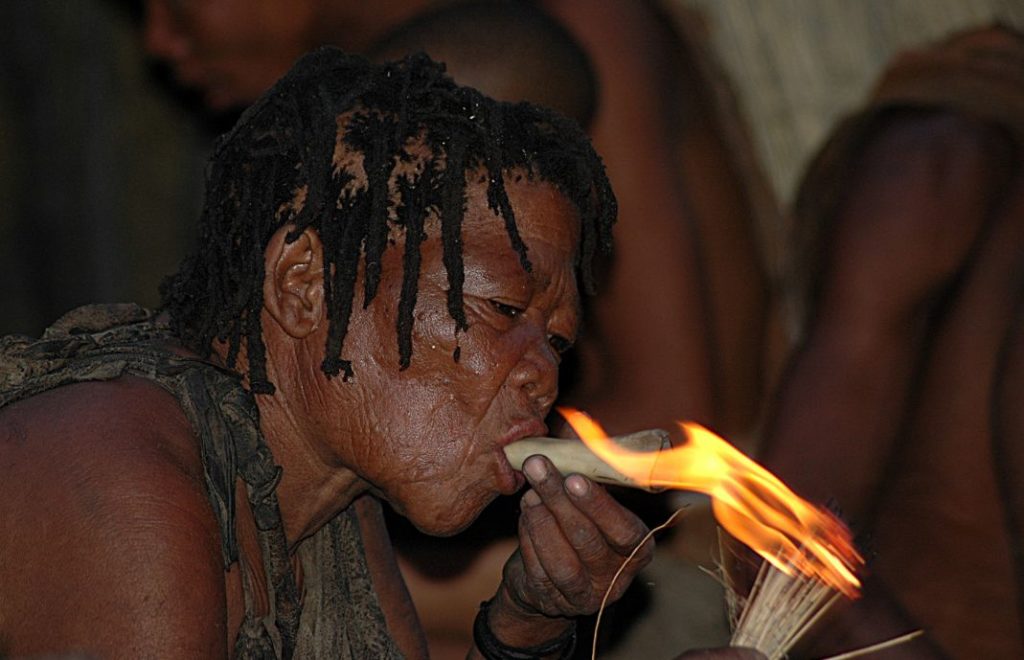
Within minutes, smoke curls upward like a whispered promise. Then, with a sudden flare, the embers catch the dry grass and flames leap to life, flickering like golden spirits against the fading light of the Kalahari.
The pride on Xuma’s face is unmistakable. This is his heritage, alive and glowing in the firelight.
Then it’s my turn.
He hands me the tools – a stick polished by countless hands, a bundle of brittle grass. I kneel, gripping the stick like a warrior preparing for battle. This can’t be that hard, I think. How wrong I am.
I grind. I twist. Sweat drips into the dust. My arms burn like the midday sun, and the stick refuses to give me anything but mockery. The only smoke rising is from my own dignity going up in flames. After what feels like an eternity (and probably two shredded palms later), I have to admit defeat.
Xuma roars with laughter, his joy genuine and contagious. He pats my shoulder, clicks something that Chrys translates with a grin:
“Don’t worry. Even fire needs to know you’re serious before it shows up.”
And just like that, in the middle of nowhere, under a vast, molten-orange sky, I realize something profound: in this world, patience and respect for nature are not optional – they’re survival.
Blisters, bruised pride, and a fiery farewell
Ten minutes. That’s how long I battled two stubborn sticks and a handful of dry grass. Ten minutes of sweat, frustration, and wild optimism – only to end up with a pair of throbbing palms covered in water blisters. Fire? Forget it. If this tribe’s survival depended on me, they’d be shivering in the dark, munching on raw roots.
The San, of course, find this hilarious. Laughter ripples through the circle like a desert breeze. My pride smolders quietly, doing what the fire refused to do.
But Xuma isn’t done playing the hero. With his usual quick-footed grace, he disappears into the thorny scrub and returns moments later with an assortment of branches and roots. His hands move like magic as he pounds, squeezes, and twists nature into a thick, earthy paste. Then, gently – almost ceremoniously – he coats my blistered hands with the cooling mixture. Relief floods through my skin. My ego? Still scorched.
As the sun sinks into the Kalahari horizon in a blaze of crimson and gold, the night comes alive. Flames crackle and sway to the deep, resonant thump of a drum. Voices rise in hypnotic harmony, weaving ancient tales into the velvet darkness. The San men leap and stamp, their lean silhouettes carving wild patterns in the firelight as they perform the Steenbok Dance, a celebration of life, survival, and freedom.
I sit cross-legged by the fire, my blistered hands cradled in my lap, and watch a culture that refuses to let go. A people who carry the whispers of the earth in their songs and the secrets of survival in their bones.
And in that moment, I understand why Xuma smiles so often: it’s not just pride – it’s resilience, joy, and an unbreakable bond with the land.
This day wasn’t just a walk with the San. It was a journey back in time. And a reminder that, sometimes, the simplest things – fire, dance, laughter – are the sparks that keep humanity burning.
More inspiration to visit Botswana:
Safari in Chobe National Park
Gliding silently in a mokoro
A guide to Chobe National Park
There’s a cheetah on the hood
When is the best time to visit Botswana?
