
Tiny Albania – a country once sealed off from the world, shrouded in secrecy and rigid ideology. Over time, it has worn many faces: occupied and invaded, a principality, a republic, a kingdom; it has endured fascism, communism, and finally, the embrace of freedom.
Today, Albania stands as one of Europe’s most intriguing destinations. A nation bursting with contrasts, alive with history, culture, and unspoiled beauty. From rugged mountains to turquoise coastlines, from ancient ruins to quirky modern cities, it’s a land where every turn of the road promises something unexpected.
And let me tell you: Albania is exciting, charming, and just the right amount of crazy.
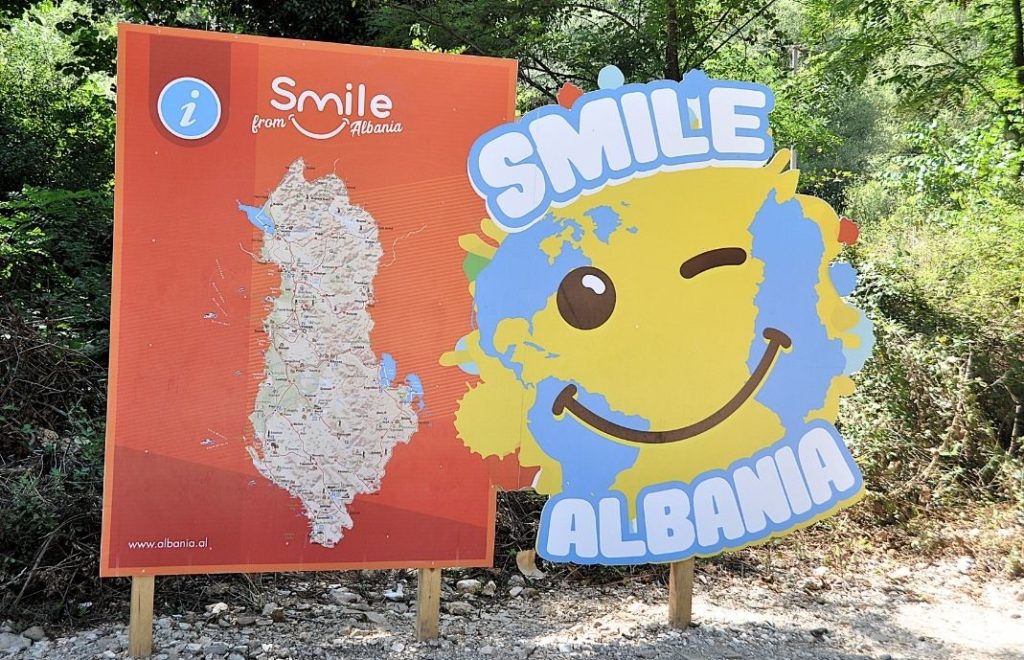
Picking up an antique
We’re in Saranda, southern Albania. Most tourists are stretched out on the beach, soaking up the Ionian sun. Not us. We weave past hotels, corner shops, overflowing trash bins, and half-finished buildings toward the car rental office – ready to start our great Albanian road trip.
After some paperwork and a brief exchange that can only be described as spirited negotiation, the keys are handed over. Our vehicle? A Suzuki Wagon 9 – at least, that’s what the rental agreement says. Our eyes, however, tell a different story.
It’s not just old. It’s an artifact from a bygone automotive era. This isn’t the car we booked, but the clerk shrugs and mutters in broken English:
“It is very clean, yes?”
Clean? Sure. Beyond that, the joys end quickly. The central locking doesn’t work, the air vents wobble like loose teeth, the clutch is heavier than a hippo’s backside, and the engine sounds like it’s gasping for life at every hill. Bonus feature: a cassette player. Classification? Antique exhibit on wheels.
There’s no GPS, so we’re going full old-school – paper map and blind faith. According to our cheerful rental guy, the drive from Saranda to Tirana will take “about five hours.”
We’re barely out of Saranda before we realize: Not. A. Chance.
The road slithers like a snake – sharp curves every twenty meters, hairpins that feel like corkscrews. Right, left, right, left, up, down, up, down. Some bends are practically 90 degrees. Speed? Forget it. Even in first gear, the little tin can groans like a diva on her last note.
And so begins our Albanian odyssey – where every kilometer is a story, and every hill feels like a victory.
Bay of Palermo
The road ahead winds like a silver ribbon through Albania’s rugged beauty, pulling us past sleepy villages where life unfolds in its simplest form – farmers tending to fields, women balancing baskets, old men sipping coffee in the shade of crumbling façades.
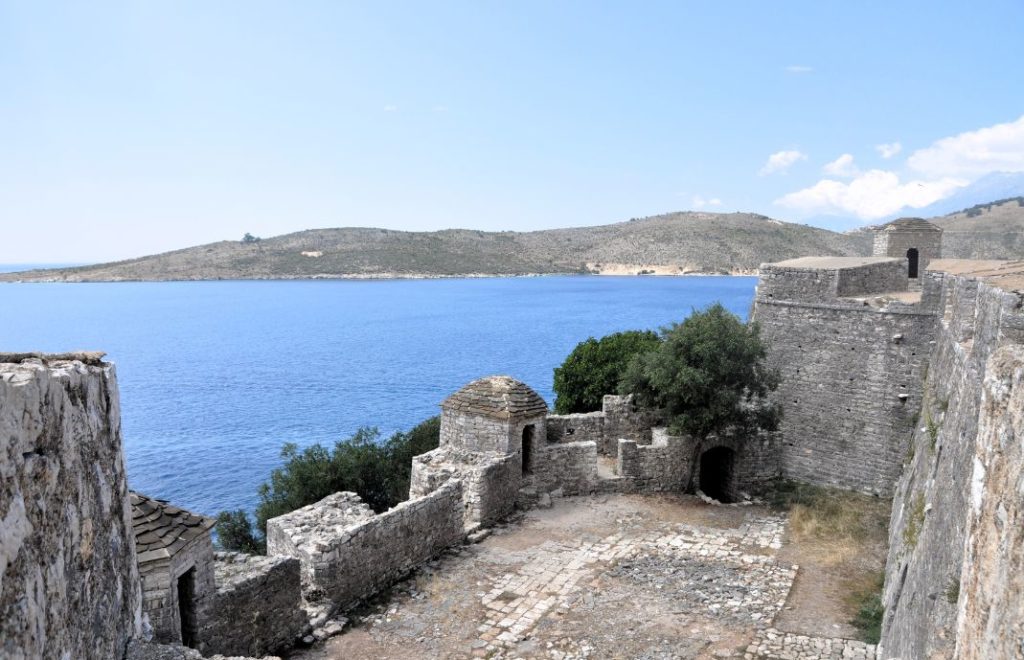
Our first stop: Bay of Palermo, a serene curve of turquoise water watched over by the stoic Palermo Castle. As we arrive, a restored Ottoman-era church greets us – a quiet relic built, they say, by Ali Pasha for one of his wives. Around it, the skeletons of faded communist buildings whisper slogans from a darker time, their cracked walls still bearing traces of propaganda.
The castle sprawls across a rocky peninsula, its vantage point offering sweeping views of the Ionian Sea. In the distance, bunkers pockmark the hillsides, eerie reminders of Enver Hoxha’s obsession with isolation and defense. The fort itself is a maze of arched corridors, dim chambers, and weathered cannons, still standing guard against enemies that never came.
Leaving history behind, the road twists upward, higher and higher, carrying us into a different world altogether. The sunburnt slopes give way to emerald forests, towering trees casting cool shadows as we enter Llogara National Park. The air grows crisp, the scent of pine replacing salty breezes. Above us looms Cika Peak, majestic at 2,045 meters.
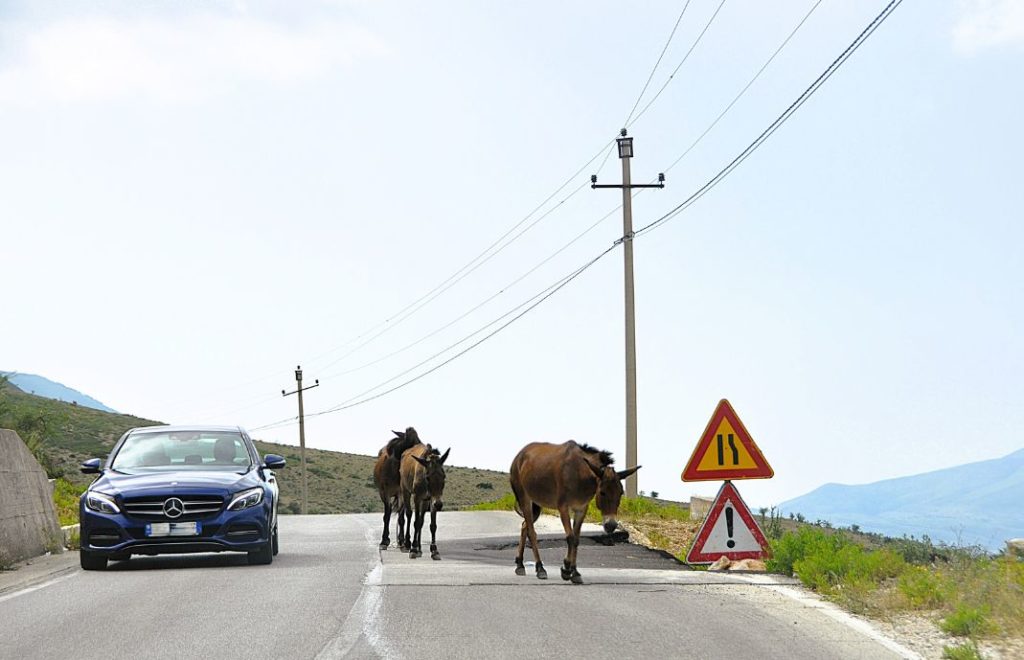
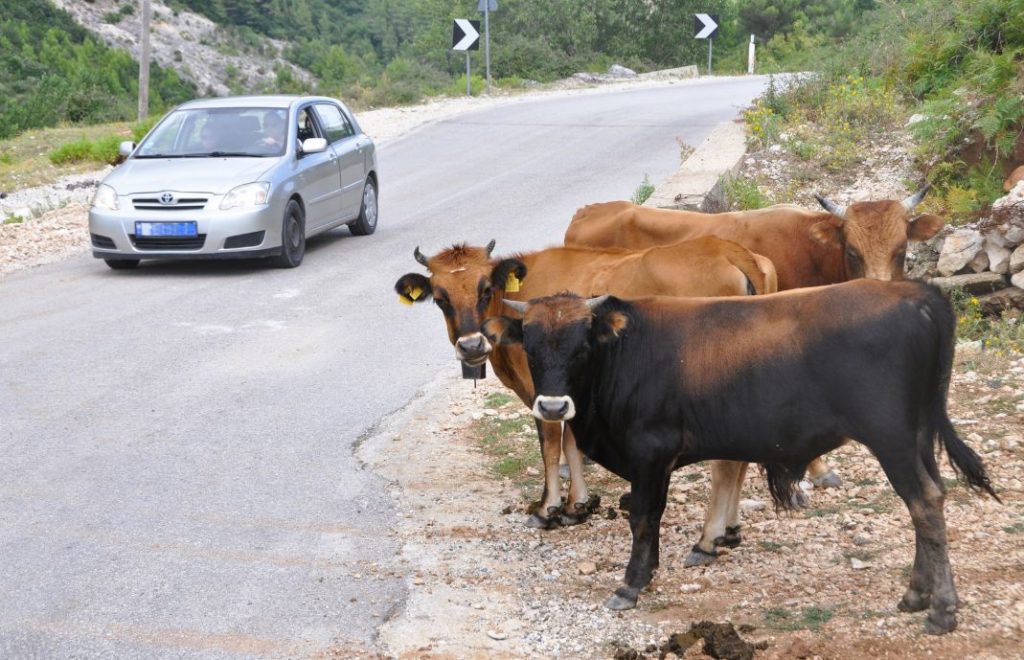
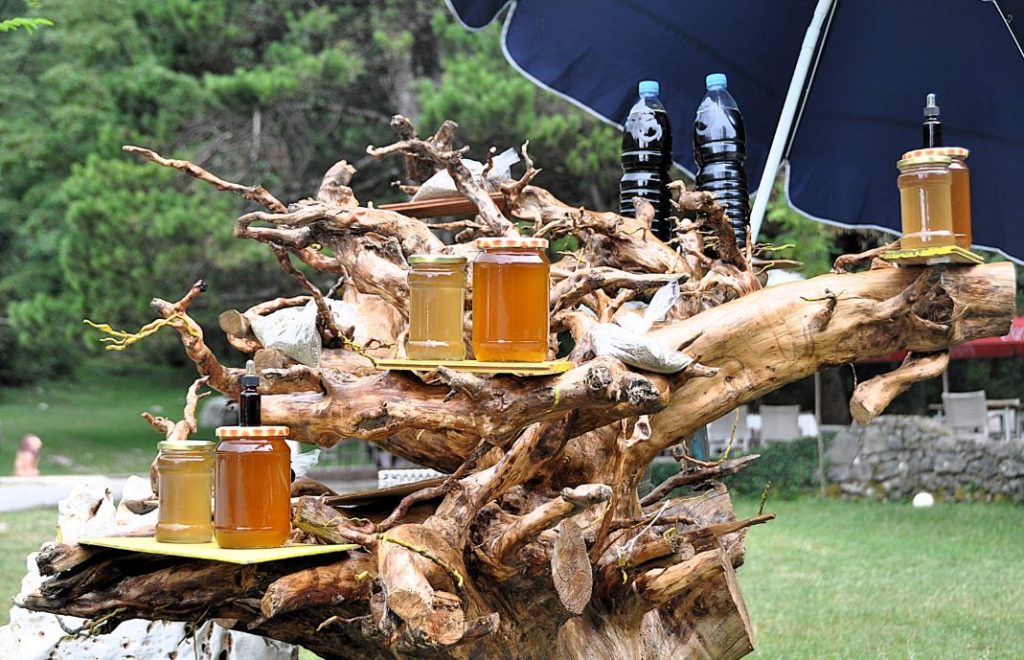
Life here seems sweeter – literally. Stalls line the roadside, glass jars of golden honey glinting in the sunlight, tempting passersby. Cows, goats, and the occasional horse claim their share of the road, reminding us that in these mountains, patience isn’t optional – it’s essential.
On the road to Tirana
At last – a highway. After hours of hairpin bends and gear-grinding ascents, our battered little Suzuki Wagon perks up like a dog off its leash. A straight stretch longer than 200 meters? A miracle! The driver floor the gas, pushing the pedal so hard it’s a wonder it doesn’t punch straight through the floor. The engine roars in triumph, the gearstick sighs with relief at being in one gear for more than a few seconds.
But dreams of flying at 100 km/h? Pure optimism. Our noble antique tops out at 90 – on a good day, downhill, with tailwind. One by one, cars blast past us, their drivers barely hiding their amusement.
The scenery, however, makes up for our lack of speed. Farmers squat roadside with baskets of fresh produce – for sale on the actual highway. Cows graze lazily in open fields, oblivious to honking traffic. Half-finished buildings dot the landscape, stubborn reminders of Albania’s chaotic leap into modernity.
Navigation becomes its own adventure. Spoiled by the instant certainty of GPS, we’re back to the old-school dance with paper maps, squinting at symbols and guessing where roads should be.
Sometimes the signs agree. Sometimes they lead us into a guessing game at yet another Albanian specialty: the endless roundabout. Tirana appears reassuringly on the signs – but which exit? Good question. Some roundabouts offer no clues at all, turning every decision into a gamble. Wrong turn? No problem – there’s always another dusty road to explore.
The closer we get to Tirana, the denser the traffic, the louder the horns, and the more chaotic the choreography of cars, bikes, and buses. Welcome to Albania’s beating heart, where madness has its own rhythm – and we’re about to dive right in.
More challenges await
Finally – Tirana!
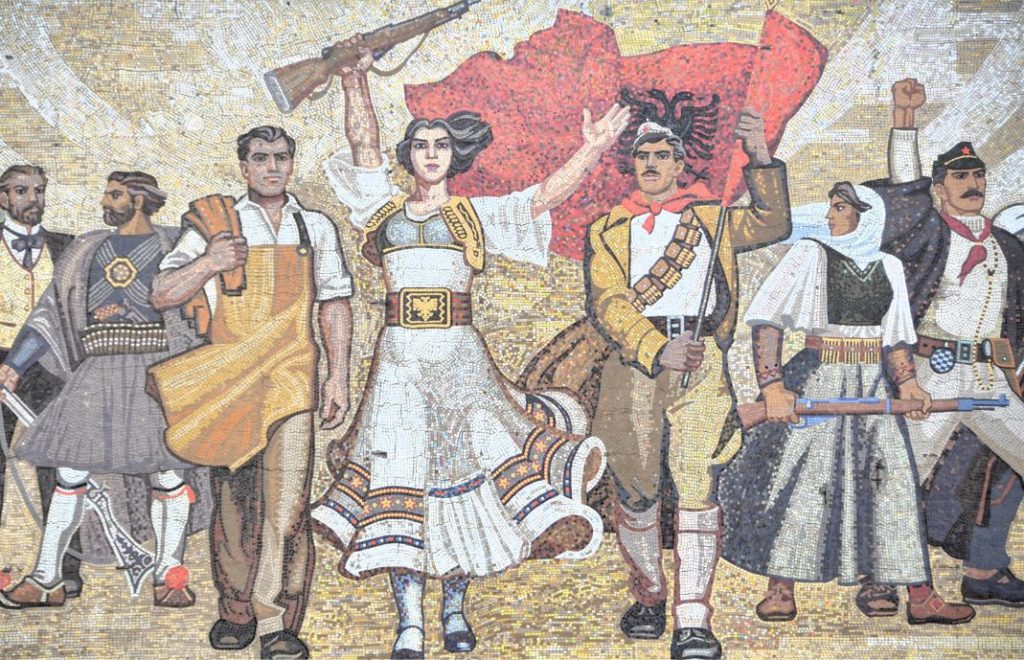
A sprawling, modern city rises ahead, shimmering like a promise after hours of winding roads and mechanical prayers. The transformation is striking: the dusty towns and tired facades we’ve passed give way to sleek high-rises, glass towers, and polished billboards flaunting Coca-Cola, Ferrari, and global brands eager to stake their claim in Albania’s capital. It’s clear: Tirana is on the move.
But so are the headaches. Finding our hotel turns into an Olympic-level challenge. The map in our guidebook lists every street in Albanian, while the road signs are in English. Logic, luck, and blind faith are our only tools. Add to that a cocktail of roadworks and an endless series of one-way streets, which – of course – are never the ones we need.
Relief appears in the form of two stern-faced policemen standing like sentinels on a street corner. Perfect! We pull over behind them, hopeful and smiling, brandishing our map like a peace offering.
Their reaction? Less than warm. One officer jabs a finger at a nearby sign, which, judging by his tone, screams NO STOPPING. I nod sympathetically, point at the map again, and try to mime “hotel?” He doubles down, stabbing the sign with enough force to bend it, his eyes narrowing.
I point at him, then the map. He points at the sign – harder. The air hums with stubbornness. Then, without a word, the officers turn on their heels and march off, leaving us marooned in the middle of Tirana’s traffic chaos.
Falënderime për ndihmën, gentlemen. Much appreciated.
A modern capital
After countless loops around roundabouts and a few unintended sightseeing detours, we finally find our hotel.
Jolly Hotel lives up to its name – a cozy little haven tucked near Avni Rustemi Square. The rooms may be snug, but they’re spotless, the staff is warm and helpful, and the breakfast hits the spot after a long day on Albania’s roads. Location? Perfect for exploring the heartbeat of Tirana.
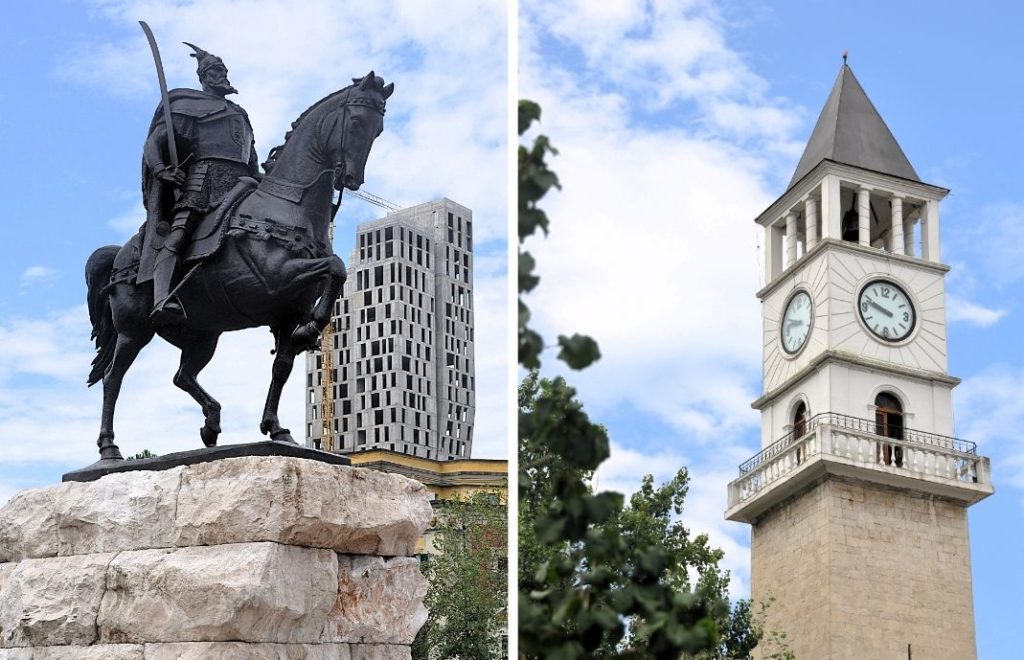
The city’s roots reach back to 1614, when Ottoman military leader Sulejman Pasha laid its foundations. For centuries, Tirana lingered in the shadows of history until the 1920s, when a bold Italian influence gave the city its modern identity. Broad boulevards, elegant facades, and the imposing central square emerged – a square now named after Albania’s greatest hero: Skanderbeg Square, honoring the legendary Gjergj Kastriota Skanderbeg.
Naturally, we begin our urban adventure here. Skanderbeg’s bronze figure towers proudly atop his horse, gazing into the distance as if still guarding his beloved homeland. Around him, the square unfolds like an open-air museum of Albania’s layered past:
- The Et’hem Bey Mosque, with its delicate frescoes, a rare survivor of Ottoman architecture.
- The Clock Tower, built in 1820, standing as a timeless sentinel over the city’s evolution.
This is Tirana’s soul – where East whispers to West, and history lingers alongside the buzz of modern cafés and the hum of a city reinventing itself.
Back to the days of communism
Albania’s descent into hardline communism was swift and severe – arguably the most extreme in Eastern Europe. Enver Hoxha seized control in 1943 and ruled with an iron grip until his death in 1985.
From 1978 onward, Albania became one of the world’s most isolated nations, sealing its borders and shutting out foreign influence. Inside, the regime tightened its fist, relying on terror and executions of so-called “enemies of the people” to eliminate dissent. Political opposition was unthinkable. Prisons and labor camps swelled with tens of thousands of prisoners, a chilling reminder of what absolute power looks like.
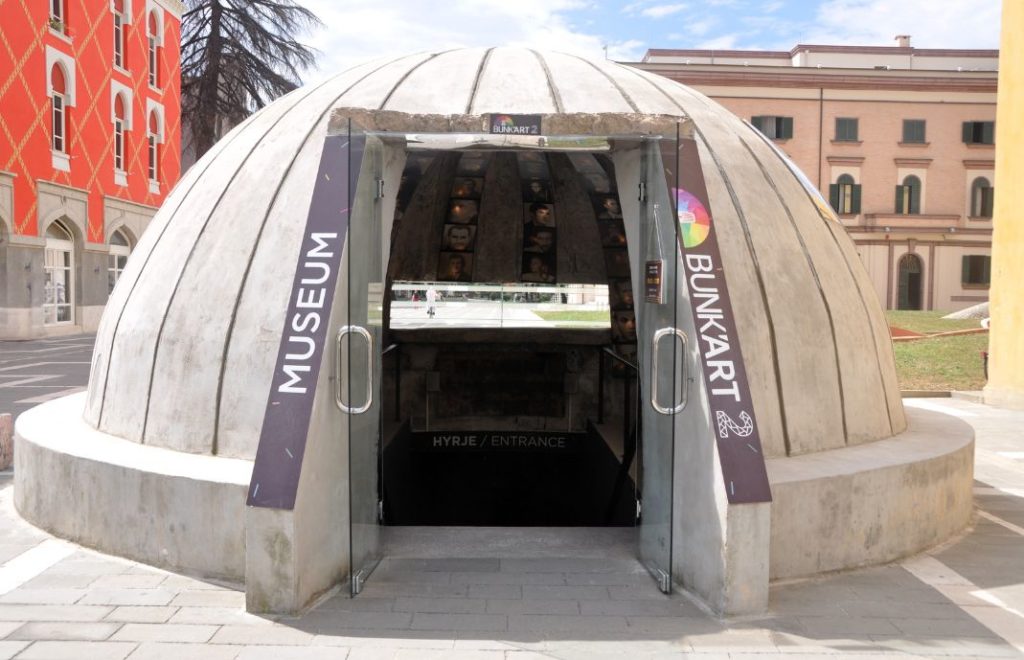
Today, Tirana offers a haunting glimpse into this dark chapter at Bunk’Art 2, a former bomb-proof bunker beneath the Ministry of the Interior. Built in the 1980s as a shelter for Albania’s political elite, it now serves as a museum chronicling the country’s turbulent past. Descending into its claustrophobic corridors, you step into history:
- Interrogation rooms and stark prison cells that once broke spirits.
- Spartan offices, sleeping quarters, and a communications hub frozen in time.
- Even a “decontamination room,” prepared for a nuclear war that never came.
Exhibits trace Albania’s journey – from independence in 1912, through Italian occupation in the 1930s, and into the suffocating grip of communist rule from 1944 to 1991.
Above ground, relics of that era linger. The Pyramid of Tirana, built as a mausoleum to glorify Hoxha, now lies defaced and crumbling, its stark white walls draped in graffiti – a striking metaphor for a regime reduced to ruins.
For a gentler brush with nostalgia, head to Komiteti Kafe Museum, a quirky café that doubles as a time capsule. Here, the 70s and 80s live on in retro furniture, propaganda posters, and vintage household items, all paired with raki and strong Albanian coffee. It’s a warm, oddly comforting contrast to the shadows of Bunk’Art.
Next stop: Berat
The road unfurls once more, leading us toward Berat, a jewel nestled at the foot of the Tomori Mountains and along the serene Osum River. Often called “The City of a Thousand Windows,” Berat is one of Albania’s oldest settlements, dating back to the 6th century BC. Its charm is instant – a postcard-perfect tableau that evokes a Swiss alpine village: whitewashed houses cascading down the hillside, their wooden balconies peering over winding cobblestone alleys and stairways polished smooth by centuries of footsteps.
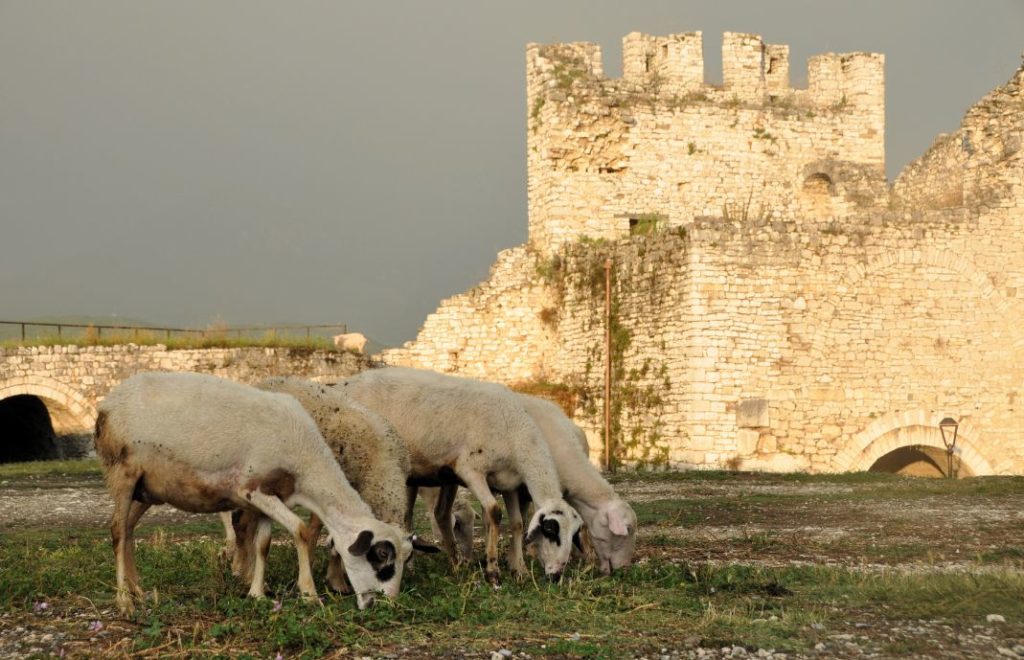
Above it all looms the Berati Castle, an ancient citadel perched like a guardian on the hilltop. Unlike most fortresses, this one still breathes life: locals reside within its walls, where time seems to linger in the scent of baking bread and the hum of small artisan shops. Wandering through its maze of stone paths feels like stepping into a living museum.
Finding our Bed & Breakfast, the quaint Nasho Vruho, is an adventure in itself. We weave through narrow lanes, climb steep staircases, and backtrack more than once before finally arriving, slightly breathless and utterly enchanted. The effort melts away the moment the door opens: warm smiles, genuine hospitality, and an atmosphere that feels like home. Our hosts fuss over us like family, eager to ensure every detail is perfect – a hallmark of Albanian kindness.
Berat is not just a stop on the map – it’s a slow exhale, a reminder that beauty thrives in simplicity.
Even guidebooks can get it wrong
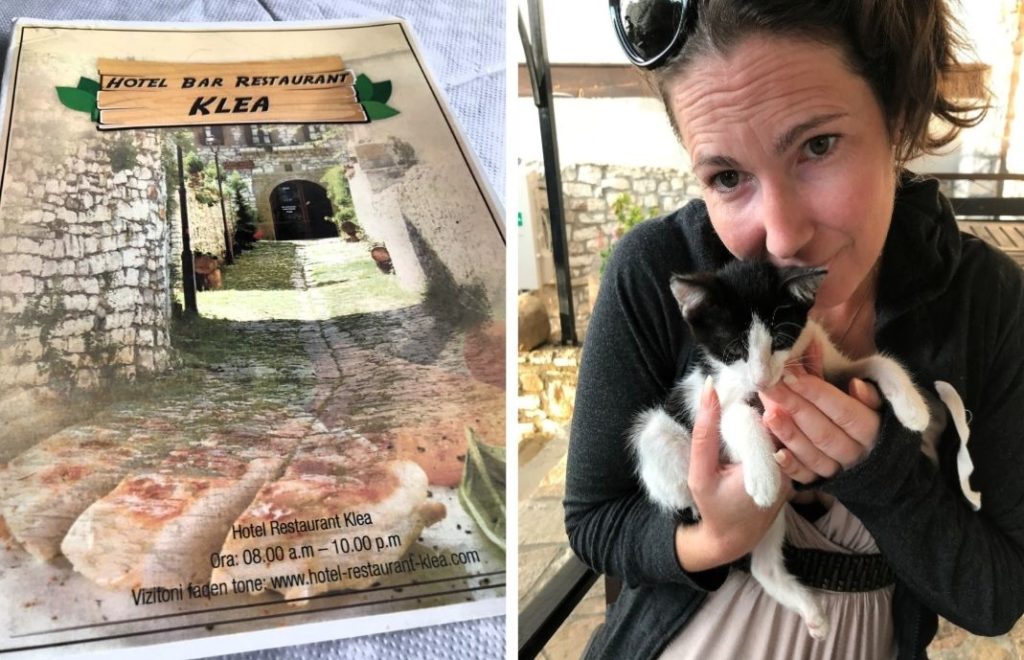
Hunger gnaws at us, and we decide to follow the advice of our trusty guidebook, trekking up to the fortress for a meal at Restaurant Klea. Expectations? Sky-high. Reality? A full-blown plot twist.
Whoever wrote that glowing review must have had one rakia too many, because this is not the culinary haven we were promised. There’s no sweeping view over the valley, no warm smiles or attentive service – only a moody owner whose glare could curdle milk.
The menu is a work of fiction: most dishes are “unavailable,” and when food finally appears, it looks like leftovers from last week, reheated three times in a microwave. Even the stray kitten we’ve befriended turns its nose up at the plate.
My vegetarian dish arrives… packed with meat. When I point it out, the owner serves me an apocalyptic scowl along with the plate. And as if on cue, the skies open – not a gentle drizzle, but a biblical downpour. We sit there, poking at lifeless food, throats burning from a dreadful rakia, gazing into the abyss of the neighbor’s corrugated metal roof. The couple next to us shares our misery, their expressions mirroring ours as they nudge the unidentifiable remains on their plates.
Back at Nasho Vruho, salvation awaits in the form of compassion – and pizza. Our hosts summon a delivery like guardian angels in human form. Thirty minutes later, a slightly breathless courier arrives bearing two glorious pies. We devour them as if they were Michelin-starred creations. After the Klea catastrophe, these pizzas taste like a gift from heaven.
When plans go off script
We head down to the car, ready to continue our Albanian adventure, only to find it boxed in tighter than a sardine in a tin. Albanian drivers, it seems, are masters of the double – and even triple – park. Blocking roads and sidewalks? Not a problem.
A policeman ambles over, tips his cap back, and shrugs. In broken English, he suggests we “maybe wait?” Luckily, fate smiles on us: the car owner has been playing chess with friends in a nearby park. He jogs over and frees us with a grin and zero apologies. Crisis averted – at least this one.
We hit the road toward Gjirokastër, crawling behind a tractor for what feels like eternity, before finally spotting a stretch of open highway. Sweet freedom! Or so we think.
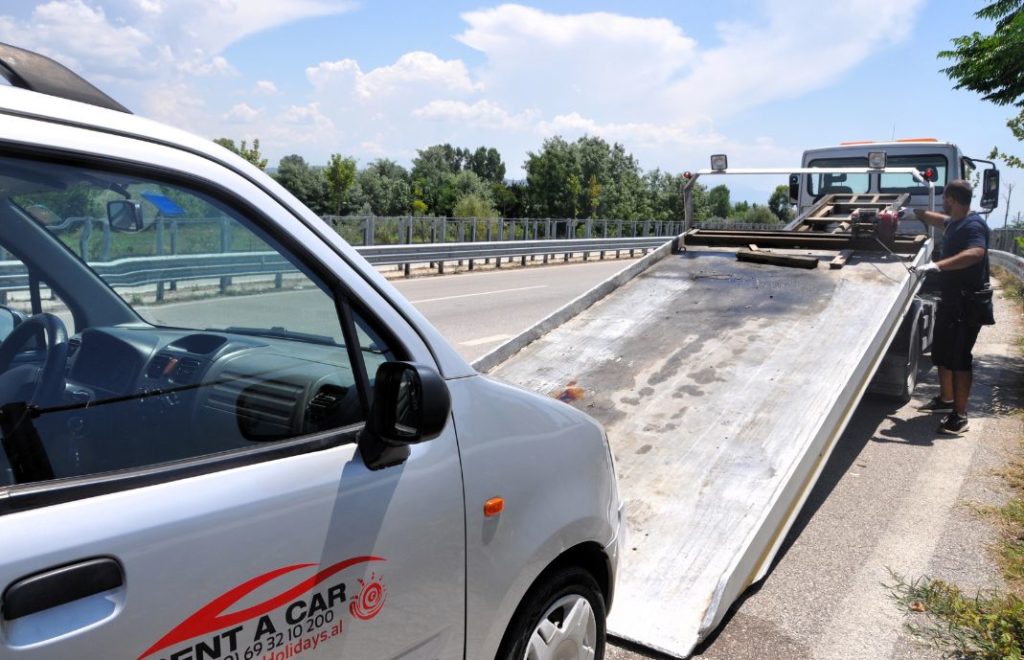
Our trusty “speed demon” has other plans. With a wheeze and a whimper, it gives up the ghost mid-journey, stranding us under a merciless sun on a desolate strip of asphalt. Somewhere between Berat and Gjirokastër. Surrounded by… absolutely nothing.
Cars whiz past. We sit there, two bewildered tourists on the shoulder of a nameless road, listening to a rooster crow defiantly in the distance – only to be answered by an angry dog. The soundtrack of rural Albania.
Several frantic phone calls later, the rental guy promises a tow truck and a replacement car. “Few hours,” he says. Of course.
The mechanic eventually arrives, our knight in greasy armor. He steps out of his battered truck, shakes our hands with a grin that could melt glaciers, and hoists our wheezing antique onto the flatbed. We squeeze into the cab like sardines, laughing until tears roll.
Because sometimes travel is messy and unpredictable.
One whole day wasted
The repair shop is, naturally, a good thirty-minute drive back toward Berat. Of course it is. The rental company assures us a replacement car is on the way – but it’ll take “a couple of hours.” So, we find a “café” a few meters down the road. Hard plastic chairs. A table wobbling on three legs. The sound of endless engines and a steady stream of exhaust fumes swirling around us.
We dangle our legs and watch from afar as our car is hoisted onto the lift. Three mechanics dive in like surgeons on a mission.
Hours crawl by. We call the rental company:
“The car that was on its way to you… broke down.”
Of course it did. “We’ve sent another one,” they say cheerfully. “Just a few more hours.”
Patience – and humor – are circling the drain.
We call again later. Guess what? The second car had gear issues. At this point, we’re convinced the guy’s a storyteller.
And then – hope. The mechanic waves us over with a big grin. The car is fixed! We can drive it back to Saranda, where a shiny, modern car is waiting for us. Apparently, it was “just a small issue with fuel supply.”
Small issue? We’ve spent the afternoon watching our little silver box being stripped to its skeleton. Parts scattered everywhere like confetti at a wedding. Six hours, blackened hands, and oil-streaked faces later, the Albanian pit crew declares victory.
There’s only one option left: we climb back into our resurrected relic and hit the road. Back to Saranda, back to square one – with a day lost but a story gained.
Gjirokastër – At last
Did we get a new car?
No way! He didn’t have any more vehicles available. I couldn’t help but comment that it’s probably because they’re all in the repair shop.
Still, a few setbacks won’t derail our holiday spirit. Fingers crossed the car holds out for the rest of the week as we set our course for Gjirokastër.
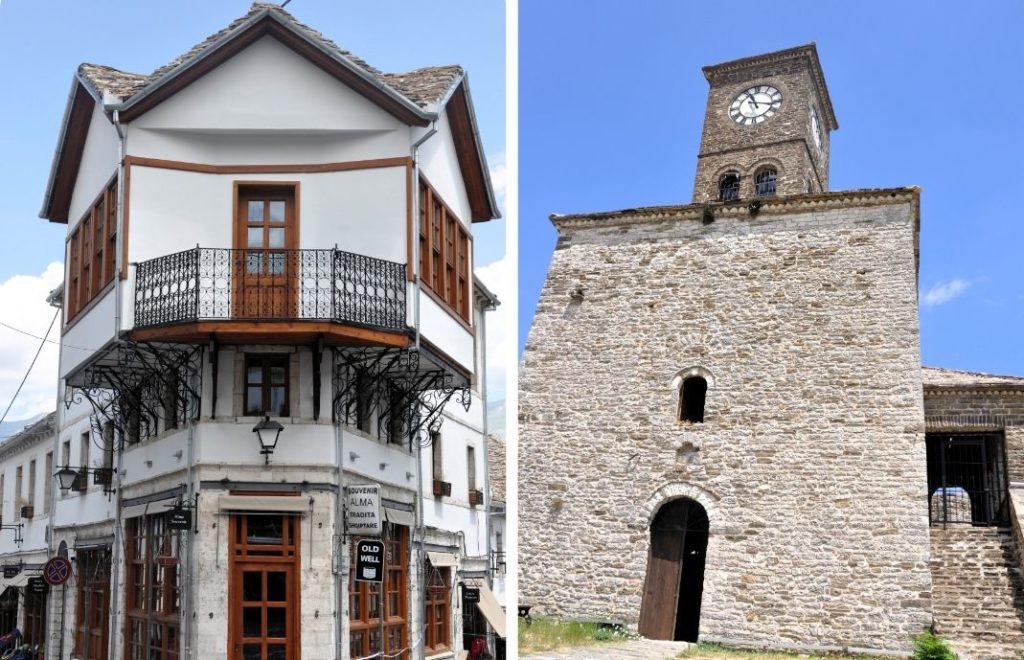
It’s easy to see why this city earned its place on UNESCO’s World Heritage List.
The old town is an extraordinary testament to centuries past, radiating an undeniable charm. The settlement that became today’s Gjirokastër grew around a citadel, which still dominates the skyline, beckoning travelers from across the globe.
Construction of the citadel began in the latter half of the 13th century. From this strategic military outpost, a small town blossomed throughout the 14th and 15th centuries. In 1419, the Ottomans captured the city, leaving behind the enduring legacy we see today.
On the way back, we detour to The Blue Eye, or Syri i Kaltër in Albanian. Here, eighteen springs converge to form a mesmerizing, eye-shaped pool. Its crystal-clear waters shimmer in hues of sapphire and emerald – a refreshing oasis that draws throngs of visitors on this sweltering day.
Magnificent Butrint
Since sunbathing and swimming aren’t exactly calling to us – despite our base in the seaside town of Saranda – we set off for the ancient city of Butrint, just a half-hour drive away.
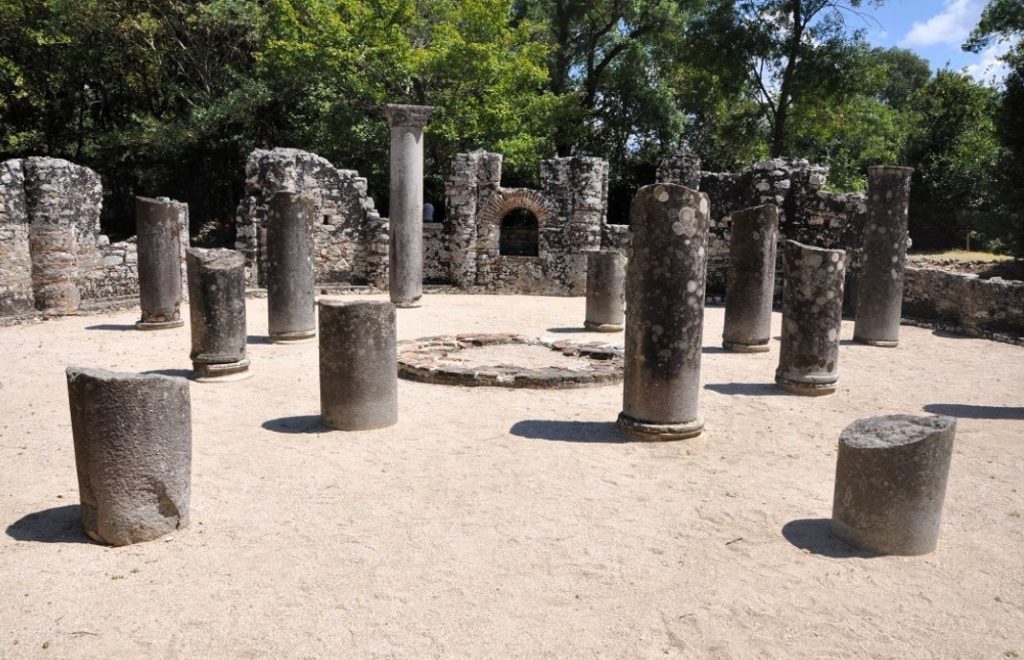
Perched on a narrow peninsula between the Straits of Corfu and Lake Butrint, these ruins are among Albania’s most treasured landmarks.
Butrint, also inscribed on UNESCO’s World Heritage List, was originally founded by the Illyrians. In antiquity, it became a revered pilgrimage site dedicated to the healing god Asclepius.
Strolling through its remains feels like leafing through a living history book, each fragment leading us deeper into the chronicles of time.
The city walls, impressive even in ruin, date back to the 3rd century BC. Later, Butrint fell under Roman control – first with Julius Caesar, and then under Augustus, who made it a colony in 167 BC. The Byzantine era brought prosperity, swelling the population to around 10,000.
From the 11th century onward, Normans, Angevins, and the Republic of Venice battled for dominance here. Butrint served as a base for the Norman prince Bohemond in 1081 when he assembled a fleet to conquer Constantinople, and later, during Suleiman I’s attempts to seize Corfu in the 17th century.
By the Middle Ages, the city was abandoned, and by the early 1800s, it had dwindled to a humble fishing village clustered around a Venetian fortress.
Rediscovered in 1928, Butrint now offers visitors a remarkable glimpse into its layered past: a Roman bathhouse, an amphitheater, a villa, a 4th-century chapel ruin, and a 6th-century basilica. The site’s museum is housed in a 14th-century Venetian fort – a fitting guardian of history on this storied peninsula.
See Albania before it’s too late
We wrapped up our Albanian adventure with a few hours on the beach in Ksamil. Sadly, it wasn’t the idyllic experience we had hoped for. Sun loungers were crammed together, and the prices per chair were far too steep to feel worthwhile. Still, a refreshing dip in the Ionian Sea made for a pleasant finale to our journey.
Returning the rental car, however, was less than pleasant. The owner, so charming when we picked up the vehicle, was now all scowls and arguments over the refund he had promised.
Yet that little metal box carried us across Albania, gifting us countless unforgettable moments.
We wandered the bustling streets of Tirana, explored ancient ruins, and strolled through old towns steeped in local charm. We paused for cows and sheep crossing the road, climbed medieval fortresses, savored traditional dishes, and shared warm conversations with locals. We marveled at breathtaking landscapes, swam in turquoise waters, and – more than once – cursed the endless roundabouts.
Albania is unlike most countries in Europe. It remains raw, authentic, and refreshingly real – a land untouched by the heavy hand of mass tourism… at least for now.
More inspiration to visit Albania:
9 reasons to visit Albania
