
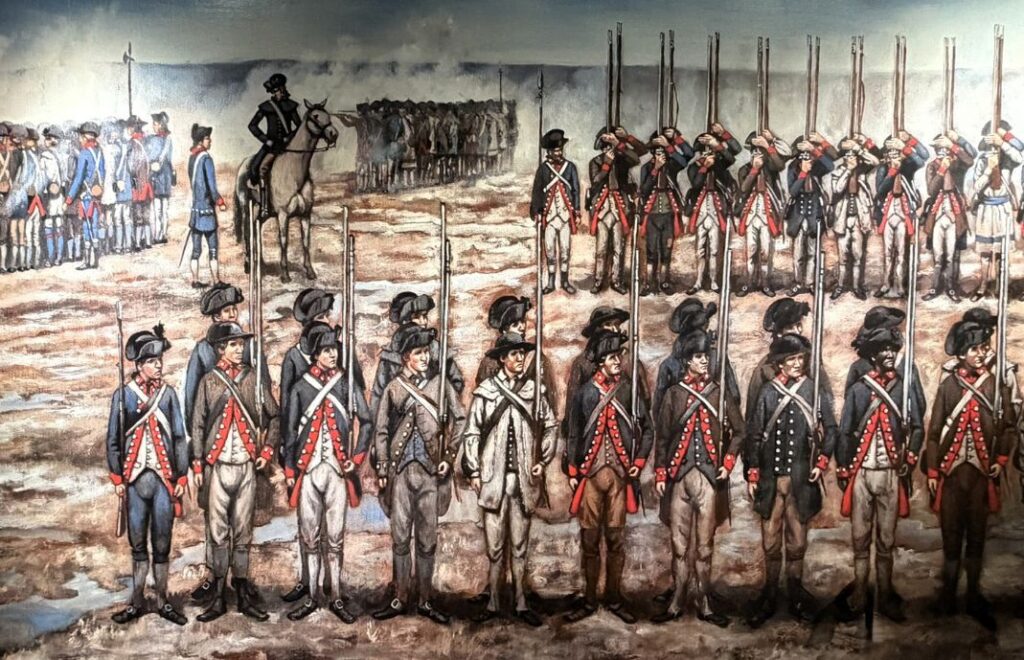
On December 19, 1777, a total of 12,000 Continental Army regulars marched into Valley Forge, Pennsylvania, to set up winter camp quarters during the Revolutionary War. The army was led by General George Washington, an army largely made up of a collection of disparate colonial militias supported by hundreds of camp followers and allies. Under Washington’s leadership, they emerged as a cohesive and disciplined fighting force.
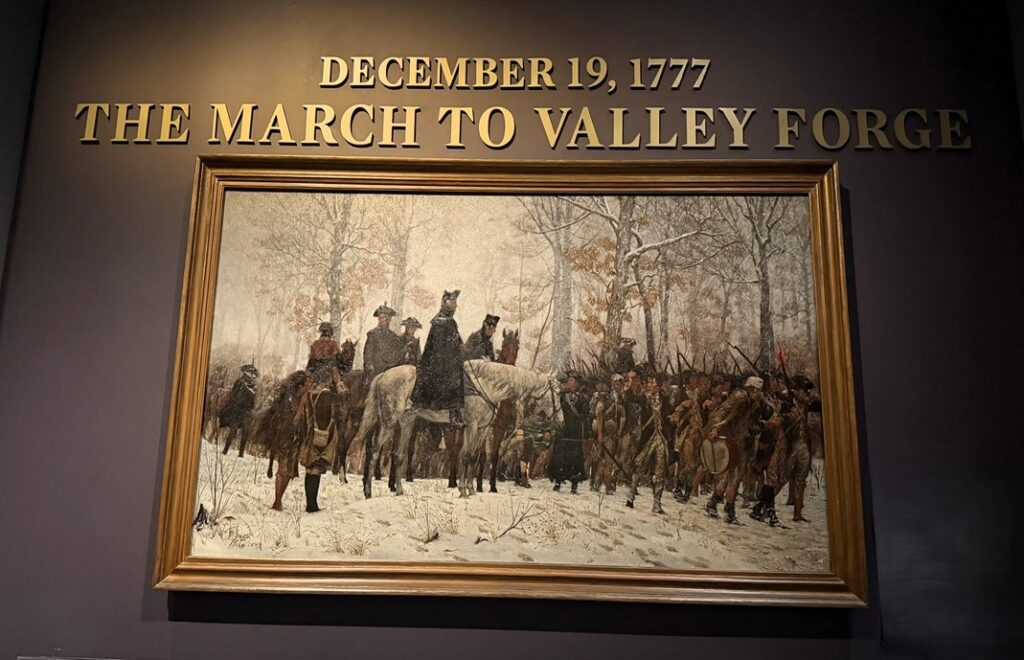
The Continental Army marches in
In late 1777 while the British occupied the American capital of Philadelphia, Washington decided to have his troops winter at Valley Forge, only a day’s march from the city. Valley Forge was a naturally defensible plateau where the army could train and recoup from the year’s battles. The wet and cold winter weather, muddy and impassable road, and scant supplies made major battles less likely.
Washington knew well that some members of the Continental Congress were questioning his leadership abilities. The Valley Forge site, located along trade routes and near farm supplies, was an attempt to balance Congress’ demands for a winter campaign against Philadelphia with the needs of his troops.
Contrary to the popular myth, the Continental soldiers marching in to Valley Forge were not downtrodden – just exhausted and ill-supplied. They exuded the confidence of people who knew that they had come close to beating the British in battle. Overall, they were optimistic about the future and resigned themselves to the task of establishing their winter camp.
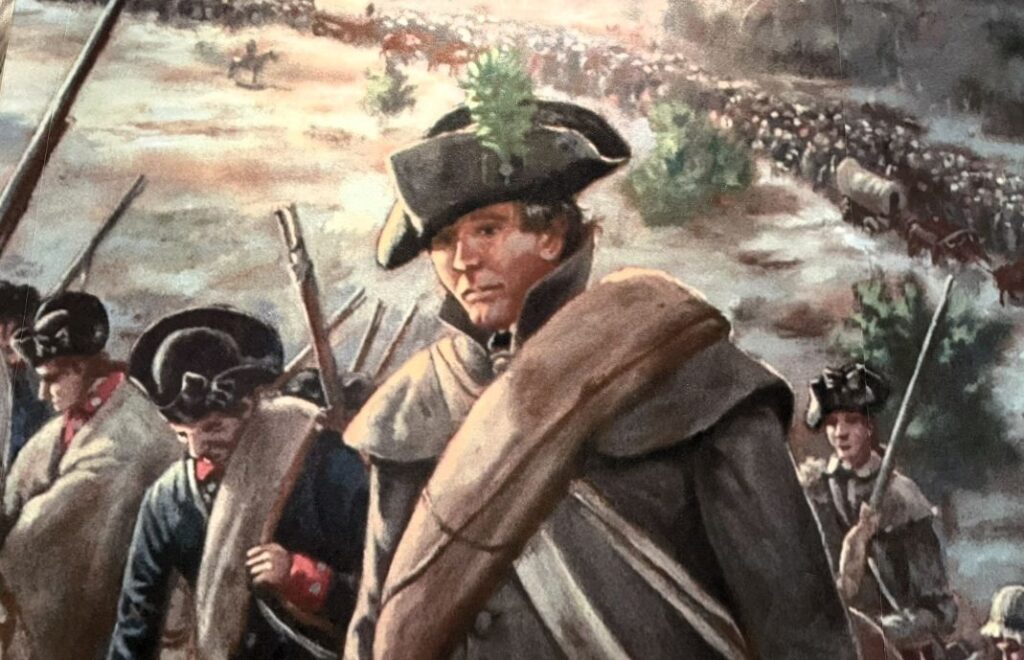
Life in the camp
There is a romantic image of that depicts the troops at Valley Forge as helpless and at the mercy of winter’s fury. The soldiers wore nothing but rags and left bloody footprints in the snow. This is not necessarily accurate. Instead, it renders the soldiers and camp followers of the Continental Army, and their commanders, a disservice.
The winter of 1777-78 was neither the coldest nor the snowiest winter experienced during the war, but conditions were extremely difficult for many reasons. The soldiers and followers had to deal with regular freezing and thawing, plus intermittent snowfall and rain. They also faced shortages of provisions, clothing and gear, all of which made living conditions extremely difficult. Rather than wait for deliverance, the army procured supplies, built log cabins to stay in, constructed makeshift clothing and cooked subsistence meals of their own concoction.
The army had provisions during the early months of the encampment. Army records of the food shipped to camp in the month of January 1778 reveal that the men received an average daily ration of 226 grams (one-half pound) of beef per man. The most serious food crisis occurred in February, when the men went without meat for several days at a stretch. Shortages of clothing did cause severe hardship, but many soldiers had a full uniform. At the worst point in early March, the army listed 2,898 men as unfit for duty due to a lack of clothing. Well-equipped units took their place and patrolled, foraged and defended the camp.
Valley Forge was also the first winter encampment where many thousands of men had to built their own huts. They also constructed miles of trenches, five earthen forts, and a state-of-the-art bridge over the Schuylkill River.
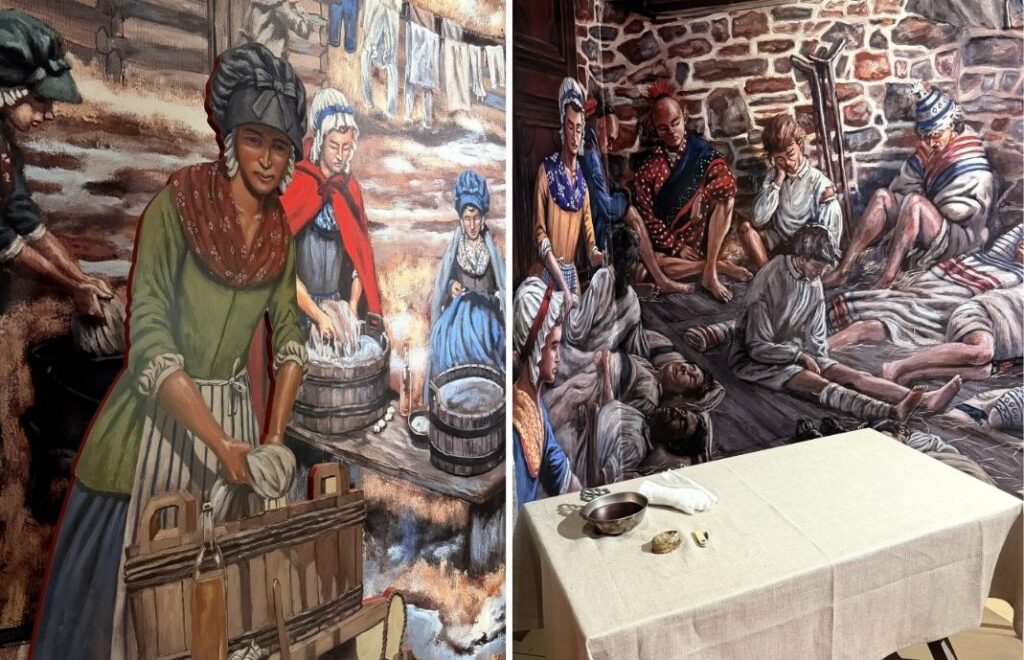
People of the encampment
On December 19, 1777, more than 12,000 soldiers and 400 women and children marched into Valley Forge and began to build what essentially became the fourth largest city in the colonies at the time. It has 1,500 log huts and 3,2 kilometer (two miles) of fortifications.
Lasting six months, from December until June, the encampment was as diverse as any city and was made up of free and enslaved African American soldiers and civilians.
Concentrating the soldiers in one vast camp allowed the army to protect the countryside and be better able to resist a British attack. But it became costly when lack of supplies and hunger afflicted the inhabitants, and diseases like influenza and typhoid spread throughout the camp.
While there was never a battle at Valley Forge, disease killed nearly 2,000 people during the encampment.
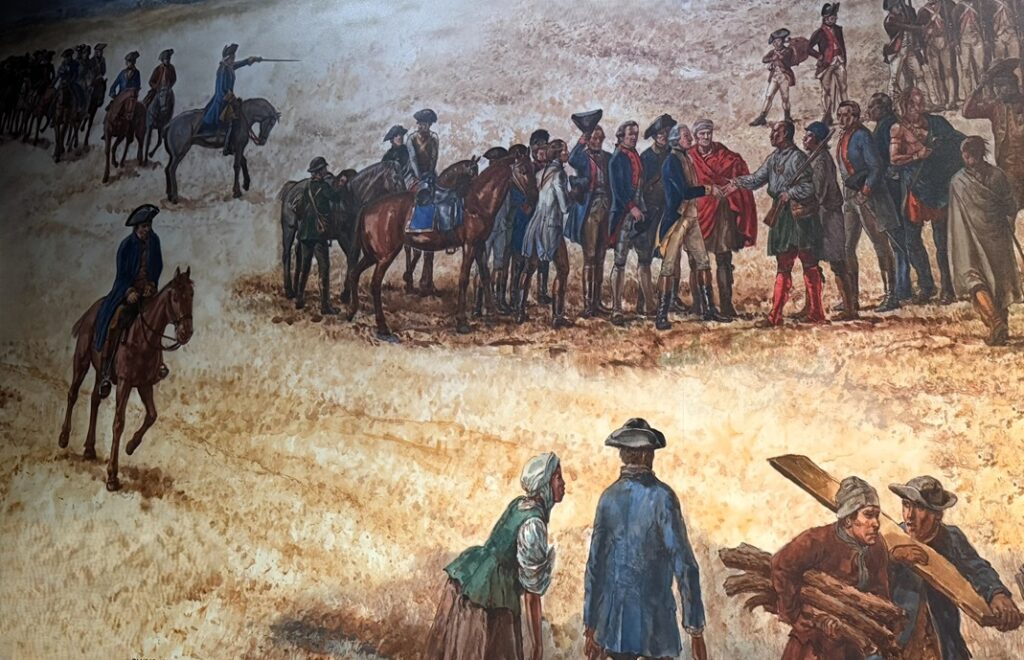
A unified army
Through the duration of the encampment, Washington inspired the soldiers through his own resilience and sense of duty. He persuaded Congress to reform the supply system and end the crippling shortages and attracted experienced officers to the cause.
One of the men recruited was former Prussian officer Baron von Steuben, who was assigned the task of training the troops. Von Steuben taught the soldiers new military skills and to fight as a unified army. These reforms in supply systems and fighting tactics, along with reforms in military hygiene and army organization, became the foundation of the modern United States Army.
In May 1778, Washington was informed that the long-sought alliance with France was secured. The British soon evacuated Philadelphia and headed north to defend their stronghold in New York City.
On June 19,1778, Washington’s troops marched out of Valley Forge in pursuit. The Continental Army’s transformative experiences at Valley Forge reshaped it into a more unified force capable of defeating the British and winning American independence during the remaining five years of the war.
The mythology of Valley Forge
The winter encampment of Valley Forge is one of the most famous episodes of the American Revolution. The significance of the encampment lies both in its fact-based history, but also in its many myths.
The mythical narrative is also important because it reveals something about the character in the heroic way we wish the Revolution to be remembered. The popularity of the myth also speaks to its usefulness. Valley Forge remains a touchstone – always ready to minister to a generation in crisis.
But the myth often obscures the actual history of the event. It tells us that it was the experience of tremendous suffering from the cold and starvation during the encampment that forged a spirit of extraordinary patriotism among Washington’s men. Hardship did occur, but it was not a time of exceptional misery. The encampment experiment could be characterized as “suffering as usual”. Patriotism did not peak during the relatively short six-month period at Valley Forge. Widespread devotion to the cause was an early war phenomenon for the most part.
Source: Valley Park National Historic Park
