
When you visit Wrocław, don’t forget to look down – not up. After all, you wouldn’t want to miss (or trip over) the city’s delightful legion of dwarfs.
They lurk in alleyways, cling to lampposts, peek out from doorways, and hide in plain sight. Cheeky, mischievous, and brimming with personality, these bronze miniatures are Wrocław’s unofficial mascots – and without a doubt, its biggest stars.
Each statue, roughly the size of a pint glass, represents a member of the city’s whimsical dwarf society: merchants, bankers, professors, postmen… there’s a tiny figure for (almost) every profession.
Here are a few of the most popular dwarfs – and the charming stories behind them!
The highest ranking dwarf
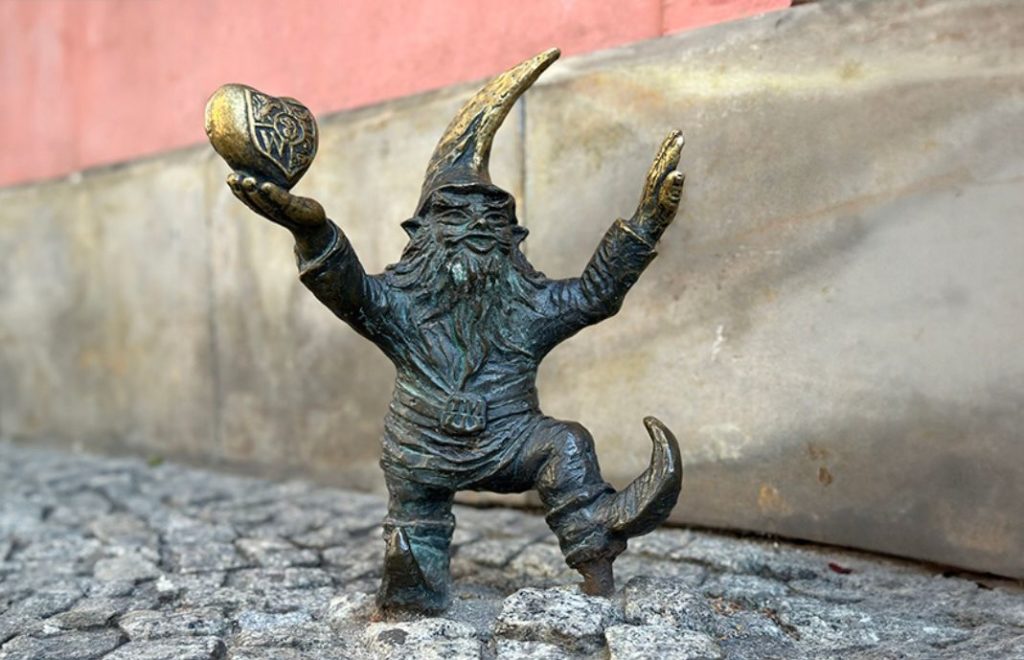
Papa Dwarf is the most distinguished – and highest-ranking – dwarf in all of Wrocław. Once a spirited activist in the underground Orange Alternative movement of the 1980s, he’s now enjoying a well-deserved retirement as the wise and respected head of the Wrocław Dwarf Council.
With a playful smile and a thoughtful, grounded outlook on life, Papa Dwarf is the ideal leader. He settles disputes, offers sage advice, and has the final word on all matters concerning the city’s miniature citizens.
He first appeared on Świdnicka Street in 2001, standing guard at the very spot where the Orange Alternative staged many of its legendary – and absurdly creative – protests. To this day, Papa Dwarf keeps watch with quiet dignity, a symbol of whimsy, resistance, and Wrocław’s irrepressible spirit.
A dwarf with a big heart
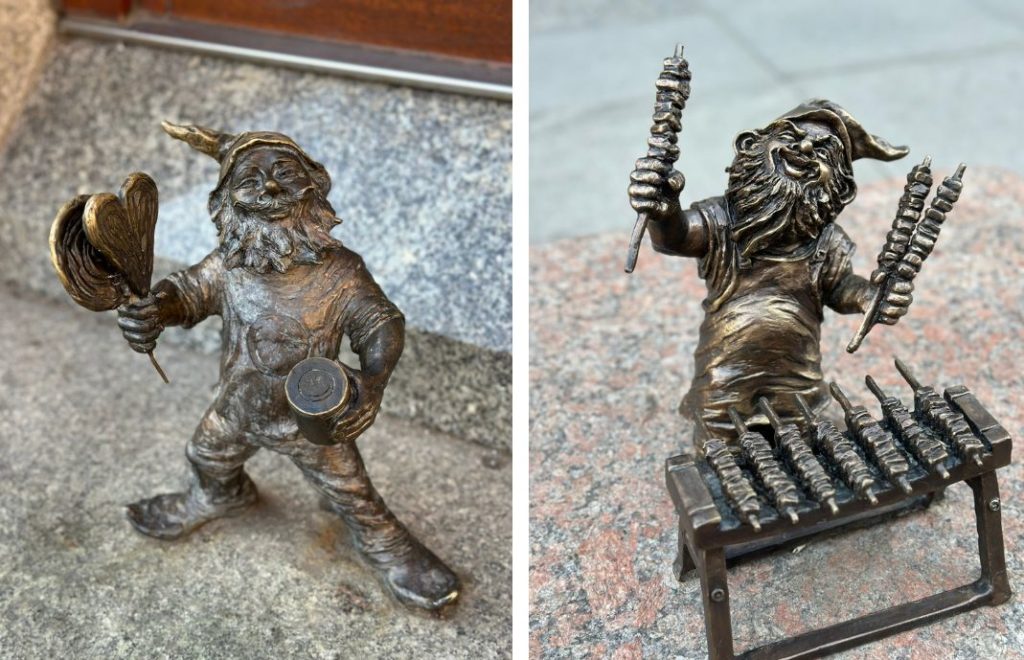
WrocLovek may be the smallest of all the dwarves, but he’s a true Wroclaw enthusiast through and through! The beating heart of the dwarf family, he welcomes visitors with an enormous smile and an even bigger heart.
You’ll find WrocLovek just outside the Magic Twin Houses – Jaś and Małgosia – widely known as the most dwarf-friendly building in Wroclaw. From there, it’s only a few long dwarf-meters to the gates of Dwarf City.
WrocLovek is the kind of dwarf it’s absolutely impossible not to fall for – and fall in love with!
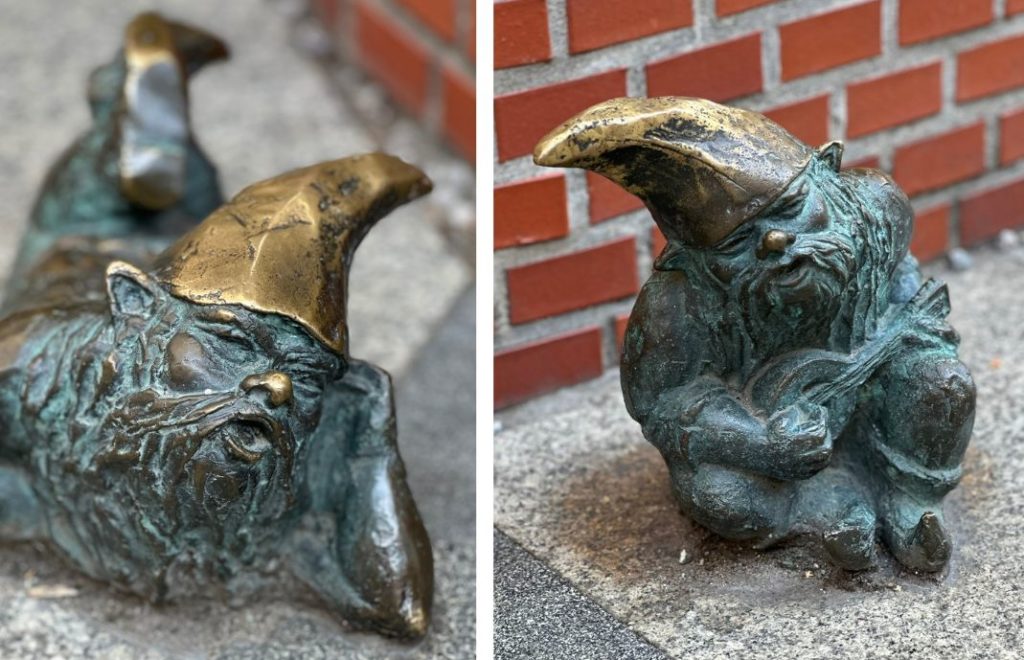
Sleepyhead sleeps soundly (all the time)
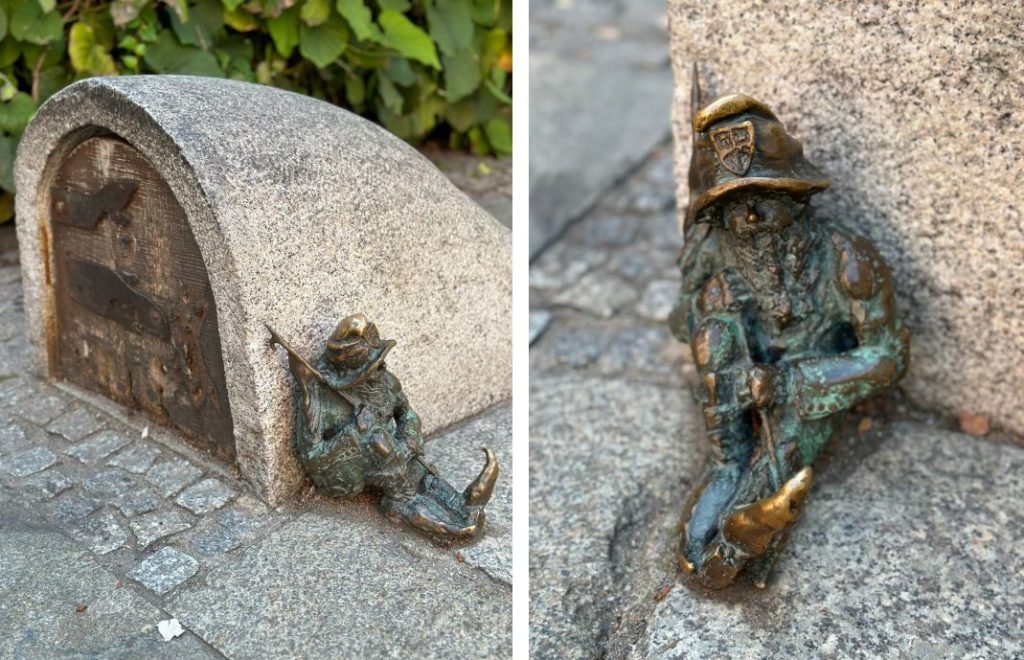
If you’re looking for Sleepyhead (Śpioch), just follow the sound of snoring. He’s almost always asleep.
Many years ago, Sleepyhead was given the task of guarding the entrance to Dwarf City. Since childhood, he’s been famously sluggish, indifferent, and unmotivated – not one to take any job seriously. On his very first shift, he sat down with his back to the stone wall and promptly dozed off. He occasionally wakes up, especially when he catches the scent of food.
One has to wonder how – and why – Śpioch ever ended up as gatekeeper to the dwarves’ realm. Everyone agrees he was the wrong dwarf for the job. But no one wants to admit it was a mistake, so to this day, Sleepyhead remains on duty.
Some say the entrance is so narrow and hidden that uninvited guests couldn’t get through anyway. Better, then, to assign a lazy dwarf to the post than to risk him messing up a more important job. Another theory holds that Śpioch’s thunderous snoring actually helps people find the hidden gate. And there are whispers that he only truly wakes if the Church of St. Elizabeth is in danger. According to legend, it was Śpioch who roused the townspeople during the roof fire of 1975 – an act that may well have earned him the right to keep his job.
Even the eldest dwarves can’t remember a time when Śpioch stayed awake longer than it takes to eat a meal. He pays little mind to what’s going on around him – more interested in stretching his legs, nibbling on snacks, letting out a loud burp, and shutting his eyes again. Occasionally, he stirs, glances at the sun, lets out a yawn, mutters something unintelligible, and drifts back to sleep.
Should you somehow manage to wake him – though that would be quite a feat – expect a disapproving glare and absolute indifference. Some claim they once provoked him enough to get a few muttered words in the ancient dwarvish tongue. Whatever was said, it was reportedly so shocking, it’s best left unrepeated.
Prisoner: The Dwarf behind bars
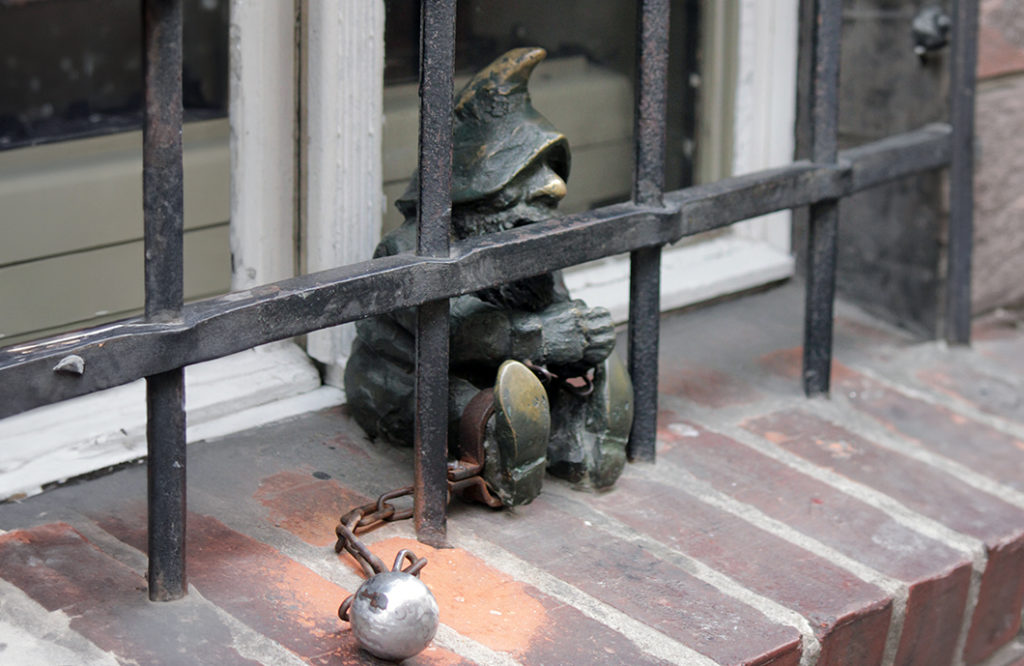
Day after day, the Prisoner (Więzień) languishes behind iron bars on Więzienna Street, a heavy metal ball shackled to his leg. But what did he do to deserve such a fate?
It’s a grim and peculiar tale – one wrapped in mystery and dwarven rumor. Depending on who you ask, his crime varies. Some say he committed the ultimate dwarven taboo: he shaved off his beard, an unthinkable act for any dwarf with a shred of self-respect. Others claim he was once known as Leniuszek, the Slacker, and was jailed for oversleeping and missing the all-important annual dwarf gathering in Wrocław.
But the truth, as best as it can be pieced together, lies in a far more gluttonous sin.
Back in the day, Więzień was called Pasibrzuch – meaning “Glutton” – and he was inseparable from his best friend, Pierożnik. The two came to Wrocław drawn by the mouthwatering aroma of local pierogi. They were cunning, too – experts at charming tasty morsels from unsuspecting tourists.
Their friendship ended in betrayal when Pasibrzuch did the unthinkable: he ate his friend’s entire plate of pierogi.
Now, stealing food from humans is considered a harmless prank in dwarf society – a cheeky pastime, nothing more. But stealing from another dwarf? That’s a serious offense. Dwarves in Wrocław are known for their tolerance and belief in second chances, which is why Pasibrzuch was initially sentenced to community service: he was tasked with guarding a vat of milk destined to become sour milk – a process that, according to tradition, requires dwarves to, well… relieve themselves into it.
But Pasibrzuch couldn’t resist. He drank the entire vat dry.
The sour milk never came to be, and the Dwarf Council had seen enough. They issued their final judgment: prison.
To this day, no one remembers his real name – it lies buried in dusty old records. To the world, he is simply Więzień, the Prisoner.
And yes, he’s still got that legendary appetite. His favorite dish? Cake – especially if it comes with a file baked inside.
The Sisyphuses: Wrocław’s tireless, lovable duo
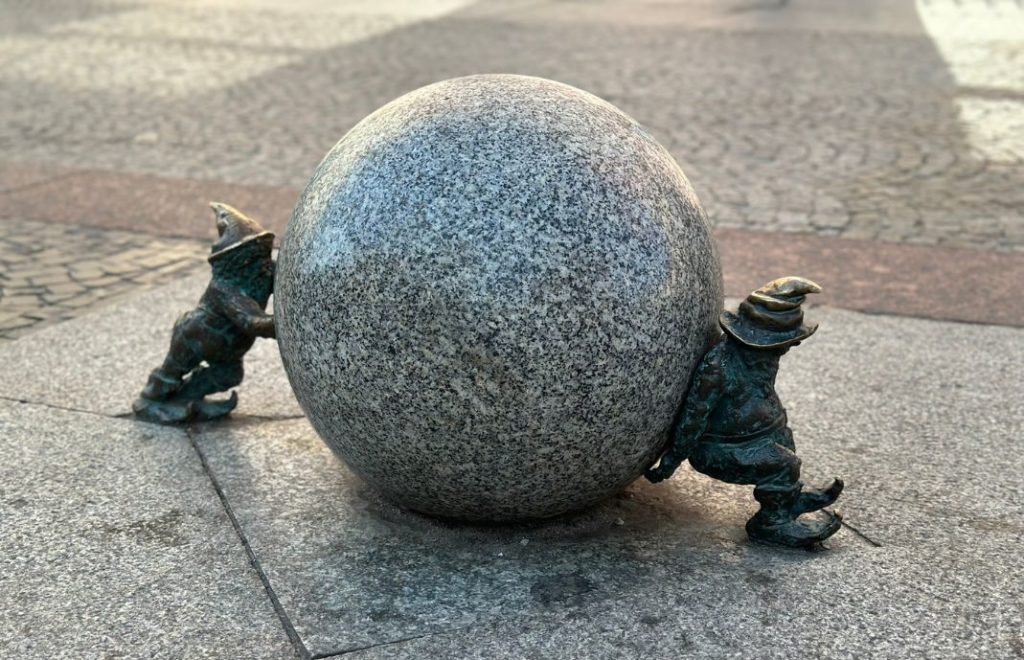
Meet the Syzyfki – two of the hardest-working dwarves in all of Wrocław, and beloved symbols of the city. Locals and tourists alike hold them in high regard, not for their brilliance (they’re not exactly the brightest), but for their relentless dedication and irresistibly charming spirit.
No one really knows how they got their name, and they’re certainly not telling. They’re far too busy with their self-imposed task: pushing a massive granite sphere through the streets of Wrocław. That’s all people know – and really, it’s all they need to know. These two industrious little fellows were overcome with a desire to help during the city’s revitalization. Without giving it much thought, they set about moving the granite ball toward Świdnicka Street.
The only problem? Their approach is, shall we say, less than coordinated.
One dwarf pushes the ball forward with all his might, while the other, facing the opposite direction, tries to roll it back down the street – effectively canceling out each other’s efforts. This tug-of-war has gone on for years, a never-ending contest between two stubborn spirits, completely unaware they’re each sabotaging the other.
They’ve become a source of amusement for onlookers, often the butt of light-hearted jokes. But beneath the laughter lies genuine admiration. The Syzyfki are earnest, determined, and wholly committed to completing their mission – even if that mission is, quite literally, going nowhere.
In fact, they’re so focused that they haven’t even noticed the granite ball is now permanently wedged into the pavement. When professional renovators encountered them, they were so charmed by the duo’s dedication that they didn’t have the heart to interrupt. Instead, they discreetly relocated both dwarves – and the stone – to Świdnicka Street, where they remain to this day.
These endlessly toiling dwarves continue to spark smiles and warm hearts. And with their endearing expressions and photogenic charm, the Syzyfki just might roll their way into victory in the contest for Wrocław’s most camera-ready dwarves.
Tourist: The wandering Dwarf of Wrocław
No dwarf in Wrocław knows the world quite like Turysta. With a weathered backpack and a glint of wanderlust in his eye, he’s a seasoned traveler who’s roamed far and wide before choosing to settle – at least for now – right outside the city’s tourist information center (naturally).
Turysta warmly welcomes visitors to his beloved city. With boundless enthusiasm, he offers helpful tips, clever shortcuts, and colorful stories from his globetrotting days. Whether you’re looking for a hidden courtyard, a quiet café, or a little-known legend, Turysta is your go-to guide – and he delivers his insights with the flair of a true storyteller.
But don’t get too attached. His backpack is already packed, ready for the next adventure. Though he’s chosen Wrocław as his current home, no one knows how long he’ll stay. At any moment, the wind might call him to explore new lands and uncover fresh tales.
Until then, Turysta remains a cheerful fixture of the city – the ultimate travel companion for anyone eager to discover Wrocław’s magic.
Fencer: The gallant guardian of the University
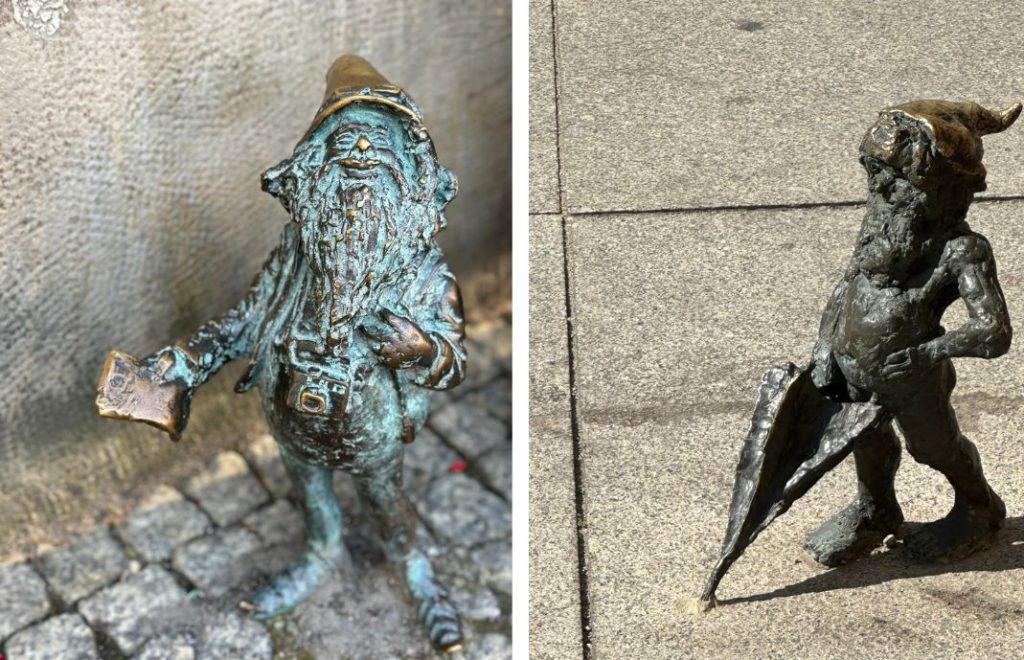
Fencer, known in Polish as Szermierz, is one of the very first dwarves to set foot in Wrocław. Since 2005, he has claimed his favorite spot – a charming passage near the main building of the university – where he has stood proudly ever since (well, mostly).
With an umbrella in hand and a dashing stance, Szermierz cuts a distinguished figure. But fame, as they say, comes at a cost. His popularity has made him a target – he’s been stolen not once, but twice. Sadly, his umbrella has proven more ceremonial than defensive when it comes to warding off vandals.
Still, this resilient dwarf made his triumphant return to his rightful place in late June 2012. Locals and students alike were thrilled to welcome him back, hoping he can now remain in peace for the rest of his dwarf days.
Graceful, brave, and slightly weathered, Fencer remains a symbol of enduring charm – a quiet sentinel of Wrocław’s academic heart.
Blind One and Deaf One: Guardians of accessibility
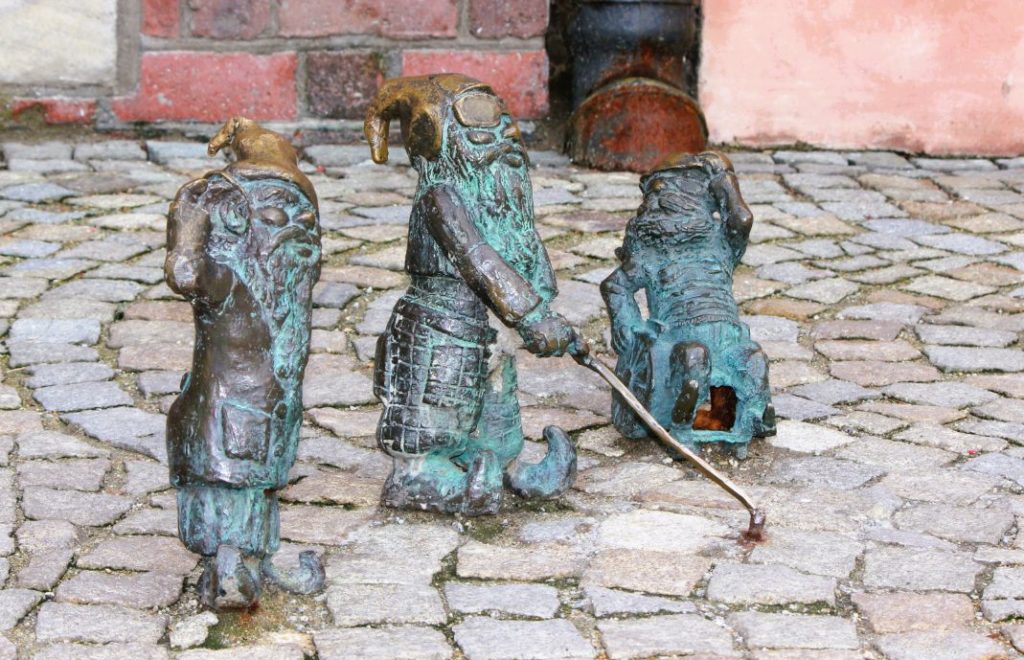
Alongside their companion W-Skers, Ślepak (the Blind One) and Głuchak (the Deaf One) form Wrocław’s inspiring trio of dwarves with disabilities. But don’t let their impairments fool you – these three are determined, proactive, and always on a mission.
Together, they roam the city streets, keeping watch for architectural barriers and everyday obstacles that make life more difficult for those with disabilities. Whether it’s a steep curb, a narrow passage, or an inaccessible entrance, nothing escapes their attention.
In true dwarf fashion – quietly determined and endlessly resourceful – they’re working to shift perceptions. Their presence encourages people with disabilities to stay active, engaged, and fearless in exploring their world. At the same time, they gently challenge the rest of society to rethink how inclusive urban spaces really are.
Ślepak and Głuchak are more than symbols – they’re tiny but mighty advocates for change, proving that even the smallest voices can have a powerful impact.
Fires: Wrocław’s bravest little firefighters
Fearless and ever-ready, the Pożarki are Wrocław’s tiniest fire brigade – always on standby, armed with a hose and a ladder, waiting for the next call for help. Though small in stature, their dedication burns bright.
You’ll find this brave duo standing guard near the Garrison Church, a historic site that has endured three dramatic fires over the years. The Pożarki aren’t just miniature firefighters – they’re also a living tribute to those fiery chapters in the church’s past.
While their emergency callouts are few and far between these days, their presence is a reassuring one. Proud, alert, and impossibly charming, they serve as a reminder that even the smallest among us can carry out heroic duties.
In a city filled with character, the Pożarki stand tall – in spirit, if not in size.
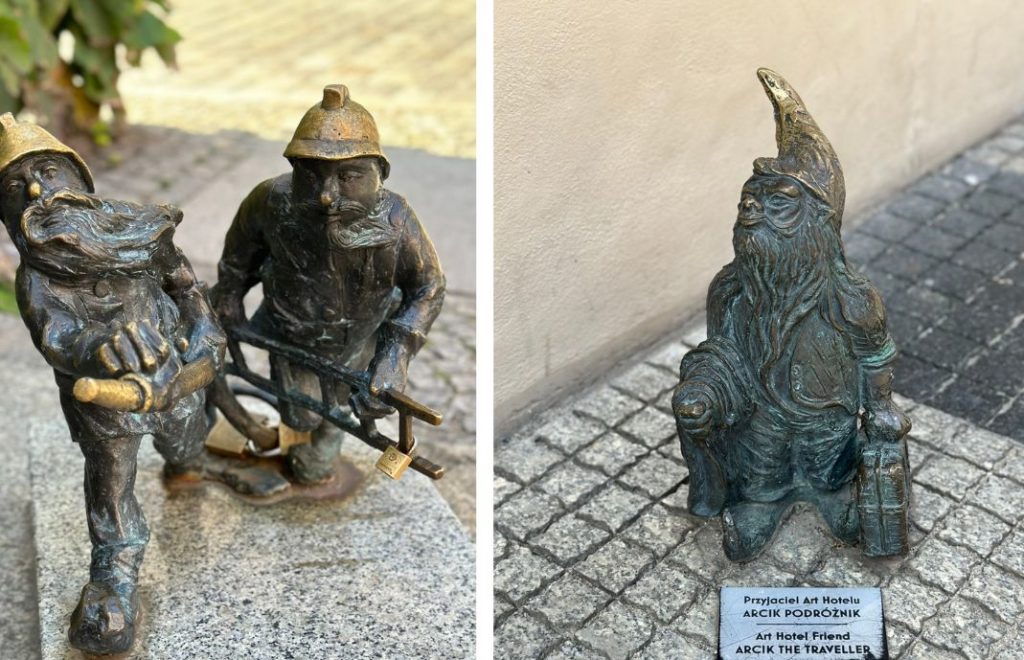
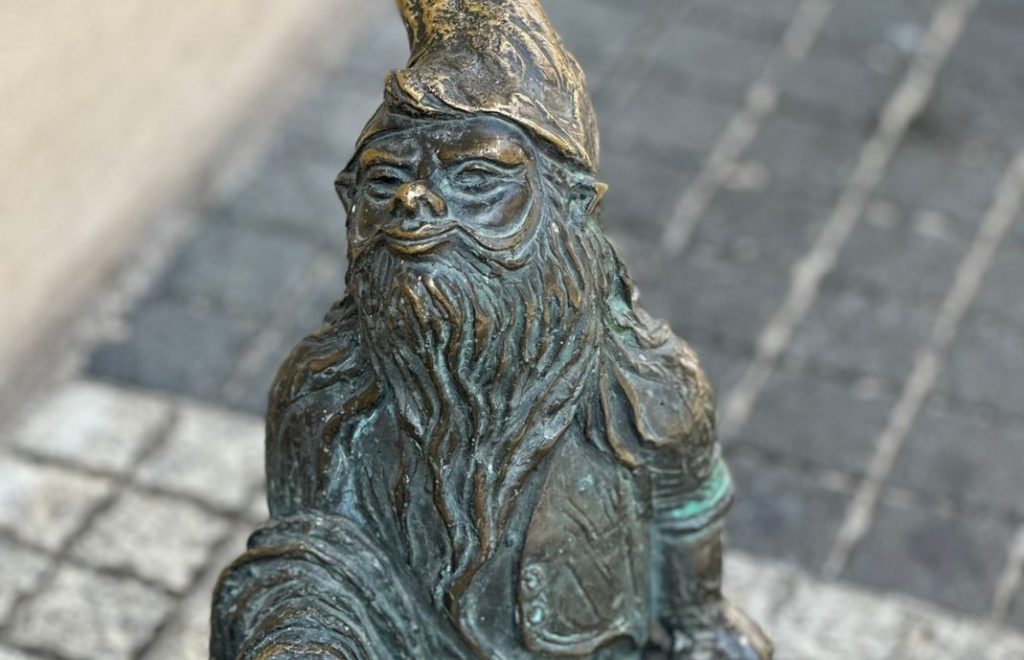
Traveller: The restless spirit of Wrocław
Among all the dwarves of Wrocław, none has roamed farther or dreamed bigger than Podróżnik. A true globetrotter, he’s known far and wide for his endless adventures and unquenchable thirst for discovery. Even in his short life, he has lived more than most – and he’s only just getting started.
Before settling (temporarily) in Wrocław, Podróżnik had already visited corners of the world most dwarves only read about. Today, you can often spot him – suitcase in hand – outside the Art Hotel on Kiełbaśnicza Street, always looking like he might vanish again at any moment.
Curiosity has always been his compass. As a child, he climbed trees, dove into rabbit holes, and wandered through Wrocław’s underground tunnels – doing everything a “proper” dwarf wasn’t supposed to do. He peppered his parents with endless questions, much to the bewilderment of his dear dwarf-mother, who often wondered how she’d raised such a wildly inquisitive son.
One day, Podróżnik announced he was leaving to see Poland. He packed his few possessions and disappeared – but never completely. From time to time, a postcard would arrive, assuring his family that he was safe, healthy, and as adventurous as ever. With each foreign stamp came the quiet understanding that he wouldn’t be returning anytime soon.
After exploring all of Poland, he set his sights on the world. Europe was just the beginning – soon he was crossing continents. Africa. South America. The United States. Backpacking through Asia. A stint in Australia. Wherever his heart led, he followed.
And every so often, he would reappear in Wrocław – bearing trinkets, strange spices, and thrilling tales. He became a legend among the younger dwarves, who huddled wide-eyed around him to hear of volcanoes, jungles, ancient temples, and near escapes. But no sooner had he unpacked his bag and shared his stories than he’d declare he’d stayed too long and vanish once again.
Whispers say he spent quite some time in the British Isles, where he picked up a refined accent and a gentleman’s manners. Gone is the mischievous rascal of his youth – Podróżnik is still cheerful and warm, but now carries the quiet gravity of one who’s seen much of the world.
After decades of travel, his home was overflowing with souvenirs – there simply wasn’t space for him anymore. So he moved into a hotel, naturally. Now, he’s made himself at home outside the Art Hotel, and word has it, he might even stay a while… well, longer than usual, at least.
Why? Because he’s working on a travel guide to Europe – one that highlights its most fascinating corners. Plans are already in motion for companion volumes on other continents, followed by a series of memoirs. Of course, any writing project will likely be “briefly” interrupted by a spontaneous journey somewhere halfway across the globe.
So if you happen to walk past the Art Hotel and notice a small, well-traveled dwarf with a suitcase and a far-off gaze – don’t be surprised. You’ve just met Podróżnik. And if you’re lucky, he might even share a story or two before the road calls him away once again.
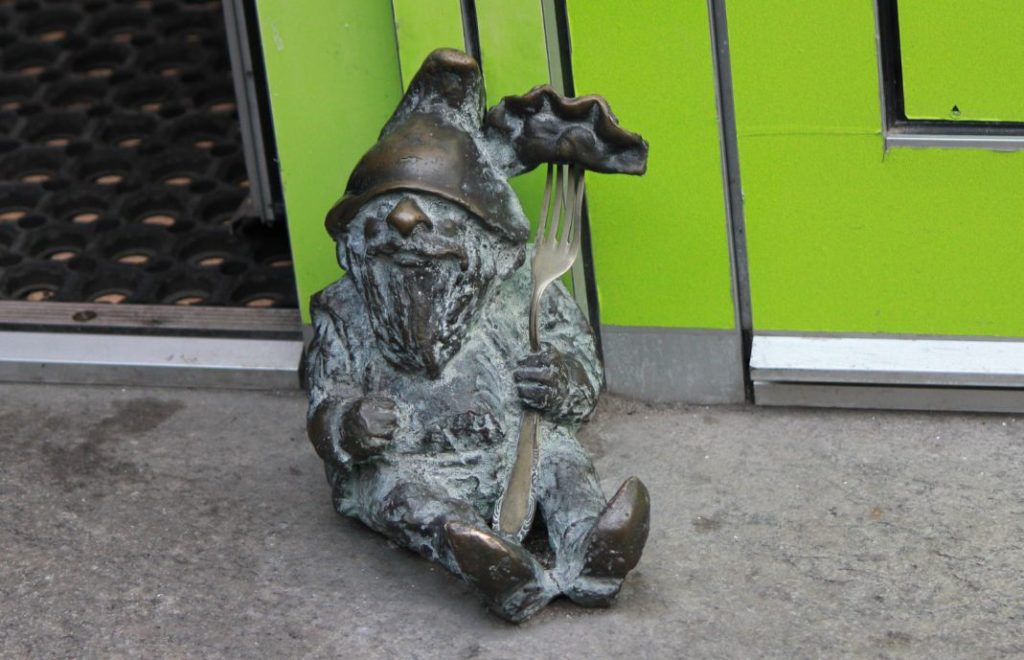
Dumpling: The greedy gourmet of Wrocław
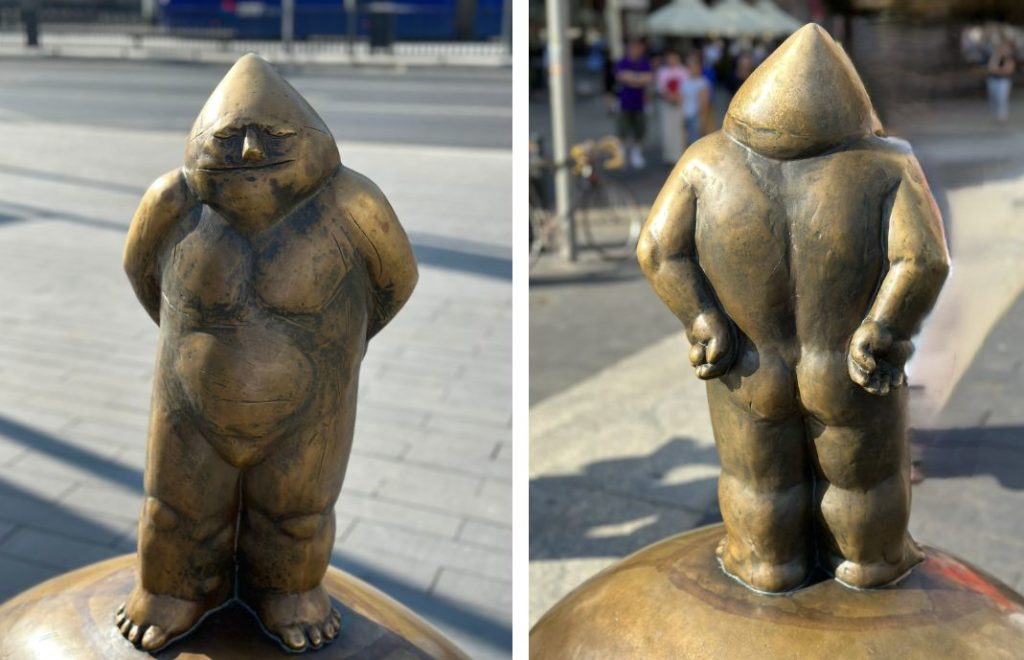
Few dwarves radiate as much pure joy as Pierożnik, also lovingly known as Estepek. With a wide, satisfied grin and a fork always at the ready, he’s one of the happiest little fellows in all of Lower Silesia – and there’s a simple reason why: he loves food. Especially dumplings.
Not just any dumplings, mind you – warm, hand-made pierogi stuffed with savory fillings and topped with golden, caramelized onions. That, in Pierożnik’s opinion, is the pinnacle of culinary bliss.
You’ll find him sitting contentedly outside one of Wrocław’s many restaurants, where the scent of steaming dumplings constantly lures him into a state of culinary ecstasy. He once fancied himself a cook, years ago – but he was so fond of his own food that he’d gobble it all up before it ever reached the guests. Needless to say, his career in the kitchen was short-lived.
Legend has it that the irresistible aroma of Lower Silesian dumplings – especially those filled with meat and cabbage – is what drew him to Wrocław in the first place. And once here, he became a master thief of the most delicious kind. With lightning-fast reflexes and a mischievous grin, he’d snatch dumplings from unsuspecting diners’ plates before they even noticed.
Confused guests began complaining to the staff, asking where their dumplings had gone. The waiters would simply shrug and mutter, “The dwarves…”
Over time, Pierożnik got bolder. He was caught red-handed more than once, fork in hand, scuttling under tables to avoid detection – a cheeky little bandit with an insatiable appetite. Word of the “dumpling dwarf” spread quickly across Wrocław. Guests began guarding their plates with playful suspicion.
But something unexpected happened: people started to love him for it.
Pierożnik’s playful antics and good-natured gluttony brought laughter and delight wherever he went. Locals began sharing their food with him, and tourists lined up to snap photos of the pudgy little dwarf with a dumpling perched on his fork. He became a minor celebrity, pampered and adored by all who crossed his path.
His round belly stands as proof that Pierożnik never goes hungry – nor does he lack attention. Ever the enthusiastic foodie, he happily accepts any invitation to lunch or dinner and spends his spare time watching eating contests (with great admiration, of course).
For Pierożnik, life is simple: Eat well, smile often, and never pass up a good dumpling.
Veteran: A salute in bronze
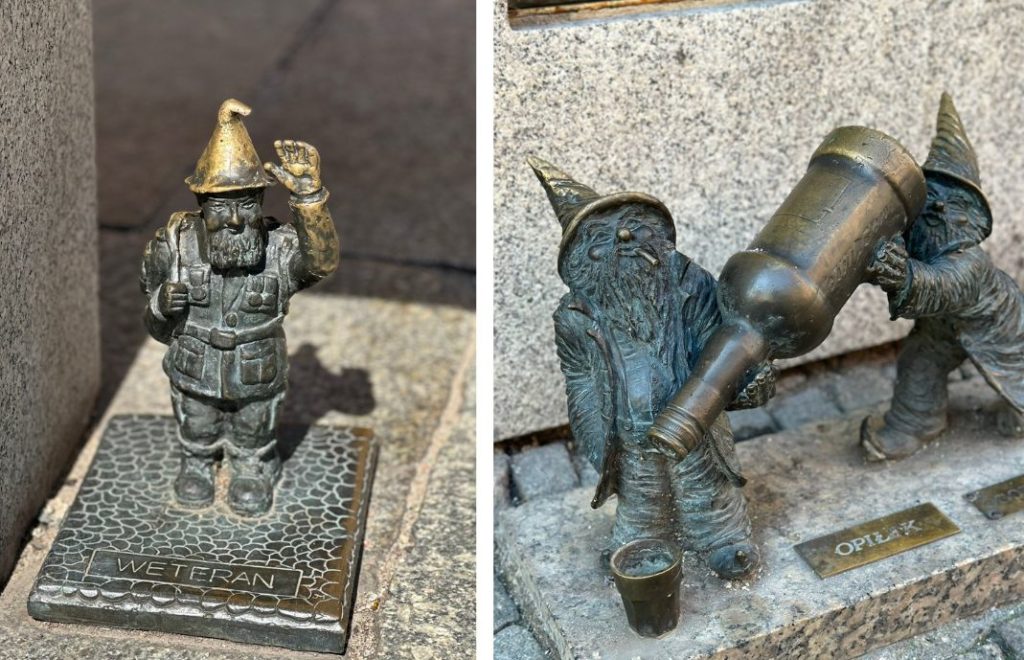
Standing solemnly outside the Church of St. Elizabeth, Weteran serves as a heartfelt tribute to the courage and sacrifice of soldiers everywhere. Unveiled on Veteran’s Day, this dignified dwarf reminds locals and visitors alike to show respect and gratitude to those who have stood on the front lines.
With a proud posture and quiet strength, Weteran isn’t just a statue – he’s a symbol. A reminder that even the smallest among us can carry the weight of bravery. Whether you pause to reflect or offer a silent salute, his presence adds depth and reverence to the heart of Wrocław’s historic center.
Hoocher & Toaster: Wrocław’s wildest pair
Meet Ogorzałek and Opiłek – better known as Hoocher and Toaster – the life of the party among Wrocław’s dwarves. This mischievous duo has made a name for themselves by boldly defying the city’s alcohol laws… one swig at a time.
Unconcerned with rules and regulations, they indulge openly, often seen toasting each other and chuckling in the streets. Their favorite haunt? Św. Mikołaja Street – though it’s also the patrol zone of the ever-watchful City Guards, their sworn nemeses.
Living on the edge, Ogorzałek and Opiłek know the risks, but they live for the thrill. For them, life’s too short not to celebrate – and they do so with a wink, a clink of bottles, and a quick dash if the guards come too close.
Whether you admire their rebellious spirit or just laugh at their antics, one thing’s for sure: these two know how to have a good time.
Taste-Explorer: The gourmet glutton of Wrocław
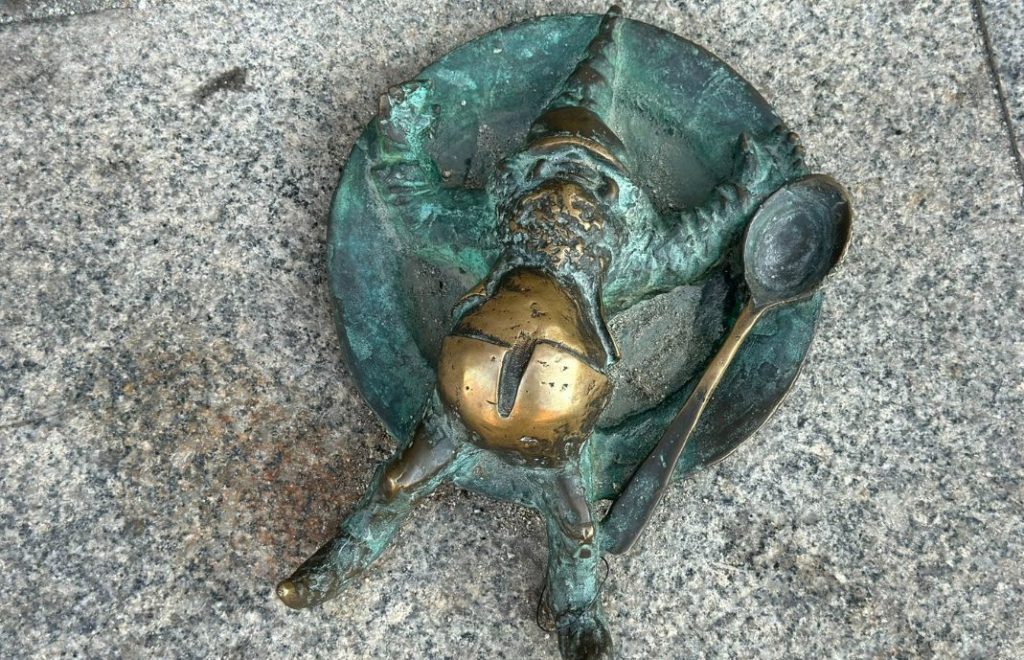
Among all of Wrocław’s famously quirky dwarves, none is quite as indulgent – or as satisfied – as Obieżysmak, the self-proclaimed connoisseur of cuisine. While others may call him a glutton, he prefers the term gourmet. And judging by the way he sprawls contentedly across a plate near Pizza Hut in the Market Square, you’d be hard-pressed to disagree.
With his belly full and a dreamy smile on his face, Obieżysmak spends his days either snoring or planning his next meal. Legend has it he developed his passion for food as a child, lovingly nurtured by his grandmother, who fed him only the finest dumplings, stews, and meats Lower Silesia had to offer.
But Obieżysmak was no ordinary dwarf. While others set off in search of adventure, knowledge, or glory, he set off with a singular purpose: to taste the world – one forkful at a time. After years of roaming the globe on this delicious quest, his heart and stomach led him back home.
Lured by nostalgic memories and the irresistible aromas of Wrocław’s Old Town, he knew he’d found his culinary paradise. The sheer abundance of eateries, cafés, taverns, and street food stands made it clear: this was the place to settle. Without hesitation, he borrowed a plate and spoon from a nearby kitchen and began sampling the city’s best local specialties.
Obieżysmak quickly became a legend – not just for his appetite, but for the joy he radiates. Locals say that rubbing his round belly brings good luck for your own food-filled journey. But beware: his greatest fear is that hungry tourists will eat up all the deliciousness Wrocław has to offer before he can get to it!
For now, you can find him basking in bliss, surrounded by the city’s culinary treasures – a plump and jolly symbol of Wrocław’s tastiest side.
Collector: The Dwarf with a keen eye for coins
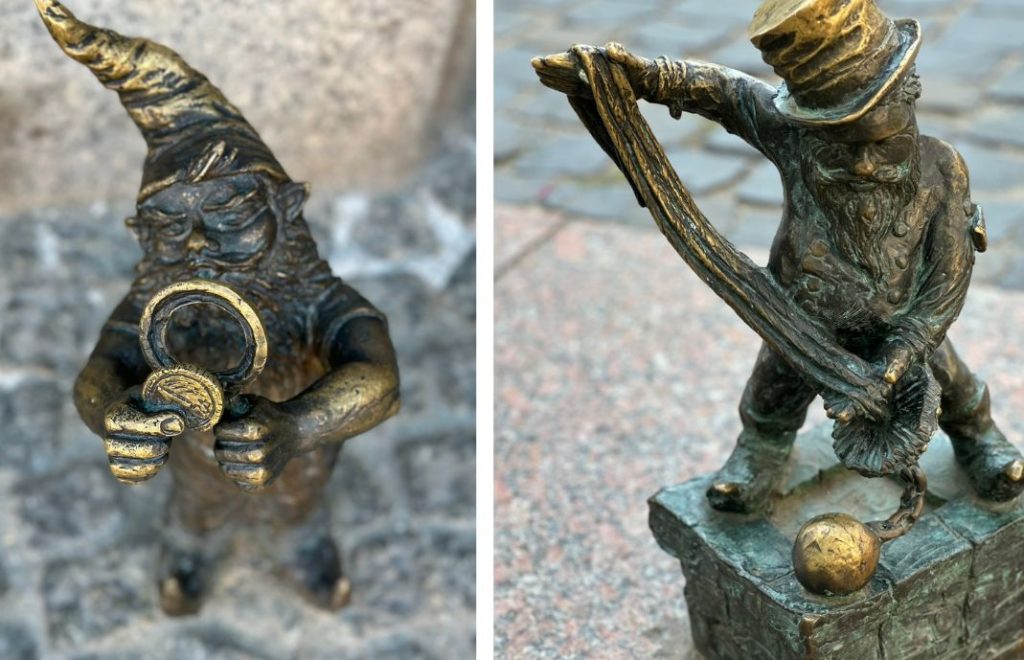
As a young dwarf, Kolekcjoner had a simple passion – he loved collecting hats. But as he grew older and a bit more serious, he turned his attention to something more valuable: coins.
And what a brilliant decision it was.
Now one of Wrocław’s most meticulous little figures, Kolekcjoner spends his days hunched over his prized collection, inspecting each coin through a magnifying glass with intense focus. To him, these tiny treasures hold stories, secrets, and – most importantly – long-term value, especially in uncertain times.
A quiet but dedicated soul, Kolekcjoner has earned a reputation for his patience and sharp eye. Whether it’s a rare historic piece or a shiny new find, no coin escapes his scrutiny.
He may be small, but when it comes to his collection, Kolekcjoner thinks big.
Florianek: The chimney sweep of fortune
Say hello to Florianek – the very first chimney sweep to take on the noble task of keeping Wrocław’s dwarf chimneys clean and soot-free! With his trusty tools and a face smudged with ash, he’s a beloved figure among the city’s tiny residents.
But Florianek isn’t just a hardworking dwarf – he’s also a bringer of luck. Locals and tourists alike know the ritual: if you pass him on Świdnicka Street, don’t forget to give his uniform a gentle rub. It’s said to bring good fortune and a dash of dwarf magic to your day.
Charming, humble, and just a little dusty, Florianek is proof that even the smallest sweep can carry a big bit of luck.
Blacksmith: The silent master of metal
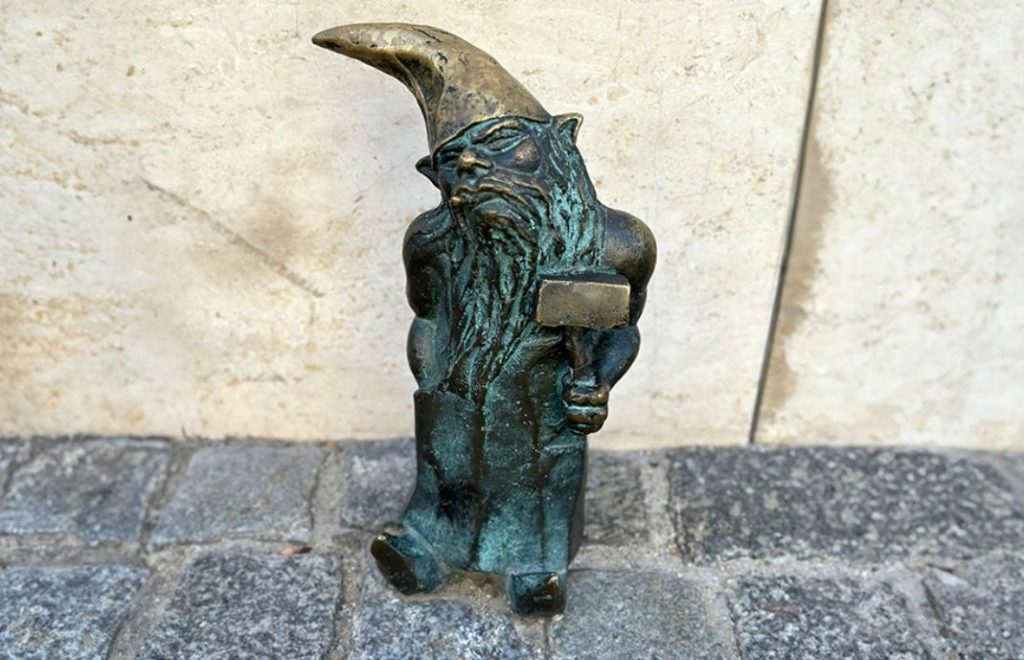
Renowned across Wrocław and beyond, Kowal is far more than a blacksmith – he’s a true artist, turning cold, unyielding metal into objects of rare beauty and exceptional craftsmanship. With nothing but his hammer and chisel, he shapes the finest weapons, armor, and jewelry in the dwarf world.
Unlike many of his adventurous kin, Kowal never left Wrocław to hone his craft. Instead, he studied under the city’s finest local masters, learning the ancient ways of shaping metal with patience, precision, and soul. A rarity among dwarves, he never ventured out in search of knowledge – for everything he needed was right here at home.
Peace and quiet are what he cherishes most. But years of hammering have taken a toll on his hearing, and while silence is no issue for him, solitude has proved more elusive. Even from a young age, word of his talents spread like wildfire. Soon, elegant dwarven ladies were requesting custom rings and brooches, while fierce warriors lined up for indestructible armor and gleaming swords.
At one point, his waitlist stretched for months, and the constant demand became overwhelming. He rarely left his workshop, endlessly toiling to meet the insatiable requests. Despite the chaos, his creations never lost their finesse – each piece a testament to his unmatched taste and technical mastery.
Eventually, the pressure became too much. One morning, Kowal vanished. His workshop stood silent, a note pinned to the door: “I am not here.”
Frustrated customers left empty-handed. The city mourned the absence of its master craftsman. Only a few knew the truth – that Kowal had retreated to the solitude of the mountains, sipping tea with a splash of rum and soaking in the peace he’d long craved.
But true passion never stays dormant for long. After a few years, he realized he missed the fire, the anvil, the spark of creation. He returned to Wrocław, determined to regain control over his life and his craft.
Upon reopening his workshop near the jewelry store on Kuźnicza Street, he implemented new rules – engraved in copper and nailed to the door. No more drop-ins. No customers in his tiny mousehole-sized apartment above the forge. All orders must be submitted in writing to his secretary, who would handle payments and deadlines.
The demand gradually eased, but Kowal didn’t mind. He welcomed the slower pace, the fewer interruptions. And yet, there’s never a shortage of requests – particularly from stylish dwarven ladies eager for dazzling, one-of-a-kind pieces.
Today, Kowal enjoys a calmer, more balanced life. He even has time for short walks now and then – without being mobbed by hopeful clients. If you’re lucky, you might spot him strolling Kuźnicza Street, soot-streaked and serene, the master of metal enjoying a well-earned breath of fresh air.
Pole-Climbers: The high-flying watchers of Wrocław
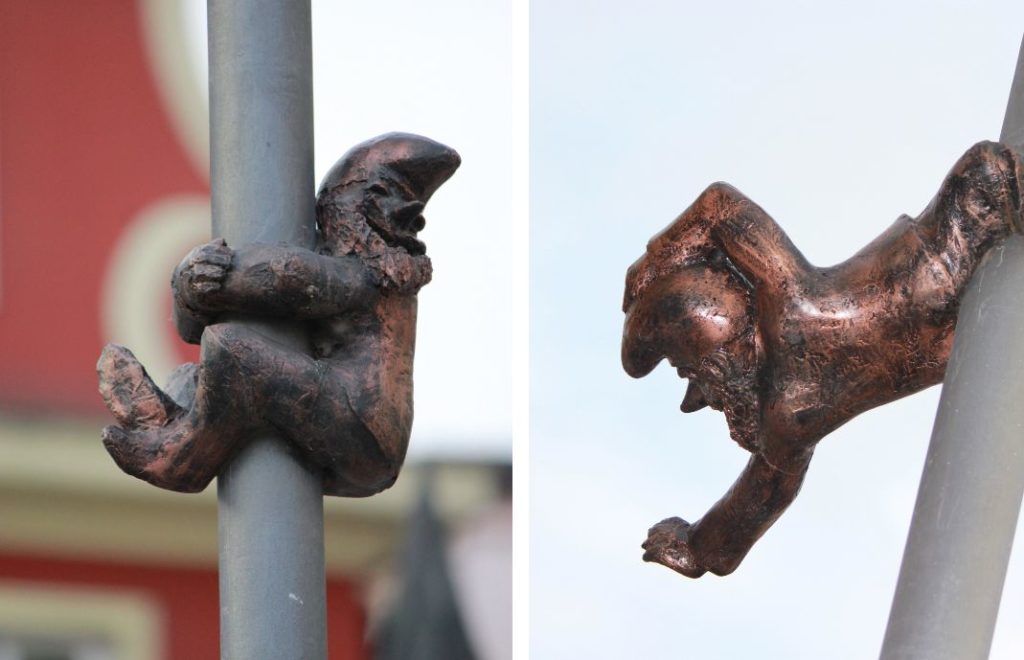
Perched high above street level, the Słupniki – also known as the Pole-Climbers – are a pair of daring dwarves who’ve taken their love of adventure to new heights. Literally.
According to legend, one day they scrambled up a pair of lamp posts on Świdnicka Street simply because they were curious. They wanted to see the world from above – and once they did, they liked it so much, they never came back down.
From their lofty perches, they became the eyes of the dwarf community. They report everything they see – unusual happenings, exciting events, or any sign of trouble. But let’s be honest, they mostly just have fun.
Their favorite pastime? Climbing, of course. And a bit of people-watching. They especially enjoy counting how many ladies in hats stroll by each hour.
Their elevated outposts have made them something of a rarity – not because dwarves don’t enjoy fun, but because most of them suffer from terrible fear of heights. It’s probably for the best; otherwise, Wrocław’s lamp posts might be completely overrun. This way, tourists don’t have to crane their necks at every corner to spot a dwarf.
To find these playful climbers, take a stroll down Świdnicka and Oławska Streets – and don’t forget to look up. The Słupniki are always watching, grinning, and counting from above.
Couch-Potato: Wrocław’s master of doing nothing
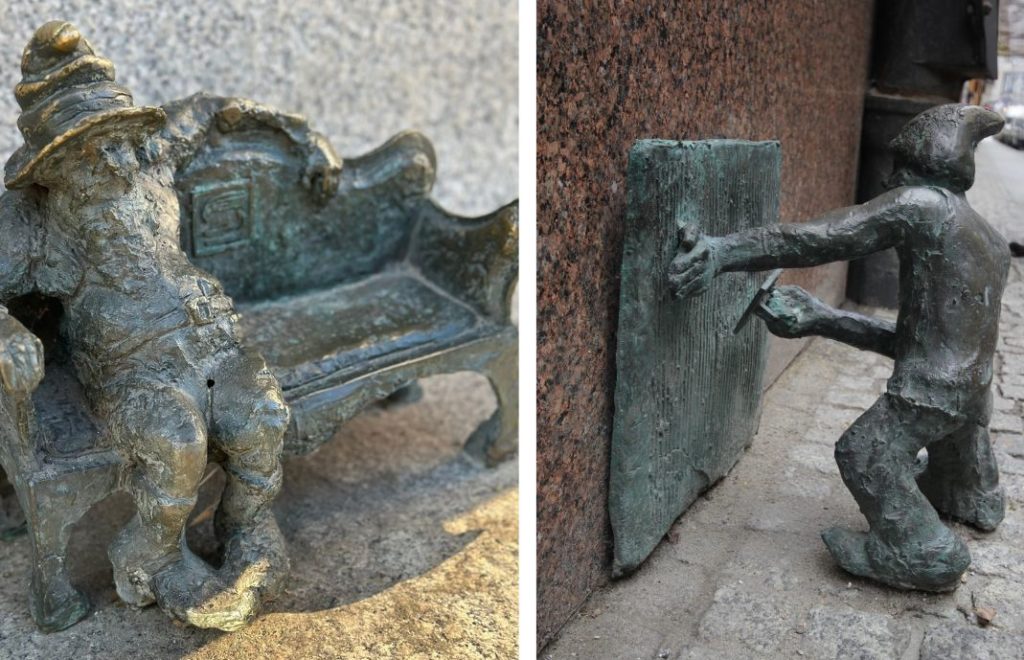
If there were a medal for laziness, Kanapownik would wear it proudly – from the comfort of his beloved armchair, of course.
This laid-back dwarf has absolutely no interest in the hustle and bustle of everyday life. From dawn till dusk, he lounges in his cozy seat, watching the endless stream of passersby with a puzzled expression, wondering why everyone is always in such a rush.
Kanapownik loves his couch more than anything in the world. It’s his throne, his sanctuary, his everything. And don’t even think about joining him – that seat is strictly one-dwarf-only.
While others run off on quests or tinker away in workshops, Kanapownik has embraced the simple life. No pressure. No plans. Just peace, people-watching, and perhaps the occasional nap.
After all, someone has to remind the world that doing nothing is sometimes the most restful rebellion of all.
TynQuś: The patch-up pro with a sculptor’s soul
TynQuś has long held the honorary title of “Dwarf of the Week” – and for good reason. He’s the one tirelessly repairing cracked plaster, chipped walls, and every structural flaw Wrocław’s historic heart can throw his way. If it’s broken, TynQuś is already halfway through fixing it.
When the authorities ordered several entrances to the dwarves’ underground realm to be sealed for safety reasons, it was TynQuś who got the job. Day after day, he’s seen diligently working, observed with admiration (and a bit of curiosity) by both locals and tourists.
Some grumble that the little worker is “growing tired of it all,” but his fellow dwarves firmly disagree. According to them, TynQuś never fails to deliver – always thorough, always reliable, always precise.
But there’s more to this humble craftsman than meets the eye. Hidden beneath his cement-speckled clothes lies a dreamer. Few know that TynQuś once aspired to be an artist. Sculpture was his passion – a world of shapes, forms, and imagination. Life, however, nudged him toward a more practical profession. Still, he never completely let go of that dream.
When no one is watching, he secretly sculpts – a quiet pursuit that brings him joy and balances the demands of his day job. Though his career took a different turn, his artistic heart continues to shape the world – just in a slightly dustier, more hands-on way.
So next time you pass a newly patched wall in Wrocław, spare a thought for TynQuś: the hardworking dwarf who builds with his hands, but dreams in stone.
Player & Music-Lover: Wrocław’s most enthusiastic – street musicians
Few duos in Wrocław are as charming (or as delightfully off-key) as Grajek and Meloman – two inseparable friends bound by an unwavering love of music… and a tragic lack of musical ability.
Their story begins long ago, in the days when a legendary bard named Beth Hoven traveled from city to city, enchanting dwarves with his songs. When he arrived in Wratislava (now Wrocław), the excitement was electric. Dwarves packed the square to hear his performance, but the crowd was so loud and dense that only those up front could catch his melodies.
Among them were two young, wide-eyed dwarves – Grajek and Meloman – instantly captivated and convinced that music was their destiny. They begged the bard to stay and teach them. Amused and well-compensated, Hoven agreed.
But the lessons were… catastrophic.
Meloman, it turned out, was hard of hearing and couldn’t play a single note on any instrument. Grajek had a speech disorder and a singing voice best described as howling. To make matters worse, neither had the faintest sense of pitch or rhythm. Despite the bard’s most valiant efforts, nothing helped. Eventually, on the brink of a nervous breakdown, Hoven fled the city under the cover of night – and never returned.
The duo, blissfully unaware that they were the reason their idol vanished, pressed on. They sought guidance from Wrocław’s street musicians – all of whom, mysteriously, always found a reason to avoid teaching them. Undeterred and brimming with confidence, Grajek and Meloman took their talents on the road.
What happened on their world tour remains a mystery. What we do know is this: when they returned, they were rich. Some say people paid them enormous sums just to stop singing. Others claim they were highly effective pest control – paid handsomely to chase rats (and humans) away with their music.
Now back in Wrocław for good, Grajek and Meloman have made Oławska Street their stage, performing with boundless enthusiasm outside the florist’s window. Grajek strums his mandolin with dramatic flair and lets out sorrowful wails, while Meloman – who still can’t play a note – keeps rhythm with confident, tuneless mumbling.
Despite their musical shortcomings, they’ve won the hearts of the city. Whether you laugh, wince, or tap your foot out of sheer confusion, one thing is certain: Grajek and Meloman perform with more heart than half the orchestras in Europe.
And really, isn’t that what music is all about?
Source: Visit Wroclaw
Has the dwarfs inspired you to visit Wroclaw? If not, here are some more inspiration:
7 very good reasons to visit Wroclaw
Dwarf hunting in Wroclaw – Catch them all!
11 reasons Wrocław is Poland’s best-kept secret
