
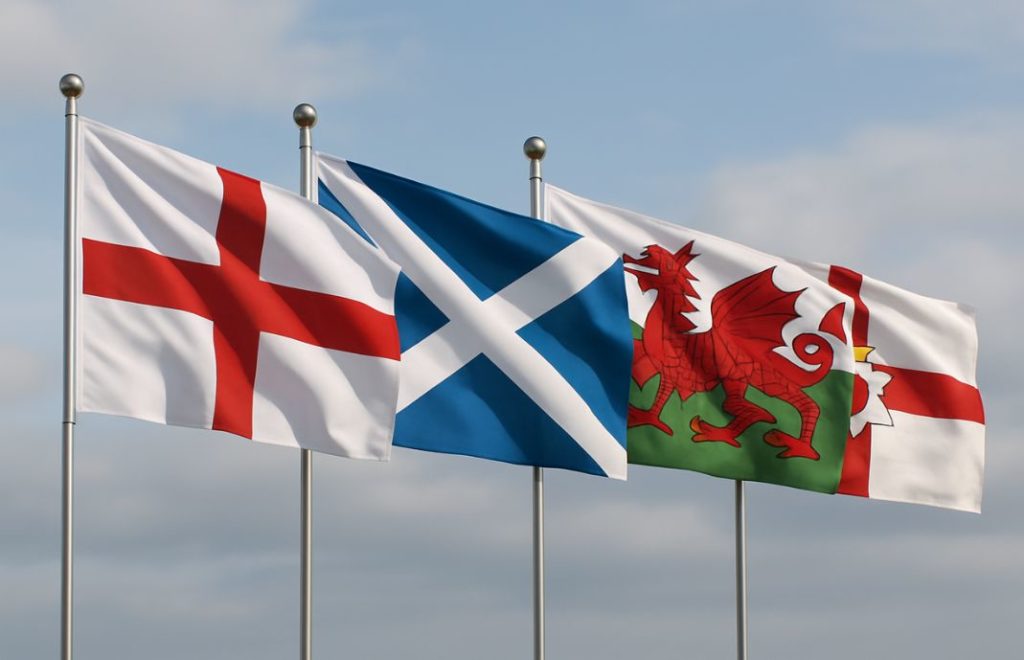
Across the windswept hills of Britain and the emerald valleys of its isles, four flags rise against the sky – each whispering its own story. They are more than cloth and color; they are echoes of battles won, legends born, and the enduring spirit of four nations bound by history yet fiercely proud of their individuality.
England’s red cross unfurls with medieval valor. Scotland’s saltire gleams like a northern star. Wales’s dragon breathes fire from ancient myth. Northern Ireland’s red hand marks resilience amid centuries of change. Together, they form a tapestry of identity – woven from faith, folklore, and the unyielding desire to belong.
In the heart of the United Kingdom, these flags are not just symbols – they are storytellers. Let us wander through their origins and meanings and discover how each one came to wave proudly in the winds of time.
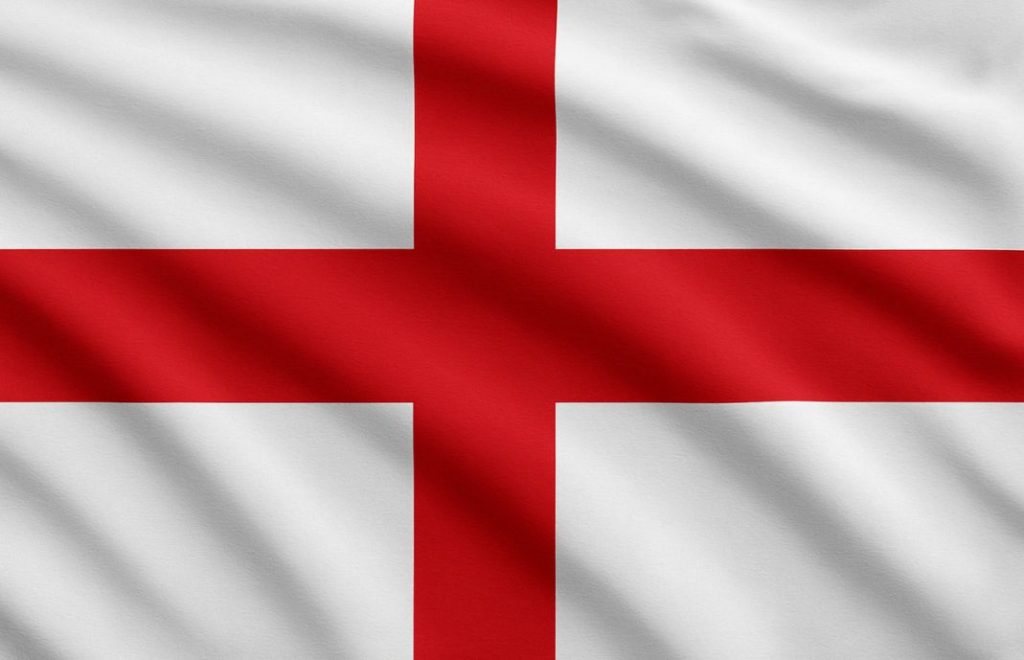
England – The Cross of Saint George
Bold and unmistakable, England’s flag is a simple red cross upon a field of white. Yet within its stark geometry lies nearly a millennium of legend and identity. Known as the Cross of Saint George, it has long stood as a symbol of courage, faith, and the English spirit itself.
The story begins in the Middle Ages, when Saint George, a Christian martyr and soldier of the Roman Empire, became England’s patron saint. His tale – of slaying a dragon to rescue the innocent – captured the medieval imagination, embodying ideals of bravery and righteousness. By the 12th century, the red cross of Saint George had become associated with English knights embarking on the Crusades, a badge of devotion and unity beneath the banner of Christendom.
By the 13th century, the emblem was firmly entwined with English identity. King Edward I adopted the red cross as a national symbol. By the 14th century, it was flying above royal ships and fortresses. Over time, its spiritual origins gave way to patriotic meaning: a sign not only of divine protection, but of the English nation itself.
Today, the flag of England represents heritage, resilience, and pride. It flutters above cricket pitches and cathedrals alike, uniting the old and the modern under its enduring simplicity. Though its origins lie in ancient faith and chivalric legend, the Cross of Saint George remains, at heart, a declaration – that from humble design can rise the most powerful of symbols.
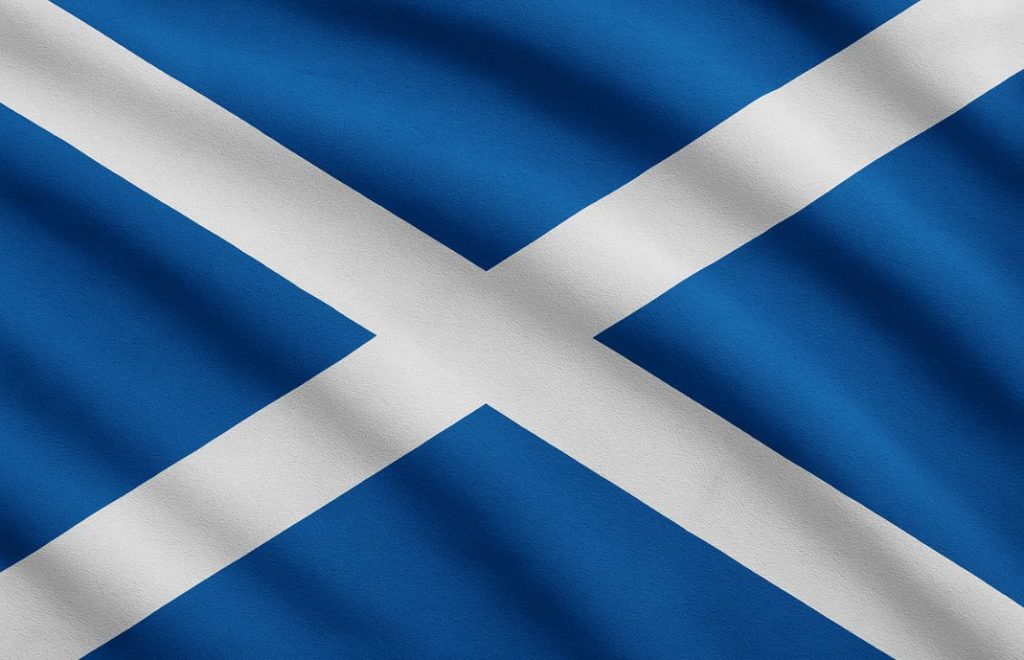
Scotland – The Saltire of Saint Andrew
Graceful and resolute, the flag of Scotland – the Saltire or Saint Andrew’s Cross – is among the oldest national flags in the world. A white diagonal cross stretched across a field of blue sky, it embodies faith, endurance, and the quiet strength of a proud nation.
Legend tells that in 832 A.D., on the eve of battle near modern-day Athelstaneford, the Pictish King Óengus II faced a formidable Northumbrian army. As dawn broke, a vision appeared in the heavens – a white cross shining against the blue sky. It was the symbol of Saint Andrew, one of Christ’s apostles and later Scotland’s patron saint. Interpreting the vision as a sign of divine favor, the Scots charged forward and triumphed. In gratitude, they adopted Saint Andrew’s white cross as their emblem.
Through the centuries, the Saltire became inseparable from Scotland’s identity. It flew above medieval castles, sailed with explorers, and inspired generations who sought independence and self-determination. When the kingdoms of Scotland and England united in 1606, the Saltire was woven into the design of the Union Flag, ensuring that Scotland’s spirit remained visible in the fabric of the United Kingdom.
Today, the blue and white of the Saltire ripple across Highland glens, city skylines, and sporting arenas – a reminder of faith, resilience, and an enduring pride in Scotland’s heritage. It is not merely a banner, but a fragment of the sky itself – a promise written in wind and legend.
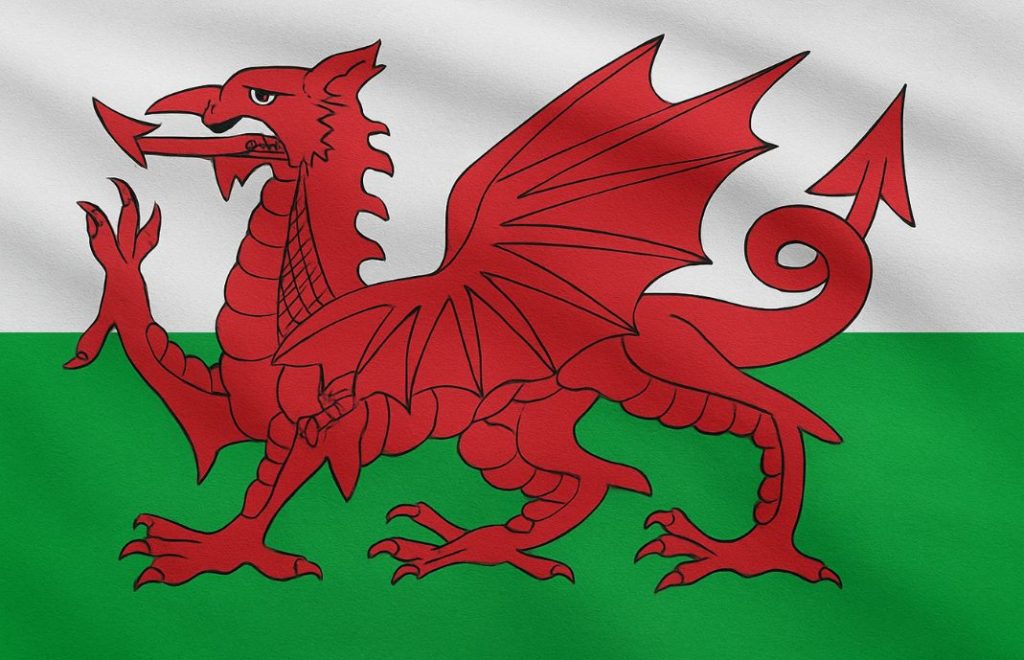
Wales – The Red Dragon of Cadwaladr
Few flags in the world are as striking – or as steeped in legend – as the flag of Wales. Against a field of white and green strides a fierce red dragon, wings outstretched and claws poised mid-roar. Known as Y Ddraig Goch, “the Red Dragon,” this emblem embodies the fire and defiance of the Welsh spirit. It’s a symbol born from myth, shaped by history, and still burning bright today.
The dragon’s story reaches deep into Celtic mythology. It appears in the Mabinogion, Wales’s ancient tales, and in the legend of Merlin, who foretold a battle between a red dragon and a white one. The red representing the native Britons, the white the invading Saxons. When the red dragon triumphed, it became a prophecy of Welsh endurance and victory over oppression.
Centuries later, the symbol was embraced by Cadwaladr, a 7th-century King of Gwynedd, whose red dragon standard became an emblem of royal lineage and resistance. In medieval times, Welsh princes carried the dragon into battle, its fiery image inspiring courage and unity.
The modern flag – green and white beneath the crimson dragon – was officially recognized in 1959, though its roots stretch back over a thousand years. The green and white are thought to represent the Tudor dynasty, the Welsh-born rulers who once sat upon England’s throne.
Today, the flag of Wales flies proudly across castles and coastlines, festivals and football grounds. It is a banner of passion and poetry – a creature of legend that still guards the heart of a nation.
Northern Ireland – The Red Hand and the Star of Ulster
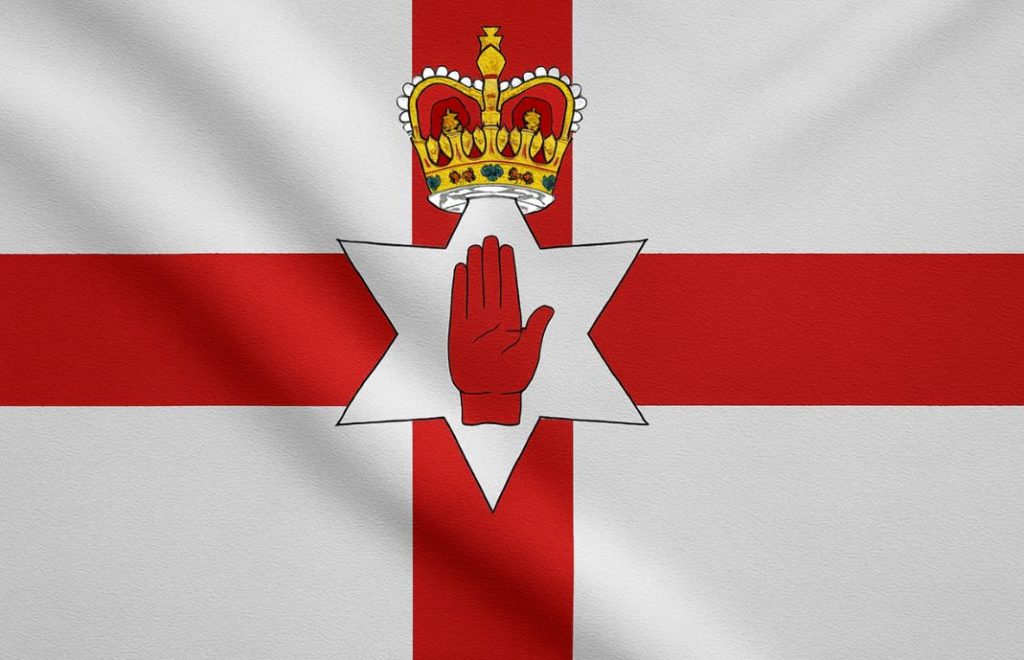
Among the flags of the United Kingdom, Northern Ireland’s is the most complex – a reflection of its layered history and evolving identity. The flag most often associated with Northern Ireland is the Ulster Banner, a white field bearing a red cross, a six-pointed star, a red hand at its heart, and a crown above – each element steeped in centuries of symbolism and story.
The red cross comes from the flag of Saint George, echoing the English influence that shaped Ireland’s history. At its center lies the Red Hand of Ulster, a symbol older than kingdoms and crowns. Legend tells of two chieftains racing to claim the land of Ulster; the first to touch its shore would become its ruler. As their boats drew near, one chieftain – realizing he was losing – cut off his hand and flung it onto the shore, claiming victory through sacrifice and determination. Thus, the red hand became a sign of courage and sovereignty, an enduring emblem of the ancient province of Ulster.
The six-pointed star represents the six counties that make up Northern Ireland, while the crown above it signifies loyalty to the British monarchy. The Ulster Banner itself was officially used by the Government of Northern Ireland from 1953 to 1972, after which it lost official status when the government was dissolved. Yet, even today, it continues to appear at sporting events and cultural gatherings, symbolizing a shared – if complex – heritage.
In Northern Ireland, identity is woven from many threads: Irish and British, ancient and modern, sacred and political. The Red Hand endures as a reminder of strength and sacrifice – an emblem as fierce and human as the land it represents. Though the Ulster Banner no longer flies from government buildings, its spirit remains alive in the hearts of those who call this remarkable corner of the world home.
Four flags, one story
From England’s crimson cross to Scotland’s silver saltire, from Wales’s roaring dragon to Northern Ireland’s storied red hand – the flags of the United Kingdom are more than symbols fluttering in the wind. They are living emblems of identity, each born from legend and shaped by centuries of history, faith, and resilience.
Together, they tell the story of a union that is not uniform but beautifully diverse – four nations, each with its own heart and heritage, intertwined by shared destiny. Their colors and crosses, dragons and stars, speak to both the struggles and the triumphs that forged them.
Across castles and cathedrals, mountains and moors, these flags still rise – proud against grey skies and golden dawns alike. They remind us that history is not something we leave behind, but something that continues to wave above us, urging us to remember who we are and where we came from.
In the tapestry of the United Kingdom, every flag is a thread – distinct, vibrant, and essential. And when they come together, they tell a story that is at once ancient and alive – the story of a kingdom united in its diversity, and of nations whose pride will forever fly free.
