
What could a tropical island paradise, a Hawaiian king, and the British Union Jack possibly have in common?
Well, the answer is Hawaii’s rather extraordinary state flag.
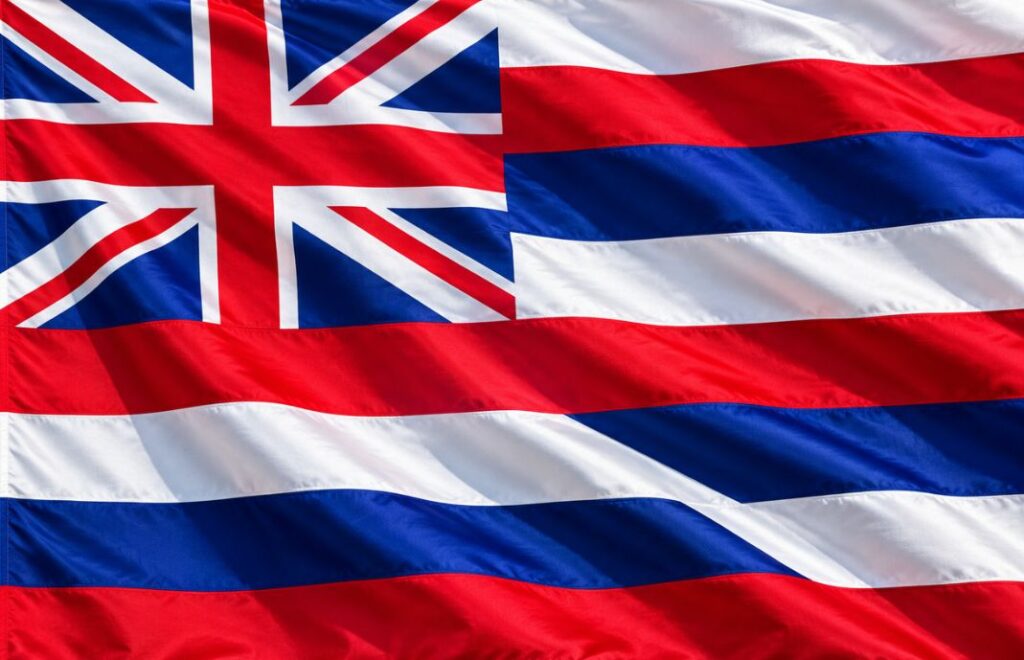
With its eight horizontal stripes of red, white, and blue and the unmistakable British Union Jack in the upper-left corner, Hawaii’s flag looks quite different from those of the other American states.
Here’s the first surprise: Hawaii is the only American state whose flag incorporates the British national flag.
But why would an American state display such a prominent British symbol?
To understand that we need to travel back to the early nineteenth century, when Hawaii wasn’t part of the United States at all.
In fact, it was an independent kingdom.
The story begins with King Kamehameha I, the remarkable Hawaiian ruler who united the islands under his authority by 1810.
During this period, Hawaii was developing relationships with foreign powers, particularly Britain and the United States.
British naval officer Captain George Vancouver had visited the islands in the 1790s and developed a relationship with Kamehameha. According to historical accounts, Vancouver presented the king with a British flag.
And that British connection eventually found its way into Hawaii’s own national banner.
But why eight?
The Hawaiian flag is traditionally associated with Kamehameha’s reign, although the precise circumstances surrounding its original design remain uncertain.
The familiar arrangement of eight stripes was standardized in 1845, during the reign of King Kamehameha III.
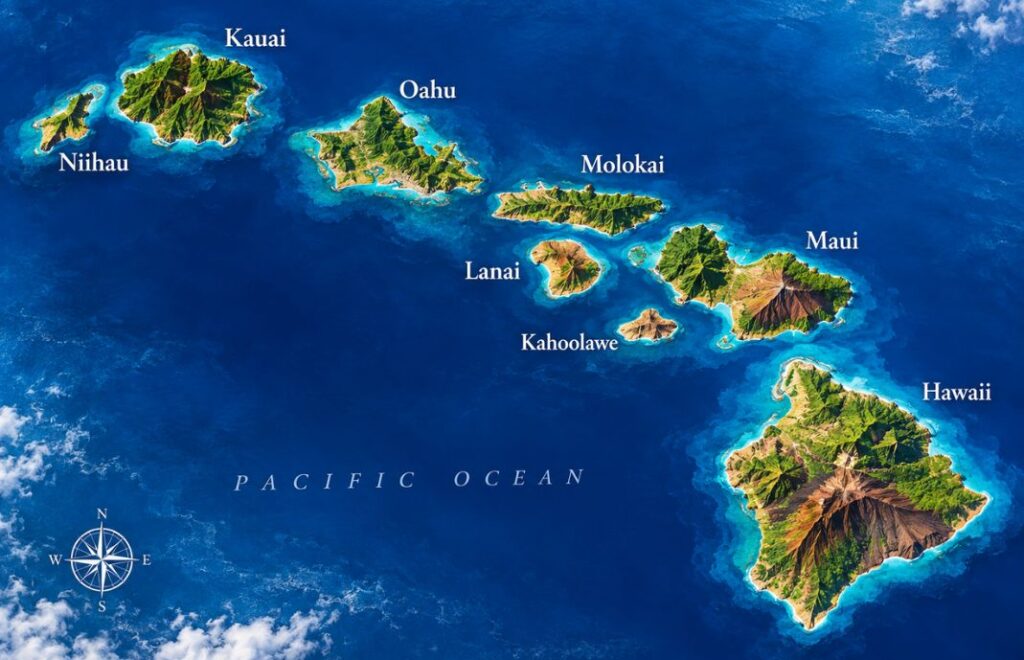
The stripes are traditionally said to represent Hawaii’s eight major islands: Hawaii, Maui, Oahu, Kauai, Molokai, Lanai, Niihau, and Kahoolawe.
Here’s where the story becomes particularly fascinating.
Hawaii’s flag has represented several different forms of government without losing its familiar appearance.
It flew during the days of the Hawaiian Kingdom, when the islands were ruled by a monarchy.
Then came one of the most dramatic chapters in Hawaiian history.
In 1893, Queen Liliuokalani, Hawaii’s last reigning monarch, was overthrown by a group backed by powerful business interests, with the involvement of American military forces.
The Hawaiian monarchy came to an end, and a republic was established the following year.
In 1898, the United States annexed Hawaii, which became an American territory in 1900.
But remarkably, the Hawaiian flag survived all these political changes!
And when Hawaii officially became America’s 50th state on 21 August 1959, the familiar red, white, and blue banner remained.
A flag created during the days of an independent Pacific kingdom was now representing the newest state of the United States.
There’s another lovely detail
The flag is known in Hawaiian as Ka Hae Hawaiʻi, meaning the Hawaiian flag.
For many Native Hawaiians, it remains an important symbol of the islands’ history, cultural identity, and former sovereignty.
So, from Hawaiian kings and British naval officers to the overthrow of a monarchy and America’s 50th state, Hawaii’s flag has witnessed an extraordinary journey.
And perhaps that’s what makes it so special.
While most American state flags tell stories about their states’ history within the United States, Hawaii’s flag reminds us that these beautiful Pacific islands once formed an independent nation with a remarkable history of their own.
Eight islands, eight colorful stripes, and one very unexpected British connection. Now that’s a flag with a story worth telling.
