America’s Midwest is often called the nation’s heartland, a place of endless cornfields, hardworking communities, mighty rivers, and vast freshwater lakes. But beneath its seemingly peaceful landscapes lies a colourful history of ambition, determination, innovation, and occasionally a little rebellion.
Believe it or not, some of those stories are proudly displayed on the region’s state flags.
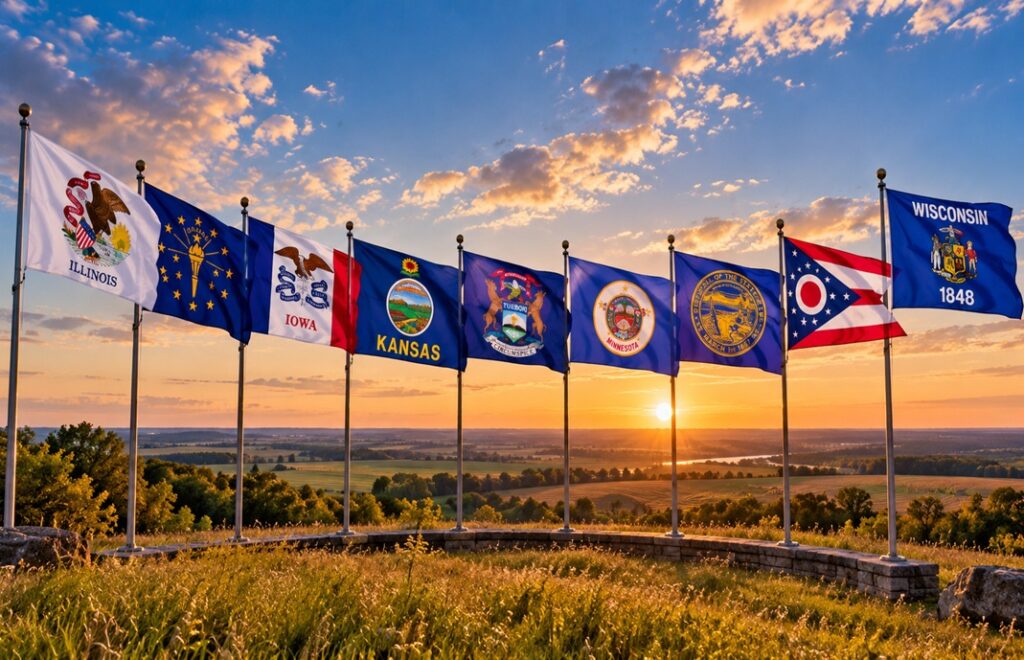
Take Ohio, for example. Apparently, an ordinary rectangular flag simply wasn’t interesting enough. Minnesota, meanwhile, has given its flag a complete makeover, replacing an elaborate historical design with something inspired by the North Star. Then there is Wisconsin, whose flag celebrates everything from mining and farming to life on the water.
Elsewhere, eagles spread their wings, bison make an appearance, and symbols of agriculture and industry remind us how important this region has been in shaping the United States.
Some of these flags have barely changed in more than a century, while others have been redesigned to reflect a changing understanding of state identity. A few are wonderfully simple, and others contain so many details that you might need a magnifying glass to appreciate them all!
But that is part of the fun.
Behind every design lies a story about the people who created it, the events they wanted to remember, and the values they hoped would represent their home.
So, let’s explore the flags of Illinois, Indiana, Iowa, Kansas, Michigan, Minnesota, Nebraska, Ohio, and Wisconsin.
Nine states, nine distinctive designs, and a fascinating journey through the history and character of America’s heartland.
Because sometimes, understanding a destination begins with discovering the stories it chooses to talk about itself.
Illinois: An eagle, a motto, and a little controversy
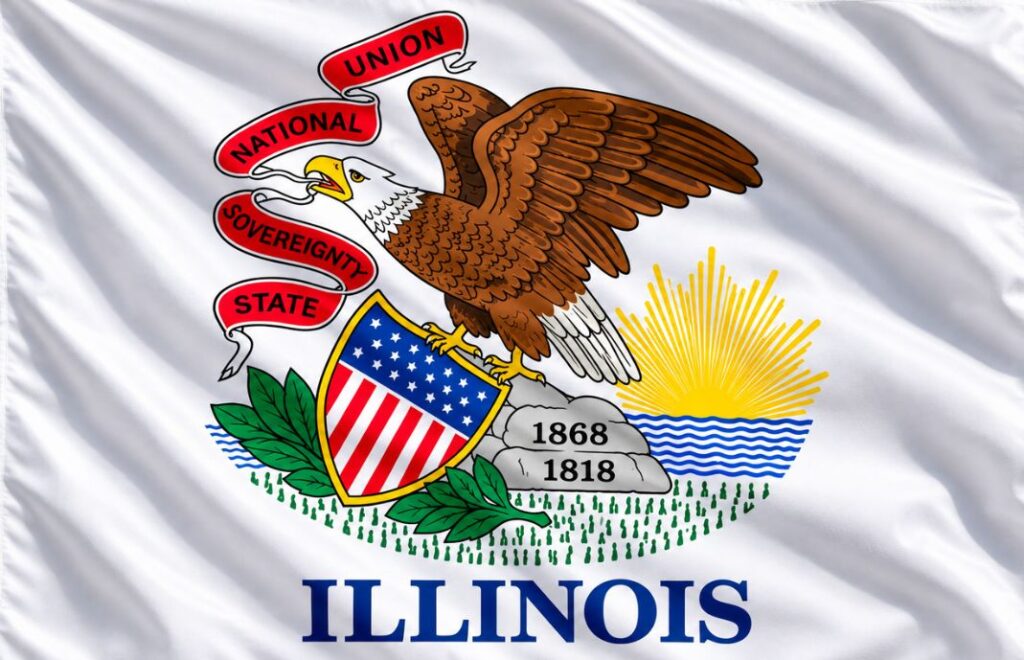
An American eagle, a collection of stars, and a motto with a rather interesting history. Illinois certainly has plenty to discover on its state flag.
Against a white background sits the state seal, featuring a bald eagle holding a ribbon with the words “State Sovereignty, National Union.”
But here’s something surprising.
During the Civil War era, Illinois’s secretary of state suggested reversing the motto to place national unity first. Although the words remained unchanged, the ribbon’s arrangement gave the motto a rather unusual appearance.
Here’s another interesting detail: Illinois voters approved a new flag design in a statewide vote in 2025, but the current flag was ultimately retained.
Indiana: A torch that lights the way
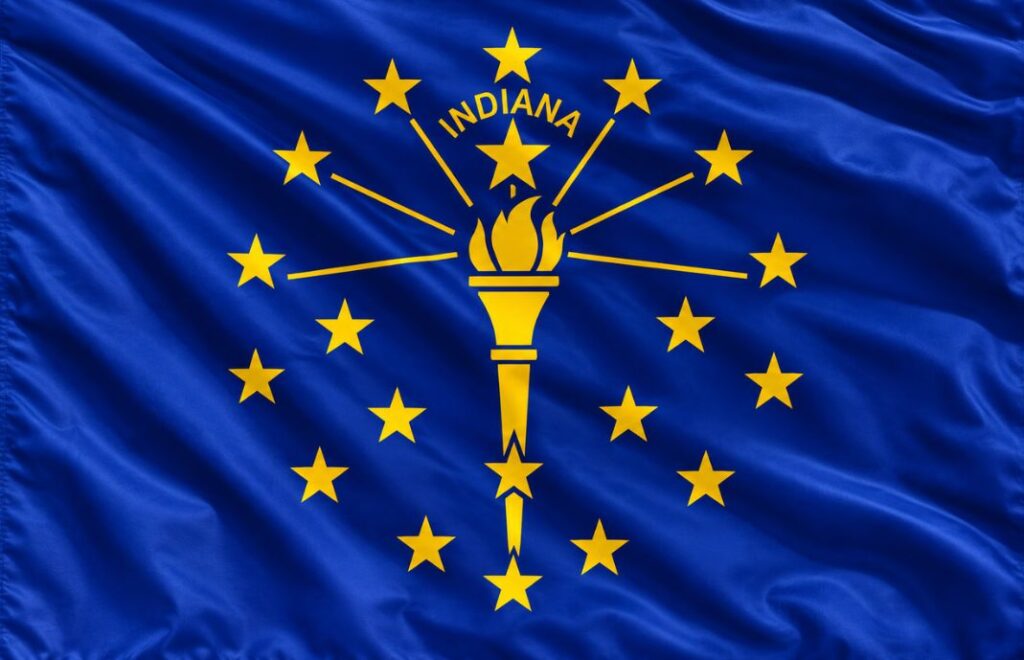
A golden torch surrounded by nineteen stars might seem like a simple design, but Indiana’s state flag carries a powerful message.
Against a deep-blue background, the torch represents liberty and enlightenment, while its golden rays symbolize the influence of knowledge and freedom.
The nineteen stars commemorate Indiana becoming America’s 19th state in 1816.
But here’s something interesting.
The flag was designed by Paul Hadley, an artist from Mooresville, who won a statewide competition in 1916 to celebrate Indiana’s centennial.
His beautifully simple creation was officially adopted in 1917 and remains one of the Midwest’s most recognisable flags.
Iowa: A little French inspiration in America’s Heartland
What does the American Midwest have in common with the French national flag? More than you might expect.
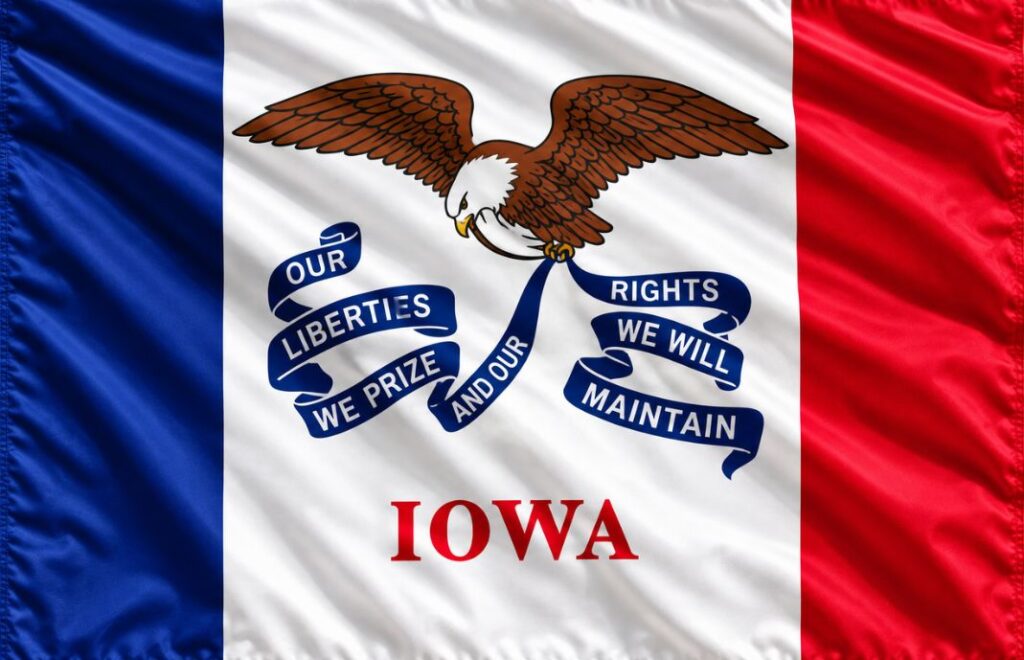
Iowa’s flag features three vertical stripes of blue, white, and red, reflecting the state’s historical connection to France.
In the center, a magnificent bald eagle carries a ribbon displaying the motto “Our Liberties We Prize and Our Rights We Will Maintain.”
But here’s a wonderful detail.
The flag was designed by Dixie Cornell Gebhardt, a member of the Daughters of the American Revolution, during the First World War.
Officially adopted in 1921, her design celebrates both Iowa’s American identity and its French colonial heritage.
Kansas: Sunflowers, stars, and the spirit of the Frontier
Sunflowers, a magnificent prairie landscape, and thirty-four stars. Kansas has managed to capture quite a bit of its history in one colorful flag.
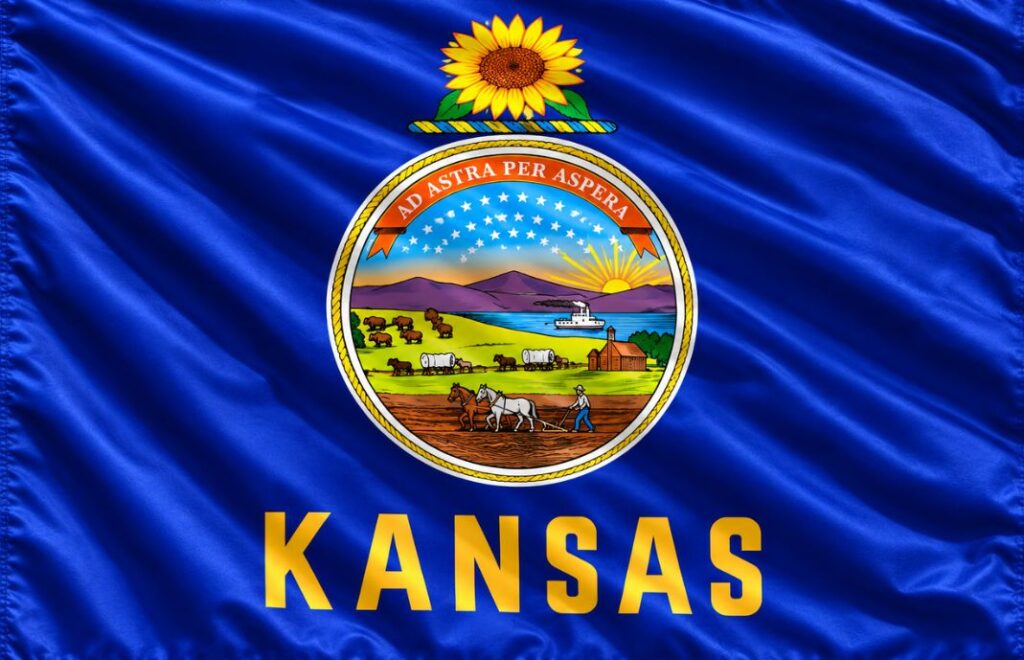
Against a deep-blue background sits the state seal, featuring a rising sun, a farmer, a wagon train, and thirty-four stars, representing Kansas becoming America’s 34th state in 1861.
Above the seal is a beautiful sunflower, celebrating Kansas’s famous nickname, the Sunflower State.
But here’s an interesting detail.
The Latin motto “Ad Astra Per Aspera” means “To the Stars Through Difficulties,” reflecting the challenges faced during the state’s early history.
Michigan: A moose, an elk, and three Latin mottos
A moose, an elk, and not one but three Latin mottos. Michigan’s state flag certainly doesn’t lack personality.
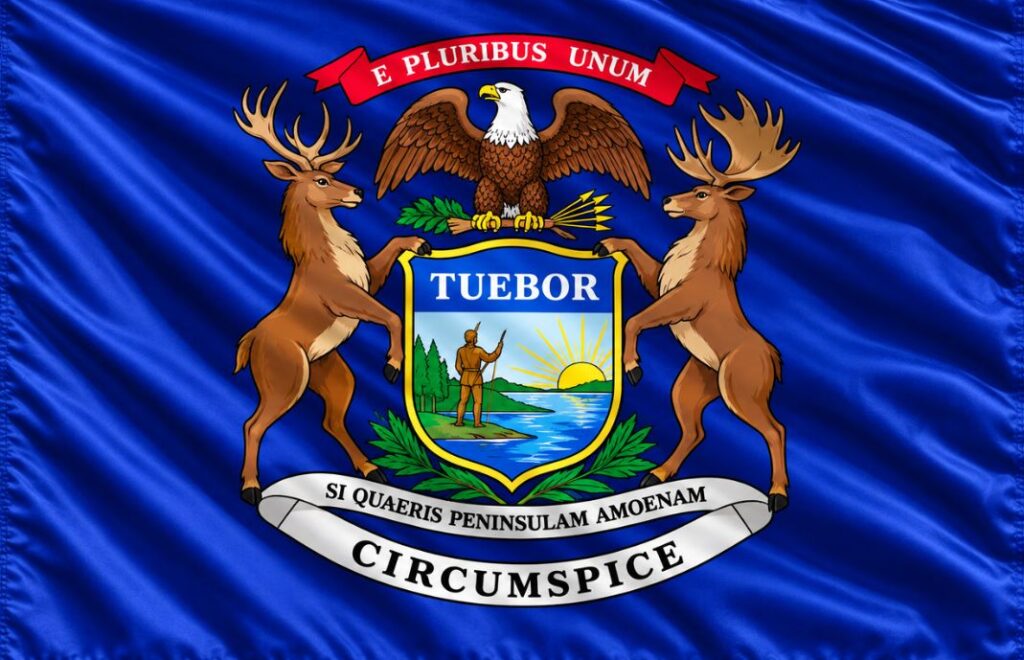
Against a deep-blue background sits the state’s elaborate coat of arms, featuring two magnificent animals supporting a shield depicting a peaceful lakeside landscape.
Above them, an American eagle celebrates Michigan’s place in the United States.
But here’s something fascinating.
One of the flag’s Latin mottos translates to “If You Seek a Pleasant Peninsula, Look About You.”
And considering Michigan’s spectacular Great Lakes, forests, and beautiful shorelines, it’s a rather fitting description.
Minnesota: A new star for the North Star State
Minnesota’s flag has undergone one of the most dramatic transformations in recent American flag history.
Adopted on 11 May 2024, the new design features a dark-blue shape representing Minnesota’s outline, a white eight-pointed North Star, and a light-blue field celebrating the state’s abundant lakes and waterways.
It’s a striking departure from the previous flag, which featured an elaborate state seal.
But here’s something particularly interesting.
The redesign followed years of discussion about the old flag’s imagery and its representation of Indigenous peoples.
And the result is a beautifully simple design celebrating Minnesota’s identity as the North Star State.

Nebraska: A journey through the American Frontier
A blacksmith, a steamboat, and a train travelling across the prairie. Nebraska’s state flag is practically a miniature history lesson.
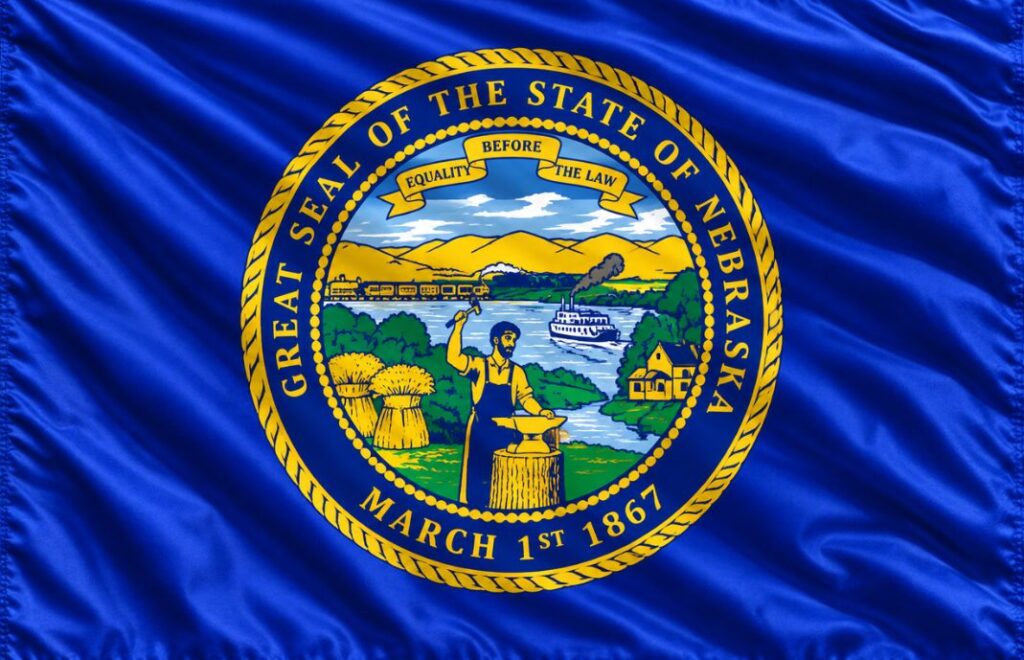
Against a deep-blue background sits the state seal, celebrating the industries and transportation routes that helped shape Nebraska’s development.
The design features a blacksmith working at an anvil, a steamboat on a river, and a railway crossing the landscape, alongside scenes of agriculture.
But here’s a curious detail.
Nebraska was one of the last American states to adopt an official state flag, approving its design in 1925.
Its motto, “Equality Before the Law,” reflects an important principle in the state’s identity.
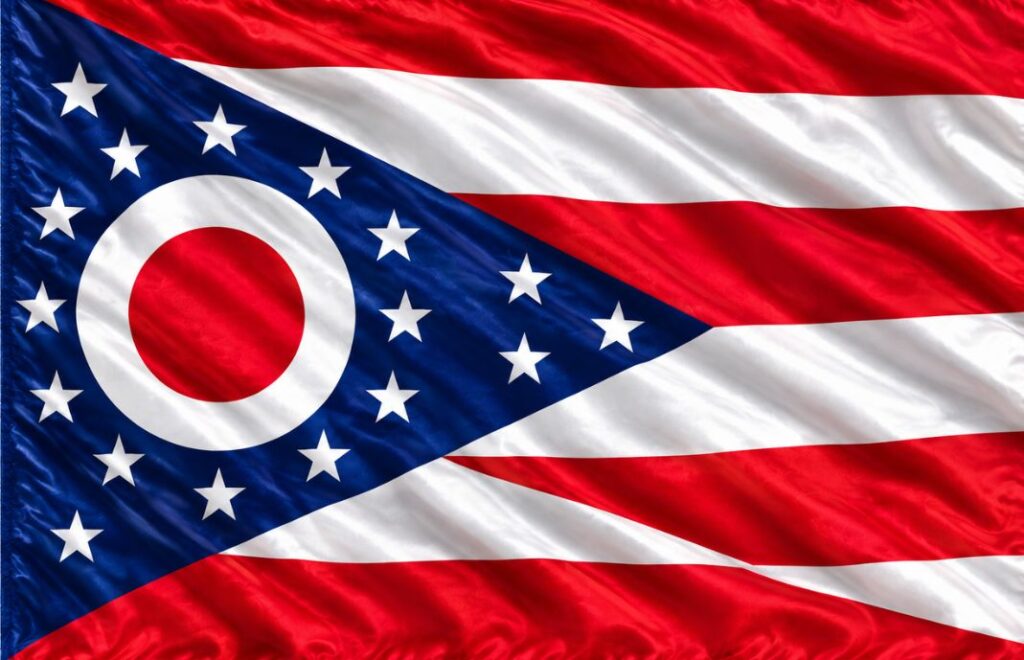
Ohio: The state that refused to be square
Most American state flags are rectangular. Ohio, however, decided to do something completely different.
Its distinctive flag features a swallowtail shape, with a blue triangle, seventeen white stars, and a red-and-white circle resembling the letter O.
The seventeen stars celebrate Ohio becoming America’s 17th state in 1803.
But here’s something surprising.
Ohio is the only American state with a nonrectangular flag, officially known as a burgee.
Designed by architect John Eisenmann and adopted in 1902, its unusual shape makes it instantly recognisable.
Wisconsin: Badgers, miners, and moving forward
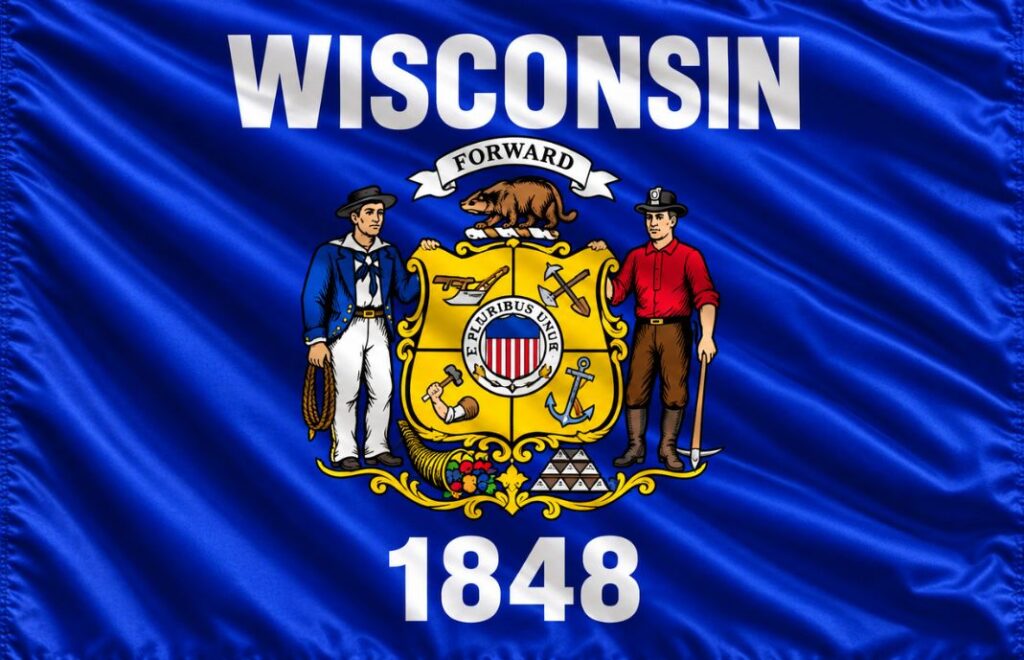
A badger, a sailor, a miner, and an enormous golden shield. Wisconsin certainly has plenty of symbols packed into its state flag.
Against a deep-blue background sits the state’s coat of arms, celebrating the industries that helped shape Wisconsin’s history.
The badger represents the state’s famous nickname, while the sailor and miner honor its maritime and mining traditions.
And here’s a curious little detail.
Wisconsin’s nickname, the Badger State, originally referred to lead miners who sometimes lived in hillside shelters resembling badger burrows.
Above the coat of arms appears the state motto “Forward,” a fitting tribute to Wisconsin’s spirit of progress.