
A beautiful white magnolia, a circle of stars, and a splash of red, blue, and gold. Mississippi’s state flag certainly knows how to make an impression.
But what makes this design particularly interesting is that it represents one of the most significant flag changes in modern American history.
And it all happened surprisingly recently.
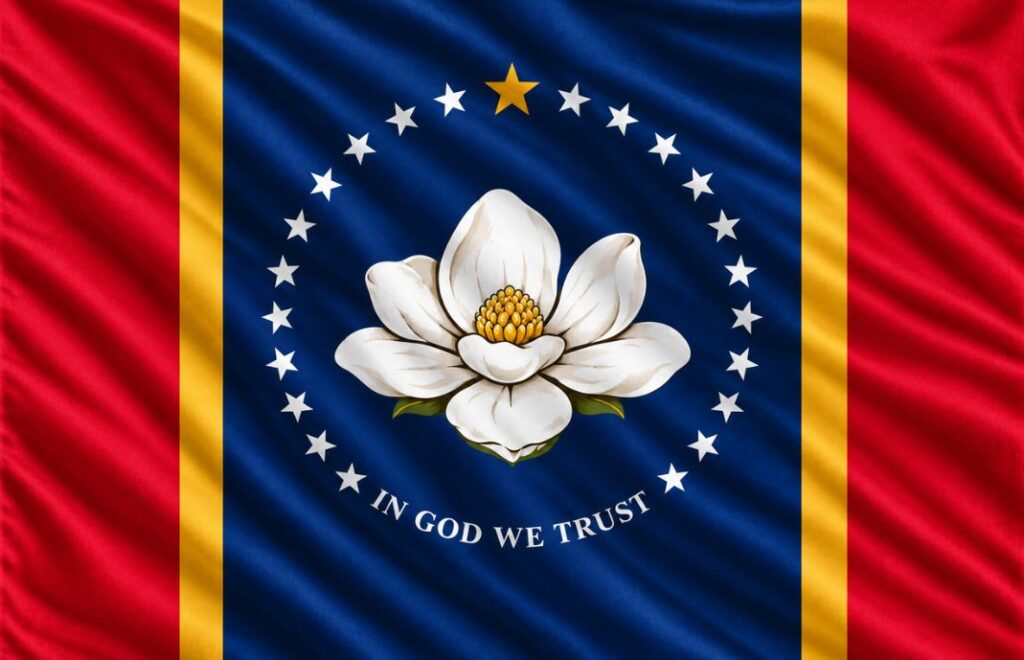
Mississippi’s current flag features a large white magnolia blossom against a deep-blue background, bordered by narrow golden stripes and wider red panels on either side.
Surrounding the flower is a circle of twenty white stars, with a larger golden star positioned at the top.
And beneath the magnolia are the words “In God We Trust.”
The secrets are in the details
It’s an elegant design, but almost every detail has a special meaning.
The magnolia is Mississippi’s official state flower and has long been associated with the South’s natural beauty and hospitality. Its blossoms also symbolize hope and renewal, making it a particularly fitting choice for a state looking towards a new chapter.
The twenty white stars celebrate Mississippi becoming the twentieth American state in 1817.
What about that unusual golden star at the top?
Look closely, and you’ll notice that it consists of five diamond-shaped sections. This distinctive star honors the Indigenous peoples who lived in Mississippi long before it became an American state.
The colors have their own meanings, too. Blue represents vigilance, justice, and perseverance, while red symbolizes courage and strength. The golden details celebrate Mississippi’s rich cultural traditions, including its extraordinary contributions to American music, literature, and art.
Speaking of music, here’s a little detail worth remembering: Mississippi is often called the Birthplace of America’s Music, thanks to its remarkable influence on blues, gospel, country, and rock ‘n’ roll.
But the most extraordinary part of the flag’s story is how it came into existence
For more than a century, Mississippi flew a flag that prominently featured the Confederate battle emblem.
Adopted in 1894, the design remained controversial because of its associations with slavery, segregation, and the American Civil War.
Mississippi was eventually the last American state to retain the Confederate battle emblem on its official flag.
Then, in 2020, following years of debate and renewed calls for change, Mississippi retired the old design.
A statewide competition invited people to suggest a replacement, attracting nearly 3,000 submissions.
The winning design was created by Rocky Vaughan, with contributions from several other designers, including Dominique Pugh, who illustrated the magnolia blossom.
And here’s something rather wonderful.
Instead of leaving the final decision entirely to politicians, Mississippi gave its residents the opportunity to vote.
On 3 November 2020, approximately 73% of voters approved the new flag.
It officially became Mississippi’s state flag on 11 January 2021.
The result is a design that celebrates the state’s natural beauty, recognizes its Indigenous heritage, and reflects a desire to move beyond a divisive chapter of its history.
So, from a magnolia blossom and twenty stars to a statewide competition and a historic public vote, Mississippi’s flag proves that even longstanding traditions can change. And sometimes, a new flag can tell an entirely new story.
