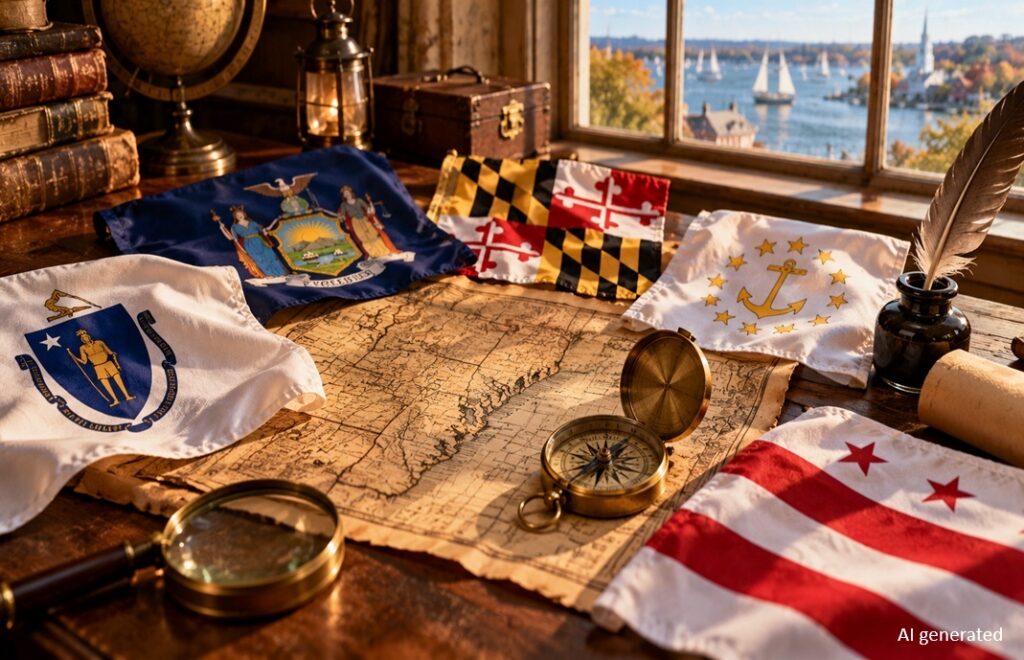
Imagine traveling back to a time when America was not yet the United States. When colonial settlements were growing along the Atlantic coast, ships carried goods and new arrivals across the ocean, and the idea of thirteen colonies becoming an independent nation was still a distant dream.
Now imagine discovering that pieces of those stories are still proudly displayed on flags today.
Welcome to the fascinating world of America’s Northeastern state flags, where history comes with a colorful collection of symbols, curious traditions, and a few unexpected surprises.
Here, flags tell stories that stretch back to the earliest days of European settlement, the American Revolution, and the founding of the United States. They celebrate everything from maritime adventures and agricultural traditions to courage, independence, and the ambitions of a young nation.
But not every symbol is quite what you might expect.
Connecticut proudly displays three grapevines. Rhode Island has an anchor with a message of hope. Maryland’s striking design looks almost like something borrowed from a medieval knight’s shield, while Maine chose a moose resting beneath a pine tree.
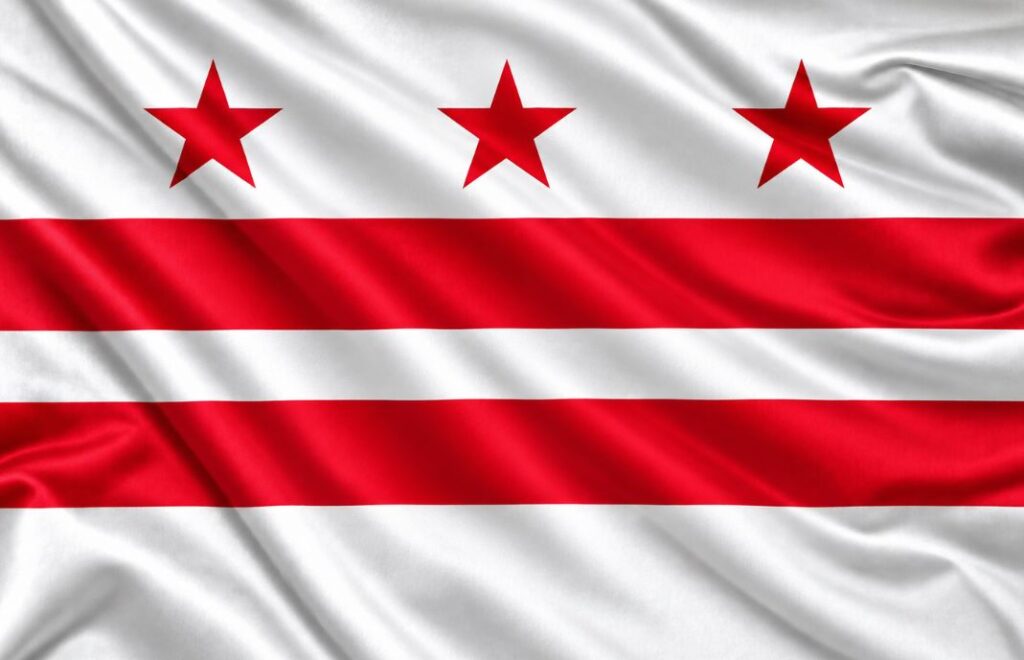
And then there is Washington, D.C., whose elegant red-and-white flag has a surprisingly personal connection to the man who became America’s first president.
Some of these designs are elaborate, filled with coats of arms, Latin mottos, and symbols that require a closer look. Others are wonderfully simple, proving that a flag doesn’t need dozens of details to tell an interesting story.
Together, they offer a glimpse into the different communities, traditions, and historical events that helped shape the northeastern United States.
So, let’s explore the flags of Connecticut, Delaware, Maine, Maryland, Massachusetts, New Hampshire, New Jersey, New York, Pennsylvania, Rhode Island, and Vermont, along with the distinctive flag of Washington, D.C.
Eleven states and one federal district, each with its own story to tell.
Because in this corner of America, even a flag can take you on a remarkable journey through the past.
Connecticut: Three grapevines and a colonial mystery
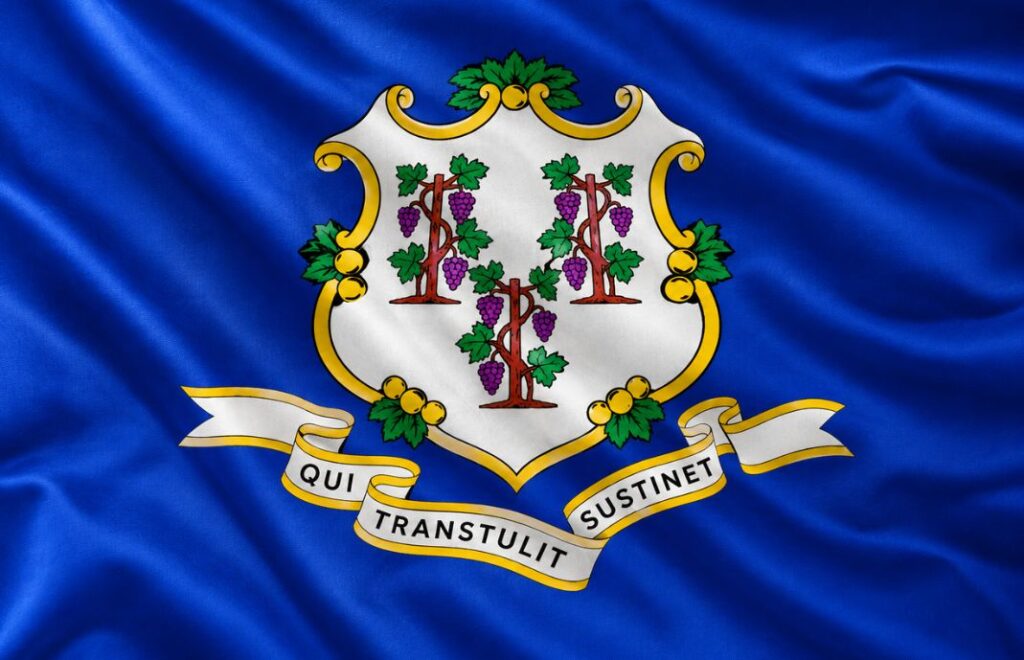
Three grapevines might seem like an unusual choice for a state flag, but Connecticut has a fascinating reason for including them.
Against a deep-blue background sits a white shield decorated with three grapevines, representing the state’s early colonial heritage.
Beneath the shield appears the Latin motto “Qui Transtulit Sustinet,” meaning “He Who Transplanted Still Sustains.”
But here’s something interesting.
The grapevines appeared on colonial seals long before Connecticut became an American state, and their precise meaning has been debated for centuries.
Officially adopted in 1897, the flag preserves an intriguing connection to Connecticut’s earliest European settlements.
Delaware: The little state that came first
Delaware might be one of America’s smallest states, but when it comes to history, it has a rather impressive claim to fame.
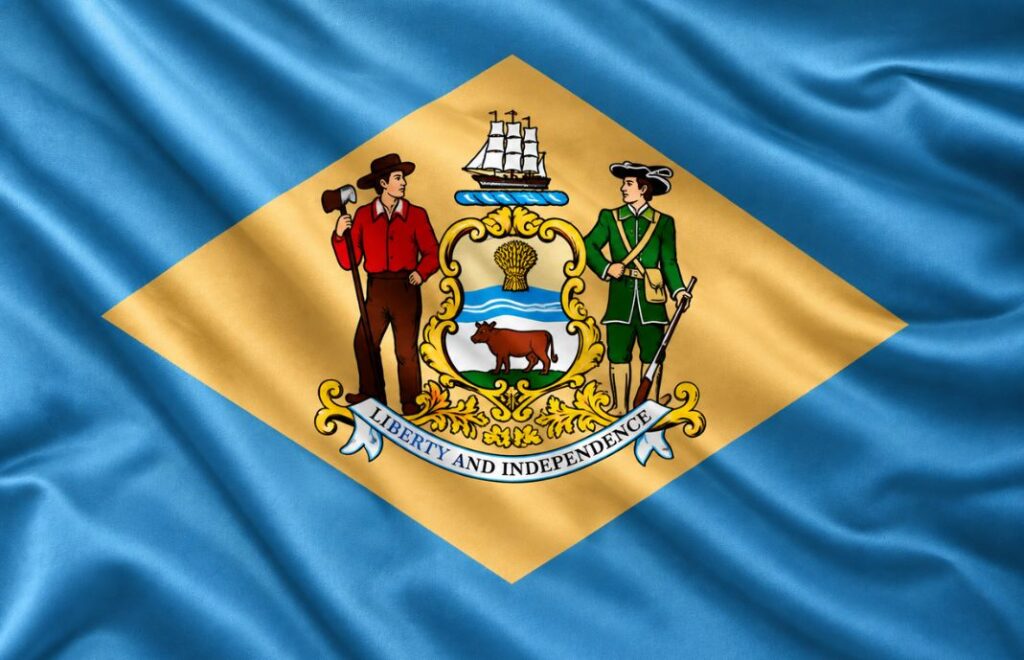
Its flag features a buff-colored diamond against a colonial-blue background, with the state’s coat of arms proudly displayed inside.
Beneath the diamond appears the date 7 December 1787.
But why is that date so important?
Because Delaware became the first state to ratify the United States Constitution, earning its famous nickname, the First State.
Officially adopted in 1913, the flag celebrates Delaware’s agricultural traditions, colonial heritage, and remarkable place in American history.
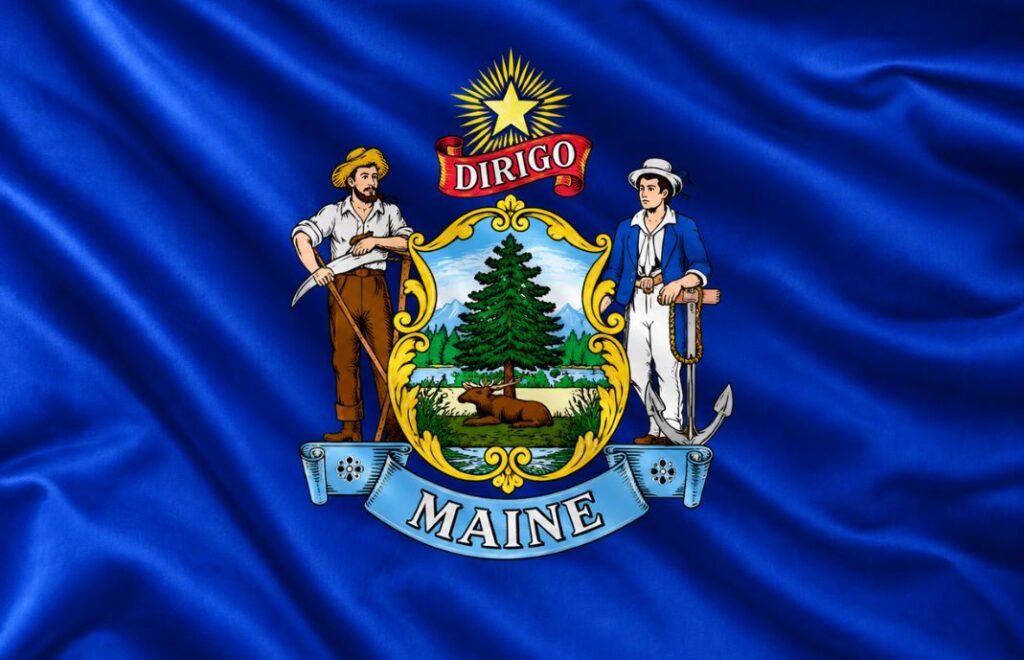
Maine: A moose, a pine tree, and a flag that almost returned
A magnificent moose resting beneath a pine tree. What could be more fitting for a state famous for its beautiful forests and wild landscapes?
Maine’s flag features its colorful coat of arms against a deep-blue background, supported by a farmer and a sailor, representing two important parts of the state’s heritage.
Above them shines the North Star, accompanied by the motto “Dirigo,” meaning “I Lead.”
But here’s something surprising.
Maine once had a much simpler flag featuring just a pine tree and a star.
In 2024, voters were asked whether to bring back a version of that historic design, but they chose to keep the familiar blue flag.
Maryland: A flag fit for a medieval knight
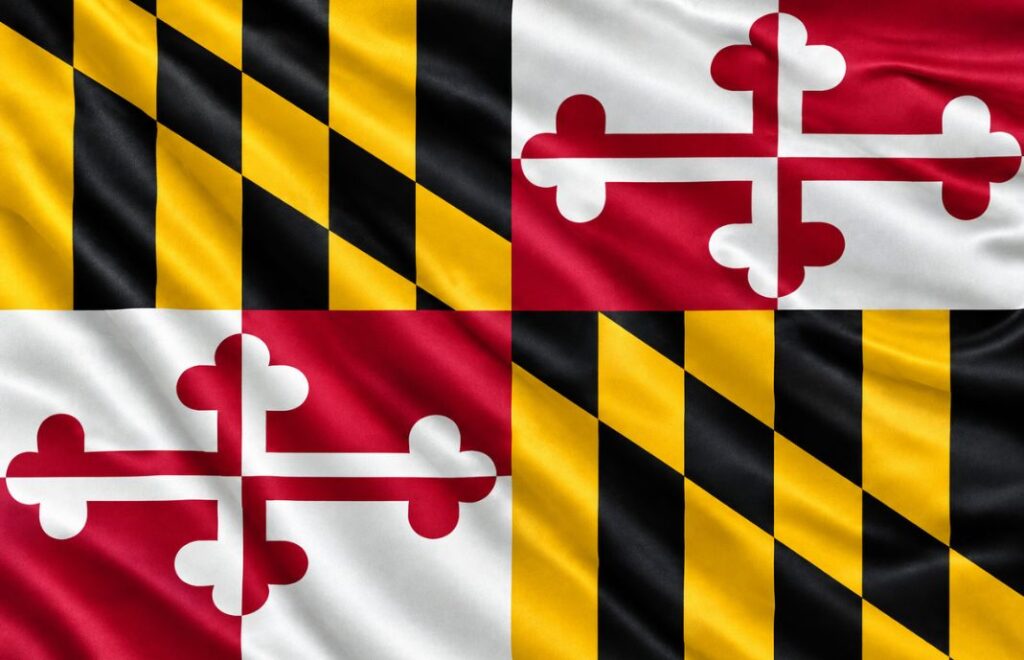
If there’s one American state flag that looks as though it belongs in a medieval castle, it must be Maryland’s.
With its striking combination of black, gold, red, and white, Maryland’s flag features the heraldic designs of two English families: the Calverts and the Crosslands.
These colorful patterns reflect the ancestry of the family that founded the Maryland colony.
But here’s where the story becomes particularly fascinating.
During the American Civil War, the two designs became associated with opposing sides of the conflict.
Their eventual combination helped symbolize reconciliation after the war.
Officially adopted in 1904, Maryland’s flag remains one of America’s most distinctive designs.
Massachusetts: A flag with a complicated past
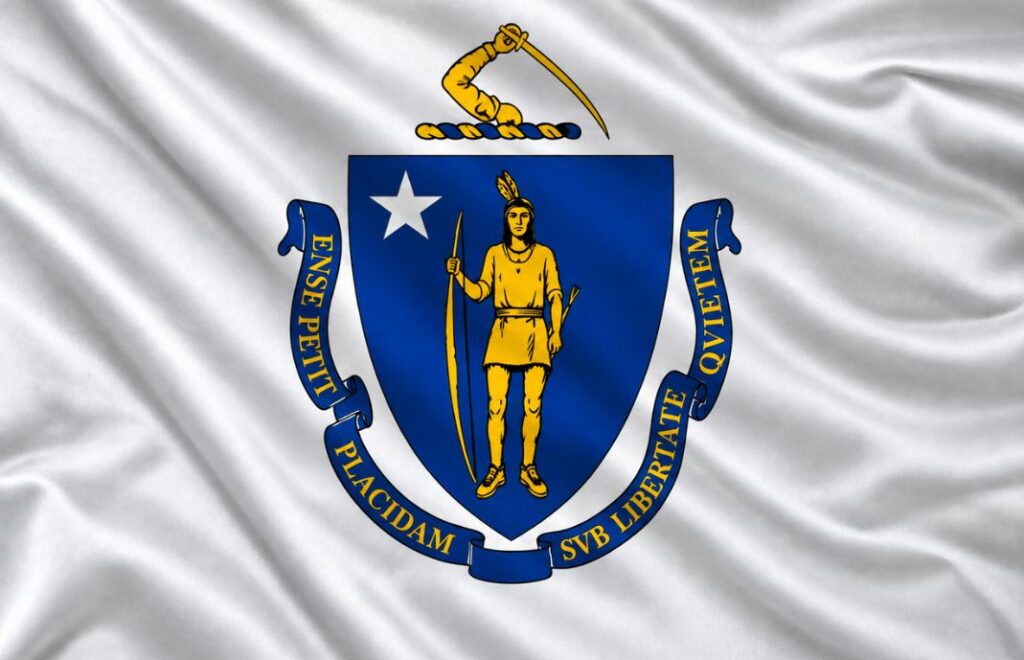
Massachusetts played an extraordinary role in America’s struggle for independence, but its state flag tells a story that reaches even further back.
Against a white background sits a blue shield featuring a Native American figure, with a raised sword positioned above it.
The design reflects the state’s colonial history, while its Latin motto expresses a desire for peace and liberty.
But here’s something interesting.
Massachusetts’s flag has become the subject of considerable debate because of the way it represents Indigenous peoples and the state’s colonial past.
Although proposals for a redesign have been discussed, the traditional flag remains in use.
New Hampshire: A warship, nine stars, and a revolutionary story
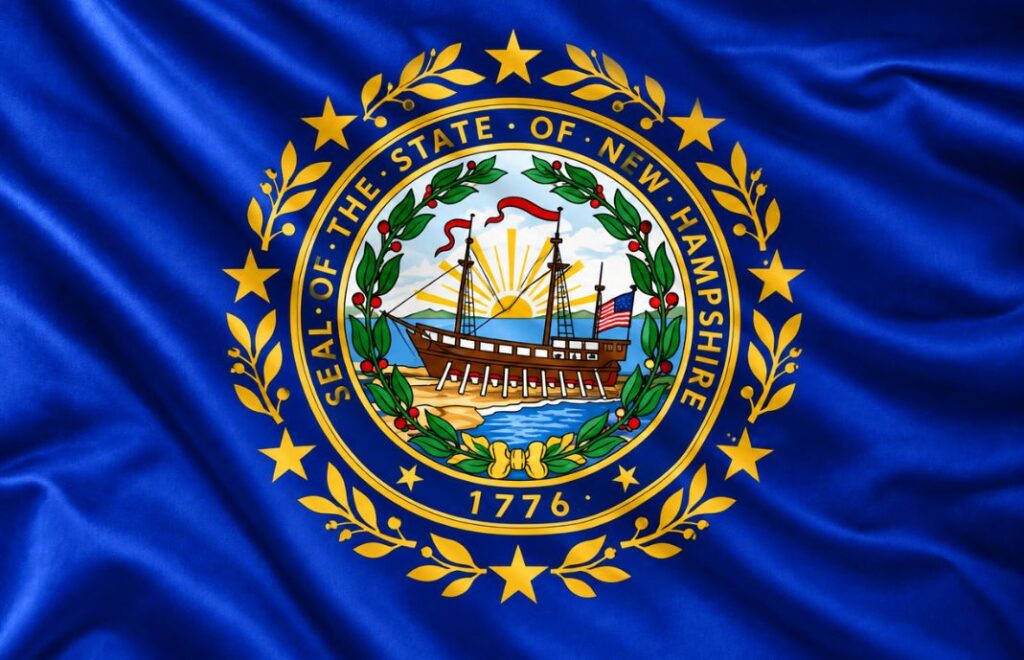
A magnificent sailing ship might seem like an unusual centrepiece for a state flag, but New Hampshire has a fascinating story behind its choice.
Against a deep-blue background sits the state’s official seal, featuring the USS Raleigh, a Revolutionary War frigate built in Portsmouth in 1776.
Surrounding the seal are nine golden stars, celebrating New Hampshire becoming the ninth state to ratify the United States Constitution.
And here’s an interesting detail.
The ship is depicted while still under construction, rather than sailing across the ocean.
Officially adopted in 1909, the flag proudly celebrates New Hampshire’s maritime heritage and revolutionary history.
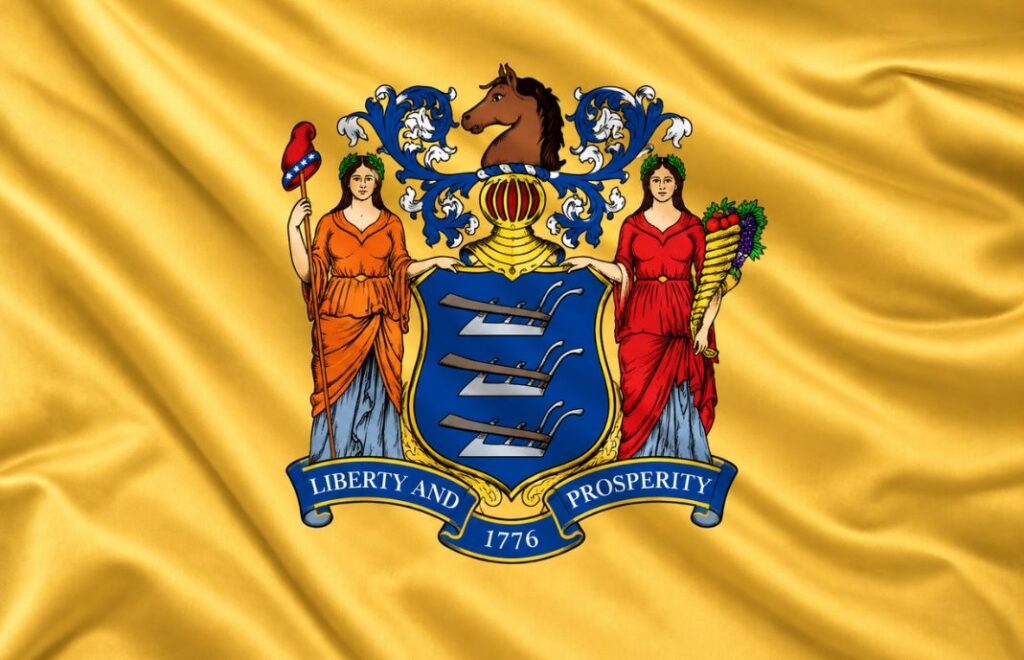
New Jersey: A horse, two goddesses, and a revolutionary connection
A horse’s head, two classical goddesses, and a beautiful golden-yellow background. New Jersey’s state flag certainly has a little of everything.
Its buff-colored background reflects the colors associated with New Jersey’s Revolutionary War soldiers.
In the center sits the state coat of arms, featuring Liberty and Ceres, the Roman goddess of agriculture, representing freedom and prosperity.
Above them is a horse’s head, celebrating the state’s agricultural traditions.
But here’s a curious detail.
New Jersey’s buff-and-blue colors are traditionally associated with George Washington’s instructions for the uniforms of the state’s Continental Army troops.
New York: Liberty, justice, and ever upward
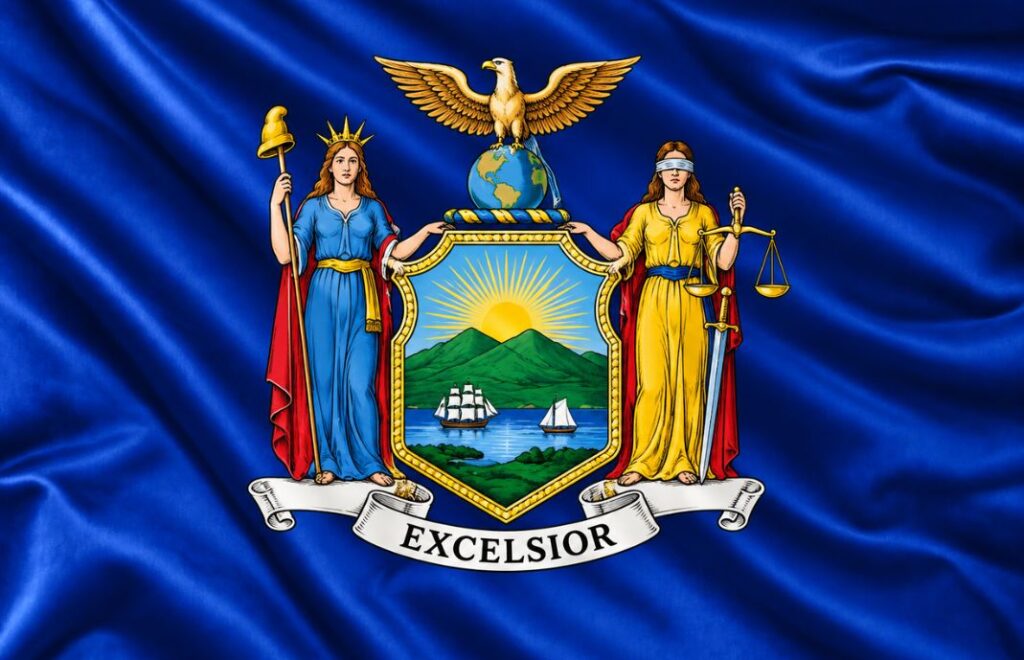
Two classical figures, an American eagle, and a magnificent landscape. New York’s state flag certainly knows how to make a statement.
Against a deep-blue background sits the state’s colorful coat of arms, featuring Liberty and Justice standing on either side of a shield depicting the Hudson River.
Above them, an eagle spreads its wings atop a globe.
And here’s a fascinating detail.
At Liberty’s feet lies a discarded crown, symbolizing America’s rejection of monarchy.
The flag also features New York’s famous motto “Excelsior,” meaning “Ever Upward,” alongside “E Pluribus Unum,” meaning “Out of Many, One,” which was added in 2020.
More inspiration: Discover the fascinating story behind New York’s state flag
Pennsylvania: Two horses, an eagle, and the spirit of independence
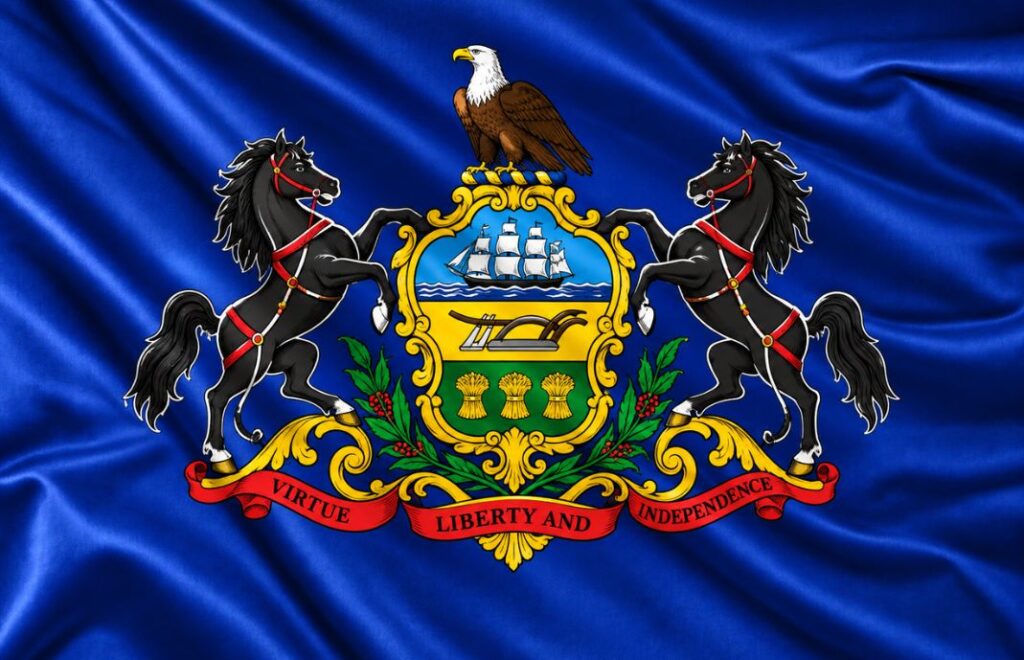
Two magnificent black horses, an American eagle, and a shield filled with symbols of agriculture and trade. Pennsylvania’s state flag certainly has plenty of interesting details.
Against a deep-blue background sits the state’s elaborate coat of arms, featuring a ship, a plough, and three golden sheaves of wheat.
Together, they celebrate Pennsylvania’s commercial, agricultural, and industrial heritage.
Beneath the shield appears the famous motto “Virtue, Liberty, and Independence.”
And here’s something worth remembering.
Pennsylvania played a central role in America’s founding, with both the Declaration of Independence and the United States Constitution debated and signed in Philadelphia.
More inspiration: Discover the fascinating story behind Pennsylvania’s state flag
Rhode Island: An anchor, thirteen stars, and a message of hope
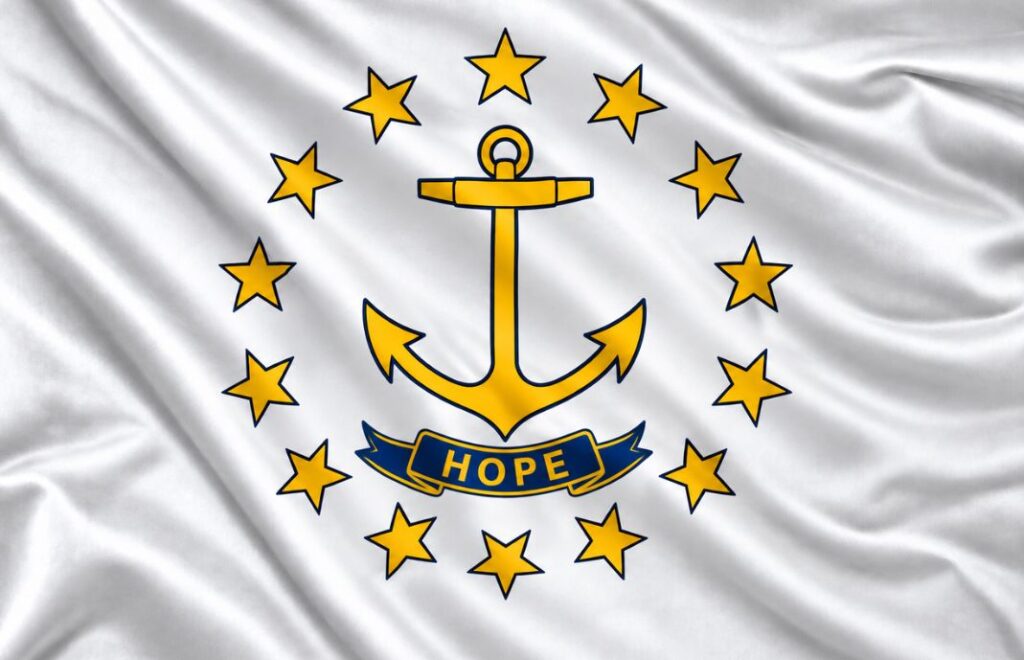
An enormous golden anchor surrounded by thirteen stars. Rhode Island’s state flag might look simple, but its symbolism is wonderfully meaningful.
Against a white background sits a golden anchor, representing hope, surrounded by thirteen stars celebrating America’s original thirteen colonies.
Beneath the anchor appears a blue ribbon carrying just one word: “HOPE.”
But here’s something fascinating.
The anchor has been associated with Rhode Island since the seventeenth century, making it one of America’s oldest colonial symbols.
Officially adopted in 1897, the flag celebrates the state’s maritime heritage and a message of optimism that has endured for centuries.
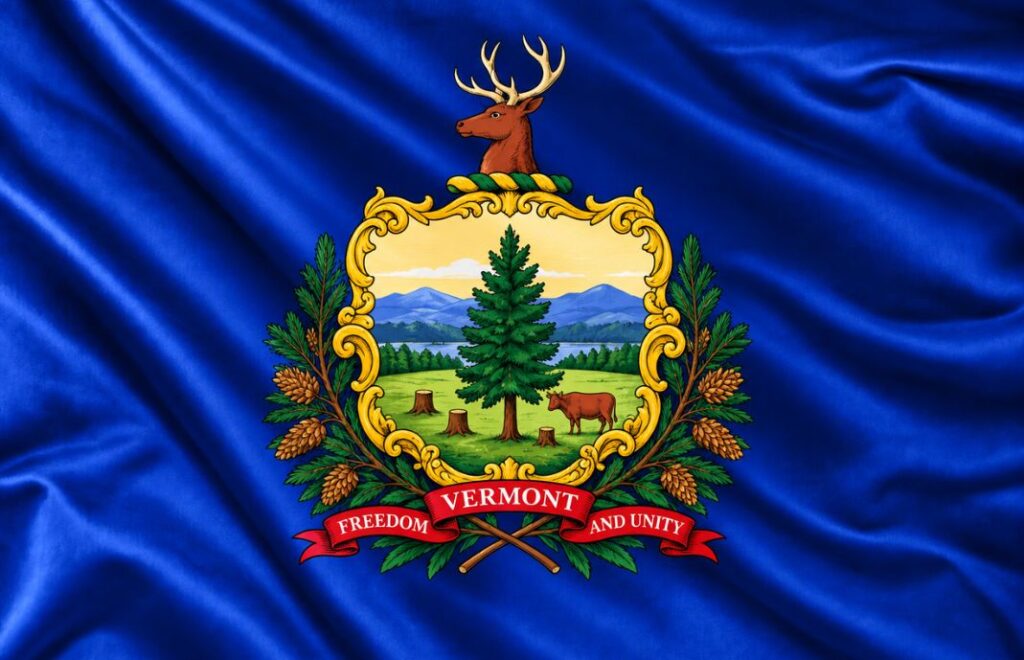
Vermont: Green mountains, freedom, and a rather proud cow
A peaceful countryside scene featuring mountains, a pine tree, and a rather contented cow. Vermont’s state flag certainly captures the character of the Green Mountain State.
Against a deep-blue background sits the state’s colorful coat of arms, celebrating Vermont’s forests, agricultural traditions, and beautiful mountain landscapes.
Above the shield is a deer’s head, while the state motto “Freedom and Unity” appears beneath.
But here’s something interesting.
Vermont was once an independent republic before joining the United States as the 14th state in 1791.
Officially adopted in 1923, the flag celebrates a state with a proud independent spirit.
Washington D.C.: Three stars, two stripes, and a presidential connection
Three red stars, two bold red stripes, and a brilliant white background. Washington, D.C.’s flag is wonderfully simple, but its history is rather surprising.
Unlike most American flags, its design wasn’t inspired by a famous battle or a dramatic historical event.
Instead, it comes from the family coat of arms of George Washington, America’s first president and the man who gave the nation’s capital its name.
Officially adopted in 1938, the flag features three red stars above two horizontal red stripes.
And here’s an interesting detail.
Despite being the nation’s capital, Washington, D.C., didn’t have an official flag of its own until the twentieth century.