High on the rugged expanses of Dovrefjell roams a creature from another age – an ancient survivor that once grazed alongside the mighty mammoth. Built for extremes, it weathers blizzards and biting cold with stoic endurance, a true relic of the Ice Age.
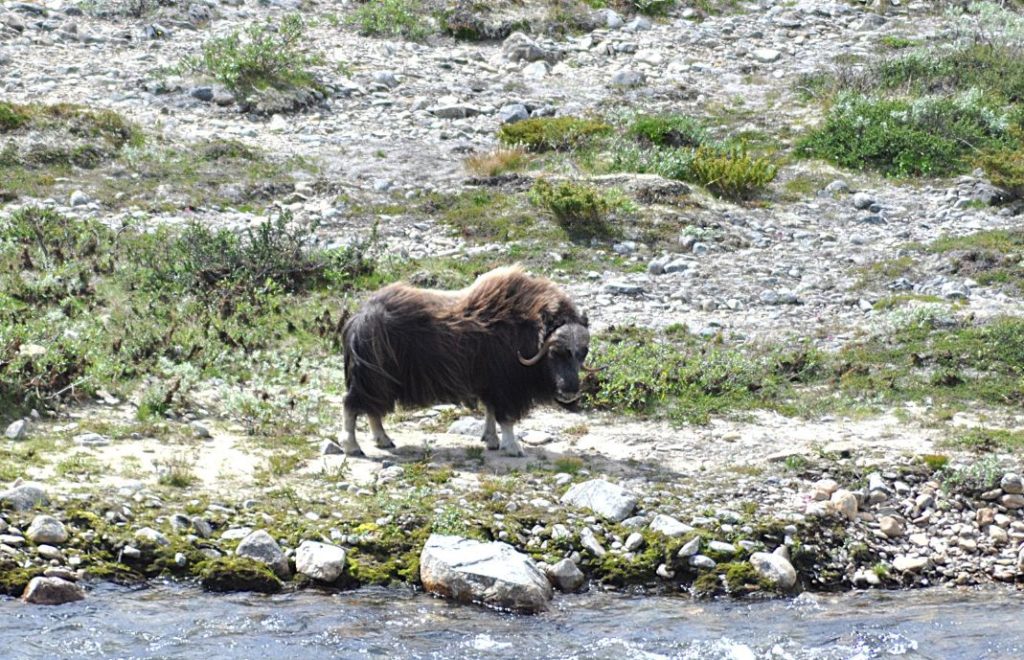
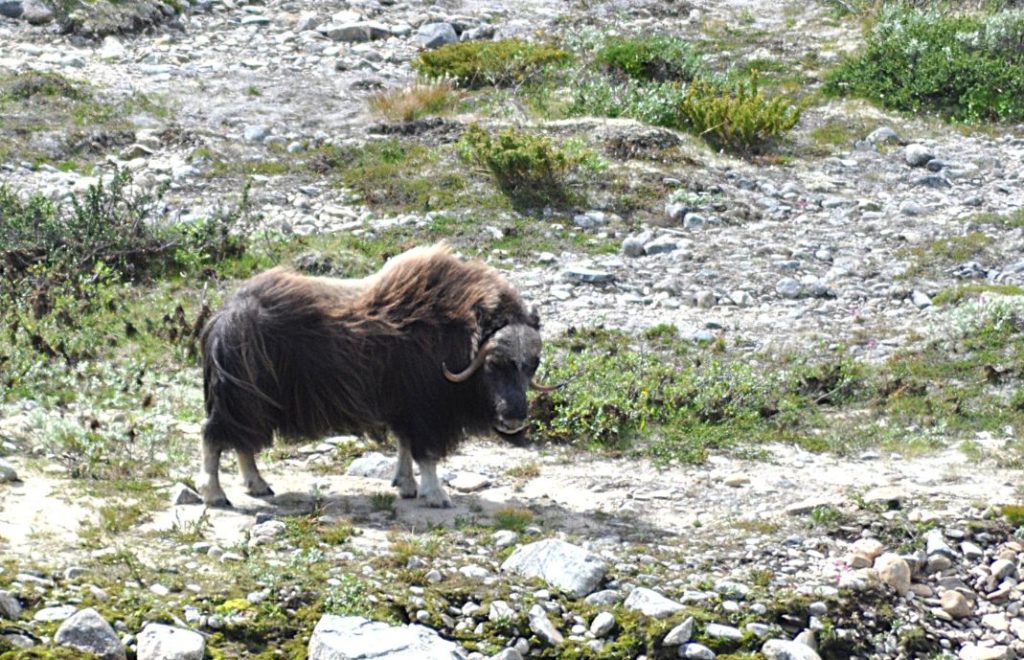
Picture this: short, sturdy legs supporting a massive frame; a thick, muscular neck and a long coat of dark brown fur sweeping the ground like a royal cloak. Its head is narrow and high, crowned by broad horns that flatten across the forehead before curving down, outward, and up to sharp tips.
Measuring up to 2.5 meters in length, standing 165 cm tall, and weighing between 340 and 450 kilos, this formidable beast commands respect. Even its tail – just 7 cm long – seems almost vestigial, a reminder of its Arctic origins.
This is the musk ox – majestic, resilient, and hauntingly beautiful. A living echo of a world long vanished, yet thriving here in the heart of Norway’s wild highlands.
Musk ox safari on Dovrefjell
Experience one of Norway’s most extraordinary wildlife encounters – come face to face with the mighty musk ox in its natural habitat and take home a memory you’ll never forget.
Dovrefjell National Park is the only place in Norway – and one of the few places in the world – where these ancient giants still roam free.
You can, of course, set out on your own across this breathtaking mountain plateau, but the most rewarding – and safest – way to find them is on a guided musk ox safari. Alongside seasoned guides, you’ll not only see these majestic animals up close but also immerse yourself in some of Norway’s most stunning wilderness.
The musk ox is a master of camouflage. What appears to be a large brown boulder may suddenly move – and only then do you realize you’ve spotted one of these prehistoric survivors.
On an organized tour, expert guides know exactly where to look and how to keep both you and the musk ox safe – a win for everyone. In fact, most tours offer something close to a musk ox guarantee.
Book your experience through an operator approved by Dovrefjell National Park. A full list of certified providers is available here.
When can you go on a musk ox safari?
Guided musk ox safaris run daily from June to September, when Dovrefjell reveals its most accessible and scenic landscapes. Some operators even offer winter safaris, giving you the rare chance to spot these Ice Age giants in a snowy wonderland.
For an experience unlike any other, Hjerkinn Fjellstue offers the world’s only musk ox safari on horseback, available Thursdays and Saturdays. Note: this adventure is for seasoned riders only.
Duration & distance
Tours typically last 3 to 7 hours, covering 7 to 15 km, depending on where the musk ox herds are roaming.
Who can join?
Musk ox safaris are suitable for anyone in normal physical condition.
Children are welcome too – provided they’re used to hiking in the mountains. Minimum age: 7 years.
Safety first
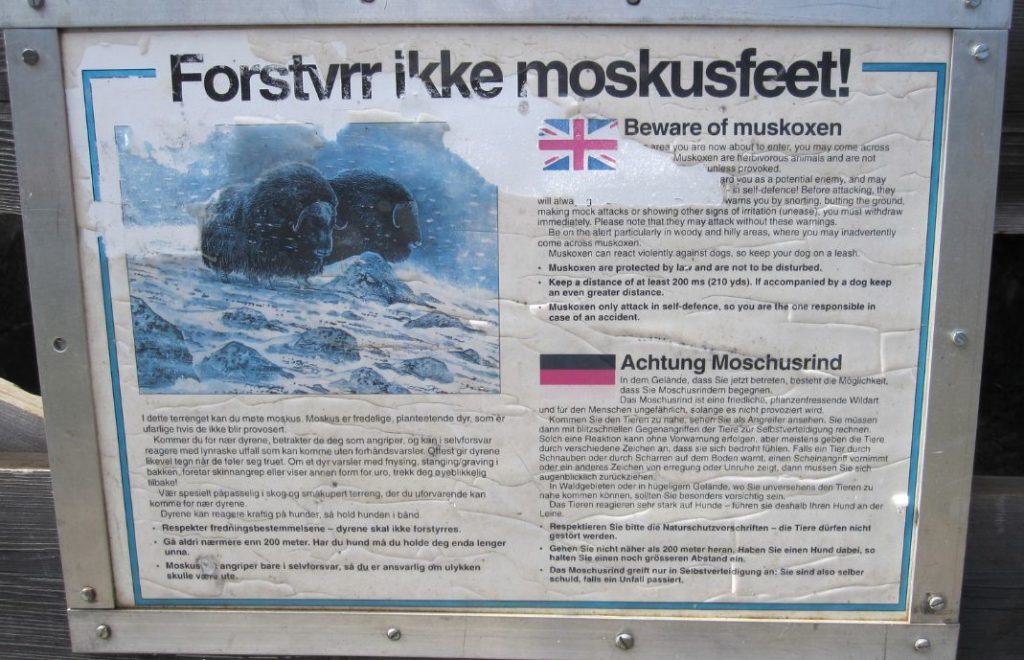
Musk oxen may look calm, but don’t be fooled. They can sprint up to 60 km/h, and at up to 450 kg, they’re like a freight train on hooves.
To keep everyone safe, a minimum distance of 200 meters must always be maintained.
Listen carefully to your guides, respect the rules, and follow instructions. They’re there for your safety – and the musk ox’s well-being.
On the trail of a prehistoric giant
We booked our musk ox safari with Hjerkinn Fjellstue, and upon arrival, our guide gave us a quick introduction and a thorough safety briefing. Mosquitoes are said to be relentless up here, so we doused ourselves in repellent before shouldering our packs, stocked with lunch and full water bottles.
Expectations? Sky-high.
The hike begins with a steady climb through birch forest, crossing streams that sparkle in the morning sun. Soon, the terrain opens up into a vast, rugged landscape dotted with moss and hardy grass tufts. In the distance, snow lingers on mountain ridges and nestles in shaded valleys. It’s a breathtaking backdrop that makes you understand why musk oxen thrive here. They’re built for this – their long, coarse coats a natural shield against harsh winds and biting cold.
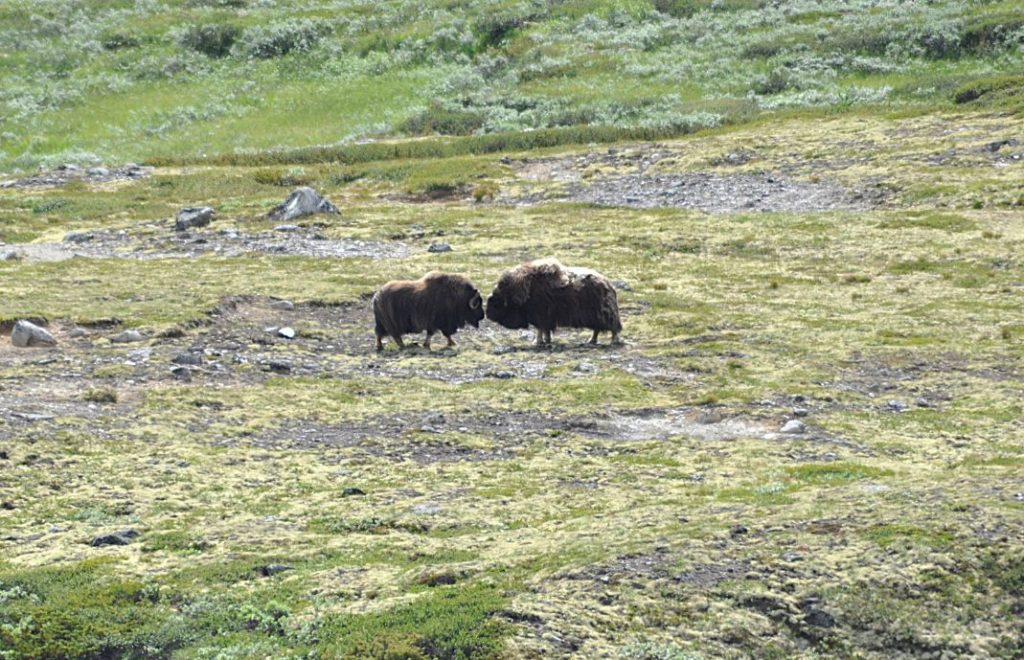
After hours of trekking, we reach a stunning vantage point with panoramic views of Norway’s majestic highlands. The guide raises his binoculars, scanning the ridges with a hunter’s precision. Then – movement. What we thought were just boulders suddenly shift. A herd of musk oxen grazes in the distance, blending so perfectly with the tundra that we’d have walked right past without trained eyes to spot them.
There are 203 musk oxen in Dovrefjell, but sightings are never guaranteed. Today, fortune smiles on us. Still, we wish they were closer.
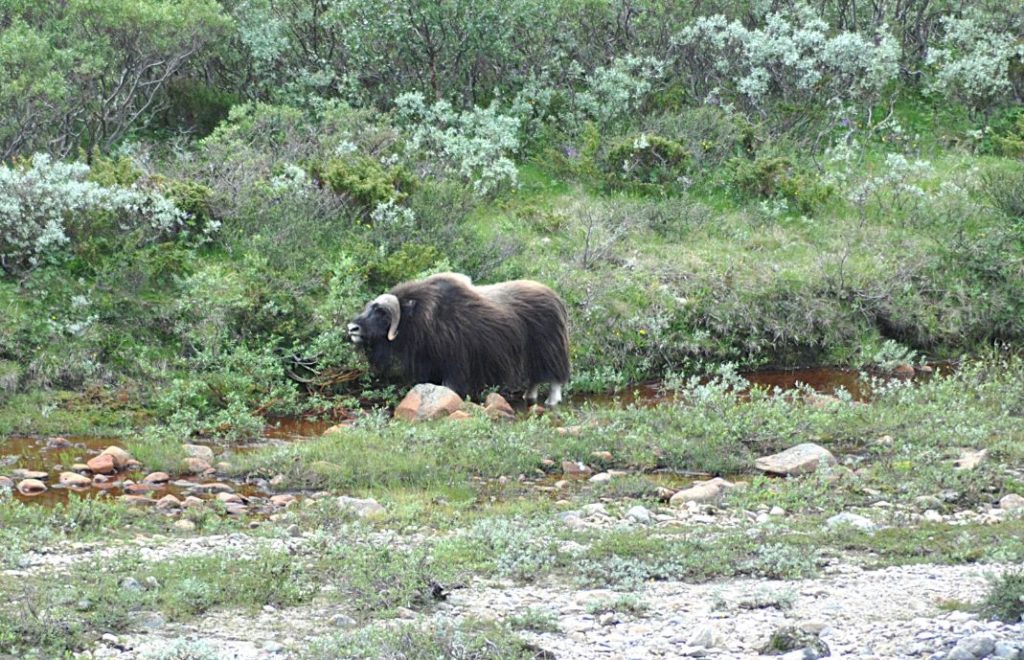
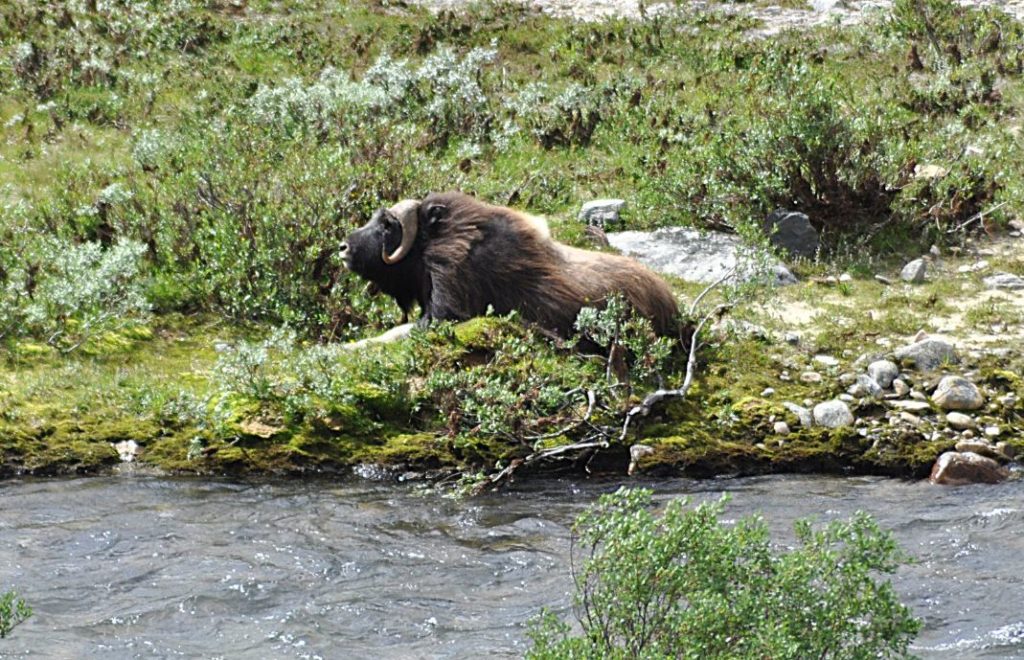
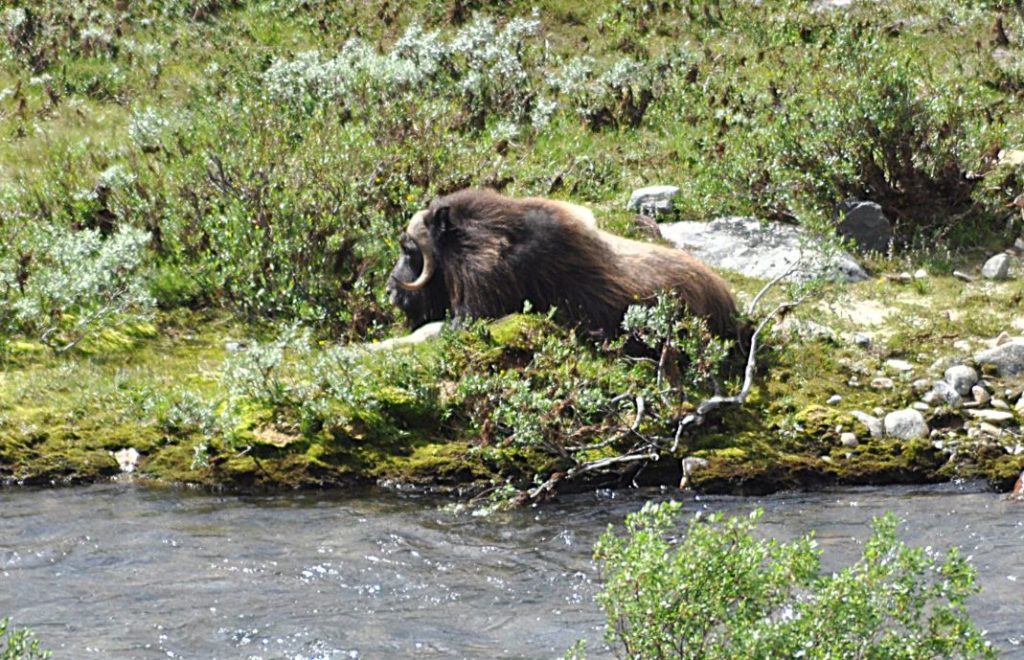
As our guide launches into an engaging talk about these Ice Age survivors, I suddenly tug his sleeve, grinning from ear to ear. Across the river, emerging from the brush, stands a solitary bull. He tears at grass tufts, bathed in golden light, utterly unfazed by our excitement.
We watch in awe for nearly an hour as he grazes and ambles slowly along, the undisputed monarch of this wild kingdom. Then, with effortless grace, he disappears back into the dense scrub – leaving us with a memory etched forever in our hearts.
Here on Dovrefjell, it’s his world. We’re just lucky guests.
How musk oxen came to Dovrefjell
The musk ox – an Ice Age relic – originates from the tundras of Alaska, Arctic Canada, and Greenland. But evidence shows these hardy giants once roamed Norway as well.
In 1913, two vertebrae from a massive musk ox bull were unearthed nine meters below ground in Innset, north of Oppdal. The bones were unweathered, meaning they hadn’t traveled far. Scientists dated them to over 30,000 years ago, proving that musk oxen once thrived on these very mountains.
The modern chapter began on October 7, 1932, when ten musk oxen from Greenland – three males and seven females – were released into Dovrefjell. Two were born in 1930, the others were yearlings. By autumn, the herd had wandered north and settled in the rugged slopes.
Tragedy struck in April 1934 when an avalanche at Hesthågåhø claimed two bulls and three cows. More animals were imported, and in 1938, another calf and yearling were released.
Between 1935 and 1941, four calves were observed – the animals had begun to reproduce. The experiment was working.
Sadly, after World War II, no musk oxen remained.
The musk ox returns to Dovrefjell
Between 1947 and 1953, a new effort to restore musk oxen to Norway unfolded. From the icy expanses of Greenland, 24 calves and three yearlings made the long journey to Dovrefjell. Eleven were released immediately, while the remaining 16 were kept in an enclosure on John Angard’s farm in Dombås, awaiting their turn to reclaim the wild.
But nature is unforgiving. Disease and accidents reduced their number, leaving just 10 animals by August 1953. These hardy survivors became the ancestors of the musk ox population roaming Dovrefjell today.
From 1966 to 1973, researchers monitored the herd closely as it grew from 22 to 37 individuals. The population was so small that scientists could identify each animal older than two years – a rare opportunity in wildlife study.
Then came tragedy. In July 1978, a powerful lightning strike killed an entire group of 12 musk oxen in an instant, a stark reminder of the challenges life endures in the high mountains.
Still, the musk ox proved resilient. Each winter, the herd is counted, and by 2024, the population had reached 203 animals, thriving once more in the land their ancestors roamed over 30,000 years ago.
Source: Dovrefjell-Sunndalsfjella National Park
Will the musk ox survive?
The musk ox may look invincible – a relic from the Ice Age, forged to withstand the harshest climates – but its future on Dovrefjell is far from secure.
The herd here descends from Greenland stock, adapted to an environment with minimal disease. This makes them highly vulnerable to infections carried by livestock, wild reindeer, and other deer species. In recent years, outbreaks of orf virus (mouth disease) and pneumonia have taken a heavy toll, particularly among calves, where mortality rates can soar during bad years.
Climate change poses another threat. These animals are built for cold, yet warming winters bring ice crusts and hard-packed snow, making food harder to reach. Hot summers, which they are ill-equipped to endure, add further stress.
Then there are human hazards. Some musk oxen wander beyond the park, leading to conflicts that often end with the animals being culled. Train collisions claim others. And tourism – a double-edged sword – also plays a role. While guided safaris are generally safe, some visitors ignore the 200-meter safety rule, approaching too closely for photos. A stressed musk ox can become aggressive, and in too many cases, the consequence is fatal – for the animal.
For a creature that once roamed alongside mammoths, survival now depends on us. On careful management, respect for wildlife, and the will to keep the last of Norway’s musk oxen thriving in the land they’ve reclaimed.
Moskusvettreglene – The Musk Ox Code
A musk ox may seem calm and indifferent, but don’t be fooled. Unlike most animals that flee when threatened, the musk ox stands its ground – and charges. To stay safe (and keep these magnificent creatures safe), follow these essential guidelines before your safari on Dovrefjell:
1. Keep a safe distance
Stay at least 200 meters away. A full-grown musk ox bull can weigh 450 kg and sprint at 60 km/h. You can’t. Enough said.
2. Count the herd
Always keep track of every animal in sight. The last thing you want is a surprise encounter with a bull you didn’t notice.
3. Make your presence known
Musk oxen hate surprises. Don’t sneak up on them. Move openly and avoid hiding.
4. Watch for warning signs
If a musk ox paws the ground, shakes its head, snorts, or starts tussling with others, it’s irritated. Back away slowly, the way you came.
5. Bring the right gear
Sturdy boots, warm layers, plenty of food and water – and don’t forget binoculars. They let you admire the animals up close while keeping a safe distance.
6. Respect the mountain weather
Conditions can change in minutes, even in summer. Check the forecast and be prepared to turn back.
7. Enjoy the experience
Take your time. Soak in the vastness of Dovrefjell and the thrill of spotting a living relic from the Ice Age.
Source: Dovrefjell–Sunndalsfjella National Park