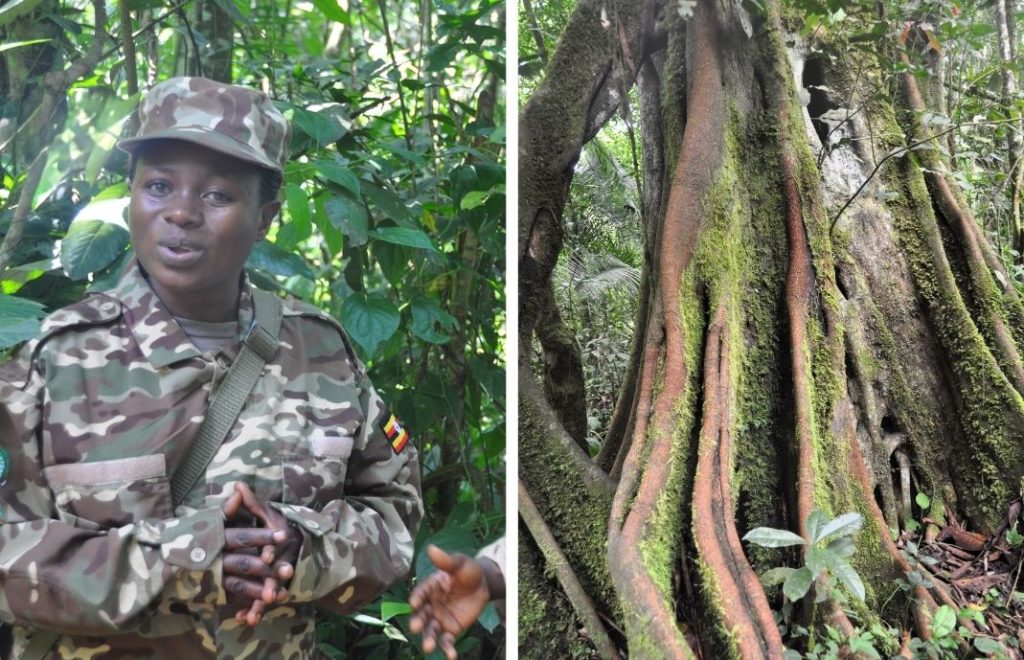
It’s been nearly an hour since we left camp and set off into the tropical rainforest. Overhead, a dense canopy of leaves weaves an emerald ceiling, filtering out the sun and casting the forest floor in soft, dappled shade. Around us, vibrant foliage and thick green undergrowth form a lush, almost cinematic backdrop.
We’re deep in Kibale National Park, a biodiverse jewel in western Uganda that has rightfully earned its nickname: “The Primate Capital of the World.” With an astounding thirteen primate species calling this rainforest home, it’s one of the most remarkable places on Earth to witness these intelligent, charismatic creatures in their natural habitat.
The chimpanzee quest begins
Our chimpanzee adventure kicks off with registration and a briefing at the visitor center. Soon after, we’re divided into small groups. No more than six people per guide – and each team is assigned a dedicated ranger and an armed wildlife officer for safety.
A short drive deeper into the forest and the real journey begins. Spirits are high as we set off on foot, stepping through puddles and thick mud. There’s some laughter at the women in jeans and pastel sneakers – less than ideal footwear for a trek through the rainforest after a night of torrential rain. Our female ranger shakes her head in amused exasperation as complaints start flying about ruined shoes and muddy clothes. For the record: white and pink running shoes are never a good idea for chimp tracking – no matter the season.
Up ahead, our guide presses on enthusiastically. She’s clearly proud of the chimpanzees she’s about to introduce us to – referring to them lovingly as “her children.” Now and then she stops, lifts a hand for silence, and listens intently – gently shushing the grumbling behind her.
We push forward into the thick of the forest, ducking branches and weaving through dense undergrowth. She scans the treetops for broken limbs, eyes the forest floor for signs. Footprints, trampled grass, clues of movement. She’s part naturalist, part detective – a Ugandan version of Hercule Poirot, following the trail wherever it leads.
Keeping pace is no easy feat. She moves with the confidence of someone who knows every twist and turn of the jungle. We’re strangers in this green labyrinth. Then – an abrupt stop. She points to the ground, where pear-shaped clumps lie nestled in the mud: chimpanzee droppings.
“Chimps do their business on the move,” she says with a grin. “Makes it easy to follow their trail.”
Where are they?
We press on a few hundred meters. The treetops begin to rustle. Branches sway. The chimps are on the move – and they’re heading our way.
Eight pairs of eyes tilt skyward, scanning the dense canopy with breathless focus. And then – there! The first chimpanzee bursts into view, leaping effortlessly from tree to tree. Then another, and another. They move with astonishing grace and speed, soaring through the branches just above our heads, then vanishing as swiftly as they came.
Our guide beams. “This isn’t over yet,” she assures us. She’s confident we can get even closer – if we’re willing to venture deeper into the forest.
Turning back? Not a chance.
We press forward, climbing steadily now – over fallen trunks, ducking beneath low-hanging branches, parting vines and foliage as we go. The terrain grows wilder, but so does our resolve. The group is buzzing with energy and anticipation.
We’re deep in chimp territory now, and every step takes us closer to one of the rainforest’s most thrilling encounters.
We’re getting closer!
Kibale National Park is home to approximately 1,500 chimpanzees, making it the densest population of our closest relatives in all of Uganda. Over time, many of these chimps have grown accustomed to the presence of humans and, for the most part, they simply ignore the odd creatures wandering through their jungle home.
The forest around us is alive – with earthy scents, melodic birdsong, and the subtle rustle of movement through the undergrowth. All eyes are on high alert, scanning for signs of a chimp. Any chimp, any hint of them. And so, we march on.
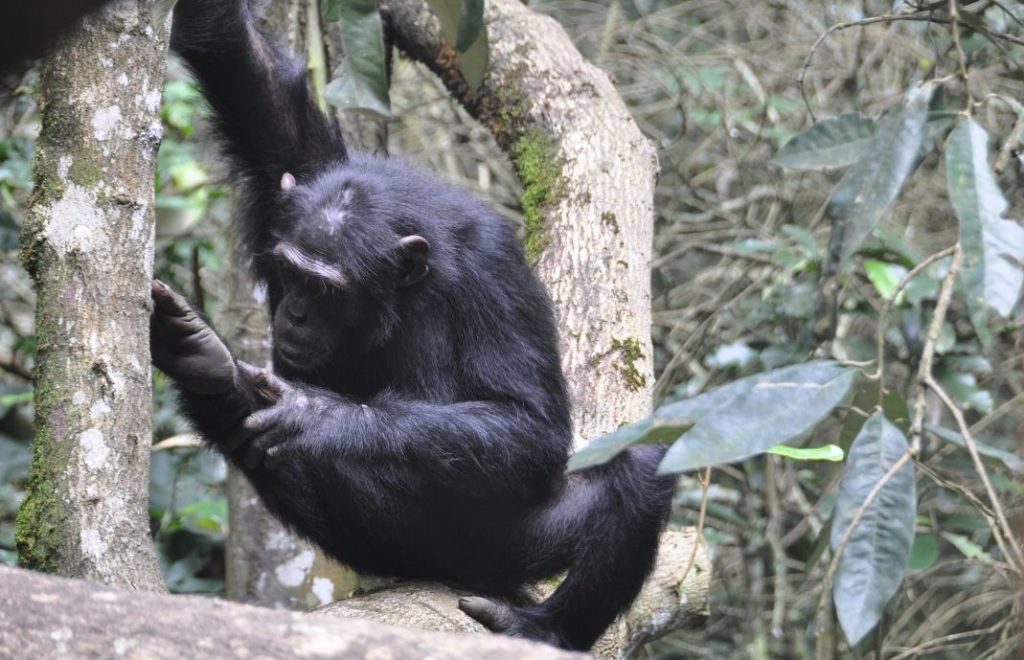
Suddenly, the guide halts. She lowers the volume on her walkie-talkie and silently points toward a fallen tree. There, perched atop the trunk, sits a chimpanzee, casually scratching its back.
He locks eyes with us for a brief moment, pauses, gives one final scratch – and then hops down.
On all fours, he ambles across a small clearing, then turns and gives us a long look. It’s almost as if he’s inviting us to follow.
We don’t hesitate for a second. Fueled by the thrill of connection, we press on. Eager to see where this silent guide might lead.
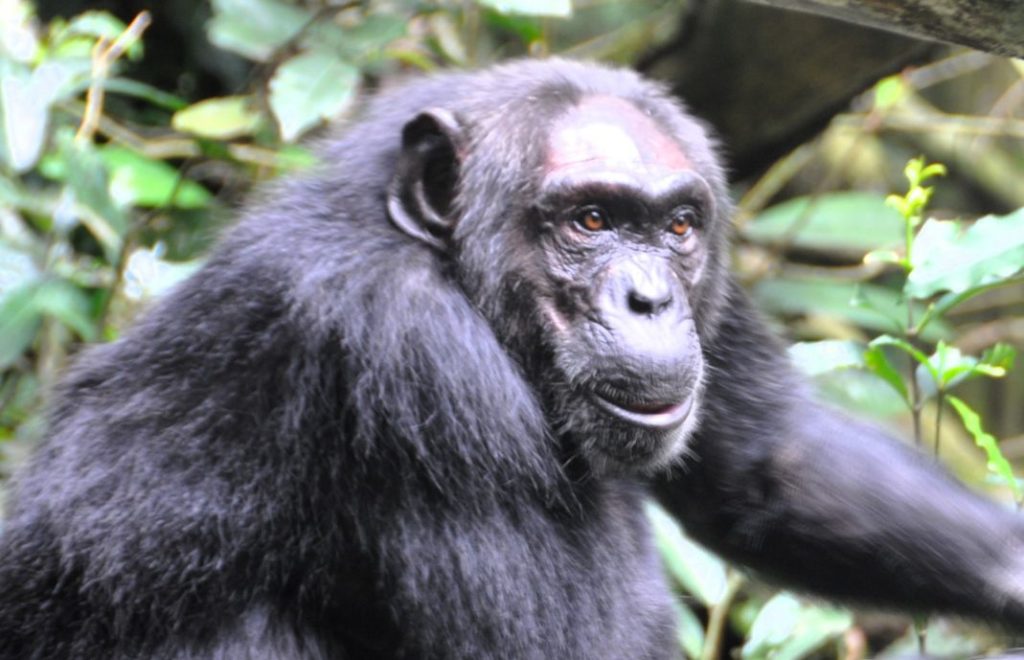
The forest’s little rascal is a heartbreaker
At last!
In a sun-dappled clearing, a group of chimpanzees comes into full view. We gather quietly, keeping to the invisible line our guide has marked in the earth – this far, no farther.
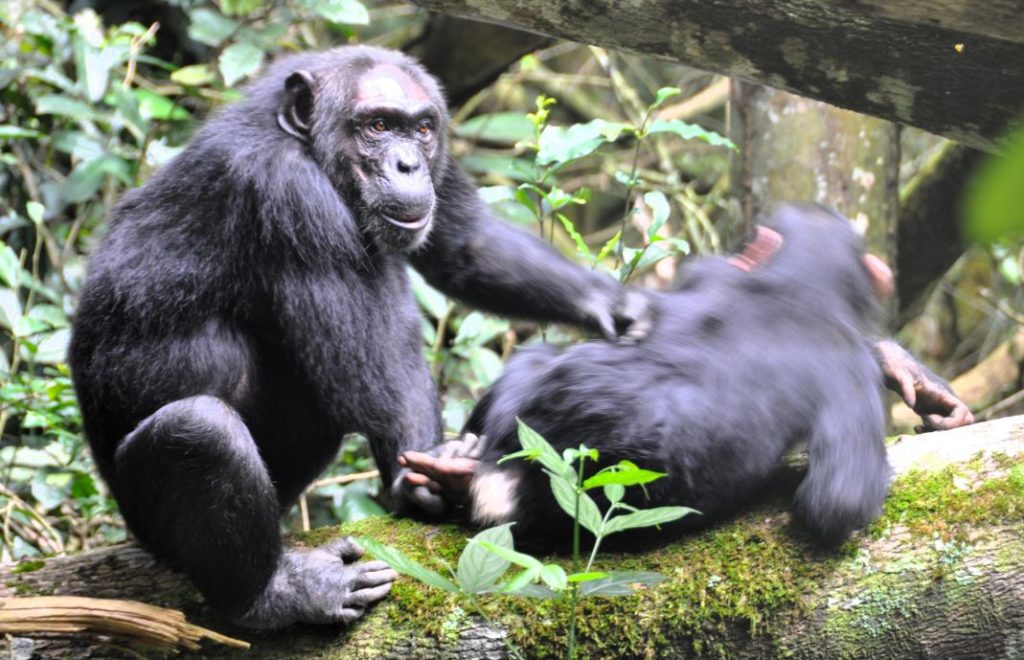
The chimps lounge comfortably on a tangle of fallen trees, entirely unbothered by our presence. A large male reclines lazily, one arm slung behind his head like he’s in a hammock. Two juveniles groom each other with slow, affectionate focus.
It’s pure magic.
And just when we think the moment couldn’t get better – it does.
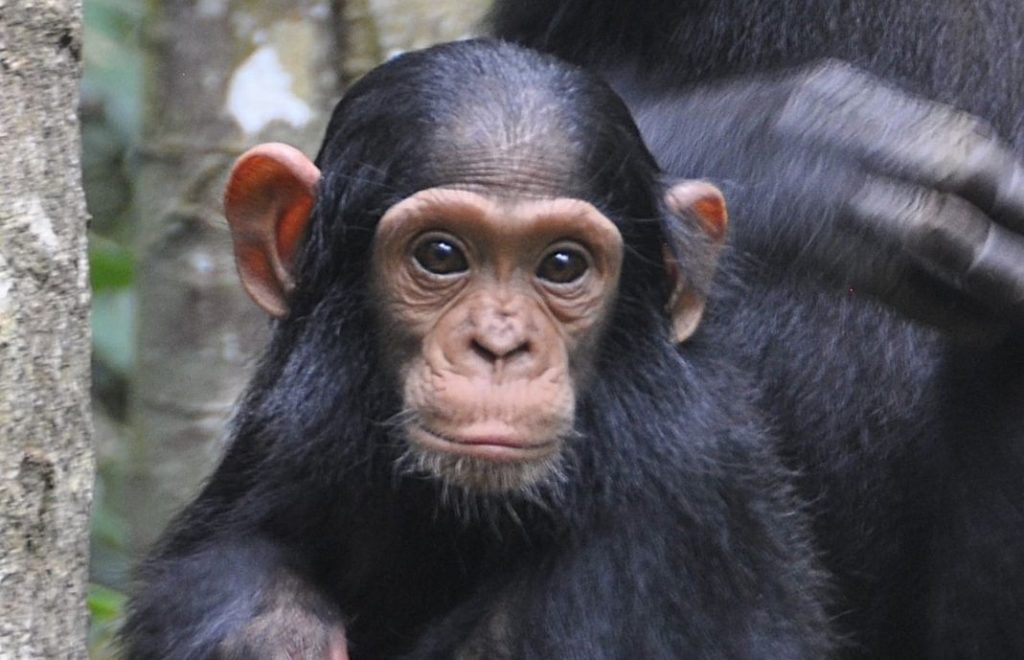
A baby chimp stumbles over a tree trunk, spots a stick, and snatches it like a sword. Now it’s showtime. With theatrical flair, he brandishes it left, right, and center like a miniature pirate in battle. He bounces on the log, swinging the stick with wild delight, clearly convinced he’s the alpha of this clearing.
This little rascal is a full-on Duracell chimp – boundless energy in a fuzzy black package.
One moment he’s hanging by one arm, so the other. Then, with a cheeky twist, he flips upside down, dangling by his foot. Chimpanzees, after all, have as much dexterity in their toes as they do in their hands.
A few meters away, mom sits calmly, watching her little whirlwind with loving eyes. But when he makes a sudden dash for the underbrush, she’s there in a flash. With a swift but gentle tug, she reels him in, ending his jungle escapade.
There are no protests. He folds into her arms without resistance, curling up contentedly against her chest-clearly more than happy to swap his pirate sword for a quiet cuddle.
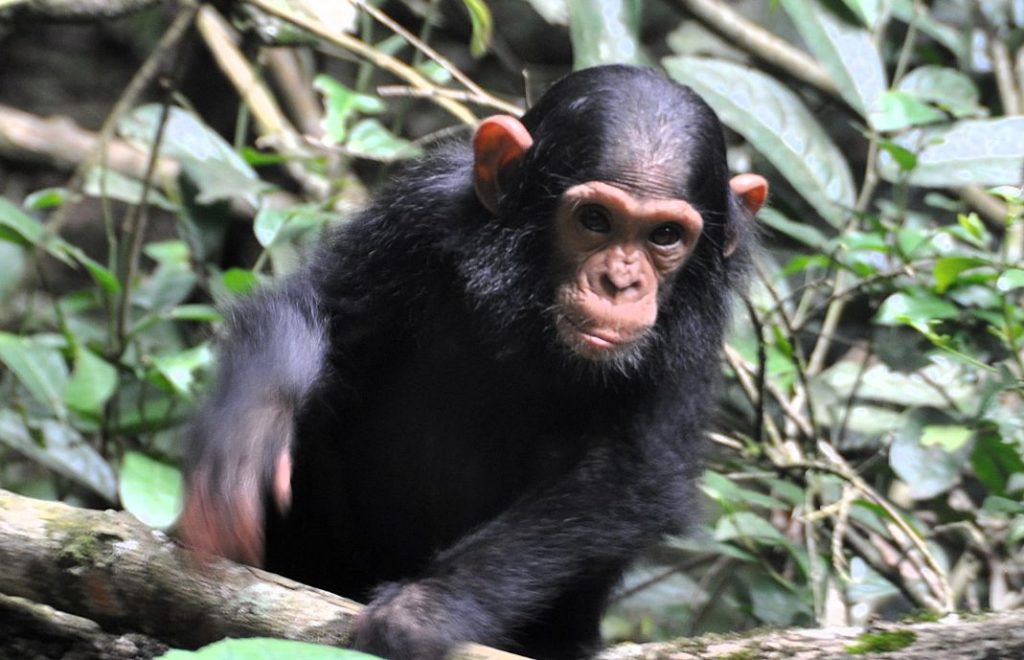
A day full of monkey business
Renowned primatologist Jane Goodall once said, “When you meet chimpanzees, you meet individual personalities.”
And she couldn’t be more right. With 98% of our DNA in common, chimpanzees are our closest living relatives – and the resemblance is undeniable.
They have clear family structures. They feel joy, sorrow, and empathy, just as we do. Though I doubt they’re quite as excited to see us as we are to see them.
Like humans, chimps are highly social creatures. While they don’t gather around a kitchen table, they bond in their own way. Grooming, cuddling, and picking through each other’s fur. It’s more than hygiene; it’s affection, reassurance, connection. And they can spend hours at it, every single day.
Our time with them – just one hour – flies by far too quickly. Park rules strictly limit how long we can stay, and now, it’s time to say goodbye and let them be.
Sweaty, muddy, and glowing with joy, we begin the trek back to headquarters, grinning like kids who’ve just gotten away with something.
And honestly, that’s exactly how it feels – because we’ve just had a wild, wonderful dose of monkey business in Kibale.
More inspiration: A guide to chimpanzee trekking in Kibale
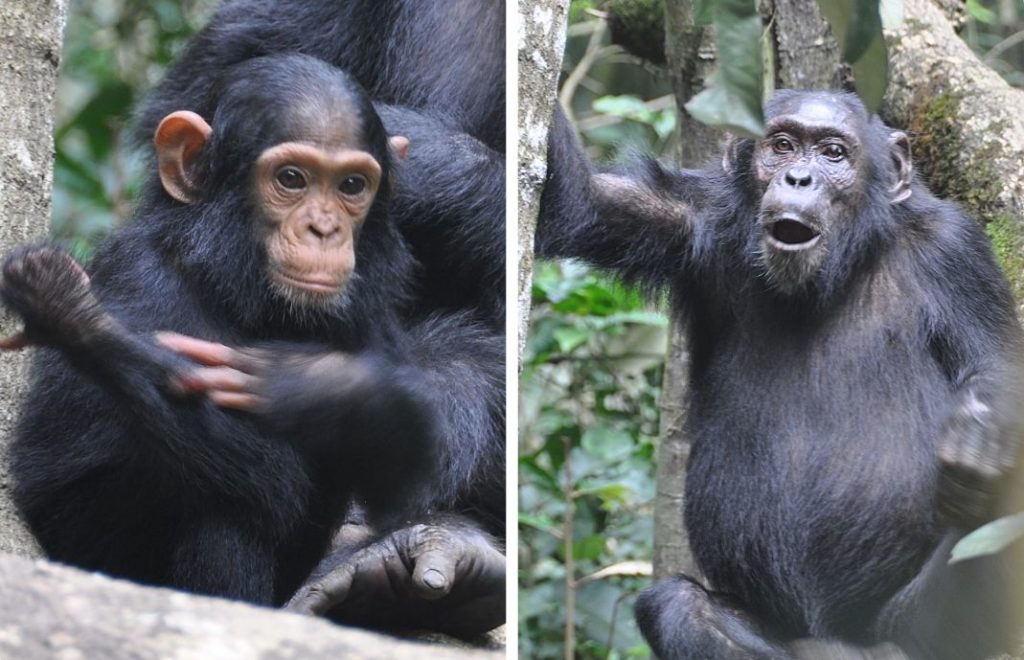
Chimpanzee facts
The chimpanzee (Pan troglodytes) belongs to the genus Pan in the great ape family (Hominidae). Alongside the bonobo (Pan paniscus), the chimpanzee is humankind’s closest living relative. We share a remarkable 98.7% of our DNA with them.
Height: 120–160 cm
Weight: 30–50 kg
Distinctive features
Chimpanzees are covered in fine black or dark brown hair, with bare skin on the face, hands, and feet. Facial skin may range from dusky pink to deep black.
Their arms are longer than their legs, and both hands and feet are highly dexterous, making them expert climbers and foragers. On the ground, they typically move on all fours using a knuckle-walking gait, but they are also capable of walking upright on two legs for distances up to 1.6 kilometers.
Habitat & distribution
Chimpanzees are endemic to Africa, meaning they are found nowhere else in the wild. They inhabit tropical rainforests, deciduous woodlands, and savannas across West and Central Africa.
From the dense jungles of Uganda to the forests of Côte d’Ivoire, these intelligent and social primates are a vital part of Africa’s ecological heritage – and an unforgettable encounter for those lucky enough to meet them in the wild.

The life of a chimpanzee
Much like humans, chimpanzees are deeply social creatures. They live in groups ranging from 20 to 100 individuals, led by a dominant alpha male. Grooming – removing ticks and dirt from each other’s fur – is a vital part of their social structure, strengthening bonds and maintaining harmony within the group.
Highly skilled climbers, chimpanzees spend the majority of their time high in the treetops, where they build nests from branches and leaves to sleep in each night.
They are also remarkably intelligent and are among the few animal species known to use tools. Chimpanzees craft sticks to fish for termites or extract food from crevices, and they crack open nuts using stones. When thirsty, they fold leaves into makeshift cups to scoop up drinking water – ingenuity in its purest form.
Communication among chimps is just as complex. They use a combination of facial expressions, body language, and vocalizations to interact, expressing everything from joy and curiosity to warning signals and social status.
In the wild, chimpanzees can live up to 40–45 years.
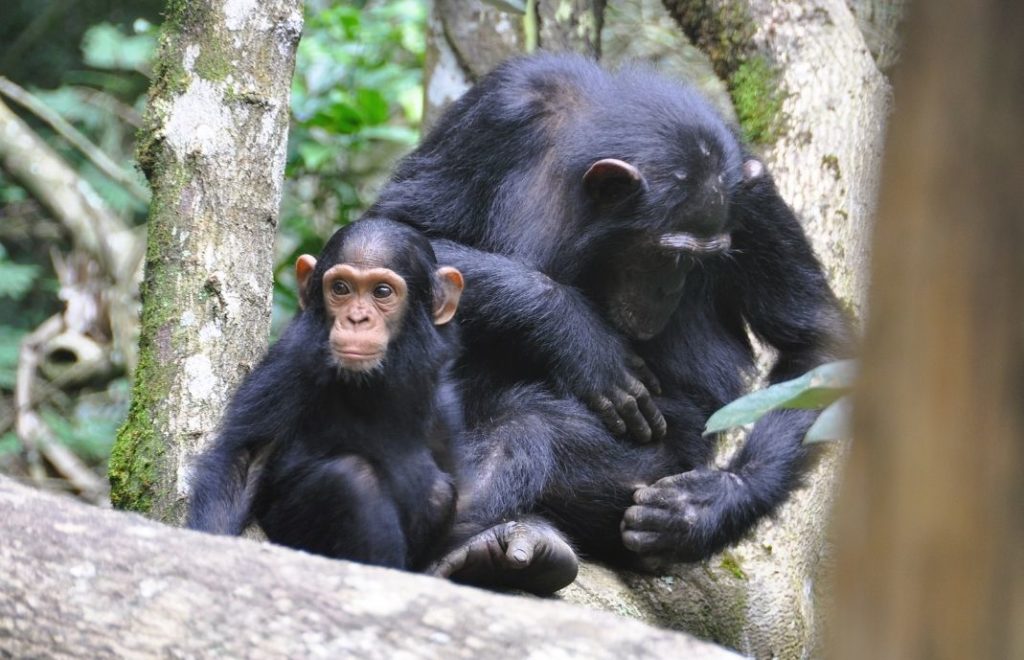
A species under threat
Sadly, the chimpanzee is classified as endangered. Fewer than 300,000 remain in the wild, and they have already vanished completely from at least four countries.
Their decline is driven by habitat loss, poaching, and disease outbreaks. Since the 1980s, Ebola has claimed the lives of tens of thousands of great apes – including large numbers of chimpanzees.
Despite their resilience and intelligence, these incredible animals face a precarious future – one that hinges on our collective will to protect them and the forests they call home.