
What do two rearing horses, a sailing ship, and three bundles of wheat have in common? In Pennsylvania, they all have an important place on the state flag.
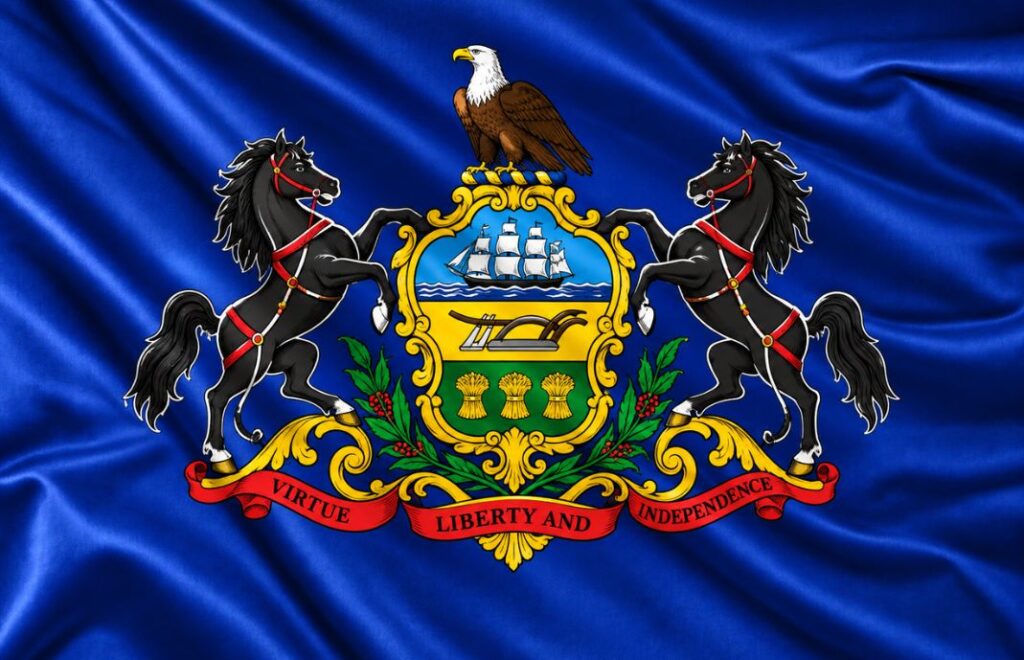
Against a deep blue background sits the Pennsylvania coat of arms, with two powerful black horses standing on either side of a colorful shield. Above them, a magnificent bald eagle spreads its wings, representing the state’s sovereignty and its connection to the United States.
But look closely at the shield, and you’ll discover three symbols celebrating Pennsylvania’s history and prosperity.
A sailing ship represents international trade and commerce, while a plough symbolises the state’s rich natural resources and agricultural traditions. Beneath them, three golden sheaves of wheat celebrate fertile farmland and the importance of agriculture.
And there is more. Below the shield, an olive branch and a cornstalk represent peace and prosperity, while a flowing ribbon carries Pennsylvania’s motto: “Virtue, Liberty, and Independence.”
A fitting message for a state that played such an important role in America’s struggle for independence.
After all, it was in Philadelphia that the Declaration of Independence was adopted in 1776, and where the United States Constitution was drafted in 1787.
Here’s an interesting little detail about the flag itself
Pennsylvania’s coat of arms dates back to 1778, when it was designed by Philadelphia merchant Caleb Lownes. The state authorized a flag featuring the emblem in 1799, making it one of America’s earlier state flag designs.
However, things became a little confusing over the years. Different versions appeared, particularly during the Civil War, when some Pennsylvania military units carried flags combining elements of the American flag with the state coat of arms.
To bring some order to the situation, Pennsylvania standardized its state flag in 1907, even specifying that the blue background should match the blue used in the Stars and Stripes.
So, while Pennsylvania’s flag may look like a traditional coat of arms, it carries a fascinating story of trade, agriculture, independence, and a state that helped shape the foundations of the United States.
