Far out in the vast expanse of the Pacific Ocean lies an otherworldly archipelago – a place where nature reigns supreme, raw and unrestrained. These islands are a living laboratory of evolution, where every creature and every crag seems to tell a story older than time itself.
It was here, in 1835, that Charles Darwin set foot and gathered observations that would forever alter humanity’s understanding of life. His discoveries on these remote shores reshaped science and sparked one of the most profound shifts in the way we view the natural world.
The name of this magical realm? The Galápagos Islands – a cluster of volcanic jewels that remain as wild and wondrous today as when Darwin first glimpsed their rugged silhouettes on the horizon.
Welcome to Santa Cruz – Gateway to the Galápagos
The plane dips sharply, slicing through the clouds, and suddenly the Pacific reveals a scattered constellation of volcanic islands – 21 fragments of raw beauty, adrift in an endless blue. Below me lies a world where nature calls the shots and humanity has no choice but to obey.
Before landing, the cabin is misted with disinfectant – an extra layer of protection to shield these fragile ecosystems from stowaway microbes. Then, the rush begins. Passengers surge forward, eager to touch this dream made real. For most, a trip to the Galápagos is a once-in-a-lifetime pilgrimage – a journey paid for in both currency and anticipation.
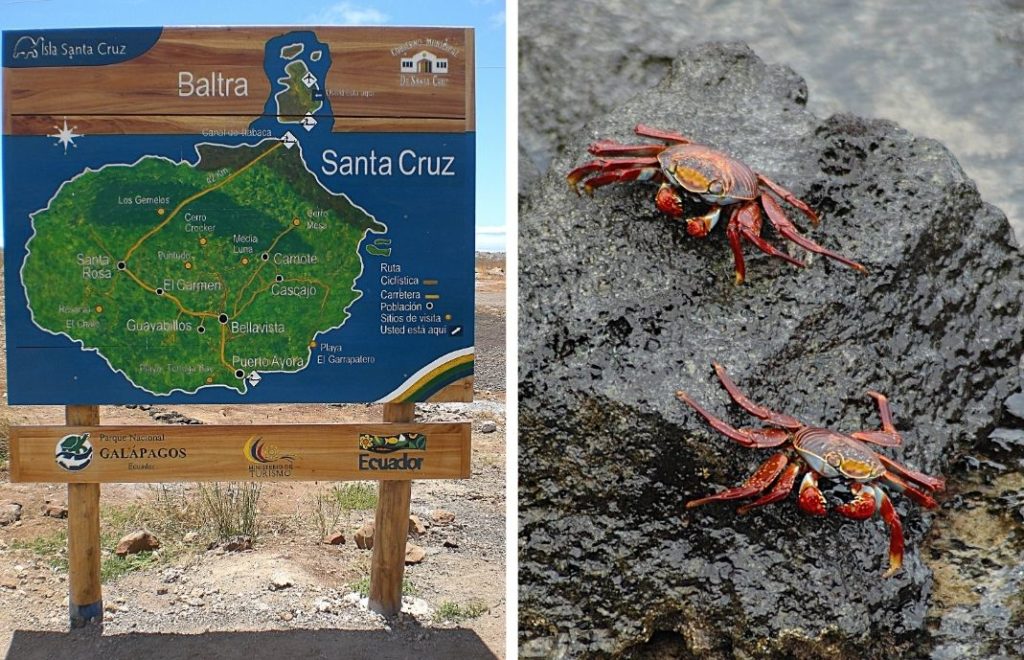
My first stop: Santa Cruz, where the vessel that will serve as home for the next five days awaits. The thought of sleeping on a boat makes my stomach lurch – I’m notoriously prone to seasickness – but there’s no denying the truth: the best way to experience the Galápagos is by water, island-hopping across an archipelago that time forgot.
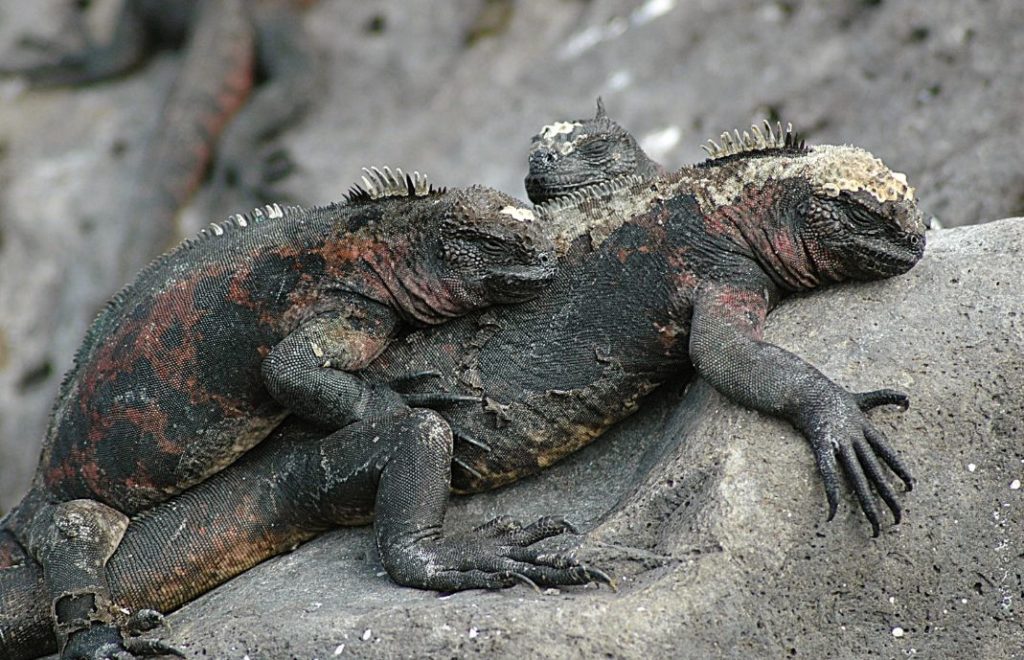
Even before reaching the harbor, the islands declare their dominion. A hulking sea lion snoozes contentedly on a wooden bench, oblivious to human hustle. Marine iguanas – those prehistoric throwbacks – cling to seawalls like stony gargoyles. Pelicans perch lazily in mangrove trees, and crimson Sally Lightfoot crabs scuttle sideways along black lava rocks, tiny splashes of color against the darkness.
Already, these remote isles feel like paradise – untamed, unapologetic, and utterly mesmerizing.
The adventure begins!
The crew gently shoos the sea lions off the lower deck, raises the anchor, and with a low hum of engines, we set a steady course toward Española – the southernmost of the Galápagos Islands. The boat cuts through the sapphire sea, frothy spray leaping in its wake like liquid diamonds.
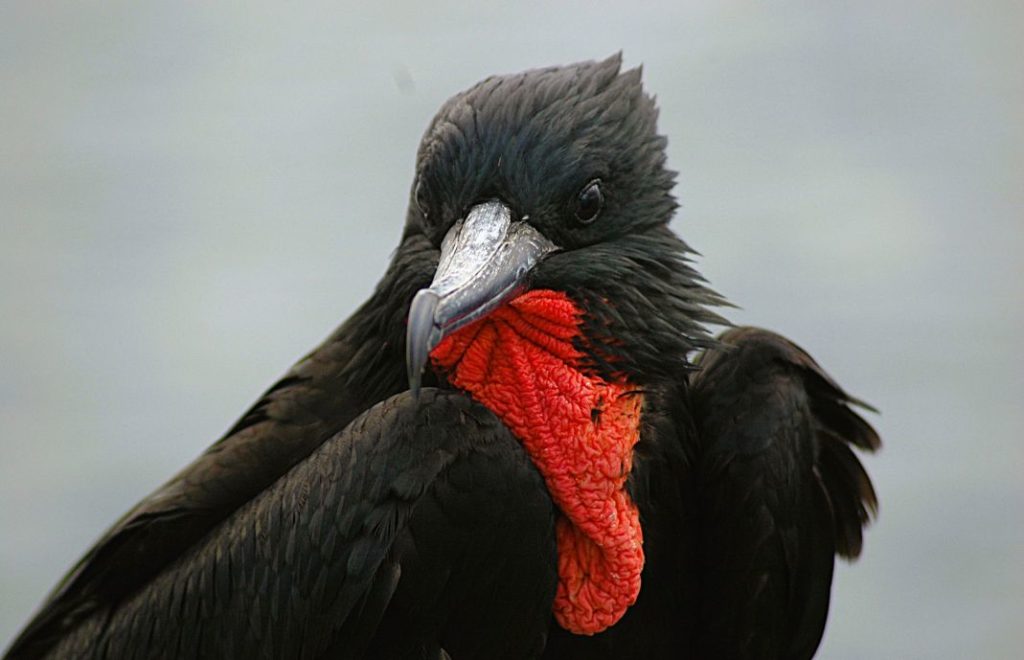
A flash of motion catches my eye – a frigatebird glides down with effortless grace and perches on the railing. Minutes later, he begins his courtship ritual: inflating his scarlet throat pouch into a brilliant balloon, a beacon of avian bravado. He struts and shimmers in the sunlight, an unapologetic showman against the endless blue.
Approaching the island, the rules of the Galápagos become clear: no anchoring offshore. Instead, guests are ferried in by inflatable dinghies. The landing? Let’s just say it’s not for the faint of heart. There’s an art to leaping from boat to surf-slick rock – or embracing the inevitable and wading in. Either way, expect wet feet and, for the less nimble, perhaps an unscheduled dip.
But who cares about soggy shoes when the reward is a once-in-a-lifetime experience?
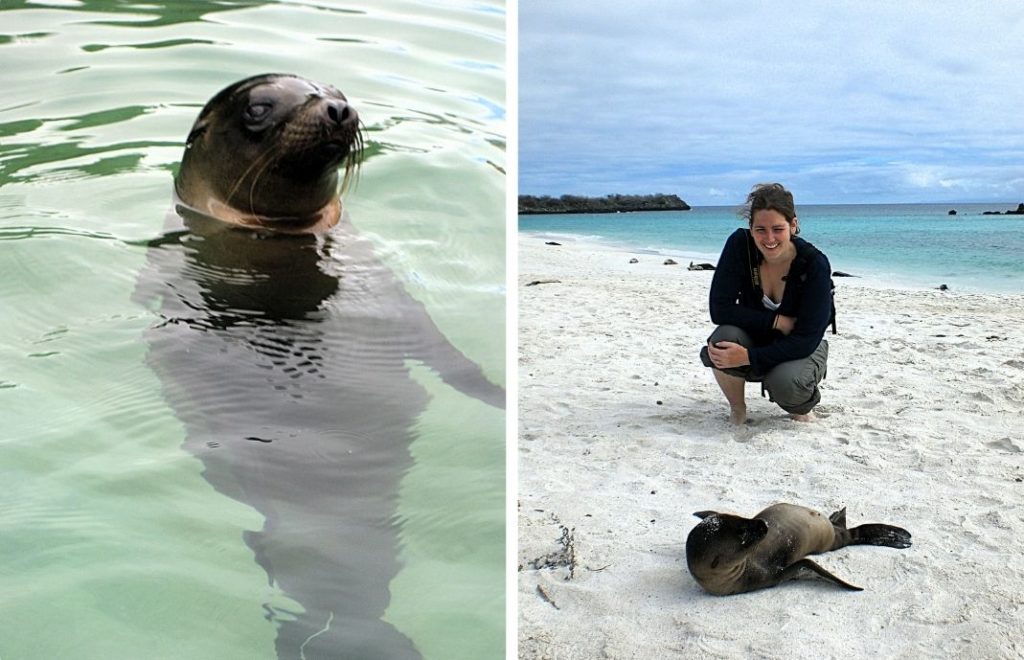
Española greets us like a dream: a sweep of sugar-white sand under a cobalt sky, its shoreline scattered with Galápagos sea lions – lounging in tangled heaps, sunbathing like seasoned pros. Their sleek bodies glisten in the heat, flippers flopped lazily over each other in a tableau of pure, unfiltered paradise.
And then comes the moment etched into memory: swimming with sea lions. Slipping into the crystalline water, I’m enveloped by a sense of wonder as these marine acrobats dart and twirl around me, inviting play in their underwater realm. Their eyes – liquid, curious, mischievous – meet mine, and for an instant, I feel like I’ve crossed some invisible threshold into their world.
This isn’t just an excursion; it’s a communion with the wild – a story you’ll tell forever.
Tag, you’re it – Playing with sea lions
The Galápagos sea lions – sleek, playful, and utterly endearing – are masters of mischief. These elegant creatures, found nowhere else on Earth, don’t just tolerate visitors; they invite you into their world. Believe it or not, they love to play – and if you’re lucky, you’ll find yourself caught up in the most unforgettable game of tag you’ll ever experience.
Mask and fins on, I plunge into the turquoise embrace of the Pacific. Within seconds, the sea lions are there, swirling like liquid shadows, eyes bright with curiosity. One darts past, another loops beneath me, as if daring me to join their choreography. I do my best to keep up – but let’s be honest: when it comes to speed and grace, I’m no match.
Then, it happens – a moment that will live forever in my memory. A tiny, wide-eyed pup glides toward me, hesitating for a heartbeat before closing the gap. He tilts his head, studies me with solemn curiosity, then presses his whiskered snout against my mask. For a breathless instant, I’m nose-to-nose with wild innocence.
And just like that, he’s gone – darting under me, fixated on my bright fins. A gentle nudge, then another, as if to say, Nice try, human. Moments later, he’s off chasing some new distraction, leaving me suspended in the shimmering blue, heart pounding with wonder.
Back on the sun-bleached sands, lunch awaits – under strict Galápagos rules: every crumb and scrap must leave with us. But before I return to the boat, there’s time for one more gift: a slow stroll along the shoreline, flanked by sea lions in every pose imaginable. Some waddle to the surf for a cooling dip; others twist and tumble in the waves like ballerinas of the sea. Most simply sleep, blissfully entwined, while tiny pups snuggle against watchful mothers.
This isn’t just wildlife-watching. This is connection. A privilege. A front-row seat to nature’s unfiltered theater – set on the white sands of Española, under a sky so blue it seems painted by the gods.
Meet the world’s largest bird – The waved albatross
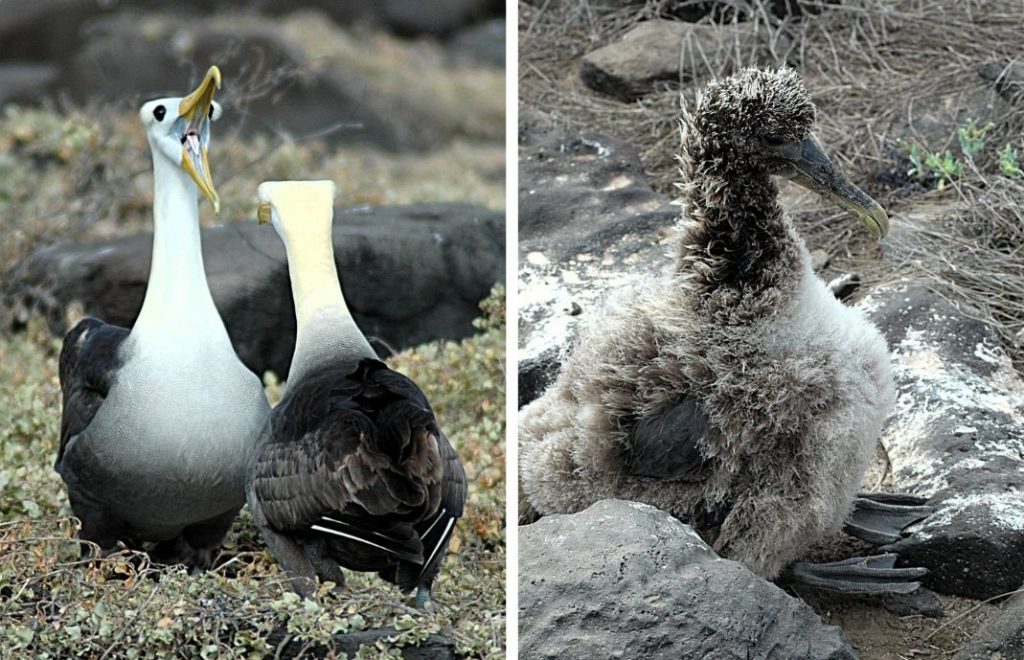
Española isn’t just about sea lions and pristine beaches – it’s also home to one of the planet’s most extraordinary avian spectacles. This remote island is the only place in the world where the waved albatross breeds, making it a pilgrimage site for bird lovers and nature enthusiasts alike.
These aren’t just big birds – they’re giants of the sky. With a wingspan stretching up to 2.5 meters, the waved albatross commands the air with an elegance that borders on the supernatural. They can soar for hours, even days, without flapping, riding invisible currents like masters of the wind.
And I’ve hit the jackpot: it’s breeding season. What unfolds before me is less a wildlife sighting and more a courtship ballet, raw and mesmerizing. The ritual begins with the clack-clack-clack of beaks colliding in rhythmic percussion. Then comes the dance: a series of exaggerated head-bobs, wing-stretches, and elegant fencing gestures, punctuated by haunting duet calls that echo across the island.
These performances aren’t fleeting flings. Once a pair bonds, they mate for life – soulmates of the skies, as steadfast as any Romeo and Juliet. Watching them, I feel as though I’ve stumbled upon an ancient rite scripted by nature itself – a love story carried on the wind.
No rush on San Cristóbal
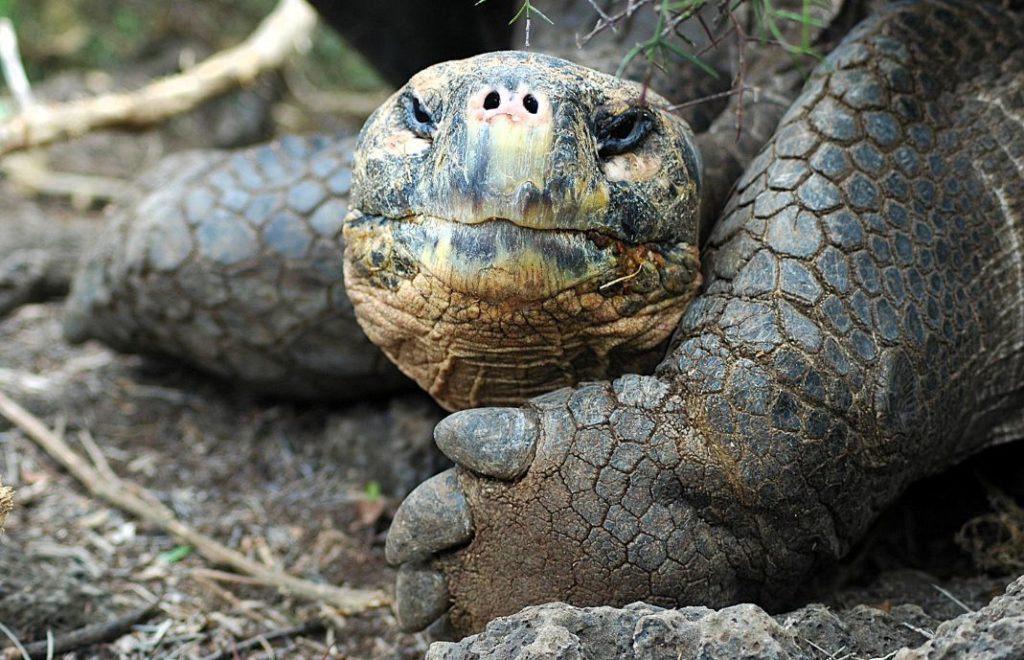
The sun blazes, the ocean lies calm and glittering – but I feel like death warmed over. Seasickness has wrung me out, leaving me pale and limp, a Nordic castaway in paradise. I collapse into the inflatable dinghy, clinging to the edge as cool spray lashes my face like tiny whips of salvation. I focus on the promise that awaits ashore: giant tortoises – the living icons of the Galápagos.
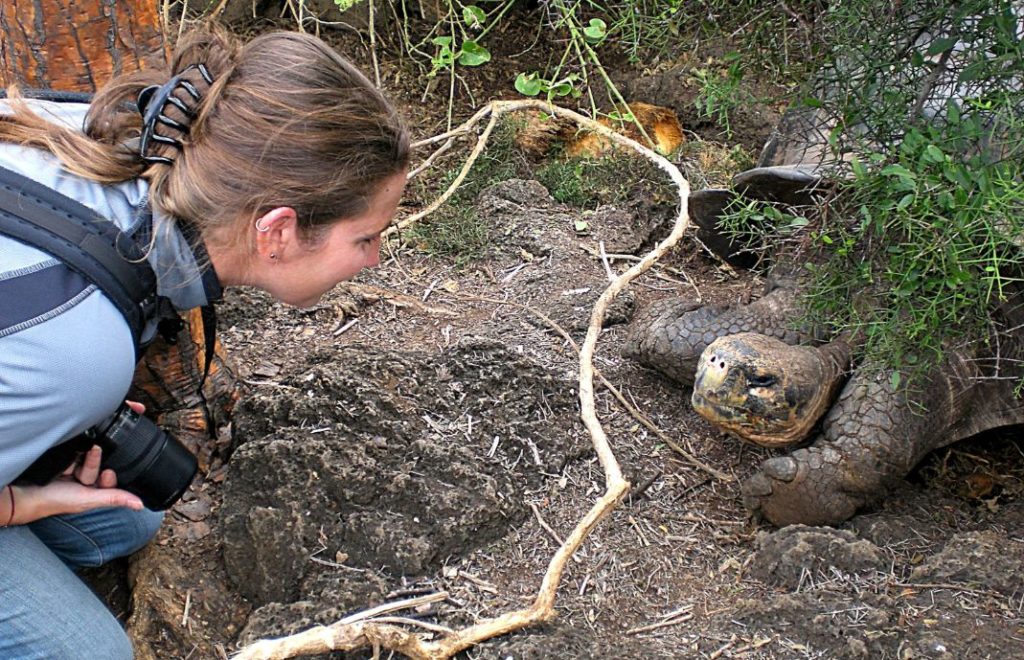
At last, solid ground. And there they are. The very emblem of these enchanted isles. A colossal creature lumbers into view, one slow, deliberate step at a time. He moves like time itself – measured, unhurried, eternal.
It makes sense. When you can live for nearly 200 years, why rush? These titans never stop growing, some tipping the scales at over 250 kilos. Meeting one feels like brushing against the prehistoric – a living relic from a world long vanished.
Their beauty is spellbinding. I fall hopelessly in love.
Each shell tells a story: some arch like ancient domes, others curve in elegant saddles, an adaptation to the vegetation of their home island. These are the largest tortoises on Earth, found only on a handful of Galápagos islands – and nowhere else save the far-off Seychelles.
As I stand there, seasickness forgotten, I can’t shake the feeling that this isn’t just a wildlife encounter. It’s an audience with the past – a moment carved out of deep time, delivered on the slow, stoic back of a creature who has outlived empires and will outlast me, too.
The Enchanted Isles – A farewell to Galápagos
In between those unforgettable encounters – the sea lion games, the giant tortoise audiences, the albatross ballets – our days were strung with moments that felt nothing short of magical.
Darwin’s finches flitted from branch to branch, each beak a masterclass in adaptation. Blue-footed boobies danced their comic courtship on sunlit shores. Marine iguanas sprawled like living fossils, oblivious to our awe. Scarlet Sally Lightfoot crabs darted across volcanic rocks, while flamingos shimmered like pink mirages in brackish lagoons. Even the shadows below held wonders – reef sharks gliding silently through indigo depths.
Add to that the backdrop: sunsets that set the horizon aflame, nights under vaults of unpolluted stars, meals crafted from the ocean’s bounty, and dolphins racing the boat in a silver-sparked chorus of waves. It was paradise – if paradise came with a generous side of seasickness and an occasional longing for still ground.
Here, evolution isn’t just a theory – it’s a living story. Every feather, fin, and scale speaks of survival. On these volcanic outposts, life learned to bend rather than break: fusing endurance with elegance in ways that leave even the most seasoned traveler humbled.
And yet, nothing here is eternal. The Galápagos are in constant flux – new islands rising from the sea as old ones sink back into the deep. A circle of creation and erasure, a rhythm of time that reminds us how fleeting – and precious – life is.
I rarely return to the same place. The world is vast, and my compass restless. But the Galápagos? They are the exception. I would come back again. And again. And again.
All journeys end, even the enchanted ones. But the spell lingers, as strong and unyielding as the Pacific wind. It’s no wonder these islands are called “Las Islas Encantadas” – The Enchanted Isles. They bewitch, they bind – and I hope their magic never lets go.
“It is not the strongest of the species that survives, nor the most intelligent, but the one most responsive to change.”
Charles Darwin (1808-1882)