
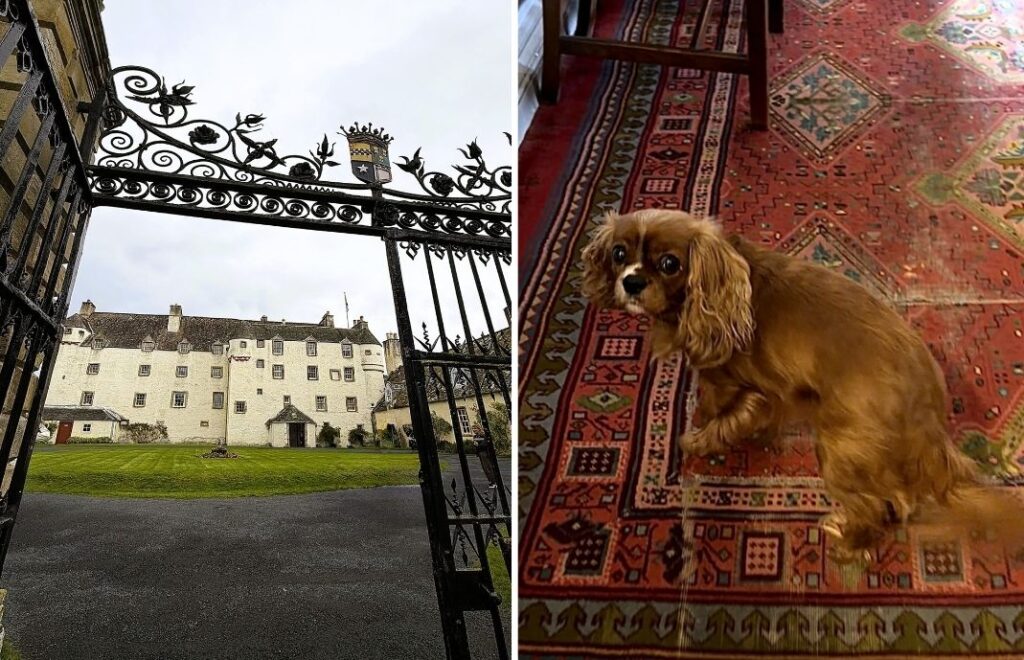
A cute little four-legged princess with fluffy, swinging ears, wagging tail and an overload of energy greets us as we exit the bus. Delphi, the furry lady with the most adorable eyes and huge personality, is the welcome committee at Traquair House. Delphi’s owner, the 21st Laird (Lady of Traquair), Cathrine Constable Maxwell Stuart, is not far behind.
Our guide for today is, officially, Laird Cathrine, but it is Delphi that takes charge. Eager to show what a good girl she is (and that this is her territory), she runs ahead, through the impressive gates and towards the house.
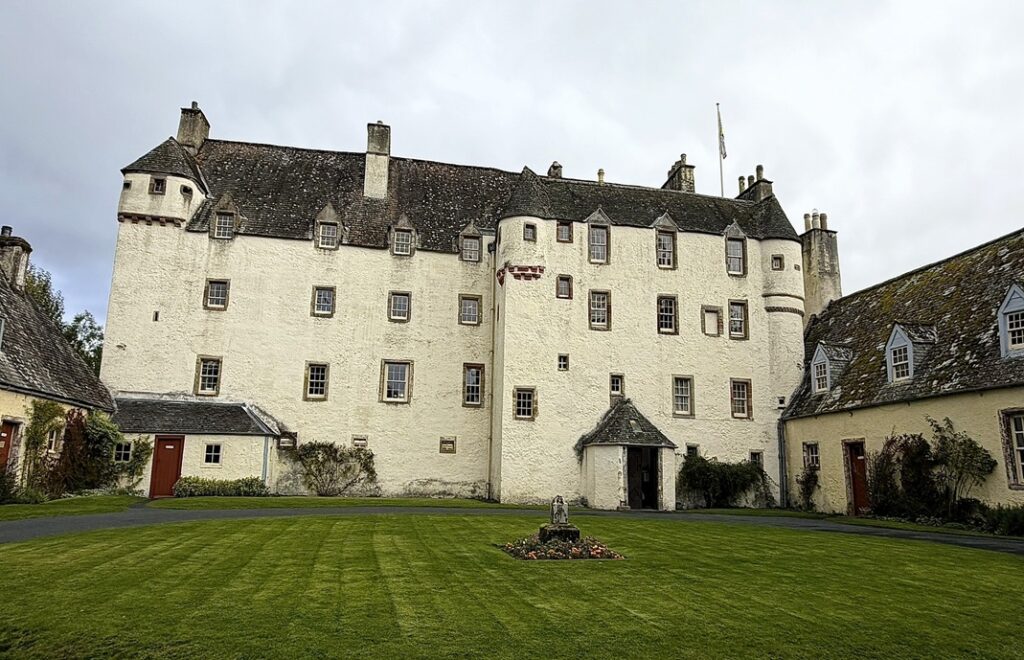
Traquair has been visited by 27 Scottish Kings and Queens and dates back to 1107. It has been lived in by the Stuart family since 1491 and has a mighty impressive history. It is this story Laird Cathrine and Delphi will reveal, layer by layer. However, after showing us a few rooms, Delphi gets bored and disappears to explore (or take a nap) away from us tourists.
Where history comes alive
Laird Cathrine on the other hand is ready to take us through the centuries, and her story starts with the famous Bear Gates, which have been closed since 1745. That’s when Bonnie Prince Charlie was the last person to pass through them. The Earl of Traquair promised they would not be reopened until a Stuart king was crowned in London. The gates have been closed ever since.
And so, our journey back in time begins…
For the next hour, we will hear stories about how Traquair started as a royal hunting house, played host to Mary Quen of Scots and how the family, as staunch Catholics, supported the Jacobite cause without counting the cost. We will also explore “hidden” stairways and taste beer from their own brewery.
Traquair is Scotland’s oldest inhabited house. In 1491, the house was gifted by the Earl of Buchan to his son, James Stewart, who became the first Laird of Traquair. It is impressive to learn that it has been lived in for over 900 years, and during our visit, history really comes to life in front of us. Not only through the artifacts, walls and ceilings but through the fascinating stories that Laird Cathrine shares with us. Yes, it might be a bit difficult to follow all the lairds, kings, and queens but it does not really matter. You will be drawn into the story regardless.
Every room has a unique story
The family has striven to keep the house primarily as a home, and the atmosphere truly reflects this. At the same time, Traquair remains an authentic piece of living history. Your visit will combine the sense of being in a home as well as a museum.
As we enter the house, we find ourselves in the Entrance Hall. It was here the Marquis of Montrose hammered in vain on the great inner door when he sought shelter at Traquair after his defeat at Philipaugh in 1645.
The Earl of Traquair pretended he was not home and was later accused by Montrose of treachery. The earl, however, assured the safety of his own person and the House of Traquair from the vengeance of the victorious Covenanting General Leslie, who was in hot pursuit.
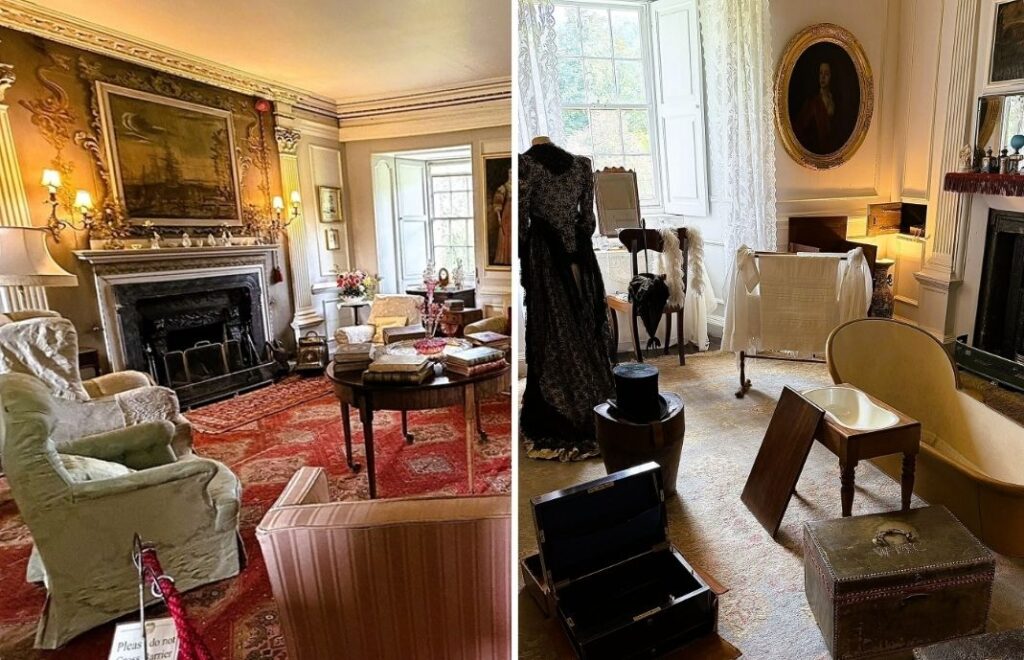
Next stop is the High Drawing room, completed in the 16th century, where Delhi decides to test out the couch and strikes a pose under the table. That is, sadly, the last we see of our furry guide as she has other duties to attend to.
We continue to the Dressing room, which has been arranged to demonstrate the domestic life of former times, with bath, bidet, hot water cans, slop basin and washstand. In Traquair, the first bathroom with running water was installed in the 1920s, and electricity was introduced in the late 1950s.
Royals, relics, and secret stairs
Scotland’s history is a bit “complicated”, and it is not easy following all the kings and queens, or lords and lairds for that matter. But as we enter the King’s Room, there is a name most of us have heard of: Mary Queen of Scots.
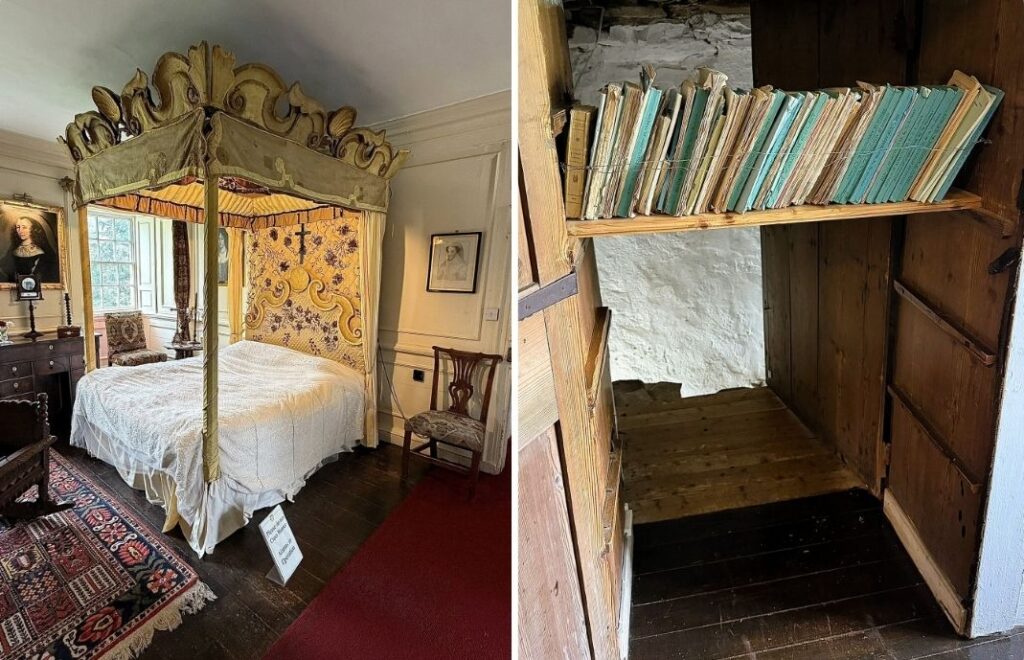
Laird Cathrine tells us that Mary herself stayed in this very room when she visited Traquair in 1566. Accompanied by her baby son and husband, Lord Darnley, she was the guest of Sir John Stuart (4th Laird of Traquair) who was captain of Mary’s bodyguard. Mary slept in the bed and the cradle was used by her infant son, who was to become James VI of Scotland and James I of England.
We leave the royals behind and head to the Museum Room, filled with items used by the family through the years.
Moving on, we enter the First Library, which has been restored to its original eighteenth century glory. It was created by the 4th and 5th earls during the 1730s and 1740s. It is an impressive collection, numbering about 3,000, and it has remained intact since the library was first formed.
Our next step draws our attention and arises a bit of excitement. We have made our way to the Priest’s Room, where the resident chaplain lived in hiding under the Catholic Emancipation Act, passed in 1829.
Laird Cathrine shows us a hidden door and asks if we want to (at our own risk) follow in the fugitives’ footsteps and (carefully) go down the three flights of the old stairs. None of us pass on the possibility to explore the “hidden stairs” and into the bookshelf we go.
The Lady who defied the Tower
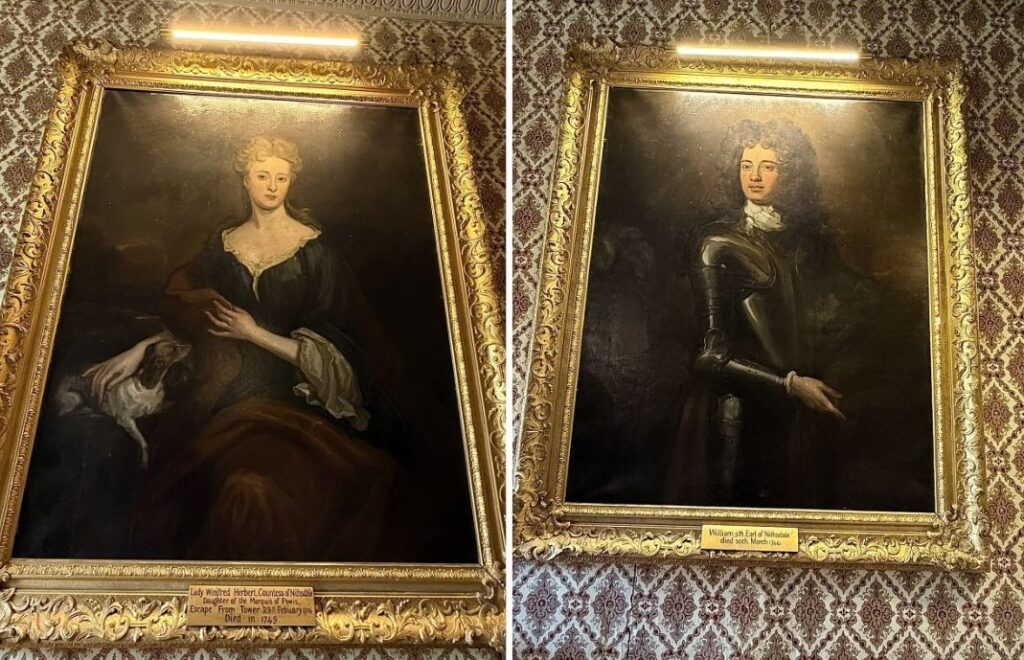
In the Dining Room another fascinating story from the past comes to life. Laird Cathrine points out two large portraits on the back wall.
The story goes like this:
As strong Jacobite sympathizers, the 4th Earl of Traquair and his wife, Lady Mary Maxwell, were determined to support the 1715 Uprising. They lent their support to Mary’s brother, William, Lord Nithsdale, who went to fight for the Jacobite army. Unfortunately, he was taken prisoner and taken to the Tower of London where he was sentenced to death.
His wife Winifred rode to London in an attempt to gain a pardon from the king for her husband. When this failed, she devised a desperate plan to rescue her husband by smuggling him out of his cell disguised as her maidservant. Her bravery extended to ensuring her maidservant was rescued as well.
They escaped to France where they lived with the exiled Stuart court but sadly, could never return to Scotland.
Traquair ghost story
If you are a castle or historic house, you must have at least one ghost. Traquair is no exception.
One warm July afternoon in the 1920s a young farm hand, Andrew Brown, was working in the joiner’s shop that stood just off the old avenue leading to Traquair House. The avenue had been out of use since 1745, and to this day the gates are shut and the disused avenue grassed over.
As he bent over his work bench, Andrew was conscious of someone walking outside. He went to the door and saw a woman coming towards him. She was dressed in a dress that belonged to the previous century.
To his amazement, when she arrived at the little gate in the fenced-off area, she did not pause to open it. Instead, she walked straight through and then through the gate on the other side, continuing across the avenue.
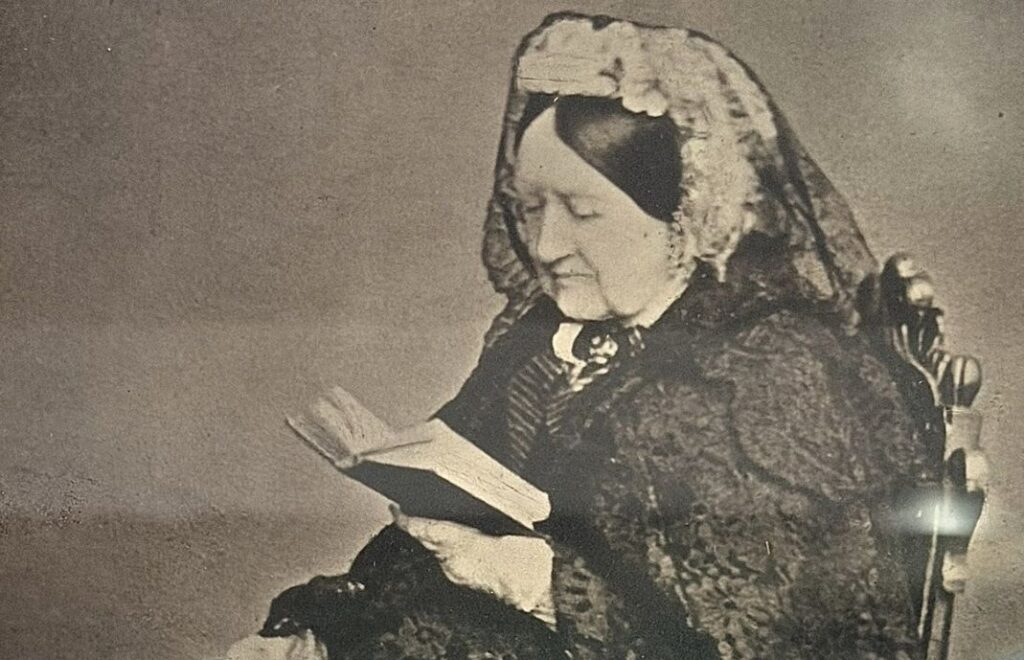
Andrew, who had never experienced anything abnormal at Traquair before, was determined to find out who the lady could be. He contacted a friend whose grandmother had been a dressmaker to Lady Louisa Stuart, the sister of the last Earl of Traquair. Lady Louisa passed away at the age of 99 in 1875.
The dressmaker had kept samples of all the materials she had used to make clothes for Lady Louisa, and these were now in her granddaughter’s possession. When Andrew looked through them, he at once picked out the material of the dress that the ghost had been wearing.
Andrew knew that the ghost was none other than Lady Louisa herself. He later learned from a descendant of her gardener that the old lady’s regular walk had been around the avenue. In Lady Louisa’s time, the joiner’s shop had not been built.
Source: Traquair – the official guidebook
Other experiences at Traquair
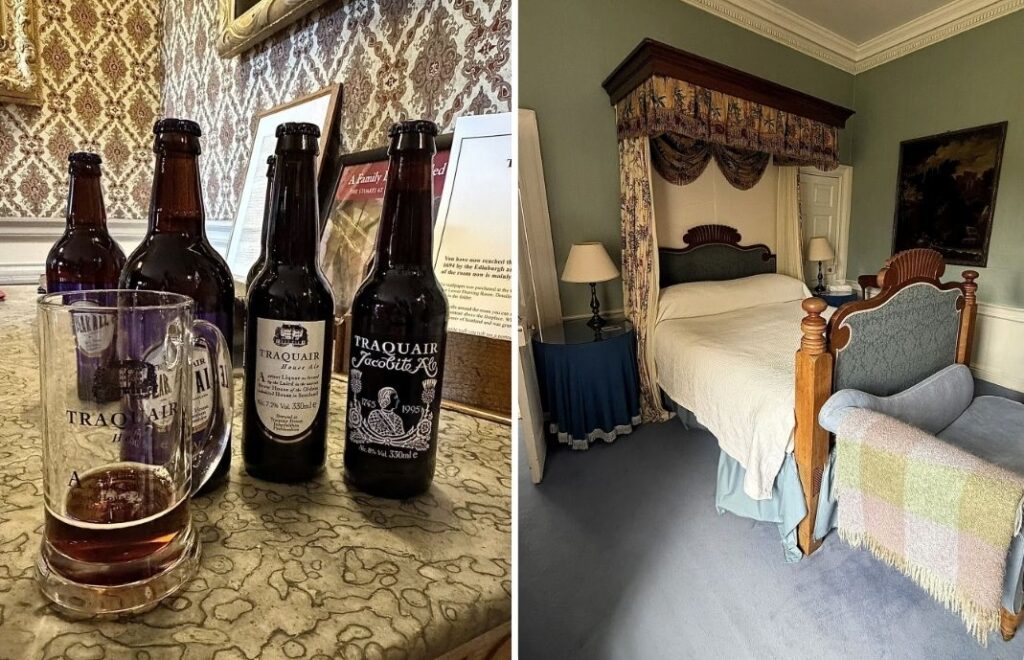
Traquair House Brewery lies directly under the Chapel and dates back to the early 1700s. It was originally a domestic brewery serving the house and the estate. In the early 1800s it was disused but never dismantled. The family filled the brewery with different things until it was completely forgotten.
Cleaning up is always a good thing, and Peter Maxwell Stuart rediscovered the brewery in the early 1960s. He began brewing again as an experiment in 1965, using all the original equipment and fermenting the ales in the original oak tuns.
Today Traquair employs two full-time brewers, and the production is approximately 800 barrels per year, or around 250,000 bottles. Altmost 70 percent of the production is exported.
Visitors can also have a look in the beautiful chapel, enjoy a walk in the woodlands or explore the maze, which takes about half an hour.
If you are looking at sleeping like a king or queen, Traquair offers four spacious double bedrooms, with a minimum of 2-night stay during high season. The rooms are furnished with antique furniture, canopied beds, central heating and have a private bathroom. A full Scottish breakfast is included.
Do as 27 Kings and Queens have done before you and make sure to include Traquair House in your program. Perhaps Delphi will greet you at the entrance and see Lady Louisa (or at least her ghost) going for her walk!
My warmest gratitude to Visit Britain and Traquair House for inviting me. There were no requirements from either of them regarding posts on social media or promotion. Options and photos (unless otherwise stated) are entirely my own.
