
What if you could discover thousands of years of Scottish history without turning a single page? Instead of reading about battles, kings, queens, inventions, and ordinary lives, imagine seeing their stories unfold through millions of carefully placed stitches.
In the charming Borders town of Galashiels, The Great Tapestry of Scotland offers exactly that. This extraordinary work of art takes visitors on a colorful journey through Scotland’s past, capturing everything from dramatic turning points and legendary figures to the everyday people whose lives helped shape the nation.
But this is no ordinary tapestry, and certainly no ordinary history lesson. It is an ambitious celebration of Scottish identity, creativity, humor, hardship, and resilience, brought to life through the remarkable skills of a thousand volunteer stitchers.
Each panel has a story to tell, and together they create something far greater than a collection of historical scenes. They reveal the character of a nation – sometimes rebellious, often inventive, occasionally eccentric, and always fascinating.
At The Great Tapestry of Scotland, history isn’t simply remembered. It is stitched into life, one story at a time.
The making of The Great Tapestry
It all began in 2010 when author Alexander McCall Smith went to see an exhibition of the Prestonpans Tapestry, depicting the early campaign of Bonnie Prince Charlie in 1745. While admiring the tapestry, Alexander got an idea – a tapestry that would tell the entire story of Scotland. It had to be stitched by hand across the length and breadth of the country.
Alexander engaged his friend, historian Alistair Moffat, and introduced him to the artist behind the Prestonpans Tapestry, Andrew Crummy. A board of Trustees was assembled and soon stitchers from across Scotland answered the call.
The Great Tapestry is the largest community arts project to ever take place in Scotland. It is designed by Andrew Crummy and Alistair Moffat, with stitching overseen by Dorie Wilkie. A team of volunteers prepared the panels for dispatch, meticulously tracing Andrew’s designs onto the linen, and allocating matching wool colors.
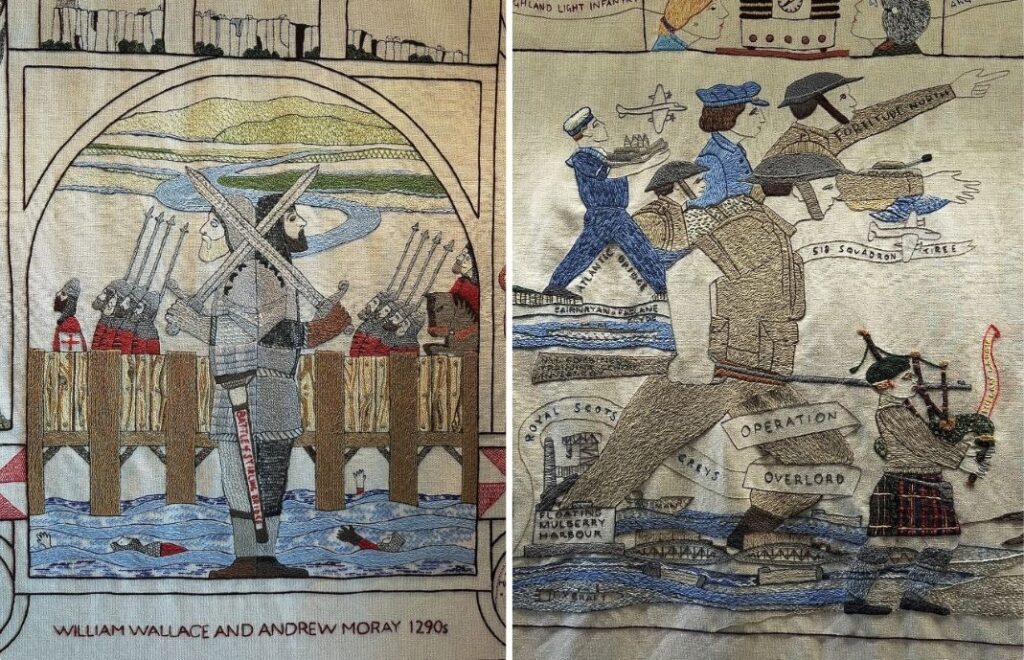
All the stitchers were given freedom to contribute their own expressions and Alistair Moffat selected episodes to depict. The tapestry would not just include iconic moments such as the Battle of Bannockburn and the life of Sir Walter Scott. Moffat ensured everyday stories of millworkers, farmers, and herring girls were represented.
The result: An inspirational true story of Scotland’s history, heritage and culture (from 8500 BC to present day). It was hand stitched by over 1,000 people in communities across the country and transported by land, sea and air to come together.
The Great Tapestry is made up of 160 panels and 482,8 kilometers (300 miles) of wool (enough to lay the entire length of Scotland from the Border with England to the tip of Shetland).
The stories behind the stitches
Every stitch tells a story, but what makes The Great Tapestry so fascinating is the incredible variety of stories woven into its panels. This is not simply a celebration of kings, queens, battles, and political events. It is a colorful portrait of a nation, told through the lives of the people who shaped it.
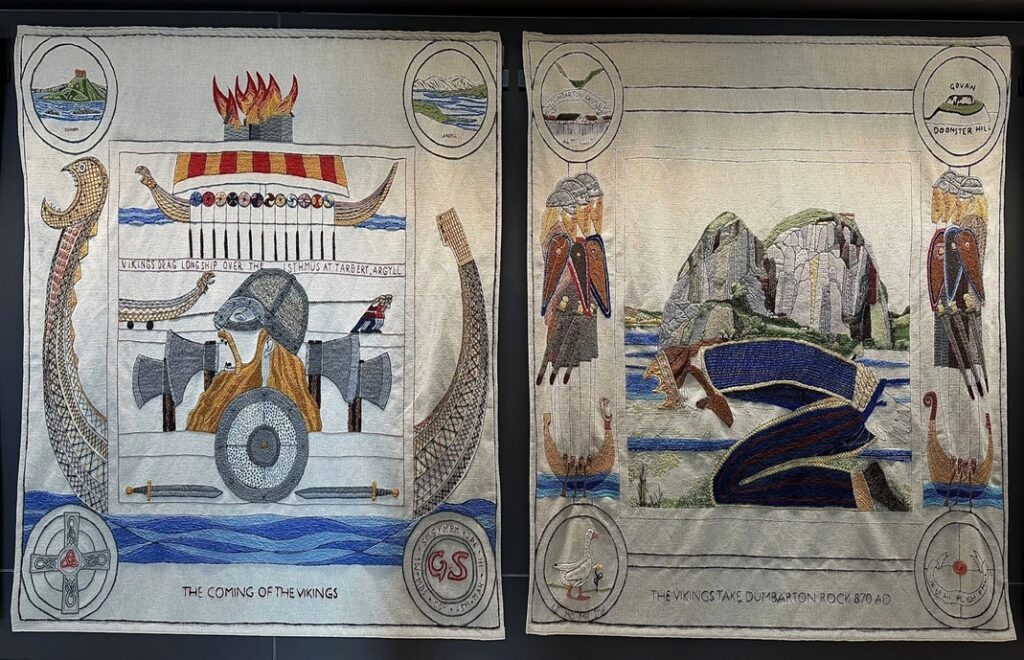
The journey begins in prehistoric Scotland and moves through thousands of years of discoveries, conflicts, achievements, and cultural change. From the arrival of the Vikings and the struggles for Scottish independence to the Scottish Enlightenment and the Industrial Revolution, the tapestry brings the country’s remarkable past to life.
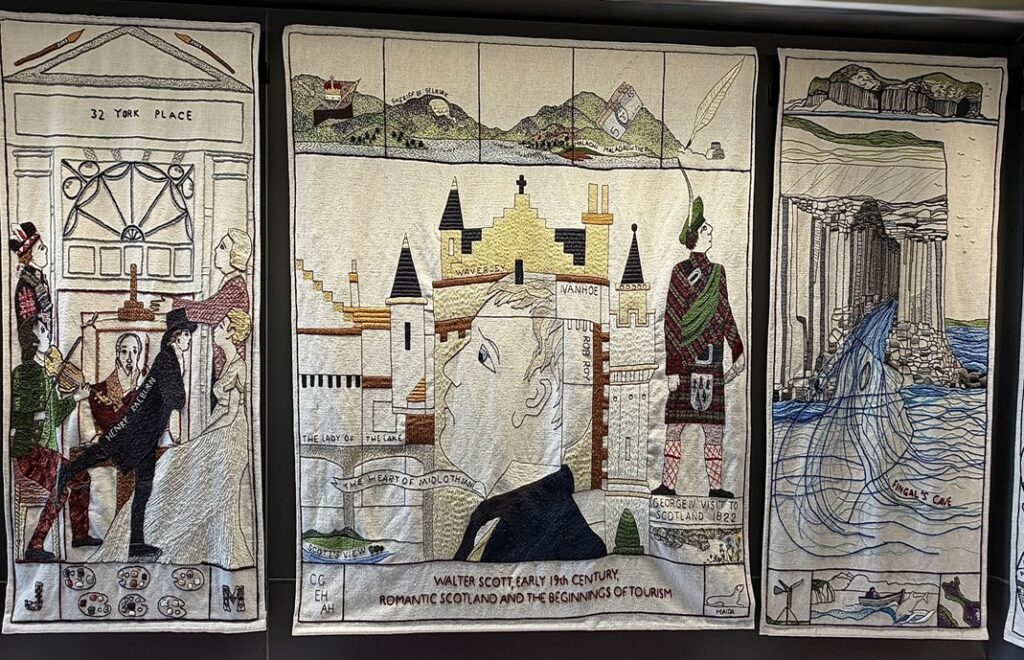
Familiar names such as Robert the Bruce, Mary Queen of Scots, and Robert Burns appear alongside scientists, inventors, artists, and ordinary Scots. There are stories of hardship and triumph, moments of great national pride, and chapters that reveal the darker sides of Scotland’s past.
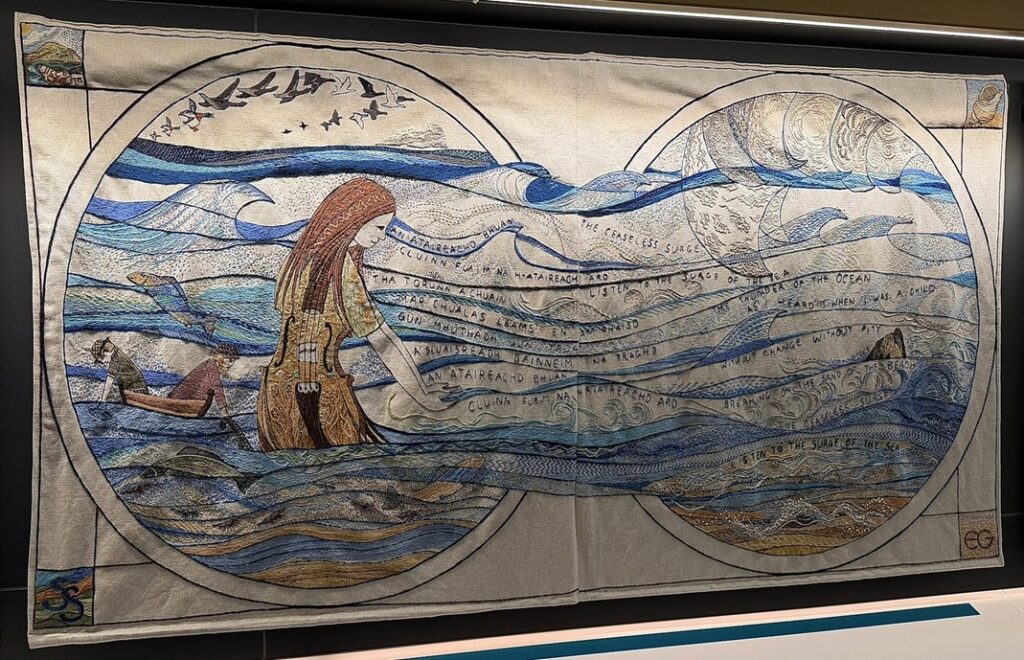
Yet some of the most captivating panels are those celebrating everyday life. Fishing communities, traditional crafts, music, literature, sporting achievements, and local customs all have their place. These smaller stories are just as important as the grand historical events, revealing the traditions, humor, and character that make Scotland what it is today.
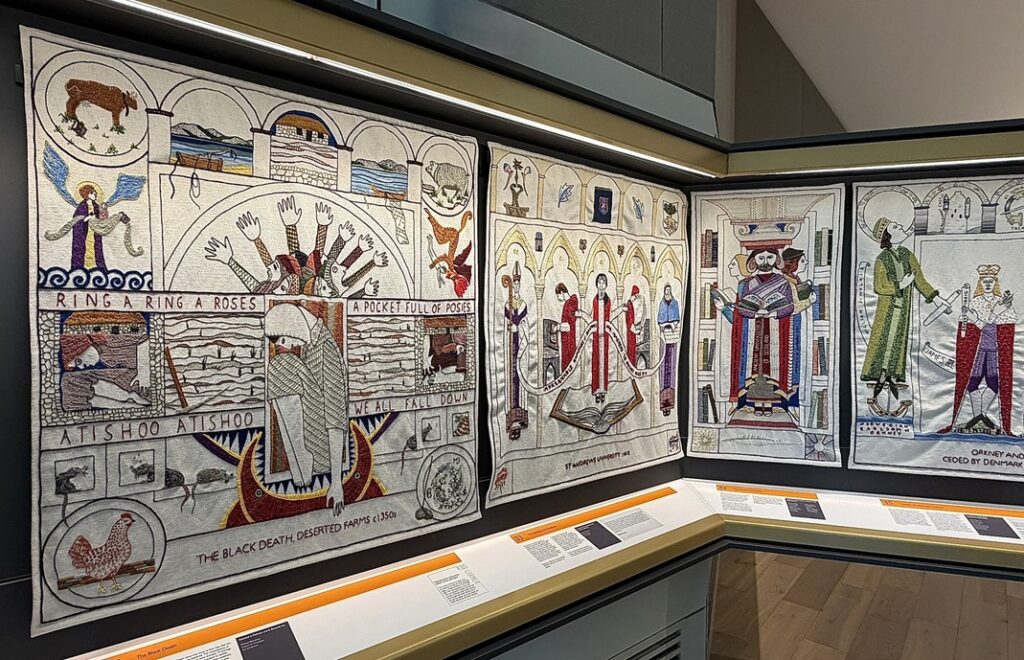
What makes the experience particularly enjoyable is the attention to detail. The more closely you look, the more you discover. A clever little symbol, a humorous detail, or an unexpected character can turn a simple panel into a fascinating story of its own.
The beauty of The Great Tapestry of Scotland lies in its ability to make history feel wonderfully human. It reminds us that a nation’s identity is not shaped by famous figures alone, but by countless ordinary lives, each leaving a small but important mark on the fabric of time.
Your visit to The Great Tapestry
Visiting the Great Tapestry of Scotland is like stepping into a beautifully illustrated storybook, where centuries of history unfold through color, creativity, and intricate stitching. Every panel invites you to pause, look closer, and discover another fascinating chapter of Scotland’s past.
This amazing artwork depicts 420 million years of Scotland’s story in 160 panels, and tells a wonderful, rich and diverse story. Each panel tells tales of politics and religion, war and peace, work and play, sport and transport, tradition and innovation.
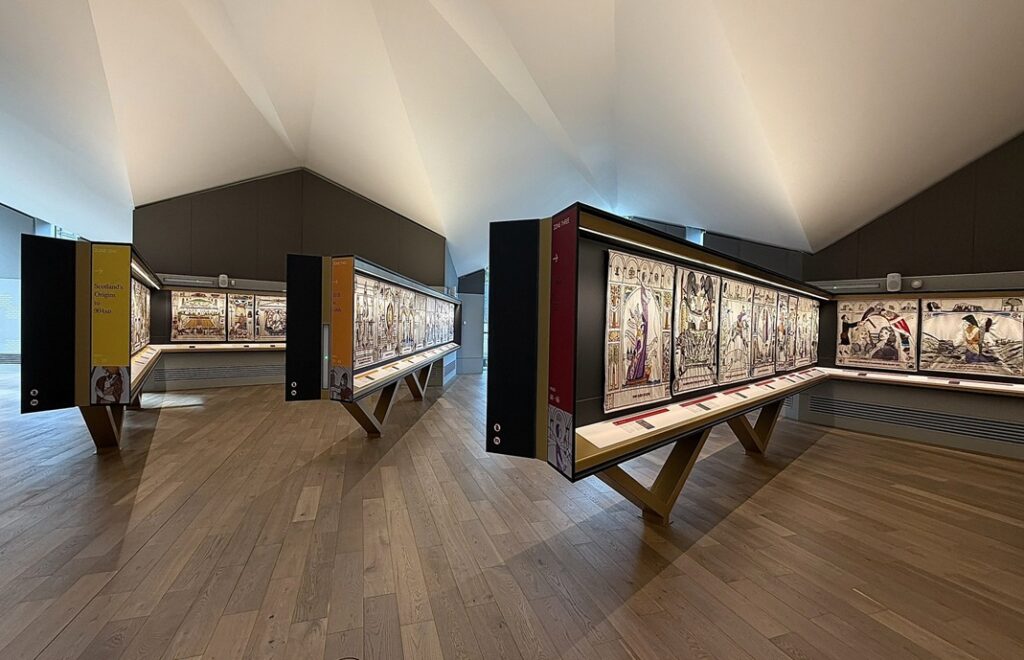
The Great Tapestry is displayed and organized in a great way, section by section. There is plenty of space which allows visitors enough room to admire the panels either up close or from a distance.
You will discover how Scotland’s past comes to life, and everything that is part of Scottish culture is symbolized. It is the story of the Scottish people, and their unique stories unfold over thousands of years – right in front of you.
The Great Tapestry invites you to explore history, listen to the stitchers’ story and discover the hidden details on the panels by using the app or the interactive screens. You will discover a lot more than you first anticipated when you entered.
This is Scotland’s story – good and bad – presented in a fascinating way. Told by ordinary people who are proud of their history and who they are.
Practical Guide
Planning a visit to The Great Tapestry of Scotland is easy, whether you are exploring the Scottish Borders or planning a day trip from Edinburgh. Here is everything you need to know before discovering this remarkable attraction.
Where is The Great Tapestry of Scotland?
It is located at 14–20 High Street in Galashiels, in the heart of the Scottish Borders.
The tapestry is displayed in a purpose-built visitor center that opened in August 2021. Its striking architecture reflects the textile heritage of the region, making the building an attraction of its own.
How to get there
Galashiels is approximately one hour south of Edinburgh by car or train, making it an excellent destination for a day trip.
The Borders Railway connects Edinburgh Waverley with Galashiels, and the visitor center is a short walk from Galashiels Transport Interchange.
If you are travelling by car, public parking is available nearby, including accessible parking spaces.
Opening hours
The visitor center open 7 days a week at 09:30 and last ticket purchase is 15:30 in summer.
Opening hours may vary seasonally, particularly during winter, so check the official website before visiting.
Entrance fees and tickets
Although tickets can be purchased on arrival, advance online booking is recommended.
How much time should you allow?
Allow approximately 1.5–2 hours to explore the tapestry and visitor center.
However, if you enjoy history, art, and discovering small details, you may want considerably longer. With 160 panels to admire, there is plenty to capture your attention.
Interactive displays help visitors explore the stories behind individual panels, adding another dimension to the experience.
Facilities and accessibility
The visitor center is wheelchair accessible, with lifts and accessible toilets.
There is also an on-site café serving refreshments and light meals, making it an inviting place to relax after exploring the exhibition.
The gift shop offers tapestry-inspired souvenirs, books, and Scottish crafts.
Photography for personal use is permitted, but flash photography and tripods are not allowed inside the galleries.
Visitors should also avoid touching the tapestry to help preserve the artwork.
A final tip
Do not rush through the exhibition simply to see every panel. Take your time, choose the stories that catch your attention, and look closely at the stitching.
Sometimes the smallest details tell the most fascinating stories, and discovering them is part of the pleasure of visiting The Great Tapestry of Scotland.
My warmest gratitude to Visit Britain and The Great Tapestry of Scotland for inviting me. There were no requirements from either of them regarding posts on social media or promotion. Options and photos (unless otherwise stated) are entirely my own.
