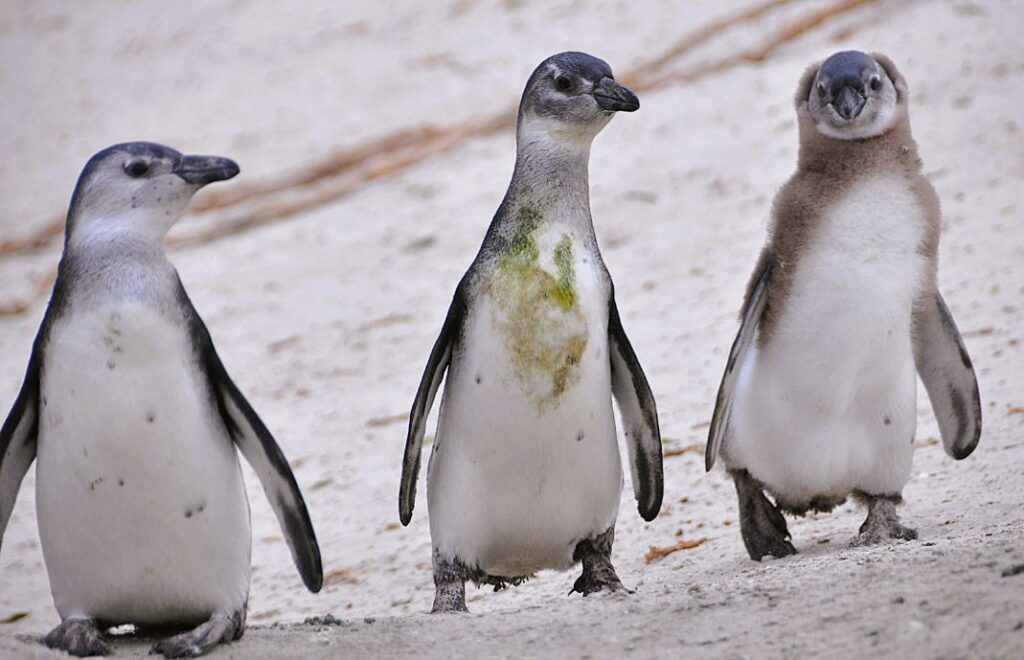
The African penguin may be one of the most adorable things you have ever seen. These charismatic creatures are impeccably dressed in tuxedos, have an endearing face, and a trademark waddle. It’s hard not to fall in love with these birds who cannot fly.
You are probably wondering about the name “African penguin” as these tuxedoed swimmers are known to live in icy landscapes. Well, the African penguins are very different. They prefer to sunbath on a picturesque beach in South Africa.
While the African penguin won’t win any marathons on land, they are absolute torpedoes in the water. Now you can get to know them better and see that they are as unique as they are adorable.
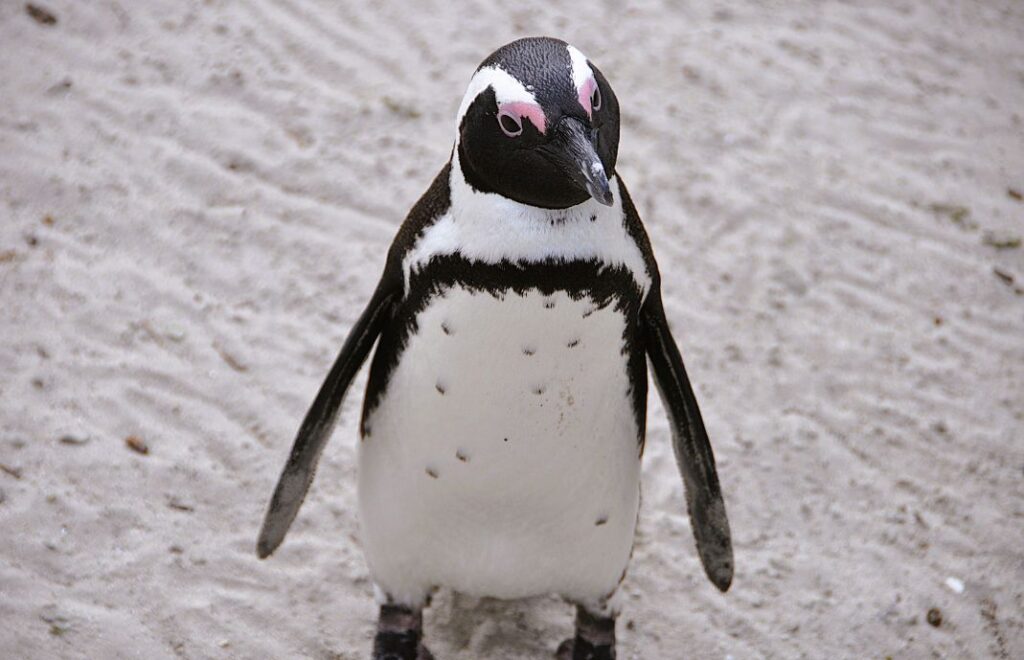
What is the African penguin?
First of all, they don’t live in Antarctica and don’t waddle around icebergs. Instead, their home is the rocky coastlines and islands of southern Africa, from Namibia down to South Africa.
The African penguin (Spheniscus demersus) is lovingly known as the “jackass” penguin. Not because it is an ass, but for its donkey-like bray.
They sport a sleek black and white coat that is not just for looks. This sophisticated tuxedo helps them navigate in their seaside world. Their diet consists mainly of fish, and the occasional side of squid.
Size-wise, the African penguin is an underdog, standing only about 60-68 cm (24-28 inches) and weighing in at a mere 3.7 to 4 kilos (5 to 11 pounds). But what these charmers lack in size, they make up for in agility, both in water and on land.
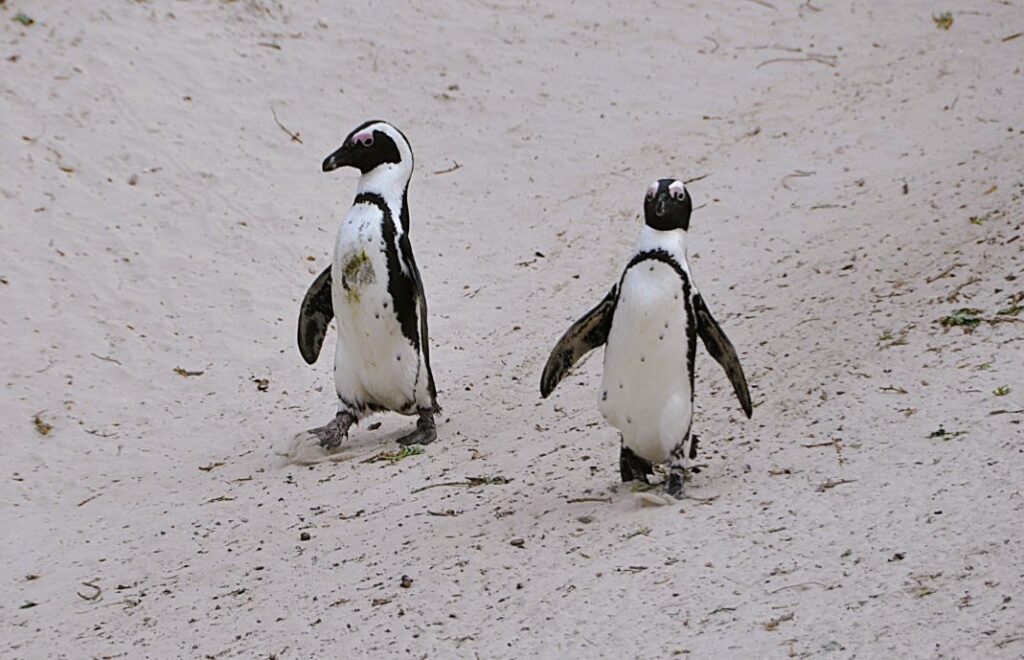
What does African penguin look like?
The African penguin is small, charming, and instantly recognizable. It has a classic black-and-white penguin look, with a dark back, white belly, and a bold black band that curves across the chest like a neat little necklace.
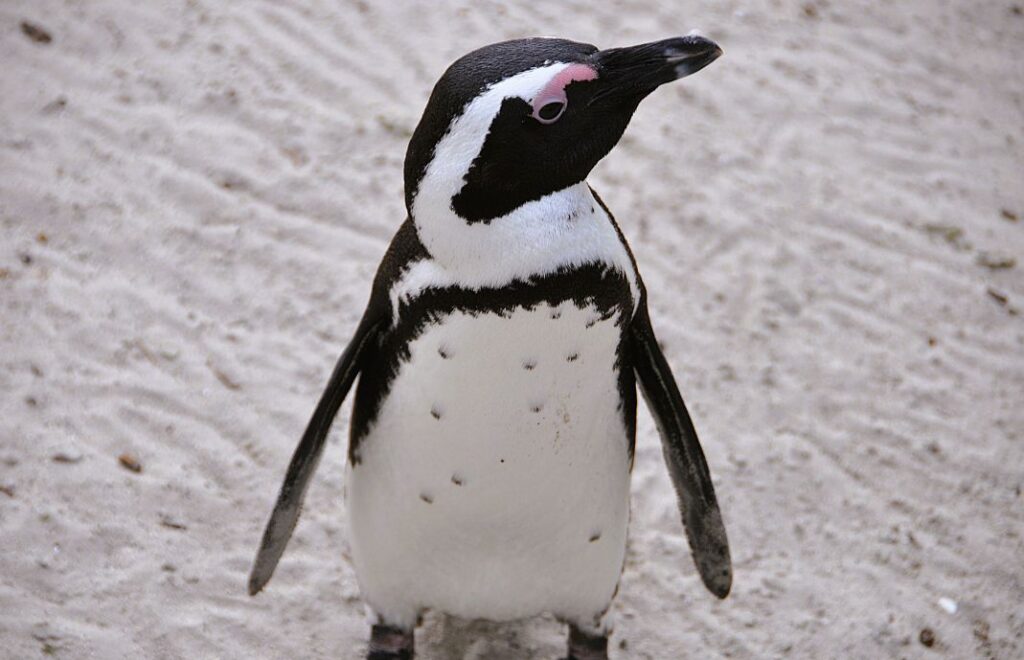
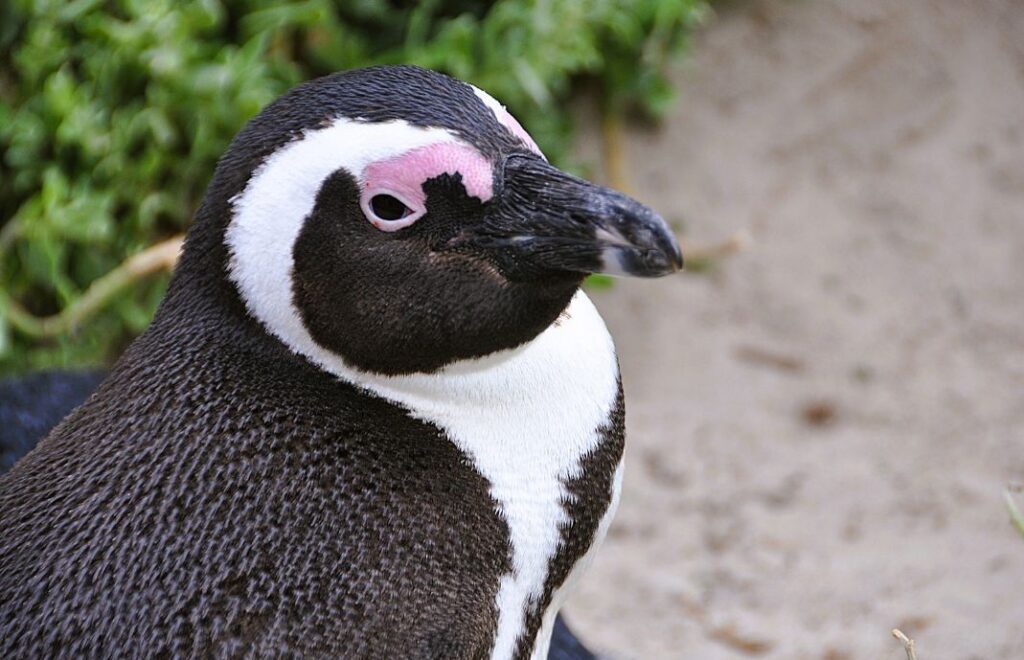
One of its most distinctive features is the bare pink patch of skin above each eye. This is not just for decoration – it helps the penguin regulate body temperature in the warm climate of southern Africa. The hotter the bird gets, the more blood flows to these patches, helping it cool down.
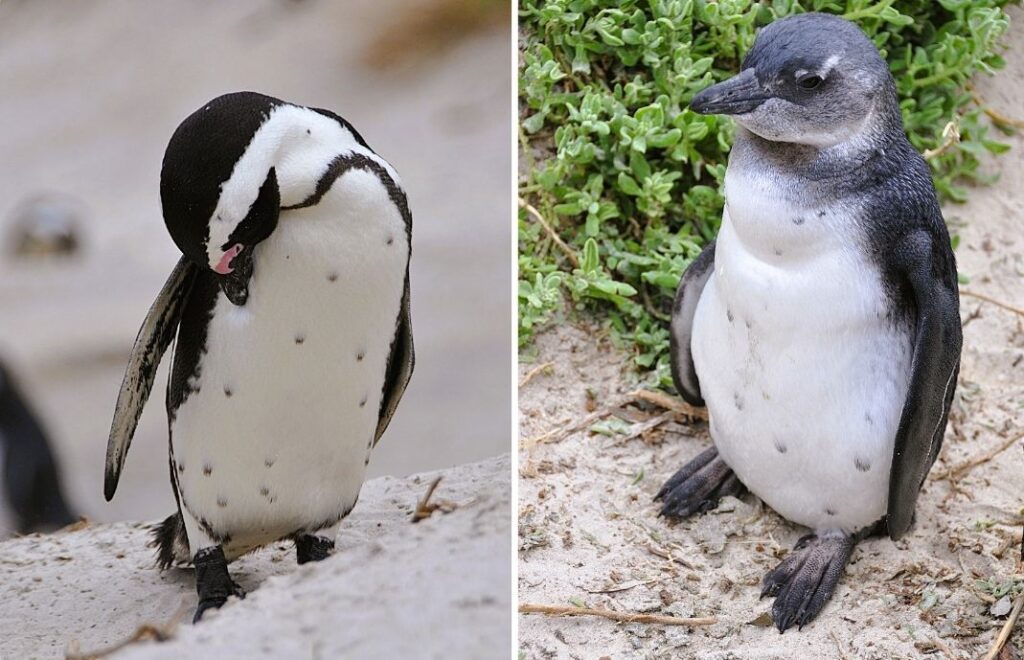
African penguins also have black spots scattered across their white chest and belly. These spots are unique to each penguin, almost like a fingerprint, which can help researchers tell individuals apart.
Their bodies are built for life in the ocean. They have short legs, webbed feet, and strong flipper-like wings that make them excellent swimmers. On land, they may look a little clumsy as they waddle over sand and rocks, but in the water, they become fast, graceful, and perfectly adapted hunters.
With their expressive faces, compact bodies, and slightly scruffy charm, African penguins are one of the most endearing seabirds in Africa. It’s a species that is both adorable and wonderfully adapted to life between land and sea.
The African penguin’s skin
One of the most interesting features of the African penguin is the bare pink skin above its eyes. At first, it may look like a simple splash of color, but it plays an important role in helping the penguin stay cool.
African penguins live in a warmer climate than many people expect for a penguin species. They are found along the coasts of southern Africa, where sun, sand, and rocky beaches can become hot. The pink patches help regulate body temperature by allowing heat to escape. When the penguin gets warmer, more blood flows to this area, making the skin appear brighter.
This clever adaptation is one of the reasons African penguins are so well suited to their environment. They may look cute and slightly comical on land, but every part of their body has a purpose – even the bare skin around their eyes.
The pink patches also make the African penguin easy to recognize. Together with its black chest band, spotted belly, and neat black-and-white coloring, they give the bird its distinctive and memorable appearance.
The African penguin’s wings
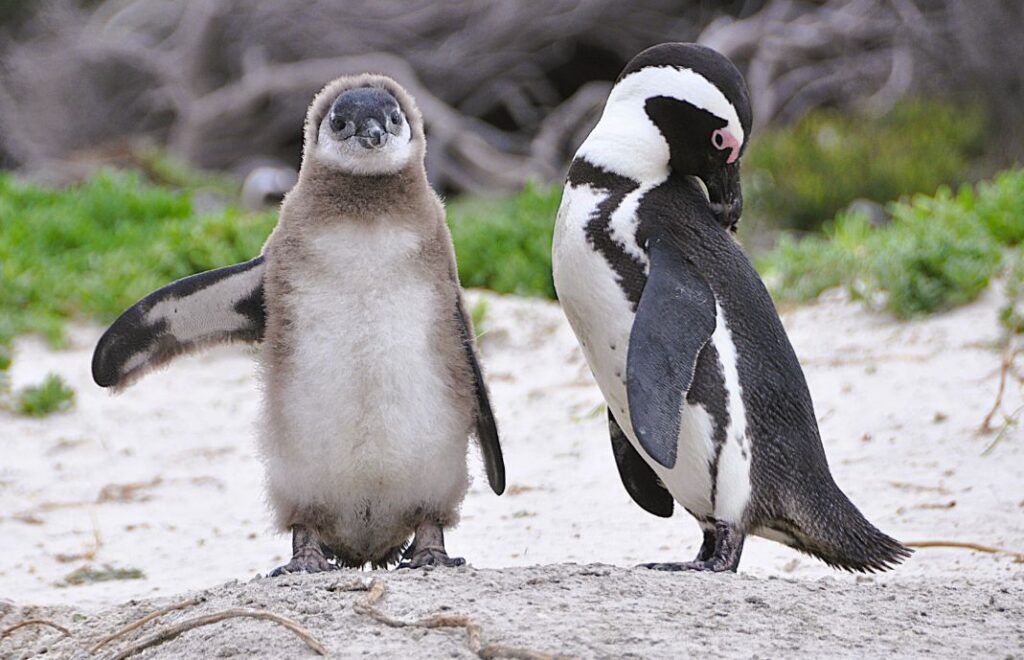
The African penguin’s wings are not made for flying – they are made for flying through the water. Over time, their wings have evolved into strong, flat flippers that help them swim with speed, control, and surprising elegance.
On land, these flippers may look short and stiff, adding to the penguin’s slightly awkward charm. But once the bird enters the ocean, everything changes. The African penguin uses its flippers almost like underwater wings, propelling itself through the water as it hunts for fish.
This adaptation is essential for survival. African penguins feed mainly on small schooling fish such as sardines and anchovies, and they need to be quick and agile to catch them. Their flippers help them turn, dive, and move efficiently beneath the waves.
The contrast is part of what makes African penguins so fascinating. They may waddle on land, but in the water, they are sleek, fast, and perfectly built for life at sea.
The African penguin’s feet
When it comes to getting around, the African penguin’s feet are another clever part of its design. They are short, strong, and webbed, helping the penguin move both on land and in the water.
On land, the feet give the African penguin its familiar waddling walk. It may look a little clumsy, but the penguin is well adapted to moving across sand, rocks, and nesting areas along the coast.
In the ocean, the webbed feet help with steering and balance while the powerful flippers do most of the swimming. Together, the feet and flippers allow the penguin to dive, turn, and chase fish beneath the surface.
Their feet also help them handle life on warm beaches and rocky shores. African penguins may not look elegant when walking, but every step is part of an animal perfectly shaped for life between land and sea.
The African penguin’s coloration
There is no doubt the African penguin looks sharp. Their distinctive black and white plumage is a masterclass in evolutionary design, offering camouflage in a phenomenon known as countershading.
The African penguins black-and-white coloring is one of the most important survival features. Its dark back and white belly are not only striking to look at – they also help protect the penguin while it swims in the ocean. From above, the penguin’s black back blends with the darker water below, making it harder for predators to spot. From below, its white belly blends with the brighter surface of the sea, helping it disappear against the light.
They also have a bold black band across its chest and black spots on its white belly. These spots are unique to each bird, much like fingerprints, and can help researchers identify individual penguins.
Its neat black-and-white appearance may look almost formal, but it is really a smart adaptation for life at sea. The African penguin’s coloring helps it hunt, hide, and survive in a world where visibility can mean the difference between danger and safety.
The African penguin’s social structure
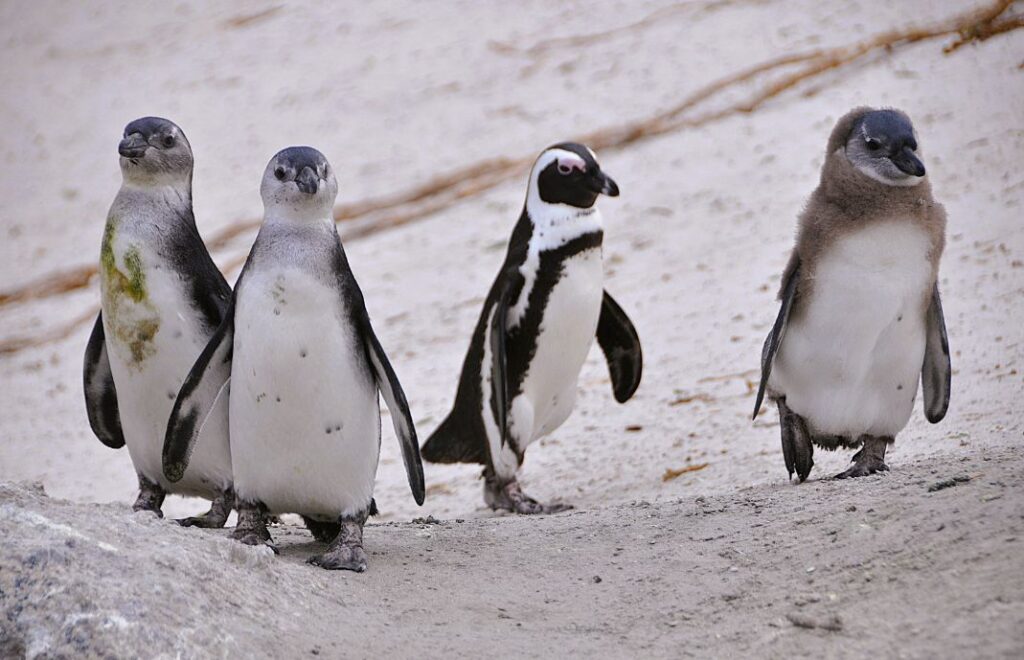
African penguins are social birds, often living and breeding in colonies along the coast and on offshore islands. These colonies can be noisy, busy, and full of activity, with penguins calling, nesting, preening, feeding chicks, and moving between land and sea.
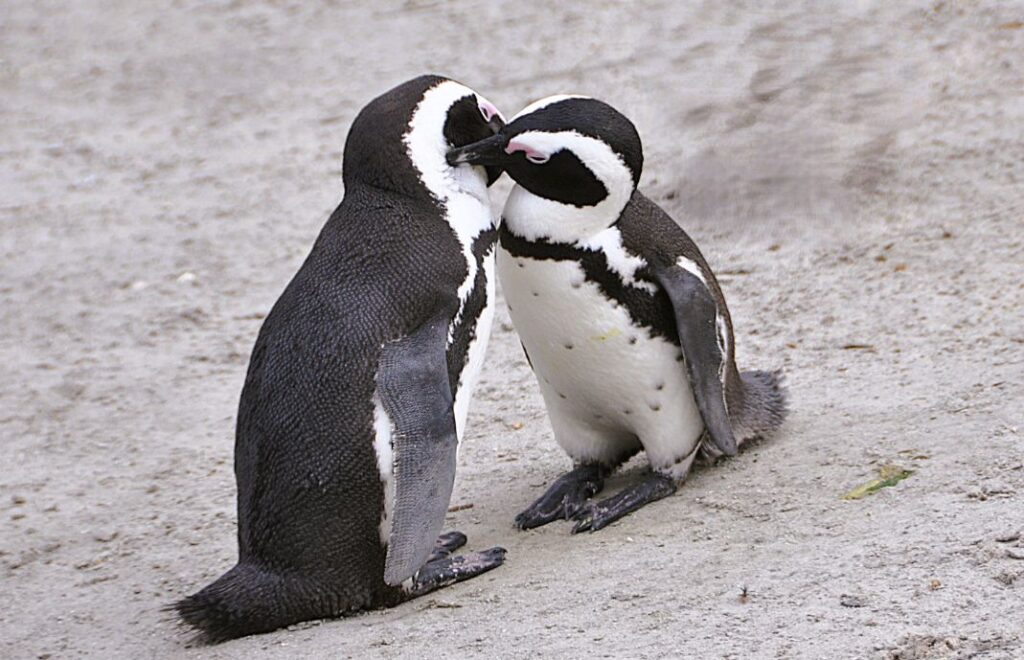
They are also known for forming strong pair bonds. Many African penguins stay with the same mate for several breeding seasons, and both parents help care for the eggs and chicks. They take turns incubating the eggs, guarding the nest, and going out to sea to find food.
Communication is an important part of their social life. African penguins use loud, braying calls to recognize each other, which is why they are sometimes called “jackass penguins.” In a crowded colony, these calls help mates and chicks find one another.
Life in a colony offers protection, but it is also full of competition. Penguins must defend nesting spaces, look after their young, and stay alert to threats. Their social structure is a reminder that African penguins are not just charming seabirds – they are intelligent, vocal, and deeply connected to their colony life.
How long do African penguins live?
African penguins can live for 10 to 15 years in the wild, although some individuals may live longer under the right conditions. In protected environments, where food, veterinary care, and safety are more reliable, they can sometimes reach 20 years or more.
Their lifespan depends on many factors, including food availability, predators, disease, pollution, and human impact. Young penguins face the greatest risks, especially when learning to survive at sea and find enough food.
Once they reach adulthood, African penguins can form long-term pair bonds and return to breeding colonies year after year. Both parents help raise the chicks, which gives the young a better chance of survival.
Sadly, African penguins are endangered, and their declining numbers show how difficult life has become for them in the wild. Protecting their nesting areas, food sources, and marine environment is essential if future generations are to keep seeing these remarkable birds along the coast of southern Africa.
Are African penguins aggressive?
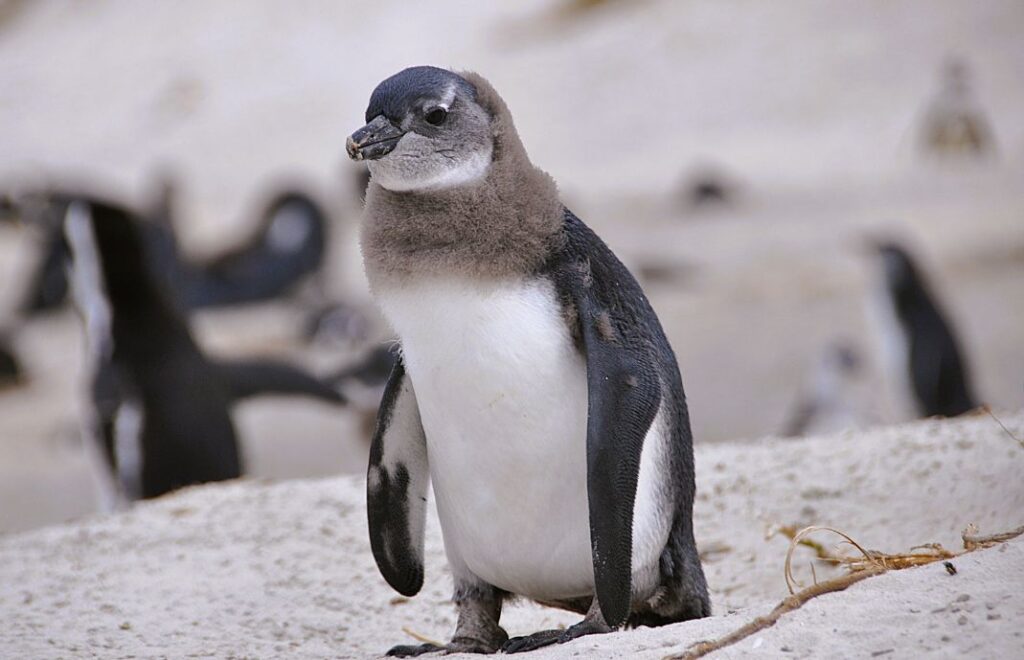
These charming creatures seem like the life of a coastal party, all dressed up and ready for a gala in their sleek tuxedos. The African penguin may look small, cute, and slightly comical on land, but they can surprisingly feisty when they feel threatened.
Most aggressive behavior happens when penguins are defending their nests, eggs, chicks, or personal space. In crowded colonies, they may peck, chase, flap their flippers, or make loud calls to warn other penguins away. These behaviors are part of normal colony life, especially during the breeding season.
If a person gets too close, an African penguin may also react defensively. Their beaks are strong, and a bite can hurt, so visitors should never try to touch, feed, or crowd them. The best way to enjoy African penguins is to watch them quietly from a safe distance and let them behave naturally.
So, while African penguins are not dangerous in the usual sense, they are confident little birds with clear boundaries. Respect those boundaries, and they are a joy to observe.
Are African penguins territorial?
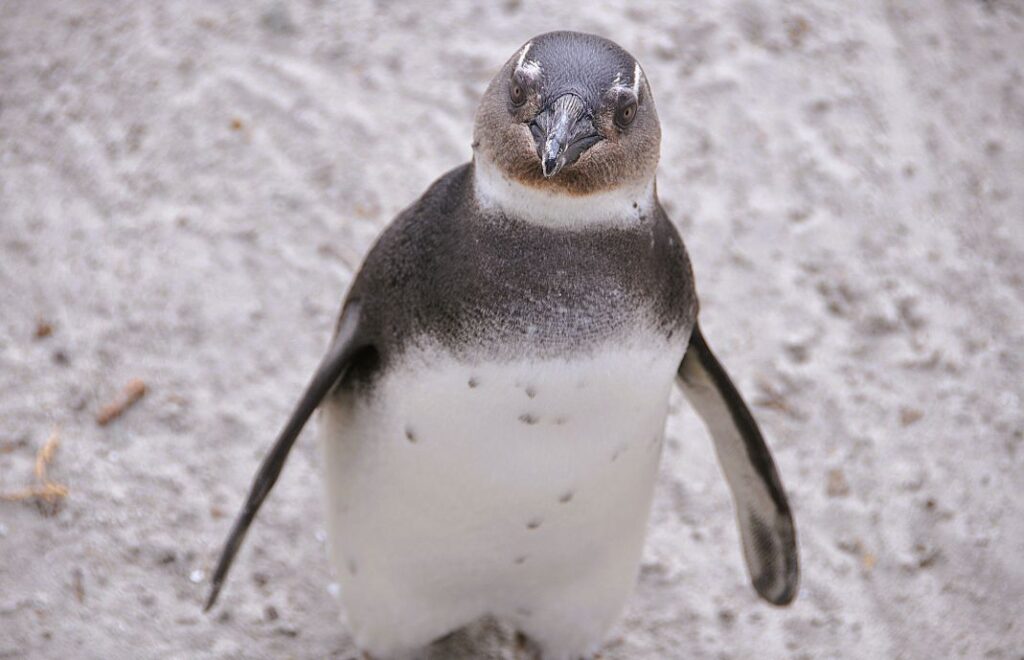
African penguins take their personal space very seriously, and can be territorial, especially during the breeding season. Like many seabirds that nest in colonies, they need to protect their small nesting space from other penguins, predators, and anything they see as a threat.
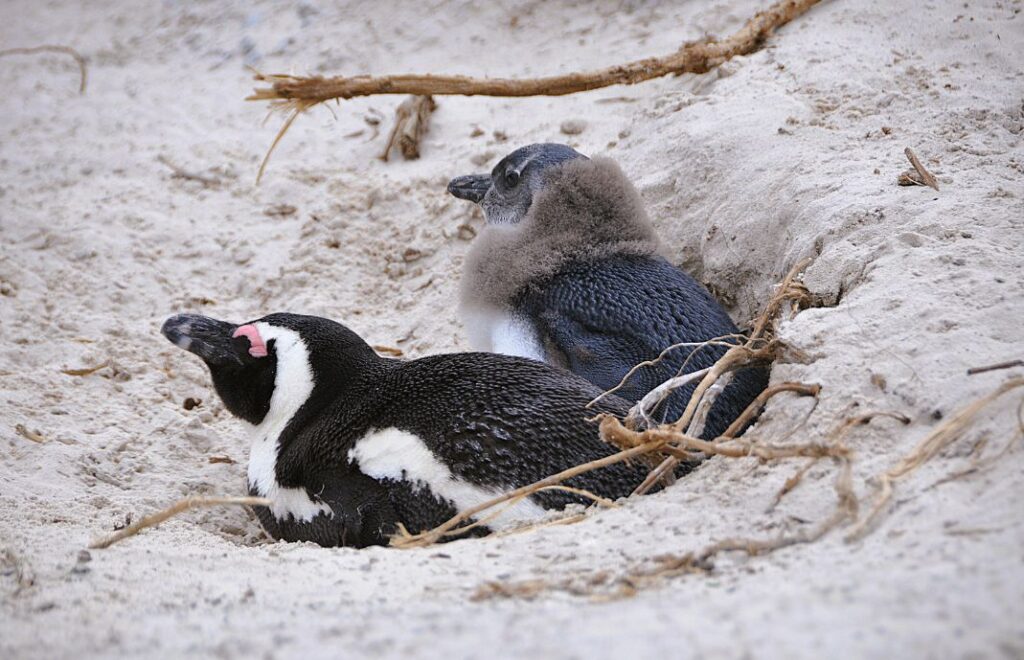
Their territory is usually centered around the nest. This may be a burrow, a scrape in the ground, a sheltered spot under vegetation, or a nest box in protected colonies. Both parents may defend the area, particularly when eggs or chicks are present.
Territorial behavior can include loud calls, pecking, flipper-slapping, and chasing other penguins away. In a busy colony, where many birds nest close together, these small disputes are a normal part of daily life.
Although they are social birds, African penguins still value personal space. Their territorial behavior helps protect their young and gives each pair a better chance of raising chicks successfully. In the end, it is all about securing the future for their offspring.
How many African penguins are there in the wild?
African penguins are now Critically Endangered by the IUCN, and their numbers have dropped alarmingly. The global population was estimated at around 19,800 mature individuals, or about 9,900 breeding pairs, in 2023. Most live in South Africa, with a smaller population in Namibia.
This is a dramatic decline from historic numbers. African penguins have lost about 97% of their population, and conservation groups warn that the species could disappear from the wild within the next decade if urgent action is not taken.
The main reasons for the decline include food shortages, overfishing, climate change, oil spills, disease, disturbance, and loss of suitable nesting habitat. Their survival now depends on strong protection of breeding colonies, better management of fish stocks, rescue and rehabilitation work, and continued conservation action.
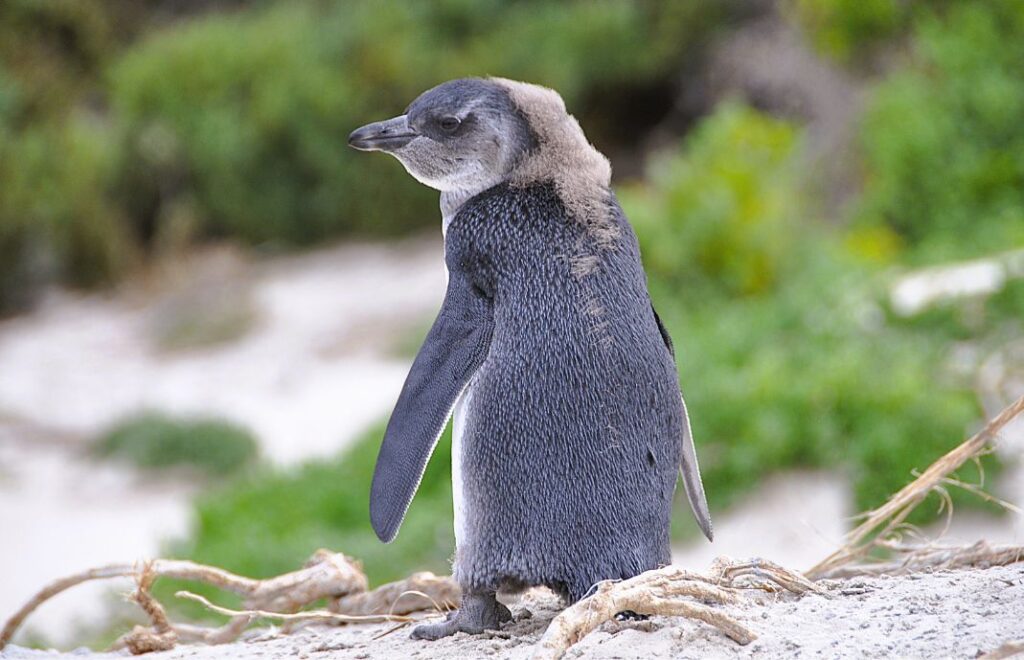
Where to see African penguins
The best-known place to see African penguins is Boulders Beach near Simon’s Town, just outside Cape Town. This protected colony is famous for its boardwalks, which allow visitors to watch the penguins up close while keeping the birds safe and undisturbed. It is one of the most accessible and popular places to see African penguins in the wild.
Another excellent place is Stony Point Nature Reserve in Betty’s Bay. This colony is often a little quieter than Boulders Beach. It also has a boardwalk system where visitors can observe the penguins in their natural coastal habitat without walking through the colony.
African penguins are found along the southern and southwestern coast of Africa, with colonies in South Africa and Namibia. Many breeding colonies are on offshore islands, which are not always easy for travelers to access. This makes mainland sites like Boulders Beach and Stony Point especially valuable for visitors.
Wherever you see them, it is important to keep a respectful distance, stay on marked paths or boardwalks, and never touch or feed the penguins. They may look charming and approachable, but they are endangered wild birds, and responsible viewing helps protect them for the future.
More inspiration: The penguins of Boulders Beach
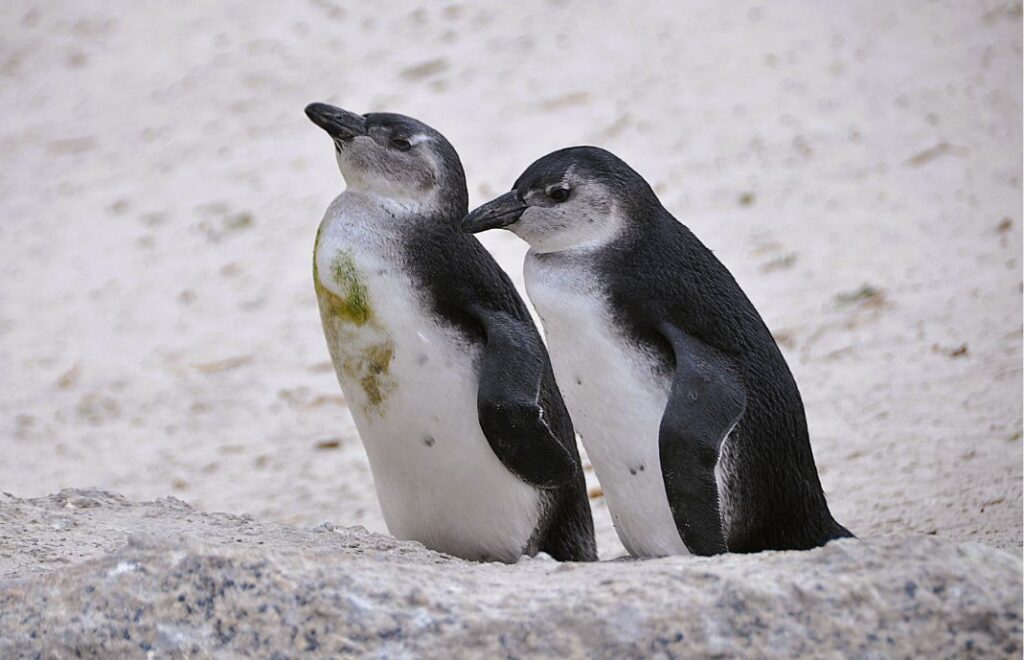
Tips for spotting African penguins
Seeing African penguins is a wonderful experience, but it is important to remember that they are endangered wild birds. The best encounters happen when visitors watch quietly, keep a respectful distance, and let the penguins behave naturally.
Go to protected viewing areas such as boardwalks or marked paths, where you can observe the colony without disturbing nests, chicks, or resting birds.
Early morning or late afternoon can be especially nice, with softer light, cooler temperatures, and active penguins moving between the beach, rocks, and sea.
Bring a camera or binoculars but avoid getting too close for the perfect photo. African penguins may look relaxed, but they can become stressed if people crowd them or block their path to the ocean. Never touch, chase, feed, or try to pose with them.
It is also worth taking your time. Watch how they waddle, call, preen, interact with their mates, and gather in small groups. The longer you stay still and observe, the more personality you notice. That is when spotting African penguins becomes more than just seeing a bird – it becomes a real wildlife experience.