I arrived on Rapa Nui, better known as Easter Island, without an aku aku.
Thankfully, thanks to Thor Heyerdahl, I knew what one was.
Here, on this remote speck of volcanic rock in the middle of the Pacific, everyone sensible carries an aku aku – those invisible guardians, protectors whispered about in island lore. And sure enough, before long, I was given one too.
To stand on Easter Island is to step into a riddle carved in stone. The moai – those monumental, enigmatic statues – stare with blank eyes toward the heart of the island, their backs turned to the sea, as if guarding secrets too heavy for words. Their sheer size is staggering. Their presence? Otherworldly.
What drew me here wasn’t just Heyerdahl’s tales or the lure of mystery – it was the promise of walking where legends still breathe. Easter Island feels like nowhere else on Earth: lonely, haunting, sacred, surreal.
And now, with my unseen aku aku in tow, I’m ready to explore the island’s most enduring question: who built these giants – and why?
Heavenly and mysterious Easter Island
After weeks of exploring Chile’s dramatic landscapes and vibrant cities, I was craving a taste of mystery. And what could be more enigmatic than boarding a plane to Easter Island – a tiny speck adrift in the vast, indifferent blue of the Pacific Ocean? Quite literally, the middle of nowhere.
I also had a personal mission: to follow in the footsteps of another Norwegian adventurer. Thor Heyerdahl crossed oceans by raft; I chose the convenience of modern aviation.
Touchdown.
After nearly five hours in the air from Santiago, our plane swoops low and kisses the tarmac of what must be one of the smallest runways I’ve ever seen. There’s a sign that sums it up perfectly: Transit (left) – Easter Island (right). Just in case anyone was wondering where on earth they’d landed!
The cabin erupts into chaos. Passengers leap up, jostling for overhead bags, elbows flying in a frenzy to be first out the door. Outside, locals mingle with equally impatient travelers. The collective energy is one part relief, two parts excitement. After all, this is a pilgrimage few will make twice in a lifetime.
At the terminal entrance, my driver waits, beaming and bedecked in flowers. With a smile as wide as the horizon, she loops a fragrant lei over my head and announces proudly that she’ll be my hostess during my stay.
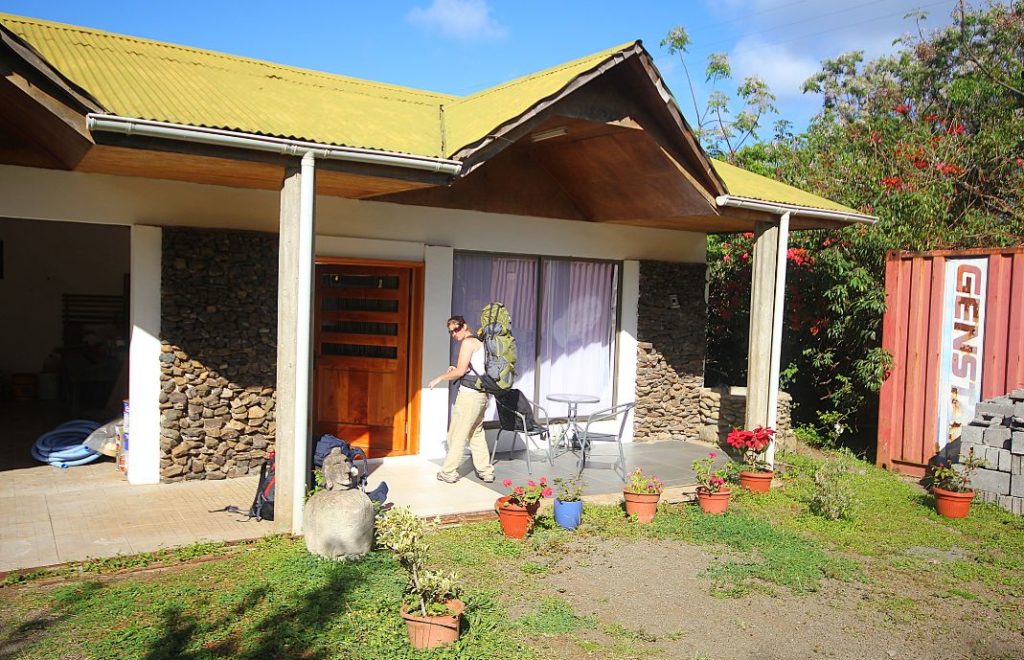
Her name is María Goretti – a woman who seems to be the heartbeat of this island. At her guesthouse, she is everything at once: owner, receptionist, cook, and keeper of all secrets.
Check-in, however, is not a pressing matter. There are errands to run, conversations to finish, life to live. Twenty minutes later, she ambles back, key in hand, unbothered by my big-city sense of time. And suddenly, it clicks: on Easter Island, time bends. Maybe even stops altogether.
When I finally open the door to my garden room, I burst out laughing. A standing lamp planted next to the toilet and a glass-paneled bathroom door? So much for privacy – guess that will have to wait until I’m back on the mainland.
And just like that, the magic begins. Not in the moai statues, not in the windswept plains, but in this gentle surrender to a rhythm older than clocks.
The story of Easter Island – Rapa Nui’s fragile legacy
Few places on Earth carry a history as dramatic – and as sobering – as Easter Island, or Rapa Nui. This remote speck in the Pacific was first settled between 400 and 800 AD by Polynesian navigators who crossed thousands of kilometers of open ocean. These early settlers built a sophisticated society centered on ancestor worship, expressed through the creation of the island’s iconic moai statues – monolithic guardians gazing inland, away from the sea.
When Dutch explorer Jacob Roggeveen arrived on Easter Sunday, 1722, he encountered a thriving population of about 17,000 people, though his journals speak of an island already riven by tribal wars.
By the time Captain James Cook dropped anchor in 1774, chaos reigned. He reported toppled moai and a population that had plummeted to around 4,000. A few decades later, French explorer Jean-François Lapérouse described signs of recovery, but the equilibrium was fragile.
The 19th century brought calamity. Rapa Nui’s isolation shattered under the weight of slave raids, disease, and colonial ambition. Peruvian slavers captured and deported hundreds of islanders, decimating the male population. In 1877, after a violent backlash that killed notorious slave trader Jean-Baptiste Dutroux-Bornier, the island’s population had dwindled to a shocking 111 people – a brush with extinction.
Chile annexed the island in 1888, following its victory in the Pacific War against Bolivia and Peru. For decades, Rapa Nui was leased for sheep ranching, and its native inhabitants were confined to a small settlement, forbidden to roam their own land.
It wasn’t until the 1960s that Easter Island reopened to the outside world – and to tourism. Today, visitors flock to marvel at its mysteries, yet the island’s story is a cautionary tale: of ecological collapse, cultural erosion, and the resilience of a people who refused to vanish.
The moai still stand – silent witnesses to triumph and tragedy, guardians of an island that remains one of the world’s most enigmatic destinations.
Legendary, mythical, and just a little strange
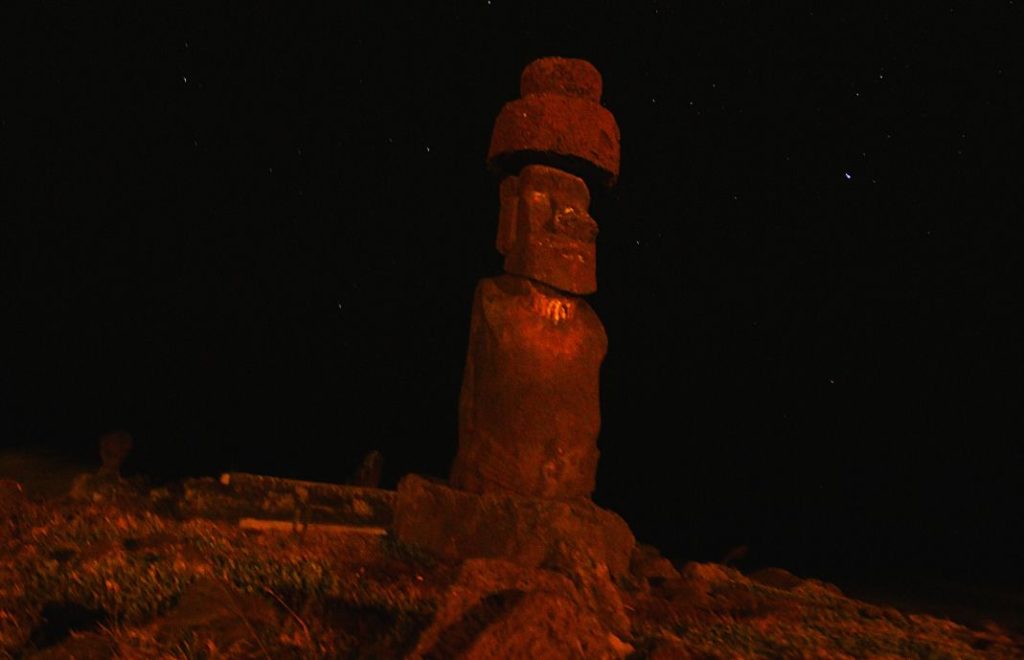
Night falls fast on Easter Island. One moment, the horizon smolders in gold; the next, it’s swallowed whole by a velvet blackness. A fragile streetlamp throws a pale halo over the dirt road, guiding me toward my first encounter with the island’s sentinels – the moai.
There are 887 of these statues scattered across Rapa Nui, silent giants carved from volcanic tuff, their origins steeped in mystery. A cluster of them lies just ten minutes from my guesthouse.
The island feels like the loneliest inhabited place on Earth. The phone in my pocket is a dead weight – signal fades the instant you leave Hanga Roa, the island’s only town. The only constants are the stars, faint at first, then flooding the sky in a riot of silver brilliance. Out here, under this cosmic cathedral, you remember how infinite the universe really is.
The grass squelches beneath my shoes as I cross the damp field, my phone’s flashlight casting a thin ribbon of light toward the looming silhouettes ahead. The statues rise slowly from the dark, their massive forms etched in shadow, their faces turned toward the ocean – solemn, eternal.
And then I’m there – face to face with the icons I first met as a ten-year-old, tucked away in the pages of Thor Heyerdahl’s Aku Aku – The Secret of Easter Island.
What secrets do they still keep?
The air is heavy, the silence almost sentient. A chill snakes down my spine as the beam from my phone glances off the stone cheekbones of the nearest moai. For a heartbeat, I swear its eyes flicker to life. Did it just move? Or is it the night playing tricks? Either way, the sensation is unmistakable: these giants are watching.
Wrapped in darkness, alone under a billion stars, I feel small, humbled, and ever so slightly terrified. Easter Island isn’t just a destination – it’s an experience that slips under your skin, whispers into your bones, and lingers long after you’ve left its shores.
New friends everywhere
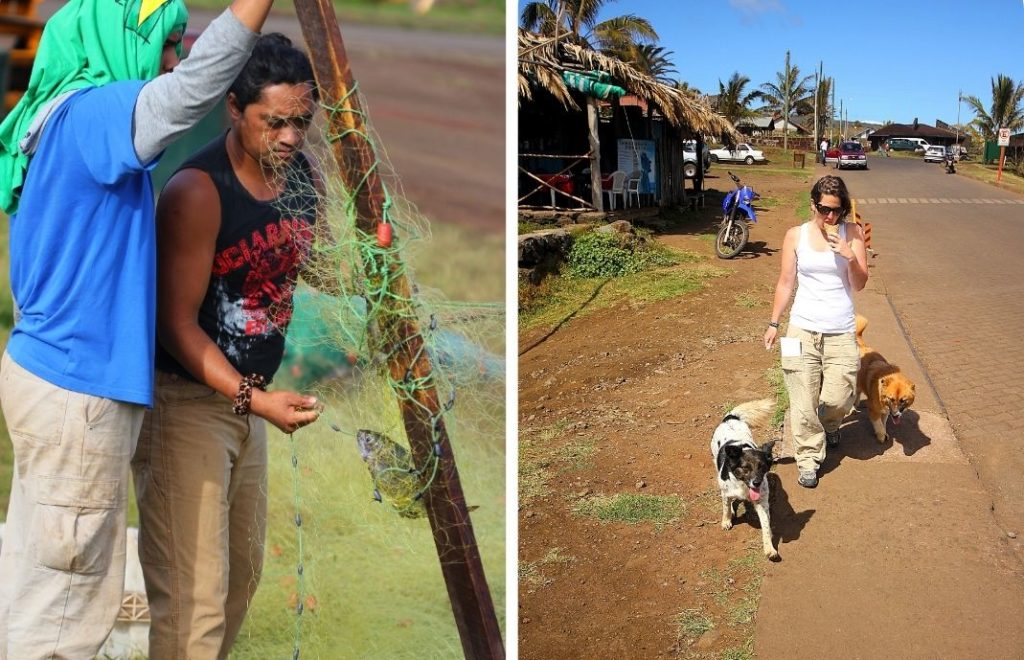
With a pack of stray dogs in tow, my camera swinging from one hand and curiosity cranked to full, I wander down the road toward Hanga Roa, Easter Island’s sleepy little hub. On the way, I pass my “friends” from last night – the moai standing stoic against the horizon, still staring out to sea as they have for centuries.
I give them a wave, grinning like an old acquaintance. That’s when I notice a woman sweeping her porch, eyeing me with a mix of confusion and amusement.
“We’re old friends, you know,” I murmur under my breath, feeling only slightly ridiculous.
Later, as I perch on a bench photographing the restless Pacific, a sunburned man with an easy smile ambles over. His name is Marc, an Australian who long ago fell under the spell of this island and stayed. He married a local Rapa Nui woman and now runs one of the island’s tour agencies.
“I’ve got no clients today,” he says with a shrug, “want a private tour?”
Perfect timing. We agree on a price, and soon we’re strolling toward his truck. My canine entourage trots behind, tails wagging hopefully. I cave, of course – buying each of them an ice cream, coconut-flavored. Their joy is pure, their gratitude boundless.
But when the engine rumbles to life and we pull away, I catch their forlorn faces in the rearview mirror – eyes full of heartbreak, noses twitching in the exhaust. For a moment, I feel like the worst person on the island.
Then the road opens up, the wind rushes through the windows, and the adventure begins anew – because on Easter Island, even goodbyes have a touch of myth.
An extraordinary guide
Marc turns out to be a treasure – a guide with the kind of insight that transforms a trip from memorable to life-changing. He doesn’t just recite facts; he breathes the island’s stories, weaving history, culture, and myth into a tapestry that feels alive beneath the relentless Pacific sun.
He grins when I mention Thor Heyerdahl. “Of course I know about him,” he says, eyes twinkling. Then comes the surprise: “You’re actually the first Norwegian I’ve ever guided.” Somehow, that makes the moment feel serendipitous – like Heyerdahl’s spirit is hitching a ride with us.
As the truck rumbles toward our first stop, the conversation sparks and swirls: Heyerdahl’s bold theories, the origins of Rapa Nui’s people, the eternal question – why were the moai raised, and for whom? These mysteries have kept scientists and explorers arguing for decades, turning green with frustration, their faces as long as the stone giants themselves.
And then, suddenly, there they are – the moai. Majestic, solemn, inscrutable. Scattered like silent sentinels across the island, they are more than statues; they are the soul of Rapa Nui made stone, the enduring emblem of a culture that refuses to vanish.
In their shadow, time feels elastic, stretched thin between past and present. And with Marc at my side, decoding secrets and legends, Easter Island becomes not just a destination but an experience that pulses with meaning.
Easter Island’s iconic landmark
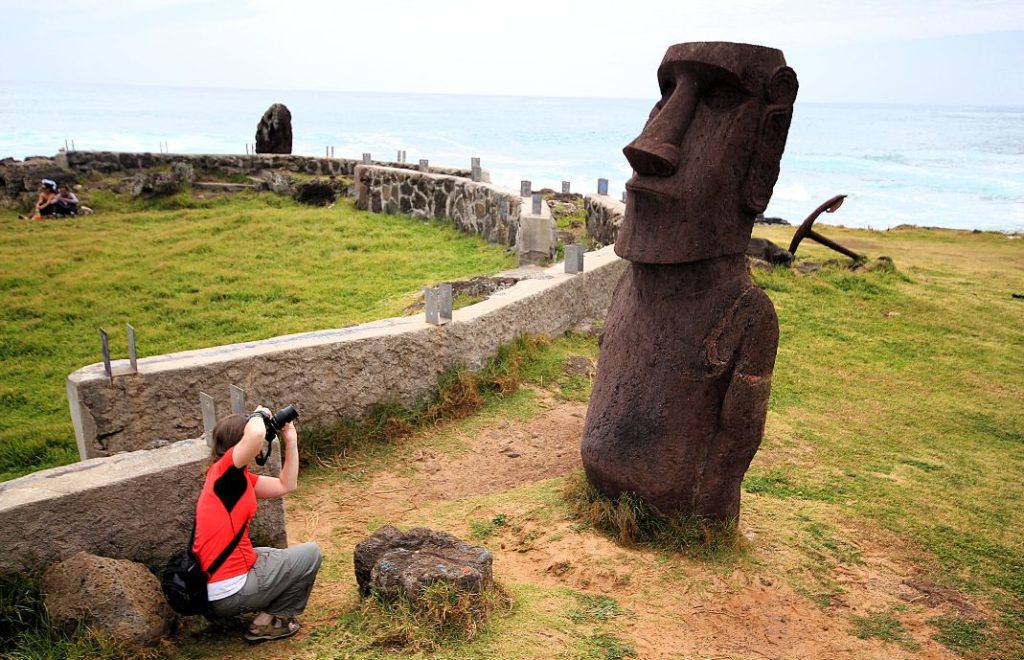
Our first stop is Ahu Akahanga, a haunting tableau where the moai lie scattered, toppled centuries ago during tribal wars and left undisturbed for over 300 years. It feels like stepping back into the 18th century – seeing the island as James Cook once saw it, frozen in the aftermath of chaos.
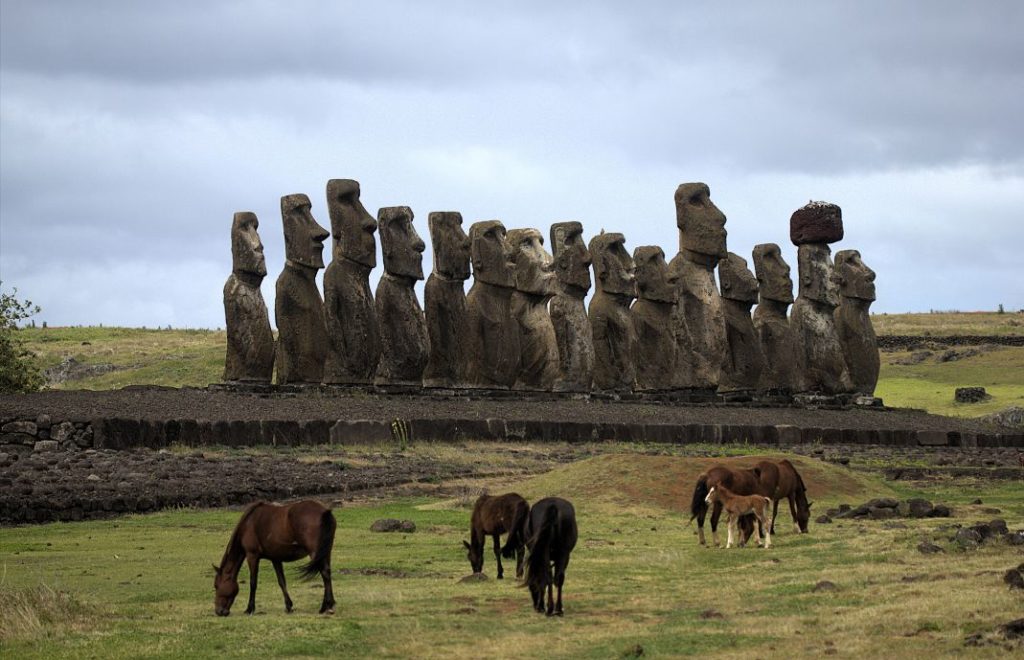
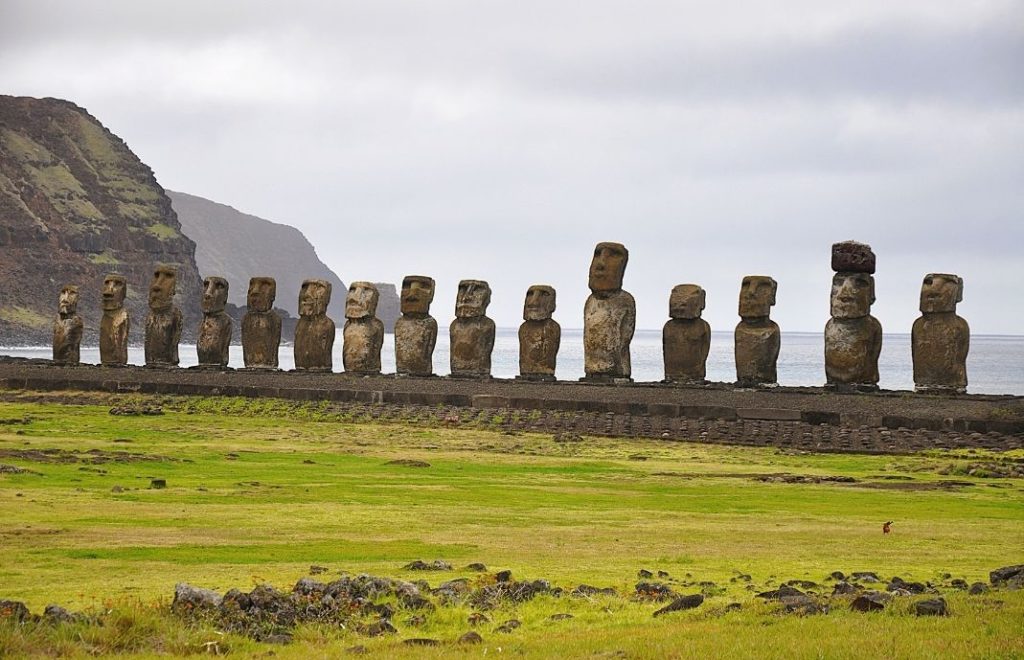
But nothing prepares me for what comes next: Ahu Tongariki, the crown jewel of Rapa Nui. If you’ve seen a photo of Easter Island, it was probably taken here. This is the island’s largest ahu – the massive stone platform on which the statues stand – and it is nothing short of breathtaking.
Before me, 15 colossal moai line up in solemn formation, their weathered faces turned inland, backs to the restless Pacific. Against the horizon, they seem almost alive, guardians carved from the bones of volcanoes, each radiating an aura of timeless authority.
Marc, my guide, speaks of them as if they were his own children – his voice warm, reverent, alive with pride. And as he shares the legends, the history, and the painstaking restoration that brought these giants back to their pedestal, I understand why. Here, on this wind-swept plain where the earth meets the infinite sea, the line between myth and reality blurs.
Ahu Tongariki isn’t just a landmark. It’s a conversation with eternity.
The fascinating moai of Easter Island
Every statue on Easter Island – all 887 of them – shares a remarkable trait: they are monoliths, carved from a single massive block of volcanic stone. Some soar nearly 10 meters high, their silent faces etched with an expression as enigmatic as the ocean that surrounds them. Many wear a pukao – a cylindrical “hat” of red scoria, balanced delicately on their heads like a crown.
And yet, despite decades of research, the moai remain a riddle. Why were they built? What power did they hold? The most widely accepted theory suggests they were created by the island’s Polynesian settlers about 1,000 years ago, serving as representations of deified ancestors or influential figures, watching over the living from their lofty perches.
Others argue the statues marked graves, or stood as symbols of clan prestige – a stone proclamation of status and strength. Some even whisper that these giants are guardians, protectors binding the spiritual and earthly realms.
Whatever their purpose, one truth is undeniable: the moai are awe-inspiring feats of artistry and engineering, hewn from the volcanic heart of Rapa Nui and transported – by methods still debated – to their ahu platforms along the coast.
Standing before them, it’s impossible not to feel small. These statues are more than stone – they are the voice of a vanished world, carved in silence, echoing across a millennium.
A visit to the quarry – Where giants were born
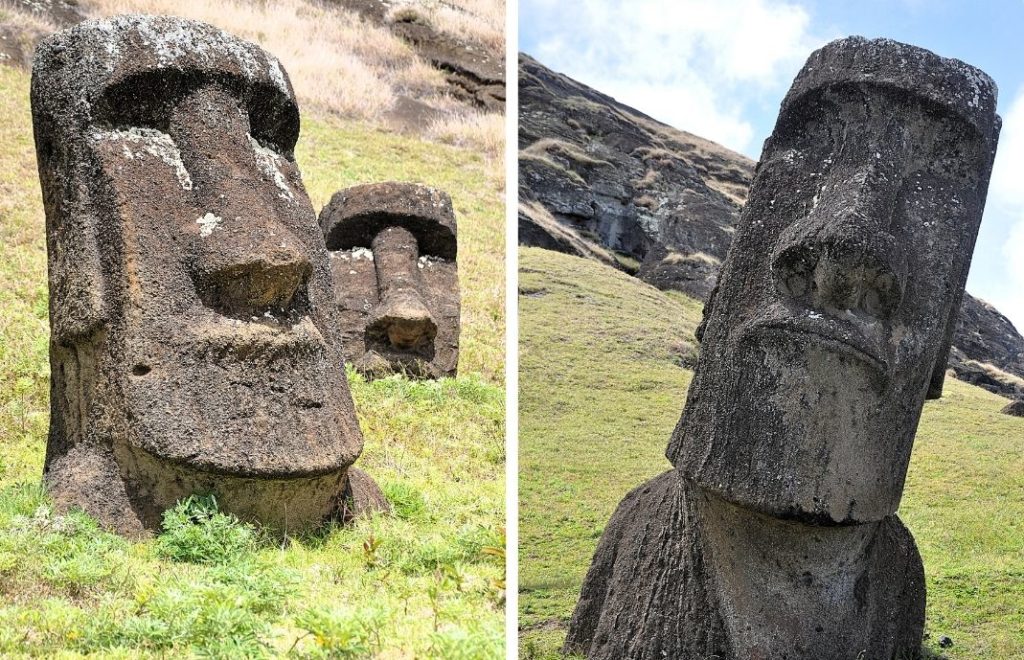
Our third stop is Rano Raraku, the beating heart of Easter Island’s greatest mystery. This volcanic crater was the island’s moai factory, the sacred workshop where nearly all of the island’s statues were carved from soft tuff stone.
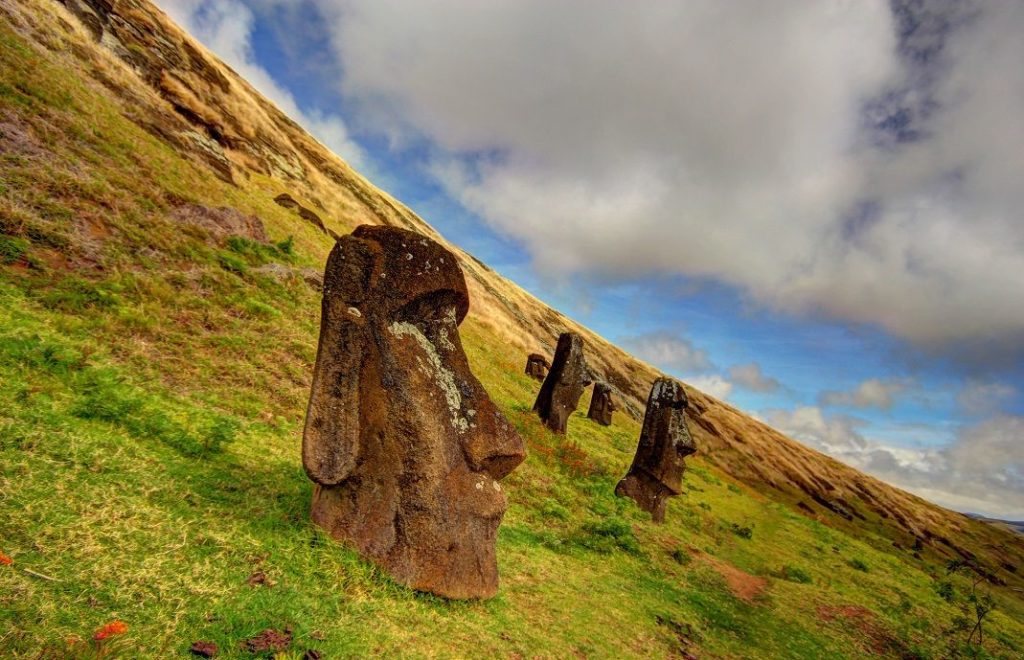
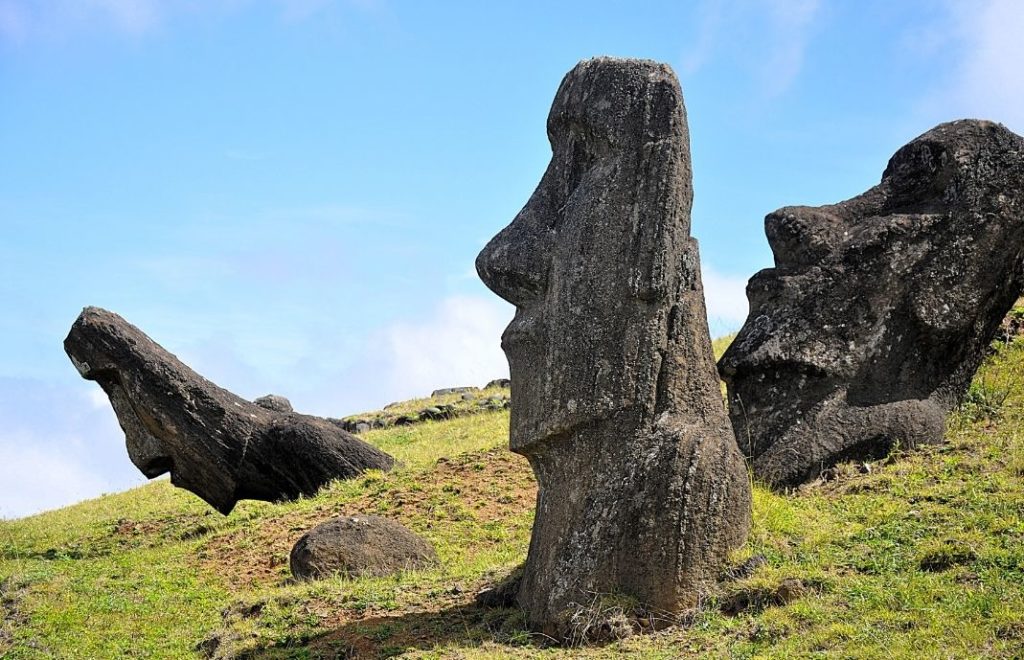
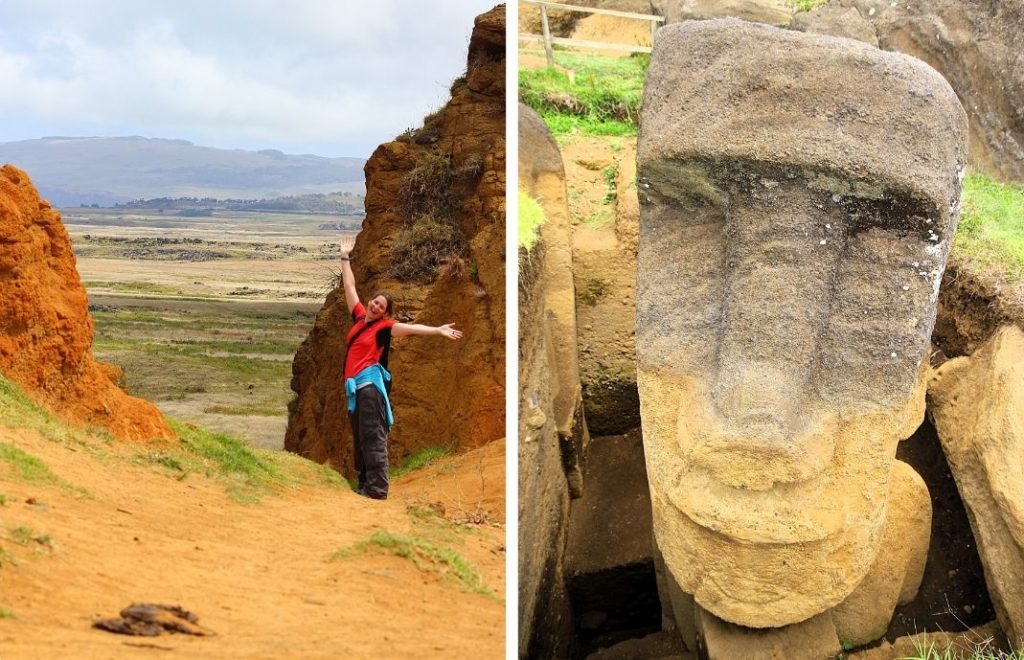
The sight is surreal. Almost 400 moai are scattered across the slopes, some upright, others reclining as if felled mid-stride, and many still fused to the rock face – half-formed, as though the carvers had simply downed their tools one day and vanished.
It feels like time slammed on the brakes here. Why the work stopped remains one of the island’s lingering enigmas. Standing among these silent colossi, you can’t help but smile – because for all their majesty, there’s something endearingly awkward about them. Some moai gaze solemnly skyward, others slump face-first into the earth like weary giants having the worst day imaginable. A few look caught in thought, their massive heads emerging from the ground like stone periscopes.
After absorbing the scene, we hike ten minutes up the ridge into the crater itself. Suddenly, the landscape transforms into a lush amphitheater of green, cradled by steep volcanic walls. The air is still, the views sweeping, and the slopes are dotted with more moai heads peeking from the earth like secrets refusing to stay buried.
Here, surrounded by unfinished giants and whispers of vanished craftsmen, you feel the pulse of an ancient ambition – an audacious dream carved in stone and left for eternity.
The world’s most unique beach
Marc grins as he suggests ending our deep dive into Easter Island’s history at a place called Anakena.
“Sure,” I reply, having no clue what awaits.
Spoiler: it’s paradise.
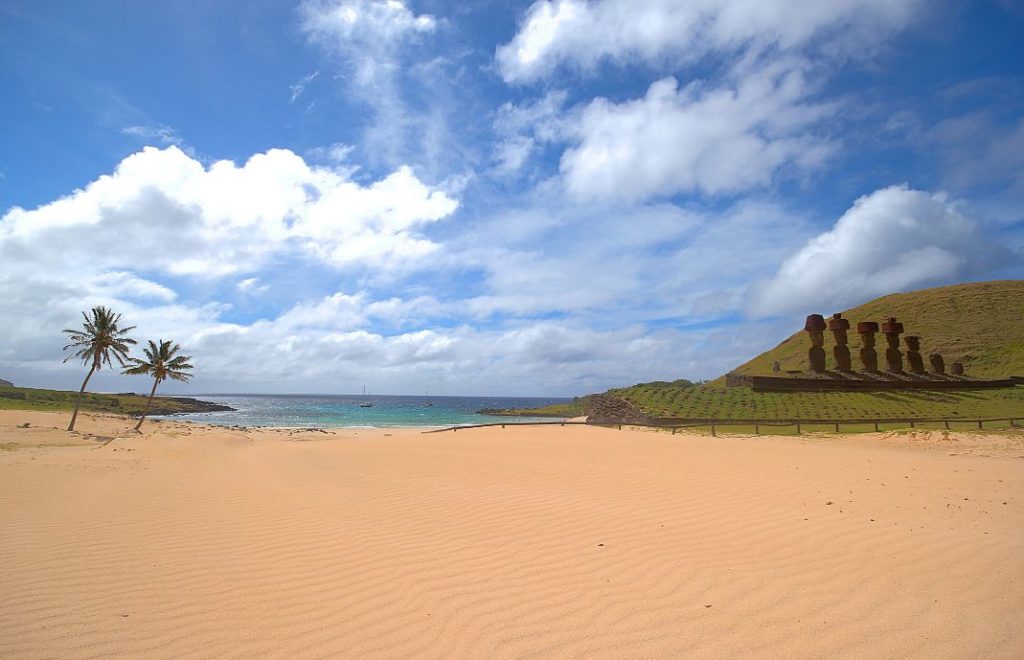
When we crest the hill, the view steals my breath: a perfect crescent of white sand, flanked by swaying palms, lapped by crystal-clear Pacific waters, and crowned by something no other beach on Earth can boast – moai statues standing guard above the shore.
This is no ordinary beach day. It’s a surreal blend of tropical bliss and ancient mystery, where Polynesian history meets barefoot leisure. I toss off my shoes and plunge into the warm, glassy sea, the salty breeze tangling my hair as I float in a scene that feels dreamt, not lived.
The moai – ever enigmatic – watch over us with their backs turned to the ocean, a silent row of guardians who seem utterly unconcerned with sunscreen or strong currents. They’re not lifeguards, but on Anakena, they’re the ultimate backdrop for a swim you’ll never forget.
Lying on the sand afterward, sun on my skin and history humming through the palms, I realize something: Anakena isn’t just a beach. It’s the soul of Rapa Nui laid bare – a meeting place of past and present, myth and paradise.
My very own Aku Aku
Just like that my Easter Island adventure is at an end.
Mariá drives me to the airport, her smile as wide as the horizon (and just as warm). At the curb, she presses something into my hands – a farewell gift, a token of Rapa Nui’s magic: my very own aku aku.
I grin, sling my backpack over my shoulder, and thank her with all the gratitude my sunburned heart can hold. Then I walk toward the waiting plane, a lump of bittersweet farewell rising in my throat.
I think of Thor Heyerdahl. How thrilling it was to read his tales of Easter Island as a child – and how infinitely more powerful it has been to trace those stories with my own feet, under this vault of sky.
“When you planned your first trip to Rapa Nui, Thor, you didn’t have an aku aku either,” I muse.
Now we both do. A guardian spirit, a whisper of belonging, a promise that we carry a piece of this mystical island wherever we go. And perhaps, just perhaps, proof that – at least on Easter Island – I was wise enough to earn it.
Easter Island essentials
Getting there
Flights: Daily departures from Santiago, Chile, plus two weekly flights from Lima, Peru.
Where to stay
Easter Island has about 100 accommodations, but be prepared: paradise doesn’t come cheap.
Recommended: Chez María Goretti – simple yet cozy, with a perfect location just outside Hanga Roa.
Most guesthouses include free airport transfers.
Experiences you can’t miss
- You only need 3 nights / 4 days to see the island’s highlights – plus time to relax.
- Ahu Akahanga – toppled moai, frozen in time.
- Ahu Tongariki – the legendary row of 15 restored statues.
- Rano Raraku – the quarry where giants were born.
- Anakena Beach – tropical paradise with moai guardians.
- Add a hike to Maunga Terevaka (601 m), the island’s highest point.
- Don’t skip Rapa Nui National Park.
Tip: A guided tour will bring the legends to life. I recommend Green Island Tours.
Island vibes
Hanga Roa, the island’s capital, feels like a set from a pirate movie – restaurants, cafés, shops, and an ATM if you need it.
Insider tips
Read before you go: Thor Heyerdahl’s Aku Aku – The Secret of Easter Island
Bring back: Your own aku aku – a talisman of wisdom and a badge of honor that says: “I’ve walked among the moai.”