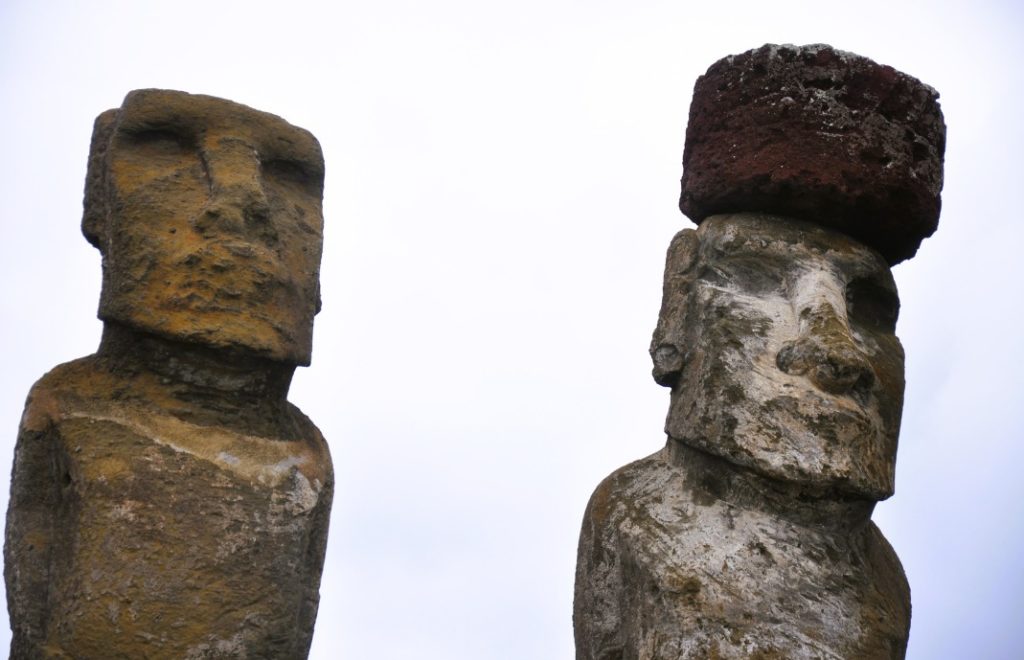
When Dutch explorer Jacob Roggeveen first set foot on Easter Island on April 5, 1722 – Easter Sunday – he and his crew were greeted by a surreal and mysterious sight: hundreds of colossal stone statues, known as moai, scattered across the island’s landscape.
Stunned by their size and craftsmanship, Roggeveen concluded that such monuments must have been created by a once-great civilization, now long vanished. After all, only about 3,000 islanders lived there at the time – seemingly too few to have produced such massive works.
But modern archaeology tells a different story.
Over the past two decades, evidence has shown that Easter Island was never home to a massive, densely populated society. The island’s poor, thin soil could not have sustained tens of thousands of people as earlier theories suggested.
Instead, the most widely accepted theory today is that the moai were carved and erected by the island’s early Polynesian settlers, who likely arrived in the 1200s. These skilled seafarers and stoneworkers created the moai to honor ancestors and chiefs, believing the statues held spiritual power to protect and bless their communities.
Far from being the work of a lost civilization, the moai stand as a powerful legacy of Polynesian ingenuity, artistry, and spiritual tradition – built not by thousands, but by a small, resilient island society with a deep connection to their land and lineage.
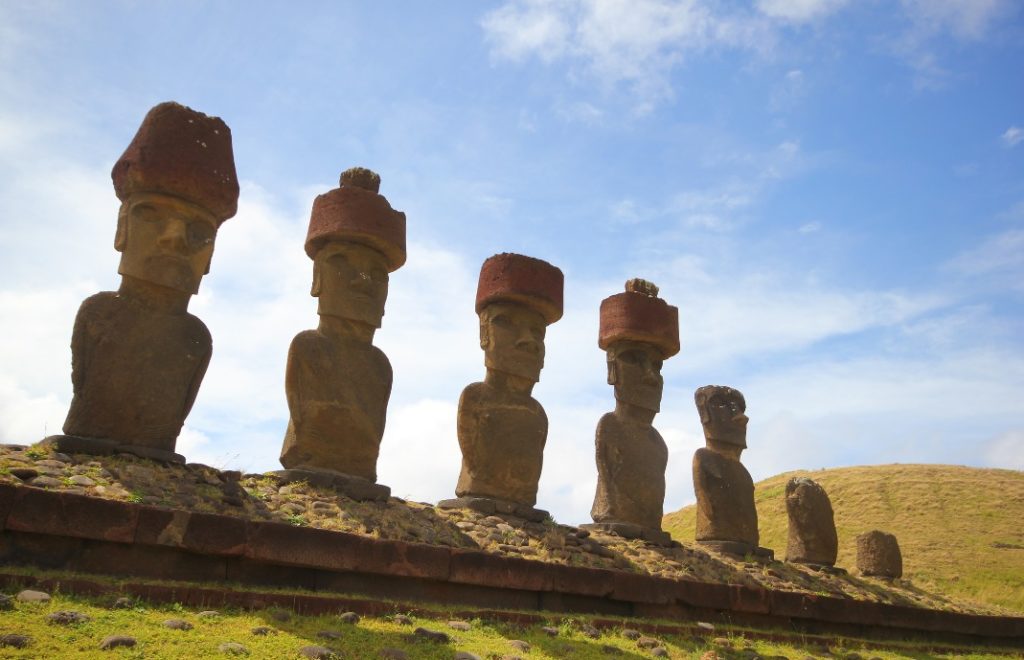
The Moai statues – Silent guardians of Easter Island
Today, around 900 moai statues are scattered across Easter Island, each one a striking symbol of the island’s mysterious past and spiritual legacy.
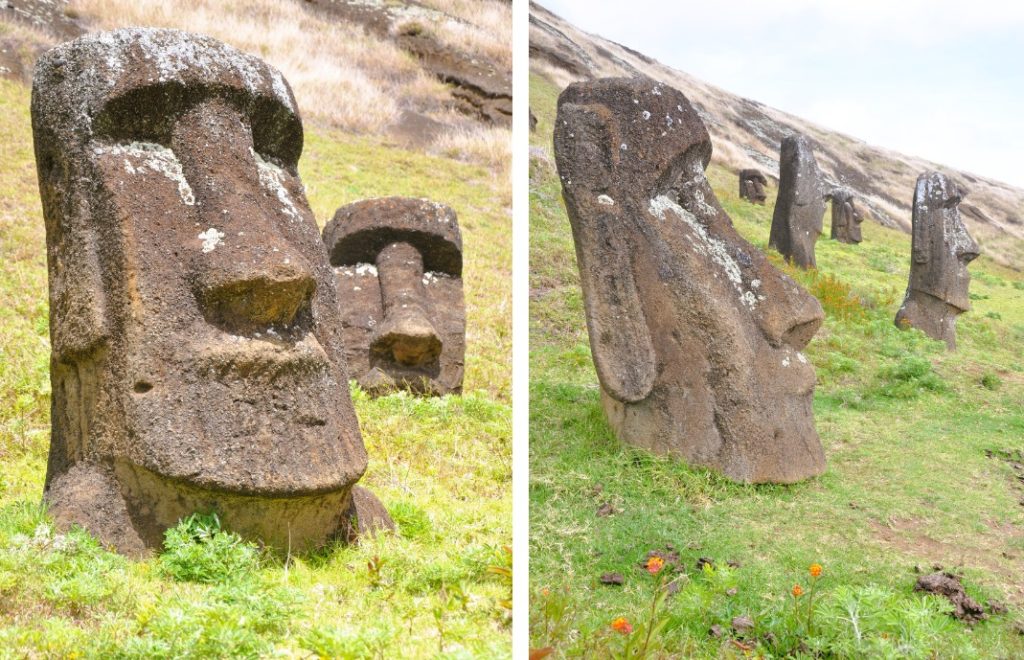
Most of these statues were carved from volcanic tuff at Rano Raraku, the island’s primary moai quarry. At this site alone, you’ll find around 400 statues – many of them still embedded in the rock. Some unfinished, as if the work abruptly stopped centuries ago. It’s a haunting scene that gives visitors a glimpse into a once-thriving cultural project frozen in time.
Interestingly, all of the upright moai were eventually toppled by the island’s own people, likely during periods of social upheaval and resource scarcity.
One statue that stands apart from the rest is Tukuturi, located at Rano Raraku. Unlike the others, Tukuturi is carved from red scoria and portrays a kneeling figure with a prominent beard – a rare and human-like depiction among the otherwise stoic moai.
As for what the moai represent?
The most common belief is that they honor deceased ancestors or powerful community leaders, marking their graves and ensuring their spirits watched over the living. Others suggest the statues may have depicted important individuals or family members chosen by those who commissioned them.
Regardless of their exact purpose, the moai continue to captivate the world, standing as silent yet powerful reminders of a Polynesian people’s devotion, artistry, and enduring mystery.
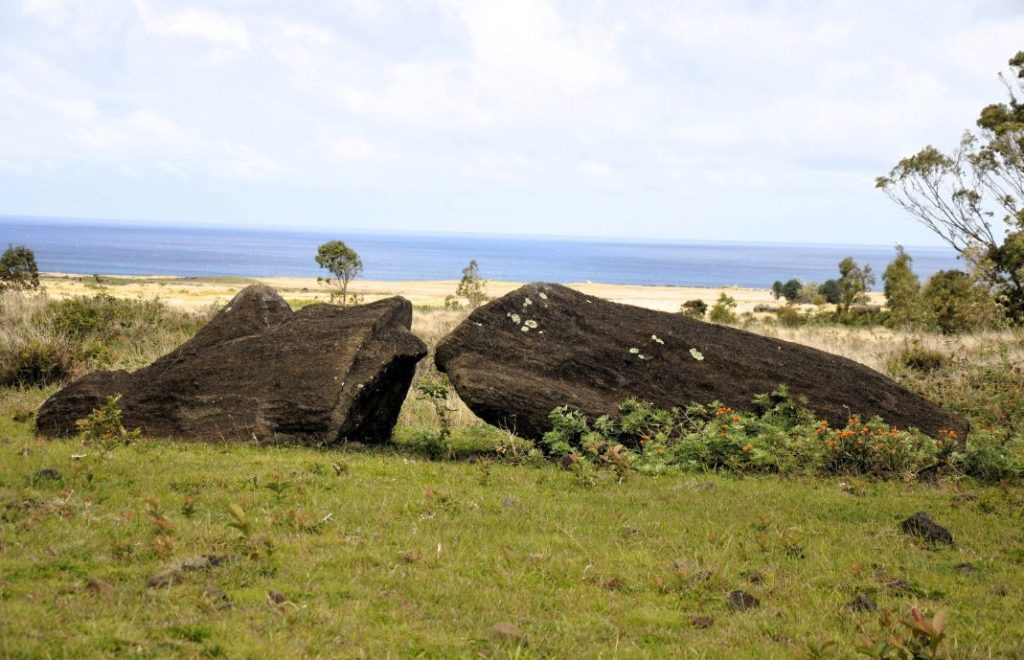
Toppled giants – The fall of the moai statues
At some point in Easter Island’s turbulent past, every single upright moai statue was deliberately pushed over from its ceremonial platform, or ahu. Many shattered into pieces, while others suffered extensive damage after lying exposed to the elements – sun, wind, rain, and salt – for more than 200 years.
Today, around 50 moai have been restored and re-erected by archaeologists, beginning in 1955, as part of efforts to preserve and honor the island’s cultural heritage.
Importantly, the moai were not felled by natural disasters like earthquakes or tsunamis. Their fall was a human act, likely tied to social unrest, tribal conflict, or shifts in belief systems. When Jacob Roggeveen and the Spanish arrived in 1722, they noted the moai were still standing. But by the time Captain James Cook visited in 1774, some statues had already been toppled.
By 1838, no upright moai were seen by outsiders – a clear sign that the dismantling had been gradual, and intentional.
What was once an island of towering stone guardians became, for a time, a landscape of fallen monuments – until efforts in the modern era began bringing the moai back to their original places, one restored ancestor at a time.
Still a mystery – Why were the moai toppled?
Despite decades of research, the true reason why Easter Island’s sacred moai were deliberately toppled remains one of archaeology’s most haunting mysteries. Two main theories attempt to explain this cultural collapse – and both speak to a society under immense pressure.
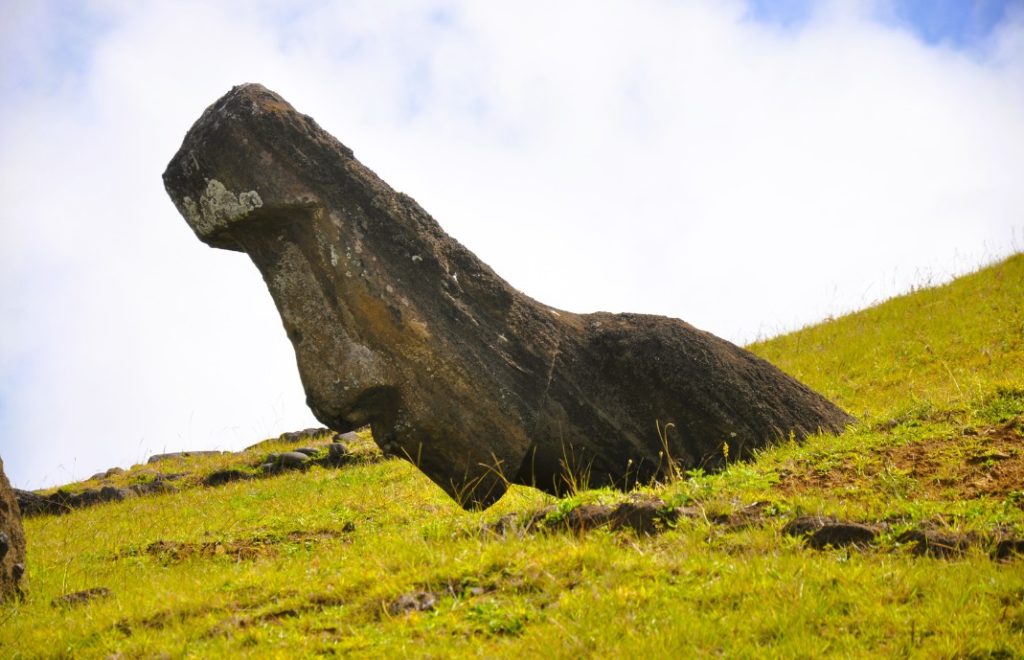
The first theory suggests that tribal warfare – fueled by dwindling resources – led rival clans to attack each other’s statues. Since each village’s moai was believed to provide mana, or spiritual protection, destroying a rival’s statues would strip them of their ancestral power. Moai were often pushed forward, burying their faces and eyes in the earth – symbolically cutting off their spiritual influence.
The second theory points to a loss of faith. Over generations, the islanders had invested massive amounts of time, energy, and resources into carving and transporting moai – yet famine, hardship, and ecological collapse persisted. Eventually, some may have decided the statues had failed them, and began tearing them down in anger, frustration, or disillusionment.
Modern scholars now recognize that the obsession with moai construction likely played a central role in the island’s downfall. Deforestation, soil depletion, and overexertion of resources were all driven by the logistical demands of moving hundreds of massive stone figures.
Whether the islanders understood the cost at the time – or knowingly sacrificed sustainability for power and prestige – remains unknown.
But one thing is clear: the moai are not only monuments to ancestral reverence, but also cautionary symbols of a civilization stretched beyond its limits.
Look them in the eyes…
As you gaze upon the moai statues of Easter Island, you may notice that some have carved eye sockets, while others – particularly those still in the Rano Raraku quarry or in transit – do not. This small but crucial detail reveals something profound about the spiritual beliefs of the Rapa Nui people.
The absence of eye sockets in unfinished or unplaced moai shows that the eyes were never carved in the quarry. Instead, they were only added after the statue had been erected on its ceremonial platform (ahu). This final step – carving the sockets and inserting coral eyes – was believed to “open” the statue’s gaze, allowing the ancestor’s mana (spiritual power) and soul to come alive.
Only then did the moai truly begin their sacred duty – watching over the people, guarding the land, and serving as a bridge between the living and the ancestral world.
To look into their eyes was to look into the soul of the island’s past.
Long ears and short ears – myth, misunderstanding, and moai
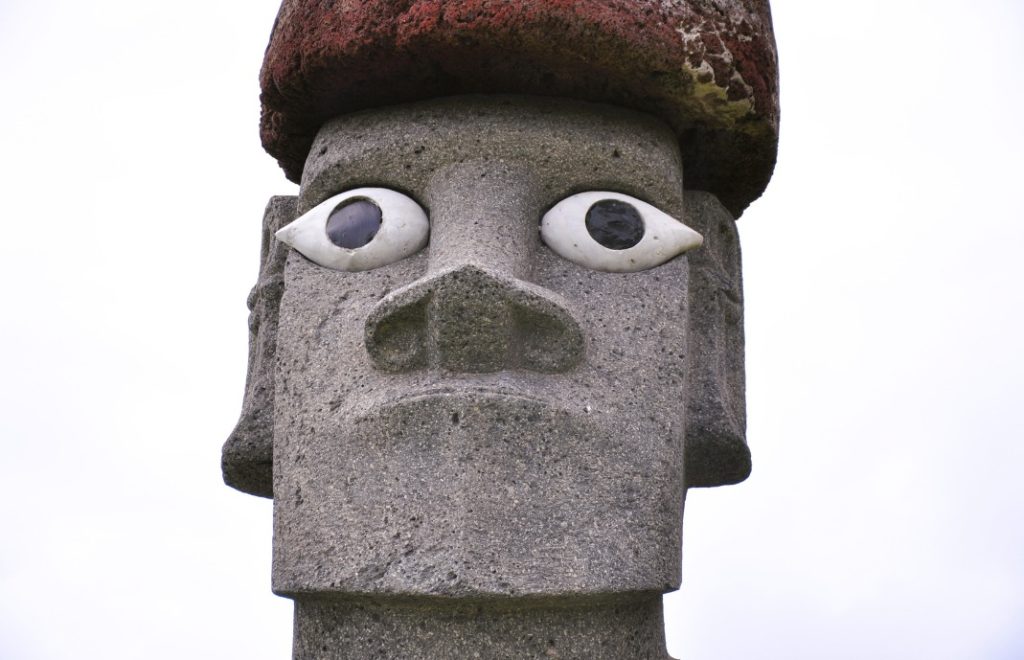
The elongation of earlobes was practiced by the early inhabitants of Easter Island and is clearly visible on many moai statues, whose long, carved earlobes reflect this cultural tradition.
Over time, this visual trait gave rise to a now-debunked legend that Easter Island was once inhabited by two separate ethnic groups: one with long ears, and another with short ears, supposedly from different migrations. However, there is no scientific evidence to support this theory.
Instead, historical and linguistic research points to two social classes, not ethnic groups:
- The Hanau Momoko, a lean, ruling class
- The Hanau E’epe, a stockier, physically stronger working class
At some point, the Rapa Nui word “E’epe” (referring to body type) was confused with “Epe” (meaning “ear”), and the legend of the Long Ears vs. Short Ears was born – more linguistic mix-up than historical reality.
When Captain James Cook visited the island in 1774, he noted that many islanders still had elongated earlobes, and that some men would flip them over the tops of their ears when running – an oddly practical use of a cultural tradition.
So while the moai’s long ears hint at the islanders’ body art and hierarchy, the tale of warring ear-types is more myth than history – a fascinating reminder of how stories evolve across time and translation.
Moving the moai – Myths, methods, and mana
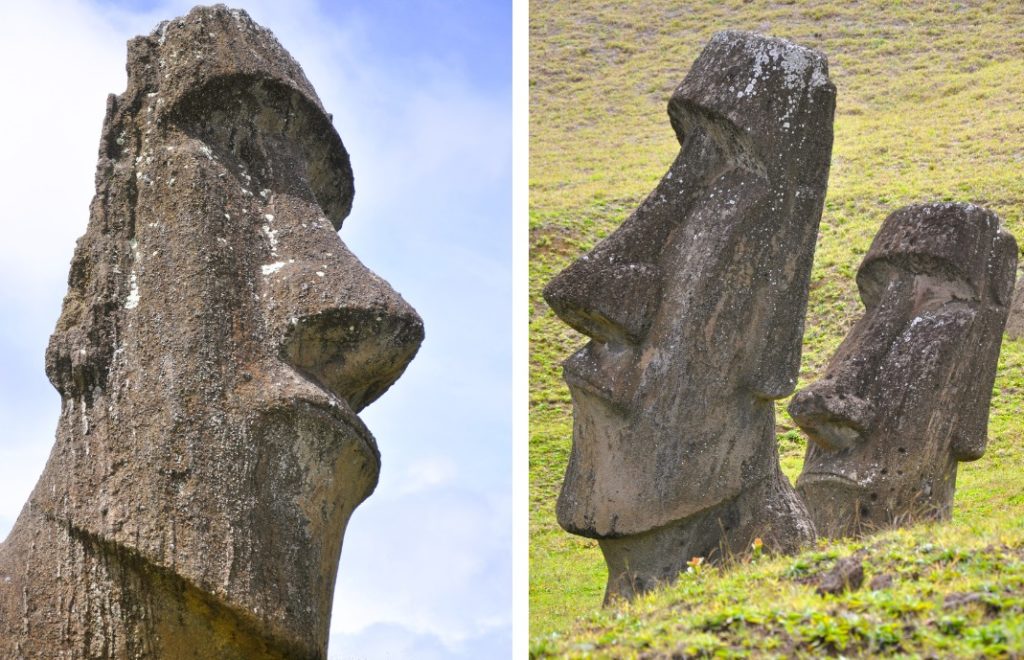
How the ancient Rapa Nui people moved the massive moai statues from the quarry at Rano Raraku to their distant platforms remains one of Easter Island’s greatest mysteries. It is also a source of lively debate among archaeologists.
The truth may be that there was no single method. Just as you might use different techniques to move a heavy fridge depending on your home’s layout, the Rapa Nui likely adapted their methods to varying terrain and distances.
Importantly, the popular idea that all the island’s trees were cut down to transport moai is now considered inaccurate. In reality, palm trees were cleared primarily for agriculture, though their large, straight trunks would have been ideal for moving heavy loads.
Along the routes from the quarry, researchers have discovered stone-paved roads – clear indications of planned transport paths. The moai were probably tied onto wooden sledges or frames and hauled over logs used as rollers. Some theories suggest sweet potatoes were crushed to make a slippery paste to reduce friction under the logs.
Oral traditions offer another explanation: the moai “walked” to their platforms with the help of mana – a spiritual force. This inspired researchers like Thor Heyerdahl and others to explore the idea that moai were moved upright, rocked side to side in a controlled motion.
However, many of the statues found along these ancient “moai roads” lie face-down or on their backs, casting doubt on the standing-transport theory – at least as a consistent practice.
Whether dragged, slid, rocked, or empowered by mana, one thing is certain: the ingenuity and determination of the Rapa Nui people made the impossible possible.
The journey of the moai is not just about physics – it’s about culture, belief, and extraordinary human effort.
Glossary – Key terms from Easter Island
Pukao
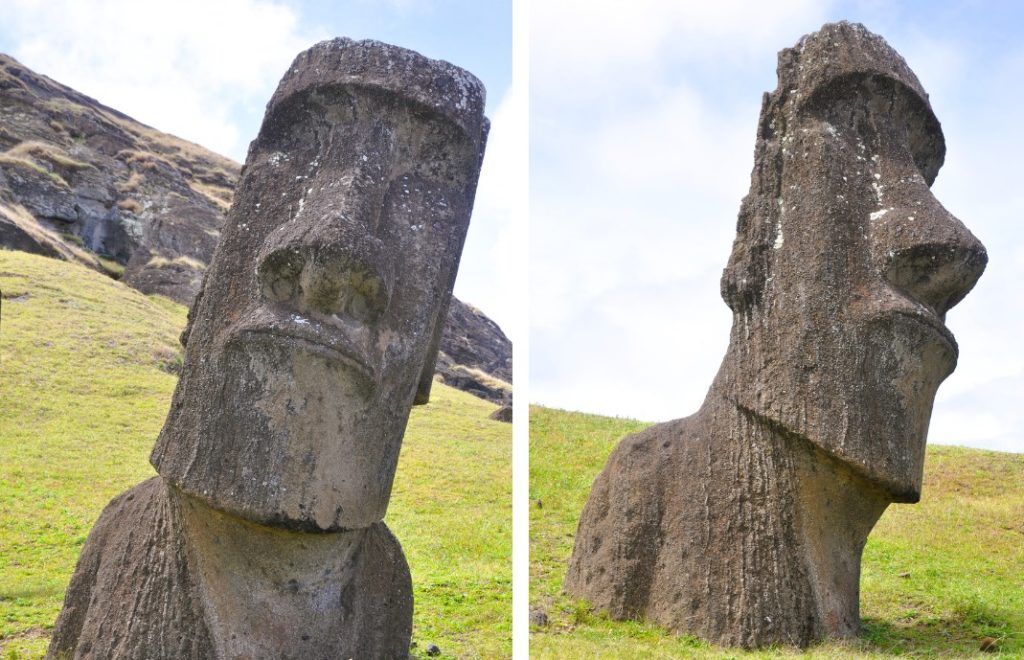
The pukao is the topknot or hat seen on some of the later moai statues. It resembles a large hair bun placed on top of the statue’s head.
According to local legends, mana (spiritual power) was believed to reside in the hair, making the pukao not just decorative, but highly symbolic.
Pukao were carved from red scoria, a volcanic rock. In Polynesian culture, the color red is considered sacred, suggesting that moai with pukao held even greater status and significance.
Ahu
The word ahu has two meanings in the Rapa Nui language:
- It refers to the stone platform on which one or more moai statues are placed—typically about 1.2 meters high.
- It also denotes the sacred site surrounding the platform, where ceremonies and rituals were performed.
An ahu was more than just a base – it was a spiritual space, believed to connect the living with their deified ancestors.