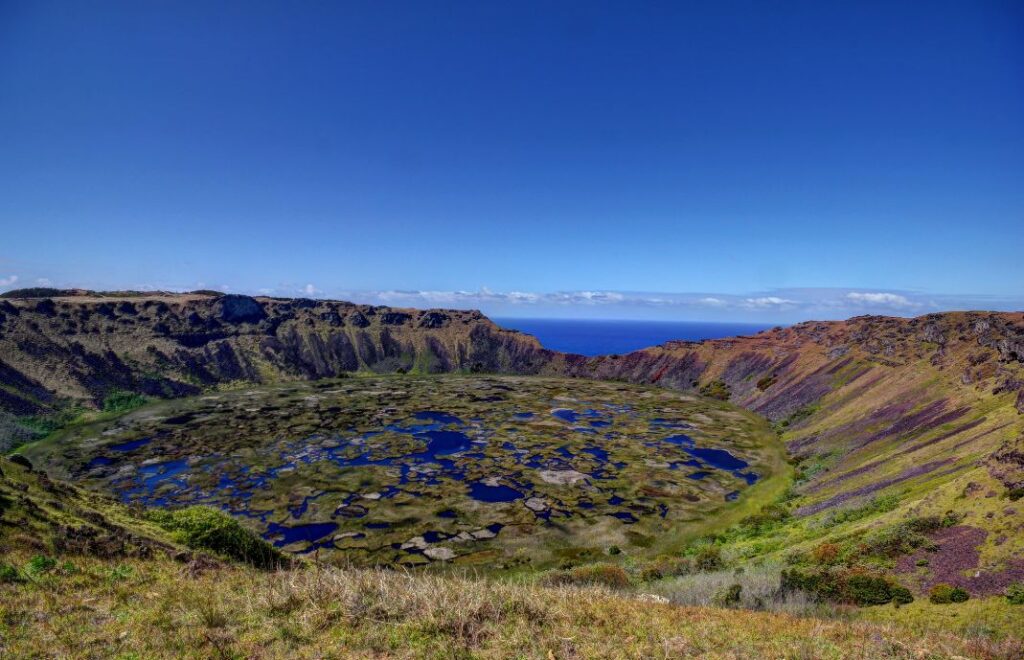
On the southwestern edge of Easter Island, Rano Kau rises as one of the island’s most dramatic volcanic landmarks. Its vast crater, filled with reeds, freshwater pools, and shifting shades of green, feels like a hidden world suspended between sky and sea. Standing at the rim, with the Pacific stretching endlessly beyond, it is easy to understand why this place became more than just a natural wonder.
Beside the crater lies Orongo, the ceremonial village connected to one of Easter Island’s most fascinating traditions: the Birdman cult. Here, stone houses cling to the edge of the cliffs, facing the small offshore islets where ancient competitions once helped decide spiritual and political power on the island.
Together, Rano Kau and Orongo reveal a different side of Easter Island – one shaped by volcanoes, rituals, ocean winds, and stories that feel both ancient and alive. It is a place where nature and culture are inseparable. Here you can slow down, look closer, and listen to the island’s past.
Rano Kau
Two and a half million years ago, Rapa Nui’s most spectacular volcanic eruption created this southwest corner of the island. It left behind an amphitheater of a crater, and one of Easter Island’s most majestic sights.
A walk up the short path leads you to the crater, stretching out like a hidden world inside the volcano. Its floor is filled with freshwater pools, reeds, and floating patches of vegetation. This creates a landscape that feels completely different from the dry, windswept slopes outside.
From the rim, the view and contrast are striking: green life below, endless Pacific Ocean beyond, and the curved edge of the crater holding it together.
In olden days, the lake would have been the principal source of freshwater for the southwest part of the island. Today it lies rather stagnant, with the only life form down there is a small fish. It was introduced to prevent mosquito lava from reproducing en masse.
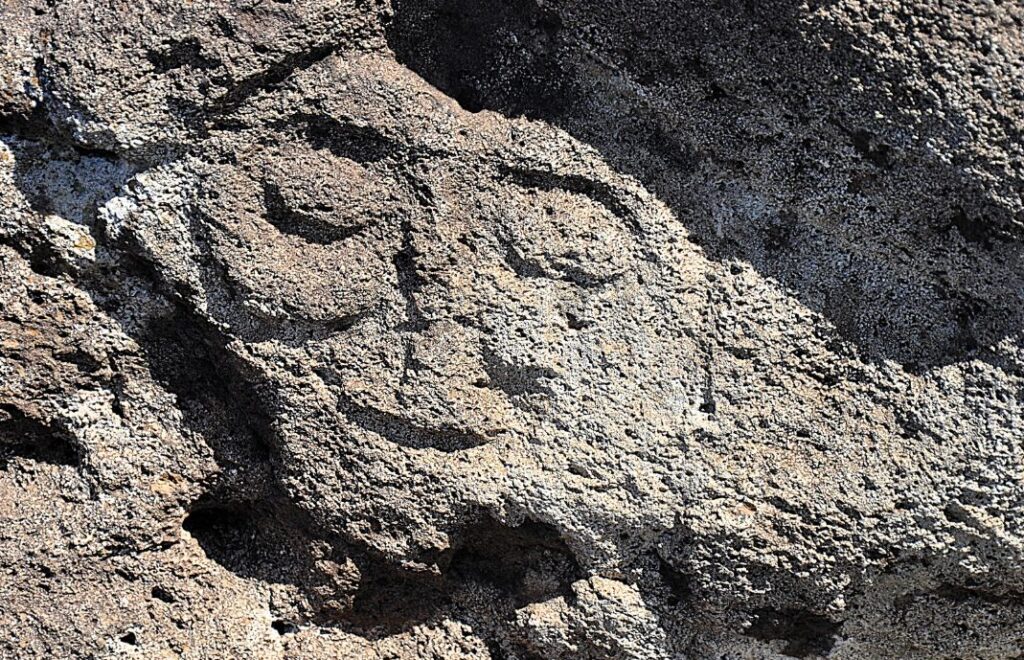
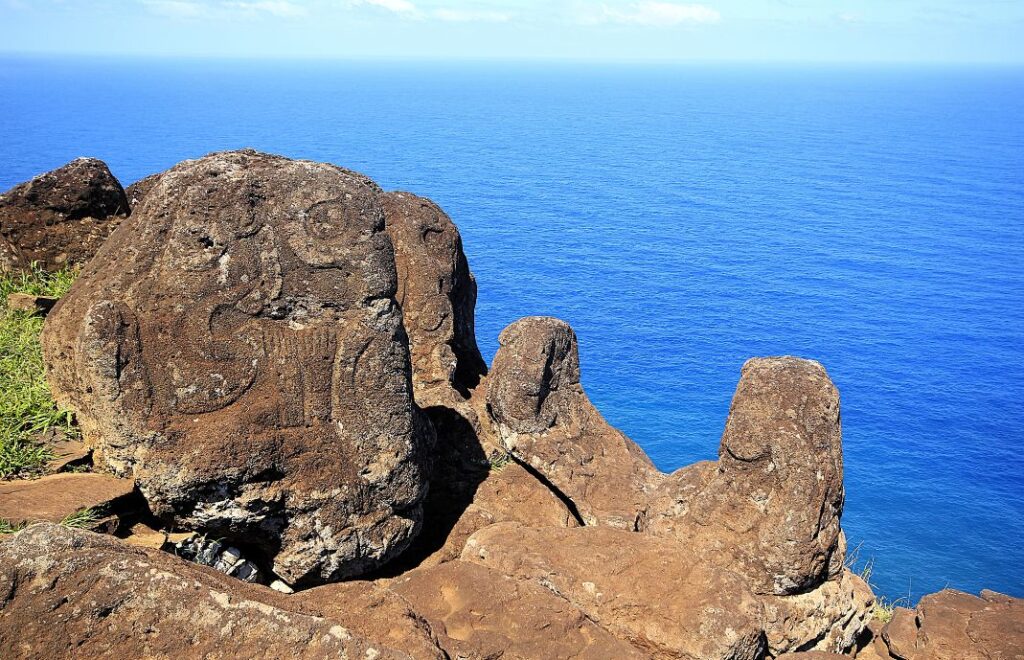
Rano Kau is also a great place to see several good examples of birdman petroglyphs. Note the bird head, complete with prominent beak and large circular eye, attached to a human body on a fetal position.
Easter Island is associated with the moai, but Rano Kau reminds you that Rapa Nui is also a landscape of fire, stone, wind, and water.
Best light: late morning or mid/late afternoon.
Orongo
This unique place is majestically perched between the rim of Rano Kau’s crater and 305-meter (1000 feet) cliffs straight down to the Pacific Ocean. Orongo enjoys Easter Island’s most dramatic setting and is one of the island’s most atmospheric and meaningful places.
This ancient ceremonial village tells a different chapter of Easter Island’s story. It is closely connected to the Birdman cult (Tangata Manu), a powerful tradition that became important after the era of the great moai-building culture. Each year, competitors took part in a dramatic ritual linked to the first sooty tern egg of the season, collected from the small offshore islet of Motu Nui.
The setting makes the story even more powerful. From Orongo, the cliffs drop steeply toward the ocean, and the islets lie beyond the waves like distant pieces of legend. Orongo is a place where rituals, power, nature, and belief came together. It is one of the most fascinating windows into Rapa Nui’s ancient world.
The story of Orongo
During the moai period, Orongo was used seasonally for various ceremonies, particular initiations, and coming-of-age ceremonies for young boys and girls.
Orongo’s real significance came in towards the end of the 17th century when the organized and structured society on the island collapsed. It was now a warrior-led anarchy, and inter-tribal warfare dominated Easter Island. Resources had become depleted, and tribes were ransacking each other’s territories. The once sacred moai were no longer being carved but thrown over and destroyed in acts of vandalism and revenge.
Order needed to be restored, and a new religious belief system was instilled. The idea was to appeases the gods and have them look favorably again on Rapa Nui. During the period of moai carving and worship, the society was organized and controlled by the chiefs and priests of each tribe. Now, the warrior class, or matato’a, took charge.
The solution for the power management of the island was a religious revolution. They implemented a competition that gave each tribe the opportunity for leadership and no longer rewarded status and rank. Instead, it focused on physical prowess. It became known as the Birdman Competition.
The highlights of Orongo
The highlights of Orongo are its dramatic cliffside location, its deep connection to the Birdman tradition, and its sweeping views over the Pacific Ocean and the islets.
The village’s low stone houses show how people adapted to the island’s powerful winds and volcanic landscape. Orongo is also known for its fascinating petroglyphs, many linked to the Tangata Manu, or Birdman, ceremony. Together, these details make Orongo one of the most atmospheric and culturally important sites on Easter Island.
The three famous islets
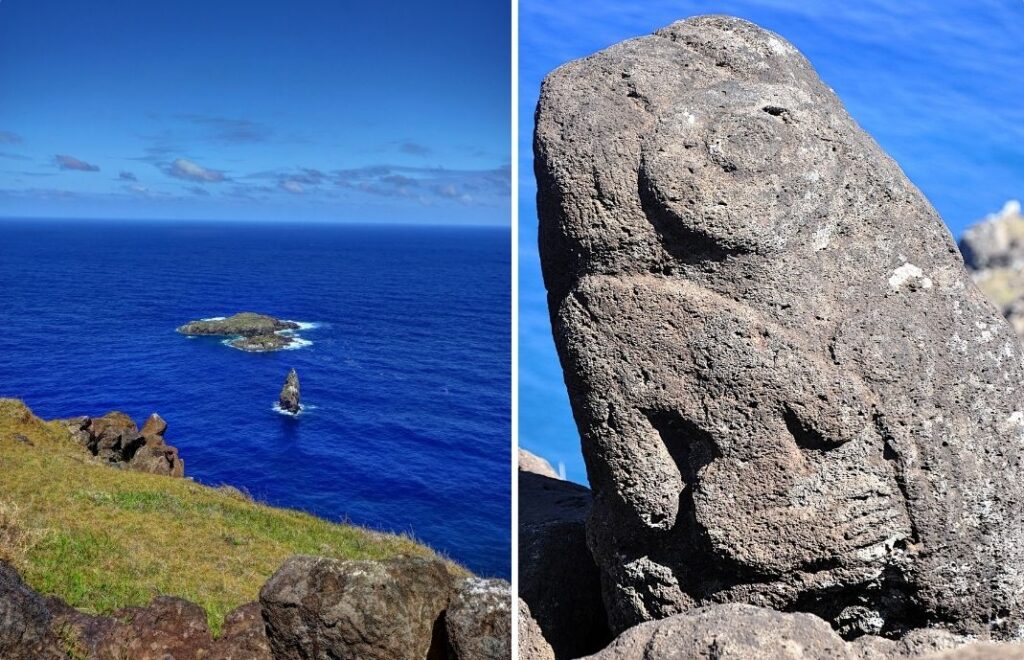
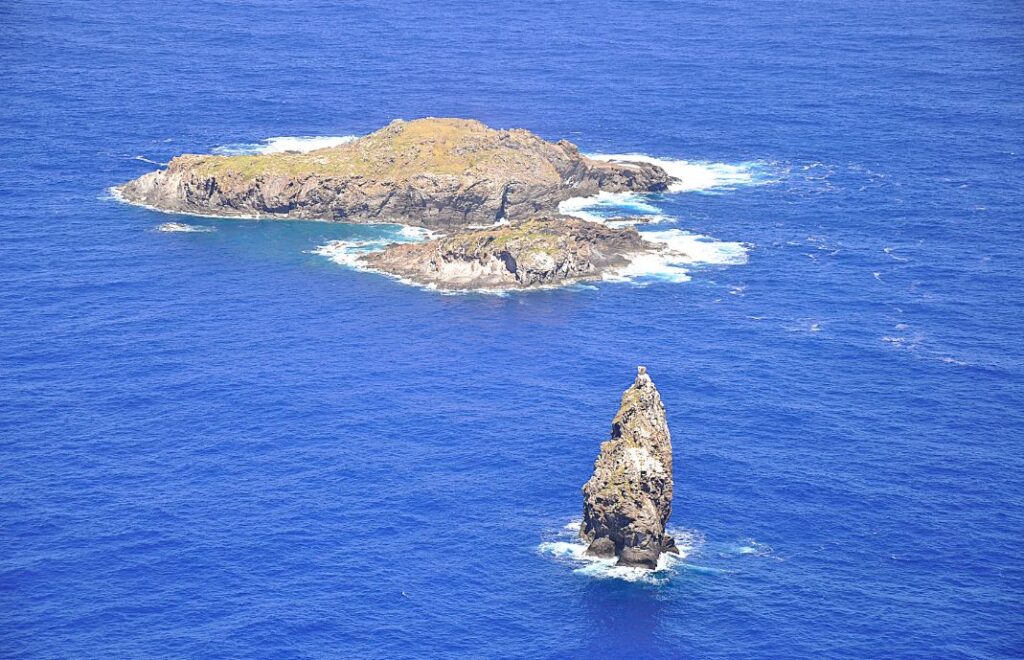
From the lookout you have fabulous view of the three offshore motus. The word motu means inlet, and these three are the largest of the 15 motus dotted around the coast of Easter Island. You are looking at the needle shaped Motu Kao Kao (meaning thin inlet), followed by Motu Iti (small inlet) and the largest and most important of all, Motu Nui (big inlet).
Seen from the ceremonial village, they appear like dark fragments of volcanic rock scattered in the endless Pacific, but their importance is far greater than their size.
The largest is Motu Nui, the main islet connected to the Birdman competition. During the Tangata Manu ceremony, competitors had to climb down the cliffs, swim across dangerous waters, and wait for the first sooty tern egg of the season. Whoever returned with the egg brought great prestige and power to the chief they represented.
Beside it lies Motu Iti, smaller but still part of the dramatic seascape that defines Orongo. The third, Motu Kao Kao, rises as a narrow, striking rock formation from the ocean, adding to the almost mythical atmosphere of the site.
These three islets are not just beautiful shapes in the sea. They are part of a story of courage, belief, rivalry, and ritual that once shaped life on Rapa Nui.
The stone houses
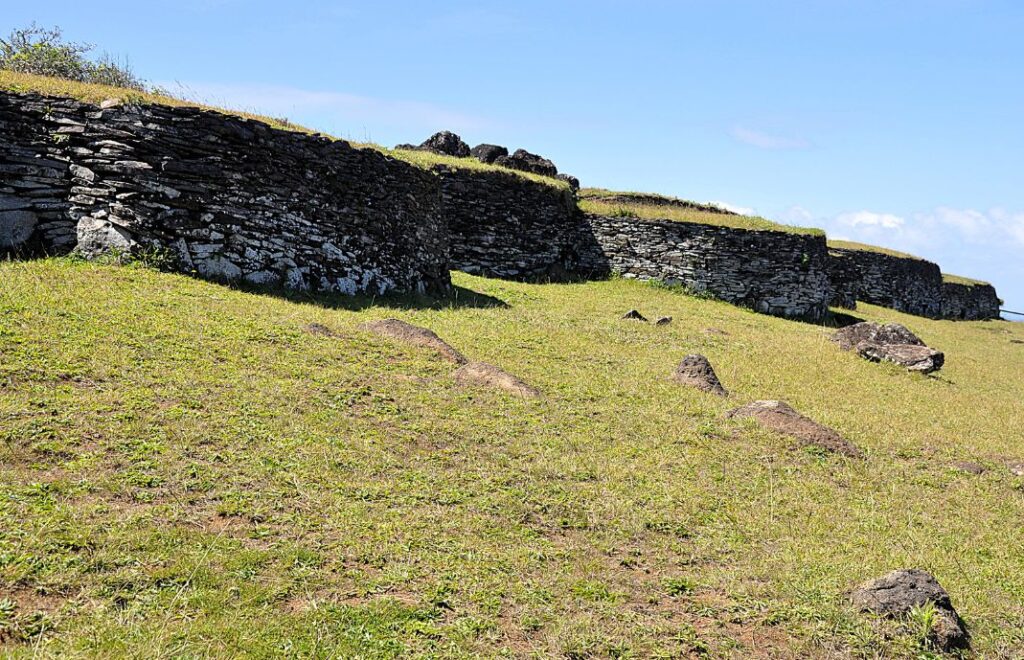
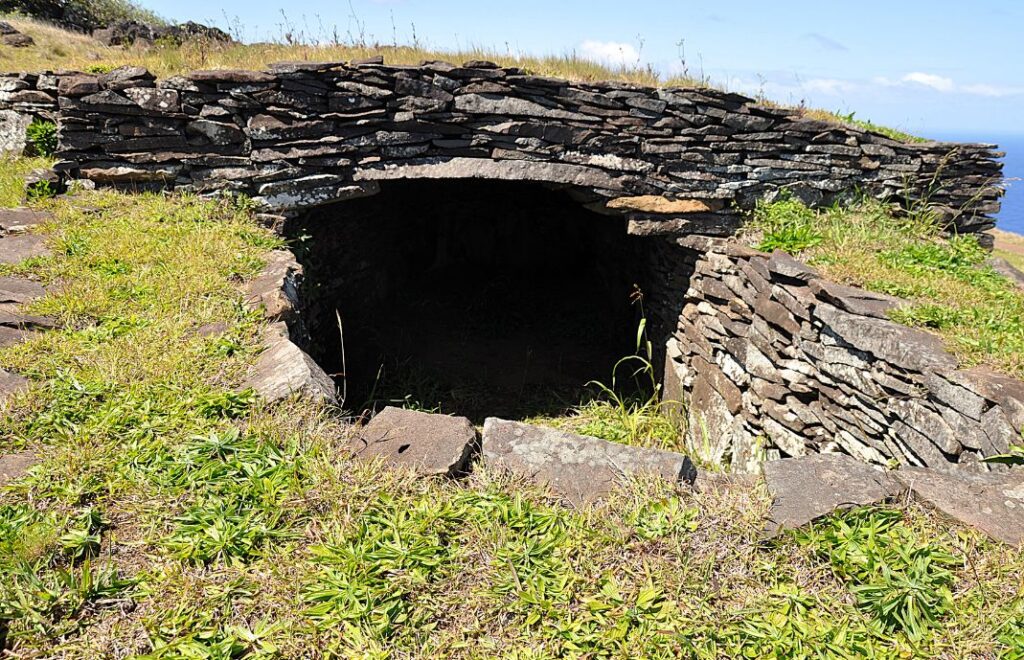
54 houses made up this ceremonial village, which were built low against the wind. They seem to blend into the volcanic landscape, as if they belong to the edge of the village itself.
Some of the houses were painstakingly restored by William Mullroy and a group of islanders in 1974. There are also two unrestored houses, the roof of which both have collapsed.
The houses were built out of basalt slabs, known locally as keho, and quarried from the interior of the adjacent crater. Soil was used between the inner and outer walls, designed to stop the wind passing through. Up here, it is usually five times windier than in Hanga Roa.
For the roof, they used a cantilever effect: progressively inward leaning slabs and finally the large central stone, that together support the heavy roof. The entrance is very small. Not only did it keep the elements out, but it also ensured that only one person could enter at a time. Some houses have multiple entrances.
All entrances look out towards Motu Nui and were only used for sleeping or for protection from bad weather. Cooking and all aspects of daily life took place outside in the open air.
Petroglyphs
Orongo is also known for its petroglyphs, many of them connected to the Birdman tradition. There are also numerous representations of komari (female fertility symbols) and images of Make Make, the island’s creator god. These carvings add another layer of mystery and meaning to the site, showing how deeply spiritual and symbolic this place once was.
There are over 1,700 petroglyphs at this site alone. Light conditions are key to how much you can see. Early morning or late afternoon lights are usually the best.