There is a saying in the American South that a good story is always worth telling. And judging by the flags of the Southeastern states, this region certainly has plenty of stories to share.
Some are filled with courage and determination. Others involve peculiar traditions, unexpected symbols, and historical events that continue to shape the region today.
And a few might leave you wondering how on earth they ended up on a state flag.
After all, where else would you find a mother pelican feeding her young with her own blood, a magnificent magnolia blossom, and a palmetto tree that helped defend a fort against British warships?
Then there are bears, horses, diamonds, and a rather impressive collection of stars.
But the flags of the American Southeast are about much more than interesting designs.
They reflect a region shaped by Indigenous cultures, European colonization, the struggle for independence, slavery, the Civil War, and the long and difficult road towards civil rights. These chapters of history have left their marks on the South, and some are still reflected in the symbols its states display today.
What makes this collection particularly fascinating is the way each state has chosen to tell its own story.
Some flags celebrate natural beauty and local wildlife. Others commemorate important moments in American history, honor longstanding traditions, or express values such as courage, unity, and freedom.
And some have changed dramatically over the years, reminding us that a flag isn’t simply a piece of colorful fabric. It can also reflect how a state understands its past and chooses to represent itself in the present.
Along the way, you’ll discover a few surprises.
Why does Alabama’s flag feature a simple red cross? What’s the story behind Arkansas’s diamond? Why does Tennessee have three stars inside a circle? And how did South Carolina’s famous palmetto tree become a symbol of resistance?
You’ll also uncover the stories behind some of America’s most distinctive state flags, including Mississippi’s beautiful magnolia design and Louisiana’s extraordinary pelican.
So, whether you’re fascinated by history, curious about unusual symbols, or simply enjoy discovering the little details that make places unique, there’s plenty to explore.
Our journey takes us through Alabama, Arkansas, Florida, Georgia, Kentucky, Louisiana, Mississippi, Missouri, North Carolina, South Carolina, Tennessee, Virginia, and West Virginia.
Thirteen states, thirteen flags, and a remarkable collection of stories.
Welcome to the American Southeast, where history runs deep, traditions are treasured, and even a state flag can have a tale worth telling.
Alabama: A crimson cross with a complicated history
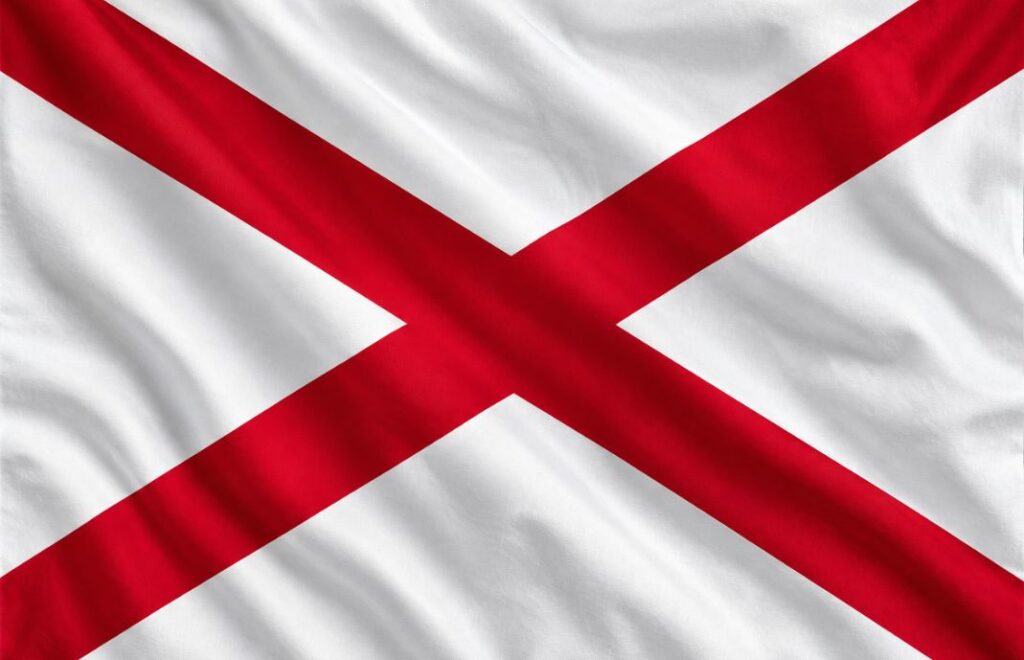
Alabama’s state flag might be one of America’s simplest designs, but don’t let that enormous crimson X fool you.
The red diagonal cross against a white background is known as a St. Andrew’s Cross, a symbol with roots in Scottish history.
Adopted in 1895, the flag also has connections to Alabama’s Confederate past, making its history considerably more complicated than its appearance suggests.
And here’s a curious detail: Alabama’s first state flag, introduced during the Civil War, featured a goddess, a cotton plant, and a rattlesnake.
Arkansas: Diamonds, stars, and a rather surprising competition
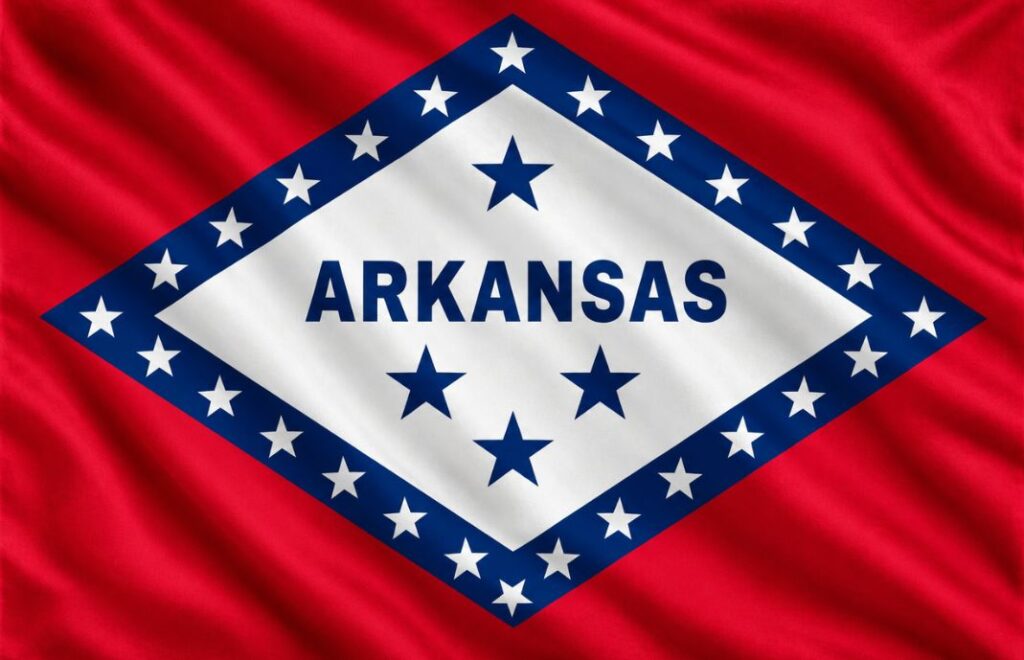
Diamonds might be a girl’s best friend, but in Arkansas, they’re also the centerpiece of the state flag.
Against a brilliant red background sits a large white diamond surrounded by 25 stars, representing Arkansas becoming America’s 25th state in 1836.
The diamond celebrates the state’s natural diamond deposits. And here’s something extraordinary: visitors to Arkansas’s Crater of
Diamonds State Park can actually search for diamonds and keep whatever they find.
But there’s more to this colorful flag than gemstones. Its four additional stars tell a fascinating story of Arkansas’s history, including its Confederate past.
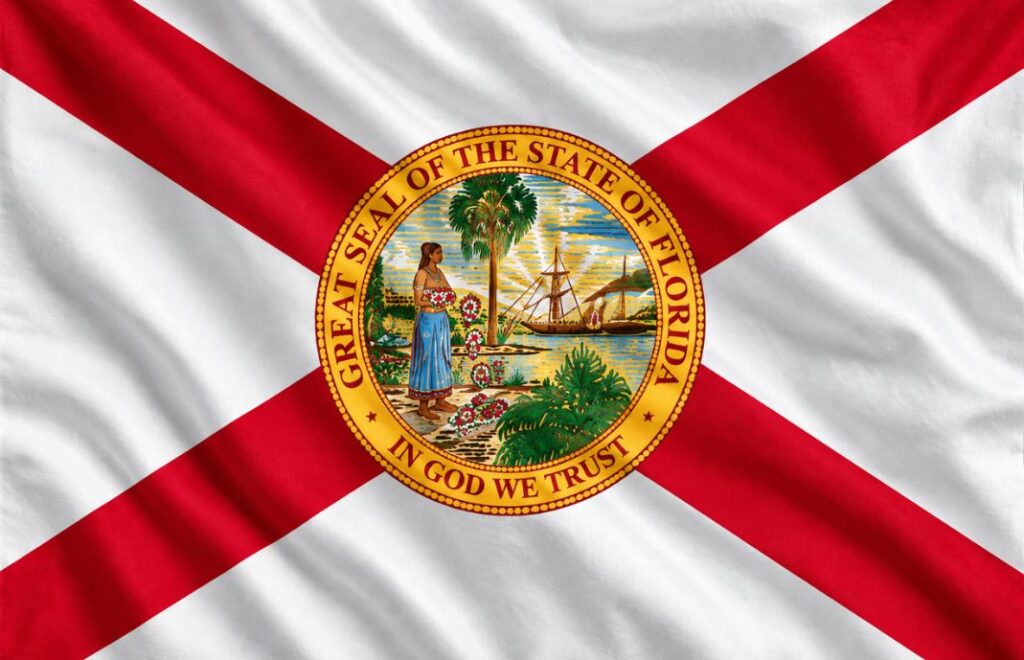
Florida: A red cross, a palm tree, and a flag that looked like surrender
Florida might be famous for its sunshine, beaches, and palm trees, but its state flag has a rather unexpected story.
Against a white background stretches a bold red diagonal cross, with the colorful state seal proudly displayed in the center. Look closely, and you’ll discover a Seminole woman, a palm tree, and a steamboat.
But here’s the surprising part.
Florida’s flag originally featured only the state seal against a white background. Unfortunately, when the flag hung without a breeze, it sometimes resembled a white flag of surrender.
The red cross was added in 1900, creating the distinctive design we recognize today.
More inspiration: Discover the fascinating story behind Florida’s state flag
Georgia: Thirteen stars and a flag that divided a state
Georgia’s state flag might look beautifully traditional, but behind its red and white stripes lies one of America’s most controversial flag stories.
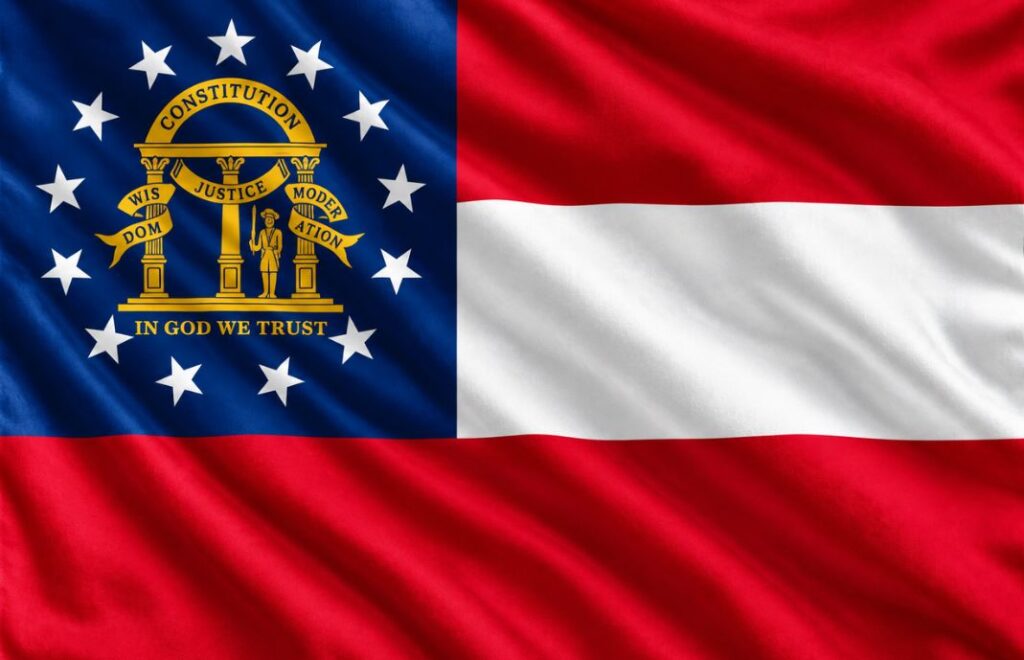
The blue corner features thirteen white stars, representing the original American colonies, surrounding Georgia’s golden coat of arms with its three pillars symbolizing Wisdom, Justice, and Moderation.
But here’s something surprising.
Georgia adopted its current flag in 2003, making it the state’s third design in just 27 months.
The changes followed decades of controversy surrounding the Confederate battle emblem on an earlier flag. Interestingly, the present design still resembles the Confederacy’s first national flag.
Kentucky: Two gentlemen, one handshake, and a powerful message
A friendly handshake might seem like an unusual choice for a state flag, but Kentucky has a wonderful reason for including one.
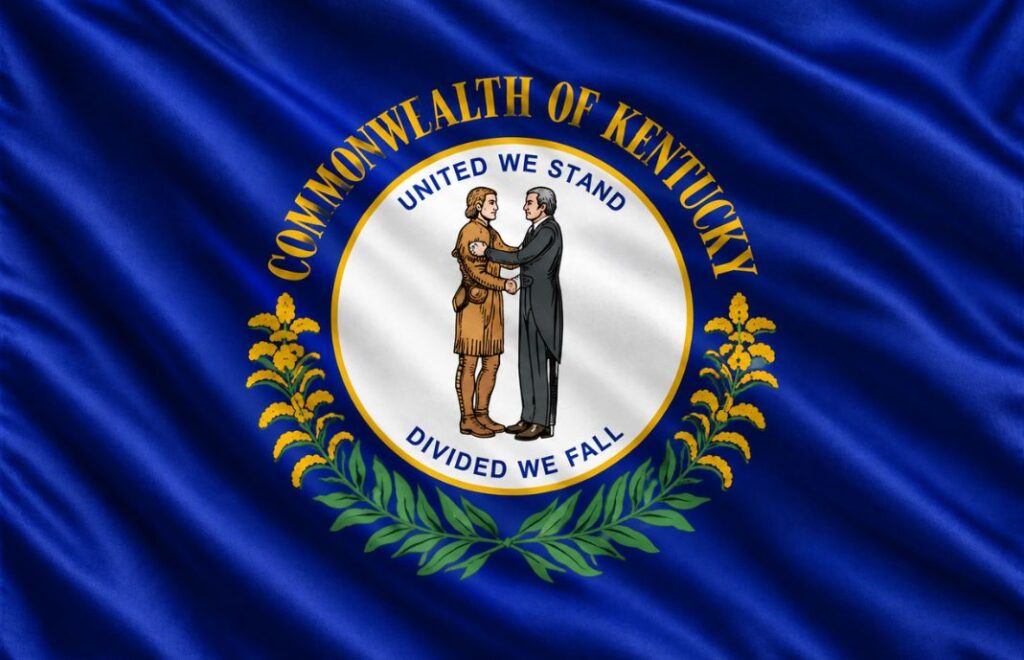
Against a deep-blue background sits the state seal, featuring two men shaking hands, surrounded by goldenrod flowers and the famous motto “United We Stand, Divided We Fall.”
But who are these mysterious gentlemen?
Many people believe they represent the legendary frontiersman Daniel Boone and the influential statesman Henry Clay. However, the figures actually symbolize friendship and unity rather than specific historical personalities.
And there’s a fascinating story behind how their appearance has changed over the centuries.
Louisiana: A mother pelican and three drops of blood
A mother pelican feeding her chicks might seem like a charming symbol for a state flag. But Louisiana’s pelican is doing something rather extraordinary.
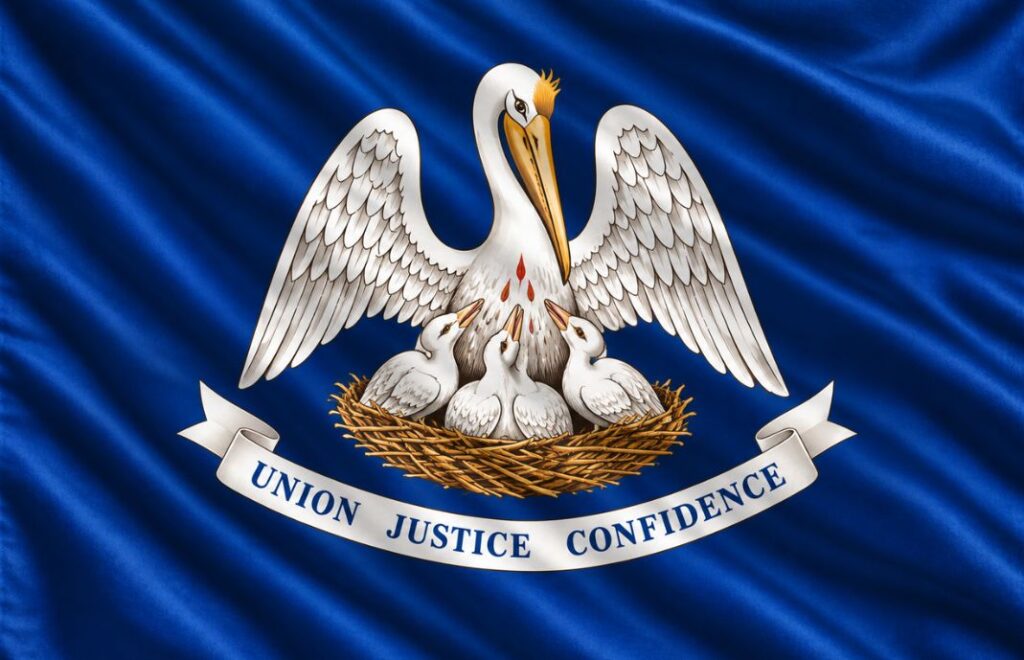
Against a deep-blue background, a white pelican sits above her three chicks, with the motto “Union, Justice, Confidence” displayed beneath them.
But look closely, and you’ll discover three tiny drops of blood on the mother’s breast.
According to ancient legend, pelicans would wound themselves to feed their starving young, making the bird a powerful symbol of sacrifice and devotion.
And here’s a surprising detail: those three drops of blood actually disappeared from many versions of Louisiana’s flag before being officially restored.
More inspiration: Discover the fascinating story behind Louisiana’s state flag
Mississippi: A magnolia, twenty stars, and a fresh beginning
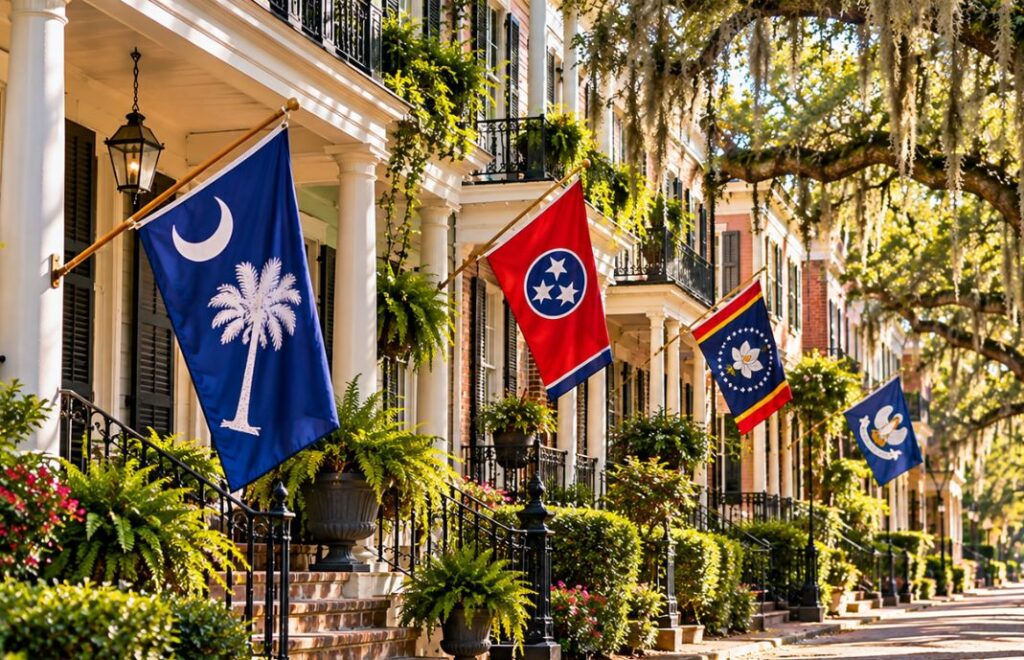
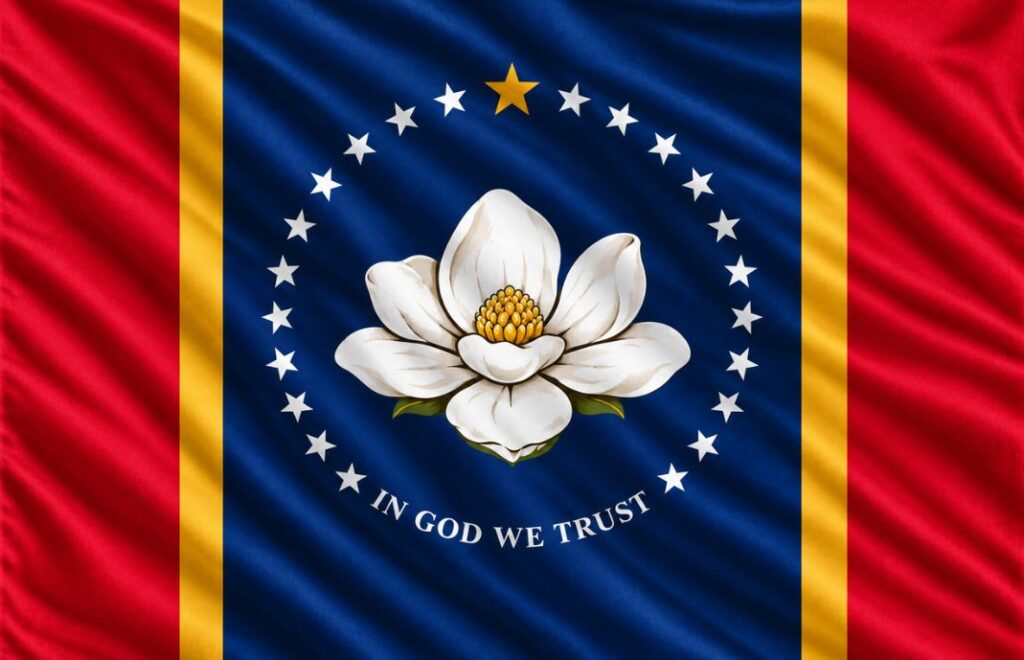
A beautiful white magnolia, a circle of stars, and a striking combination of red, blue, and gold. Mississippi’s state flag certainly knows how to make an impression.
The twenty white stars celebrate Mississippi becoming America’s 20th state in 1817, while a larger golden star honors the Indigenous peoples who lived in the region long before statehood.
But here’s something particularly interesting.
Mississippi adopted its current flag in 2021, replacing a controversial design that had featured the Confederate battle emblem for more than a century.
The new flag was chosen through a statewide competition and approved by voters, marking an important new chapter in Mississippi’s history.
More inspiration: Discover the fascinating story behind Mississippi’s state flag
Missouri: Two grizzly bears, twenty-four stars, and a determined woman
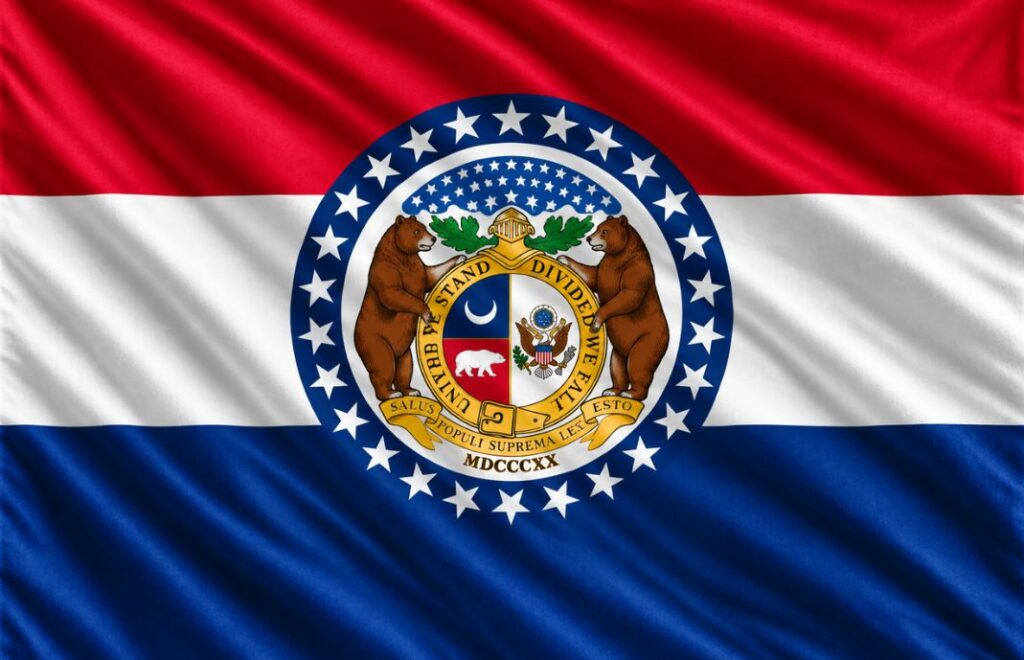
Two enormous grizzly bears standing on their hind legs might seem like an unusual choice for a state flag, but Missouri has a good reason for including them.
Against three horizontal stripes of red, white, and blue sits the state’s elaborate coat of arms, featuring two grizzly bears symbolizing strength and courage.
Surrounding the emblem are twenty-four stars, celebrating Missouri becoming America’s 24th state in 1821.
But here’s something surprising.
Missouri didn’t adopt its official flag until 1913, thanks largely to the determination of a woman named Marie Elizabeth Watkins Oliver.
Her journey wasn’t easy. It involved years of campaigning, a devastating fire, and eventually a group of schoolchildren who helped preserve her creation.
North Carolina: One star, two dates, and a revolutionary mystery
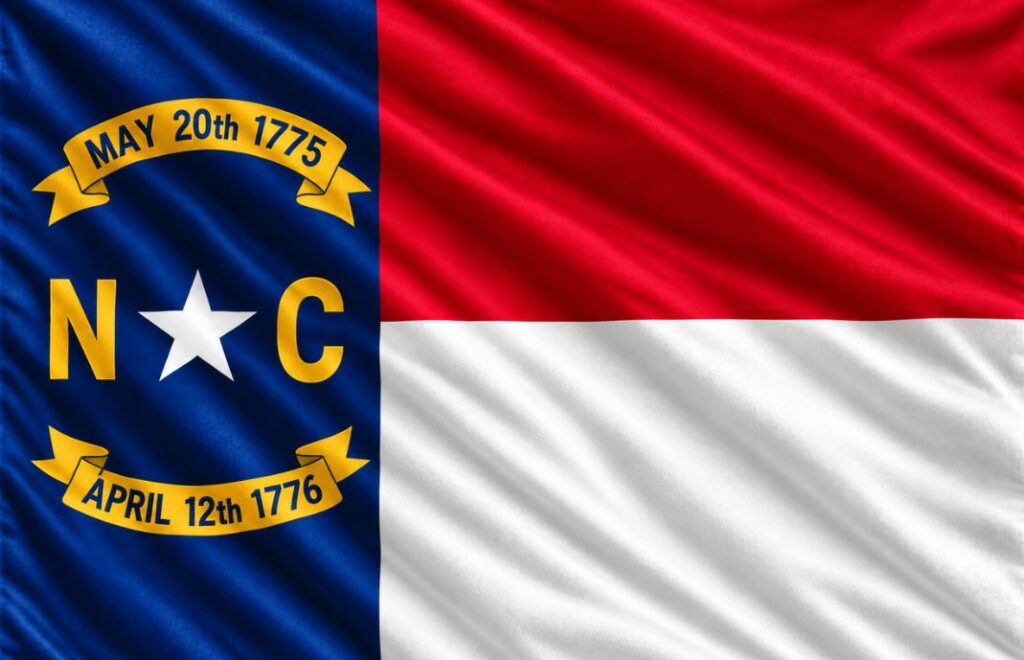
North Carolina’s state flag might look fairly simple, but those two golden ribbons contain a fascinating piece of American history.
Against a red, white, and blue background sits a single white star, accompanied by the letters N and C and two important dates: 20 May 1775 and 12 April 1776.
The second commemorates the Halifax Resolves, when North Carolina became the first American colony to officially authorize support for independence from Britain.
But here’s the intriguing part.
The earlier date celebrates the supposed Mecklenburg Declaration of Independence, an event whose existence is still debated among historians.
South Carolina: A palmetto tree, a crescent, and an unlikely victory
Who would have thought that a humble palm tree could help defeat a fleet of British warships?
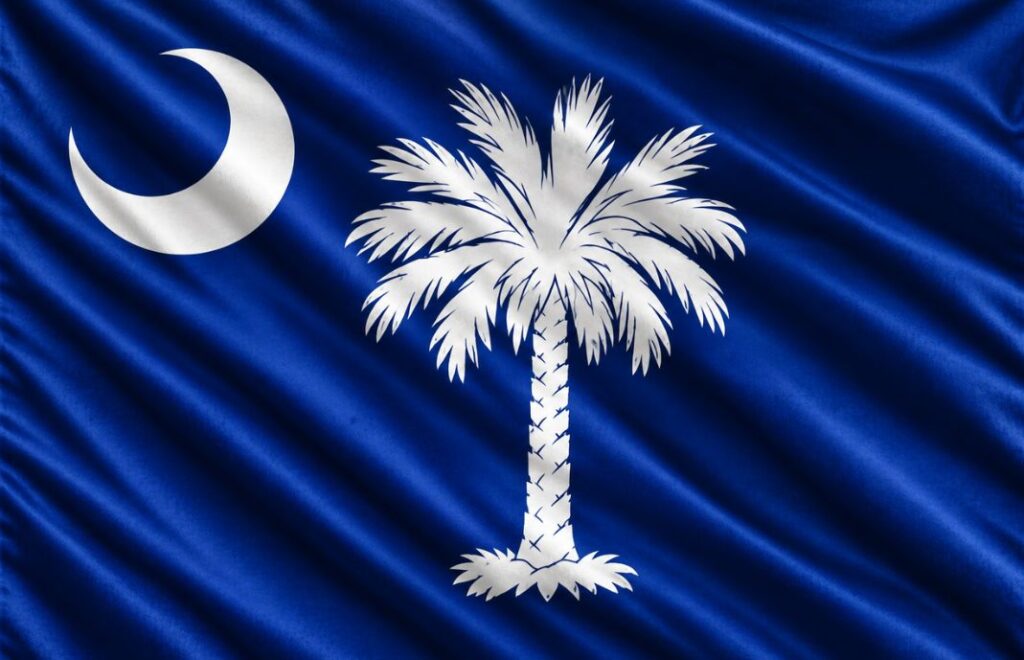
South Carolina’s flag features a white palmetto tree and a crescent against a deep-blue background, but these simple symbols have a remarkable history.
During the American Revolution, soldiers defending Charleston Harbor built a fort using soft palmetto logs. When British warships attacked in 1776, the flexible wood absorbed much of the impact of their cannonballs, helping the Americans secure an extraordinary victory.
And here’s another fascinating detail.
During the battle, a brave soldier risked his life to rescue the defenders’ fallen flag.
Tennessee: Three stars, one circle, and a clever little design
Three white stars, one blue circle, and a brilliant crimson background. Tennessee’s state flag might look simple, but there’s a clever story behind its design.
The three stars represent Tennessee’s three distinct regions: East Tennessee, Middle Tennessee, and West Tennessee. The blue circle symbolizes their unity, bringing together the state’s mountains, rolling countryside, and Mississippi River lowlands.
But here’s something interesting.
The stars are deliberately arranged so that no single one takes precedence over the others.
Designed by Captain LeRoy Reeves and officially adopted in 1905, Tennessee’s flag proves that even three little stars can tell a remarkable story.
More inspiration: Discover the fascinating story behind Tennessee’s state flag

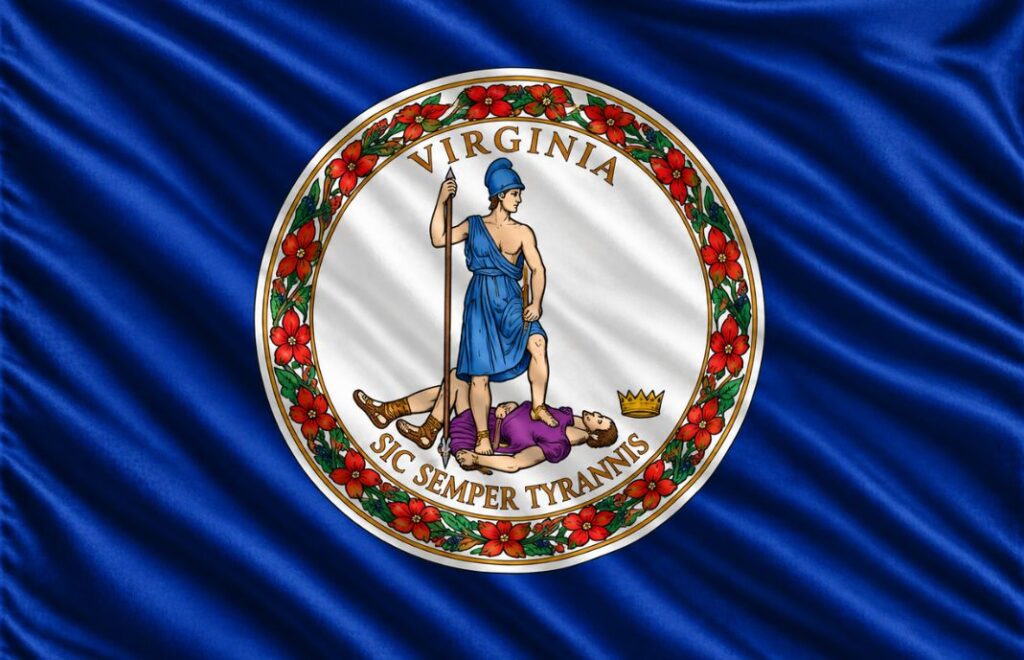
Virginia: A Roman goddess, a fallen tyrant, and a famous motto
A Roman goddess standing triumphantly over a fallen tyrant might seem like something from an ancient legend, but it’s actually the centrepiece of Virginia’s state flag.
Against a deep-blue background sits the state’s official seal, featuring Virtus, the Roman goddess of courage and virtue, standing over a defeated figure representing tyranny.
Beneath them appears the famous Latin motto “Sic Semper Tyrannis,” meaning “Thus Always to Tyrants.”
But here’s something fascinating.
The dramatic design dates back to 1776, when Virginia was fighting for independence from Britain. However, the familiar blue flag wasn’t officially adopted until 1861, during the American Civil War.
West Virginia: Mountaineers, miners, and a remarkable fight for freedom
“Mountaineers Are Always Free.”
Now there’s a state motto that makes quite a statement.
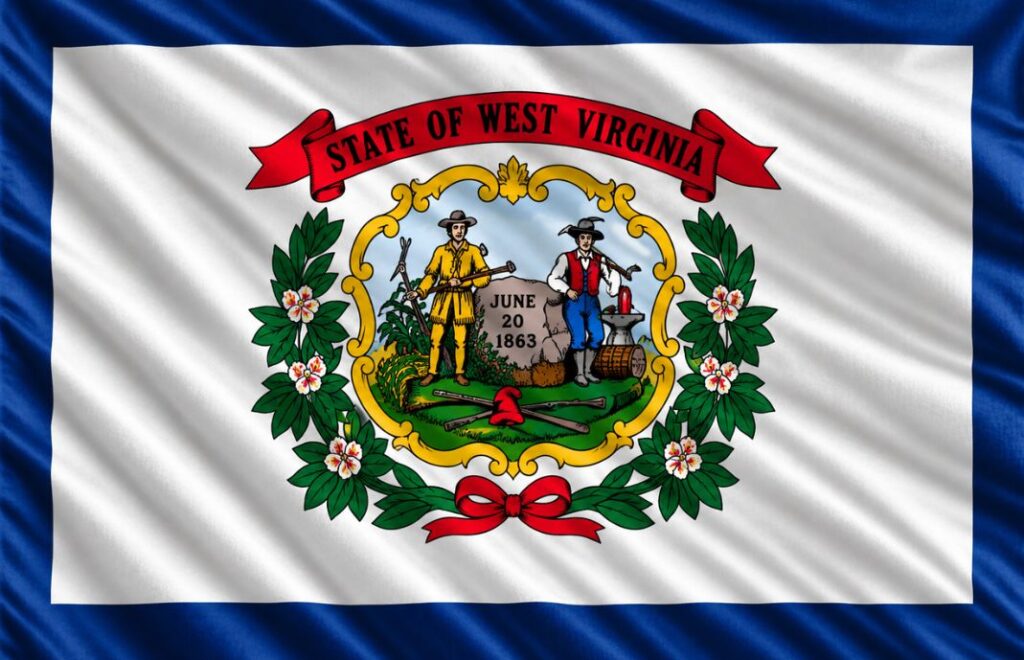
West Virginia’s flag features a white background with a blue border, surrounding a colorful coat of arms depicting a farmer and a miner, representing two industries that helped shape the Mountain State.
Beautiful rhododendron blossoms, the state’s official flower, complete the design.
But here’s something extraordinary.
West Virginia was actually born during the American Civil War, when its western counties broke away from Virginia after the state voted to join the Confederacy.
On 20 June 1863, West Virginia became America’s 35th state, creating a remarkable chapter in American history.