
From the depths of time, the ancient Egyptian civilization rises before us. Its secrets carved into temple walls, its stories whispered through hieroglyphs hidden beneath the desert sands.
Here, in the hushed corridors of tombs and the lofty ceilings of vestibules, the past speaks in symbols and shadows. And nowhere does it speak more powerfully than on the Giza Plateau, where the pyramids stand guard over history – immense and eternal, as commanding now as they were thousands of years ago.
They are the silent sentinels of a vanished world, monuments to ambition and ingenuity, towering reminders of a civilization that defined greatness long before the word existed.
As the old Arabic proverb says, “He who has not seen Cairo has not seen the world.” And it’s true. Cairo is a paradox of life: a whirlwind of history and chaos, exhaust fumes and golden dust, concrete sprawl and vibrant humanity. It overwhelms and captivates in the same breath.
We rise before dawn, determined to reach Giza before the tourist convoys arrive. Our driver takes the back roads, steering clear of the city’s morning madness. And then, suddenly – they appear. Majestic, triangular silhouettes piercing the horizon, their edges softened by a lingering morning haze – a haze born more of Cairo’s smog than of desert mist.
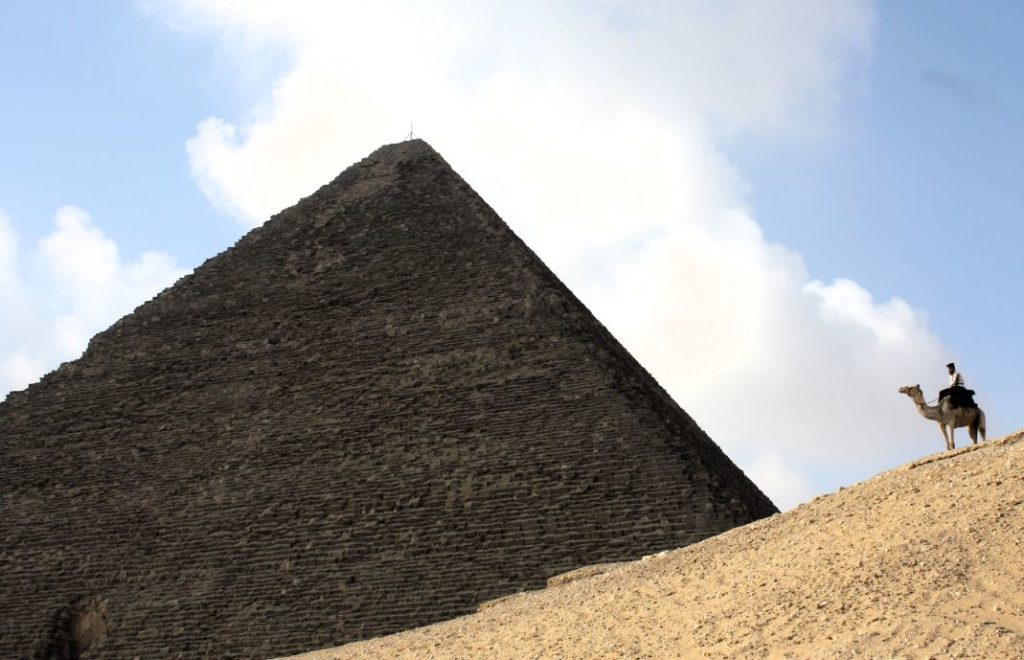
The closer we come, the more imposing they grow, until they dominate the skyline, unapologetically magnificent. Here they stand: the Great Pyramids of Giza, eternal resting places of kings – Khufu, Khafre, and Menkaure – their legacy rising from the sands in perfect symmetry, defying time itself.
Into the sacred heart
Our early start pays off – we manage to secure coveted tickets to step inside the Great Pyramid of Khufu. A stern Egyptian guard stands watch at the entrance, his gaze sharp as he reminds visitors: No cameras allowed.
We nod obediently, but as I summon the few Arabic phrases etched in my memory, his expression softens. A smile, a handshake – and suddenly, the rules bend just enough for a photo, not inside the pyramid, of course, but at the entrance. Beaming like a toothless celebrity, he proudly poses with us, two Norwegian travelers immortalizing the moment before crossing the threshold into eternity.
Then, with the ceremonial photo-op complete, we stoop low and slip into the ancient passageway, our backs bent as we navigate the narrow, stifling corridor. The air grows heavier, scented faintly with dust and antiquity. Each step forward feels like a step back in time, deeper into the very heart of Egypt’s mightiest monument.
At last, the cramped tunnel gives way to the soaring expanse of the Grand Gallery, its sloping walls converging in an awe-inspiring corridor that seems to defy both gravity and imagination. Here, at least, we can stand tall – though the weight of history presses down like an invisible force.
The gallery leads us upward, toward the sanctum of sanctums: the King’s Chamber. Inside, silence reigns, broken only by the whisper of breath. Before us rests Khufu’s sarcophagus, hewn from rose-hued granite, monumental in its simplicity – a stark reminder that even the greatest kings carried nothing with them beyond this point.
It’s a humbling moment, standing here in the stillness of 4,500 years. The walls are bare, stripped of the splendor that once adorned them, yet they radiate an almost palpable power. Here, inside this stone womb, eternity doesn’t feel like an abstract concept – it feels real.

The Solar Boat Museum
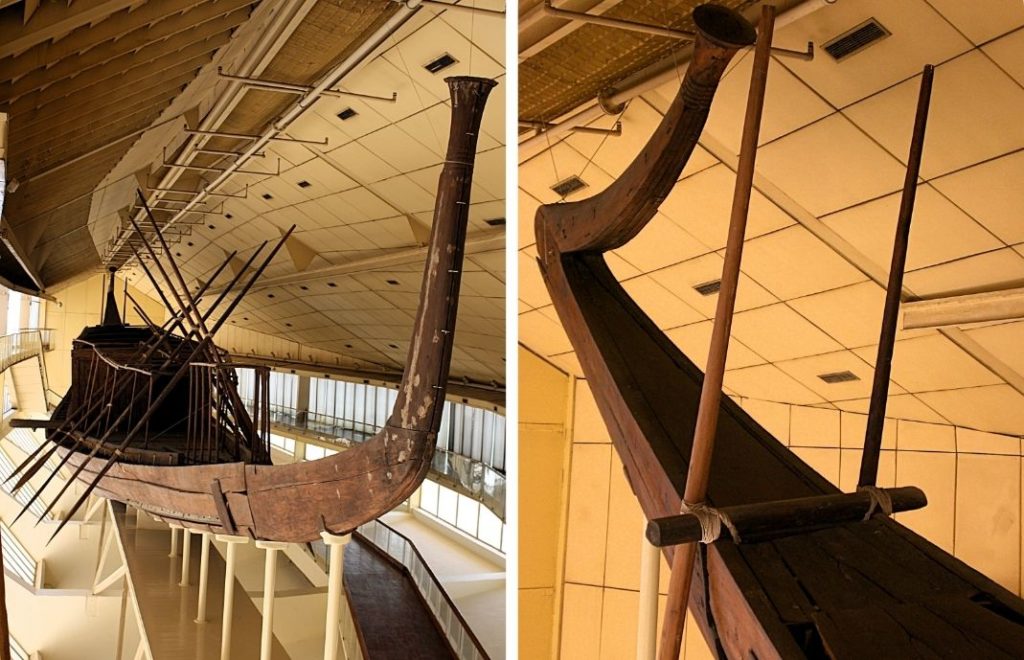
The day is still young, and possibilities abound. We wander toward what might be the ugliest building on the Giza Plateau. A stark, modern structure that jars against its timeless backdrop. Yet inside this unassuming shell lies one of Egypt’s most astonishing treasures: the Solar Boat Museum.
Housed within is a magnificent funerary vessel, a colossal wooden boat that once carried the soul of a pharaoh into eternity. What makes it even more remarkable? This ancient masterpiece was constructed without a single nail or metal fastener, its intricate joints and bindings holding strong for over 4,500 years. Standing before it, you can almost hear the echo of oars slicing through the waters of myth and ceremony.
Outside, reality quickly reclaims its throne. Giza’s eternal curse? Peace is a myth. Even in these early hours, the hawkers descend – peddling postcards, alabaster statues, and bottles of water with relentless zeal. The key here: be polite but firm. A smile and a decisive “La, shukran” (No, thank you) usually does the trick – eventually.
And then there are the camel men. One flashes a toothy grin and insists that posing on his camel is free.
“Yes,” I whisper to my friend with a smirk, but getting down will cost you!”
It’s a playful reminder that in Egypt, as in life, nothing is truly free.
Ships of the desert
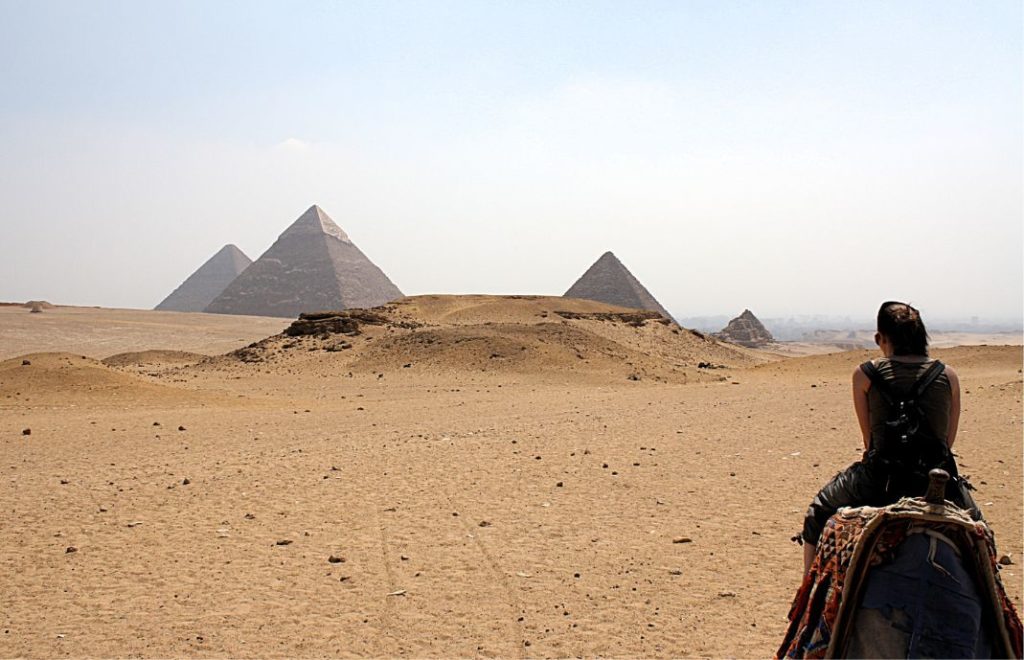
No trip to Egypt is complete without a camel ride – especially for a first-timer. So we make our way to the panoramic viewpoint, where all three pyramids align in a picture-perfect tableau. Here, negotiations begin. Prices fly back and forth in a desert dance as old as tourism itself.
Fortunately, two years as a tour guide in Egypt have taught me the golden rule: never accept the first offer. With a calm smile and steely resolve, I hold my ground. The man in his flowing galabeya sighs dramatically, as though the world itself teeters on the brink. Finally, with a theatrical shrug, he concedes. We have a deal.
He leads us to his camels, lounging languidly in the sand like desert royalty awaiting their subjects. With a helping hand, we mount the saddles, gripping tightly as the beasts rise in their signature, lurching motion – front legs first, then back. And just like that, we’re swaying high above the golden dunes, the pyramids shimmering like mirages on the horizon.
The ride isn’t long – perhaps thirty minutes – but it feels timeless. Each rhythmic step carries us deeper into the silence of the Sahara, the ancient giants watching from afar. Our camel guide, sensing our delight, softens. The stern negotiator vanishes, replaced by a man beaming with pride as he shares his desert kingdom with us.
Back at the viewpoint, we settle the agreed price and slip a little extra his way. His grin stretches wide. Moments ago, we were “very, very difficult.” Now? “My favorite people!”
In Egypt, even the smallest journeys become stories worth telling.
More popular than the Sphinx
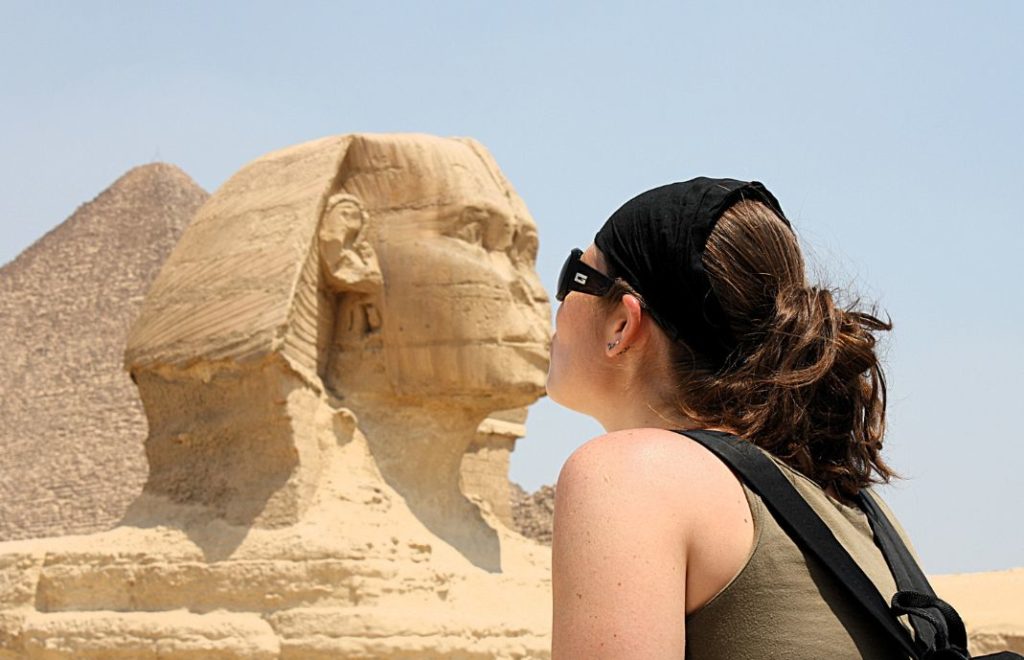
Our next stop is the timeless guardian of Giza – the Great Sphinx, a colossal enigma that has kept watch over the plateau for more than 4,000 years. At 73 meters long and 20 meters high, its leonine body and regal face radiate silent majesty. If this stone sentinel could speak, imagine the secrets it would share – of pharaohs and dynasties, desert winds and shifting sands.
But today, the chatter comes not from the Sphinx, but from a swarm of Egyptian schoolchildren. They spot us, glance at their teacher for permission, and then – like a tidal wave— – they rush forward, all giggles and eager smiles. Suddenly, we’re celebrities in the shadow of an ancient wonder.
“Welcome to Egypt! Where are you from? Do you like Egypt? What’s your name?”
The questions tumble out in charming, broken English, each one delivered with unfiltered enthusiasm.
Their joy is infectious. We laugh, we chat, and soon we’re swept into a flurry of selfies and group photos, our own presence adding a new layer to their school trip story.
And there it is – the real magic of Egypt. Not just in its monuments or myths, but in moments like this – where the past looms eternal, yet the present feels so vibrantly alive.

Egyptian treasures and timeless kings
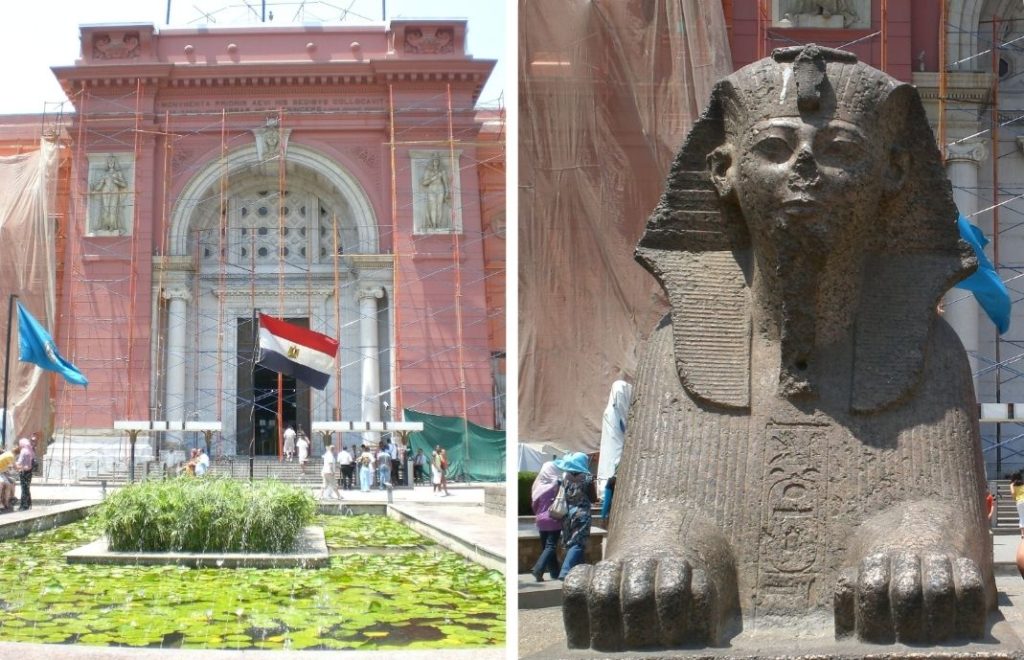
Our journey into Egypt’s storied past continues at the Egyptian Museum in Cairo, a place where history breathes from every corner. The building itself is an artifact – old, dusty, and overflowing with relics, its dimly lit halls lined with cabinets crammed full of wonders. Before stepping inside, cameras are surrendered; here, the treasures deserve your undivided attention.
For hours, we wander through labyrinthine galleries, past towering statues and glittering artifacts. Every turn reveals something extraordinary: amulets, papyrus scrolls, jewelry worn by queens, and relics of gods long forgotten. But nothing quite prepares you for Tutankhamun’s golden mask – a masterpiece so exquisite, it seems to glow from within, a silent echo of a boy king who ruled millennia ago.
Then comes the moment of reverent awe: the Mummy Room. Here, behind glass, lie the mighty pharaohs – Ramses II, Seti I, and others who once commanded empires. Their leathery faces and clenched hands bear witness to eternity. It’s eerie, yes, but utterly fascinating – a rare, humbling encounter with immortality.
As dusk settles, we return to the Giza Plateau. The pyramids, now bathed in twilight, seem even more imposing. But the night has one final enchantment: the Sound & Light Show. Under a canopy of stars, lasers and floodlights animate the ancient silhouettes, while the voice of Omar Sharif narrates tales of pharaohs and gods. Music swells, colors dance across stone, and history comes alive in a spectacle that feels both magical and surreal.
One thing is certain: a visit to Cairo isn’t complete without this unforgettable finale.
Where it all began…
The next day, we journey even further back in time. Leaving behind Cairo’s chaos, our car weaves through clusters of palm trees and sleepy villages before the gray cityscape dissolves into the endless sweep of desert.
For thousands of years, the desert wind has carried whispers of history across these sands. And now, it seems to breathe those stories into our skin. Grains of golden dust swirl around our feet, softening the ground before the very monuments that gave birth to an empire. This is the Egypt of your imagination: raw, timeless, majestic.
Welcome to Saqqara, a treasure trove where the entire saga of ancient Egypt unfolds. Here, the Imhotep Museum introduces us to artifacts unearthed in this storied necropolis – a modern gateway to a world carved in stone.
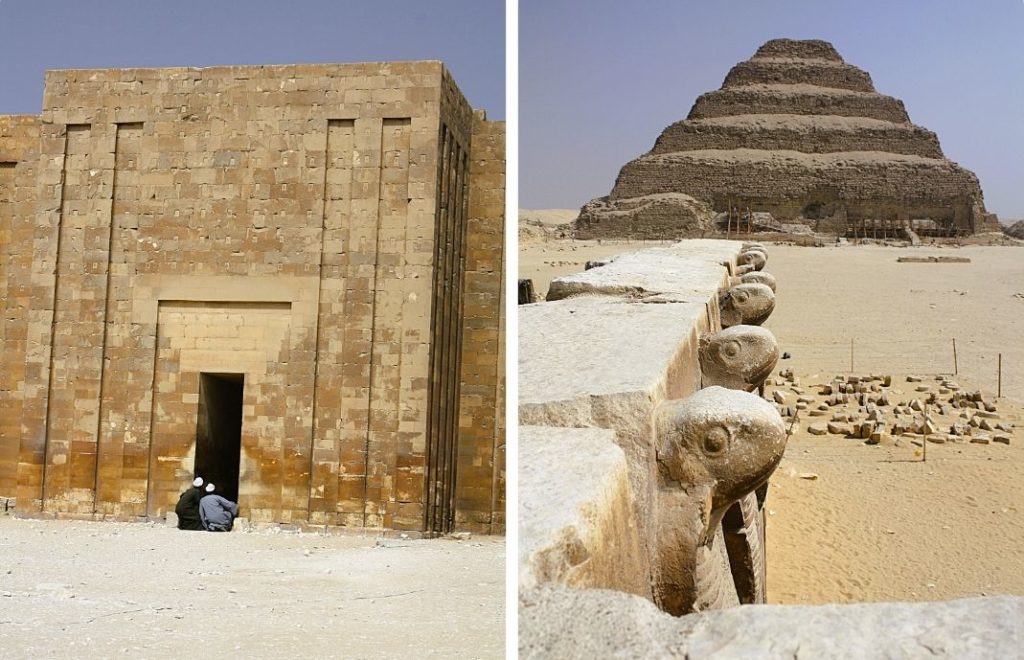
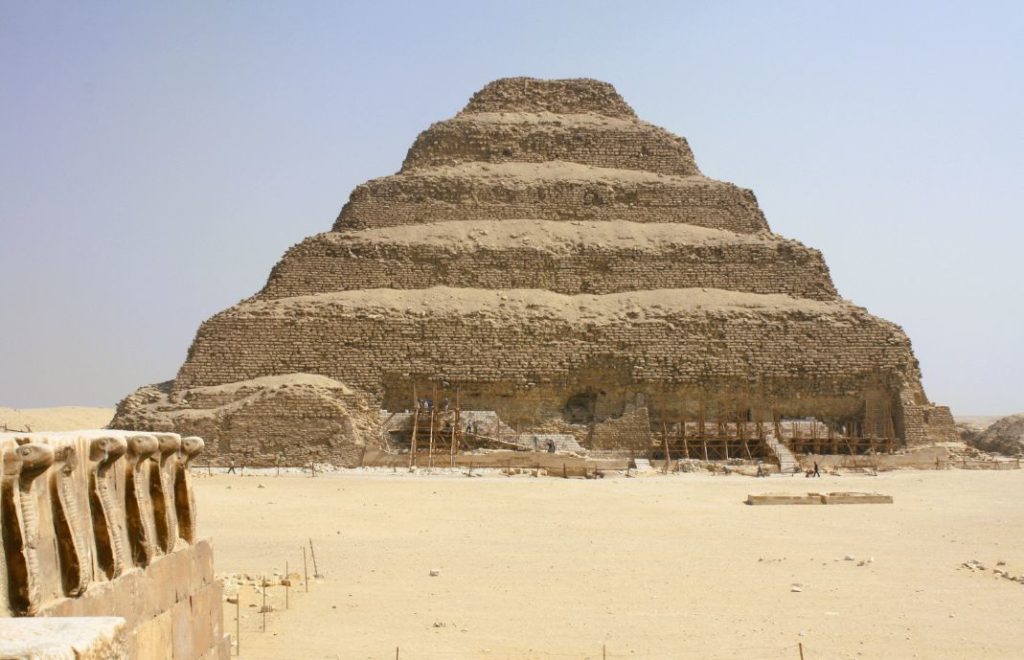
But nothing compares to the sight of Djoser’s Step Pyramid, rising in austere glory against the sky. Standing before it, you can feel it in your bones: this is where it all began.
At 62 meters tall, this is the oldest pyramid in existence – the prototype that forever changed the course of architecture and eternity. Before pyramids, the dead were entombed in chambers beneath flat-topped structures called mastabas (Arabic for “bench”), their sloping sides echoing the desert’s dunes.
Then came Imhotep, Djoser’s visionary architect. His idea was radical: stack mastabas one atop another, stretching toward the heavens. And so he did – layer by layer – until the world’s first pyramid stood triumphant, heralding a new age of ambition, innovation, and divine kingship.
Here, in the shadow of these ancient steps, history feels less like the past and more like a living presence – etched in stone, whispered by the wind.
More inspiration: Saqqara – where it all began
Egypt’s former capital
From atop the ancient walls surrounding Djoser’s pyramid complex, the desert stretches endlessly before you – a golden ocean frozen in time. On a clear day, your gaze may reach the Red Pyramid to the south, its hue glowing faintly under the relentless sun. To the right, a curious mound catches the eye. At first glance, it seems nothing more than a heap of rubble. In truth, these are the remains of Pharaoh Unas’ modest pyramid.
Though unimpressive today, Unas’ tomb holds monumental significance. During his reign (2378-2348 BC), a new tradition began: the carving of Pyramid Texts – sacred inscriptions meant to guide the pharaoh’s soul into the afterlife. These were the first of their kind, setting the stage for a literary legacy that would endure for millennia.
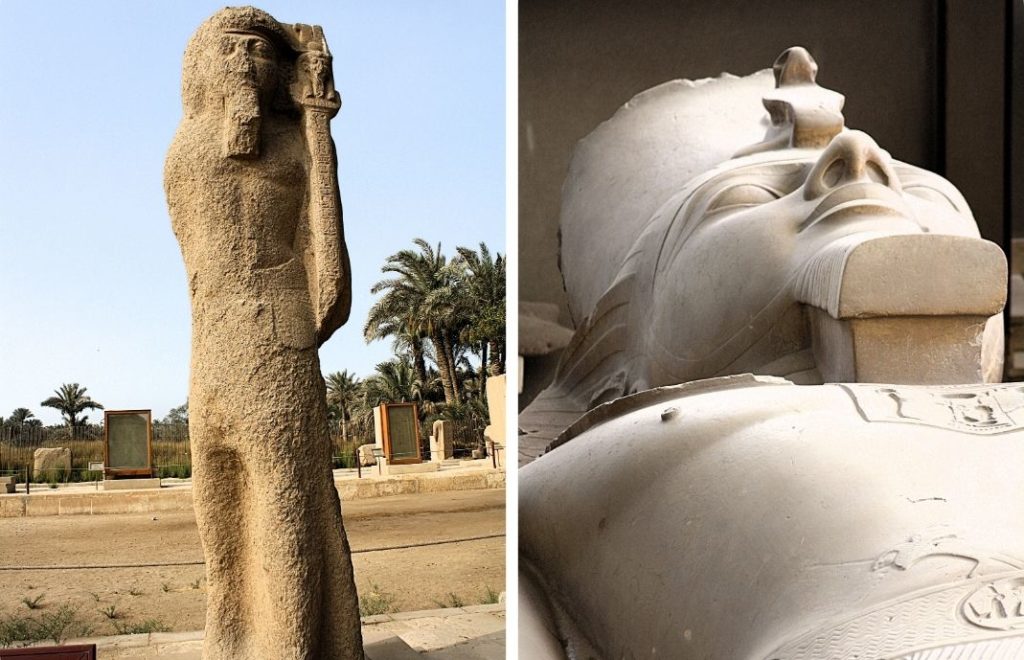
Our journey through pharaonic history ends in Memphis, once the beating heart of the ancient world. Founded around 3100 BC by Menes, Egypt’s first pharaoh, Memphis marked the birth of a unified nation, where Upper and Lower Egypt merged into one kingdom. For centuries, this city reigned supreme as the capital of the Old Kingdom and the spiritual hub of the land.
Here, the god Ptah – creator deity and patron of craftsmen and architects – was venerated above all. Today, little remains of Memphis’ grandeur, yet what survives still whispers of glory: the ruins of Ptah’s temple, fragments of sanctuaries, and a handful of statues, including two colossal figures of Ramses II, each hewn from limestone and standing over four meters tall.
Though Memphis has long since fallen silent, its legacy endures in the stones, the sand, and the echoes of an age that shaped civilization itself.
More inspiration: A guide to Memphis
The Pharaohs still fascinate
The pyramids have revealed many of their secrets, yet countless mysteries remain buried beneath the sands. One thing is certain: no other country on Earth boasts such a wealth of unique, awe-inspiring monuments – wonders that continue to captivate humanity thousands of years later.
Our journey has taken us 4,500 years back in time. We’ve stood before the colossal pyramids, those eternal bridges between mortals and gods. We’ve watched the Nile snake its way through Cairo like a shimmering ribbon of life. We’ve ridden camels into the heart of the desert and gazed upon the pyramids beneath a star-studded sky.
This is Egypt – the cradle of civilization, the keeper of timeless treasures, the land where history breathes in every grain of sand.
Welcome to the world’s greatest cultural heritage.
Welcome to Egypt.
You don’t want to miss
The Pyramids of Giza
Stand in awe before the last of the Seven Wonders of the Ancient World.
Camel ride by the Pyramids
An iconic desert experience with panoramic views of all three pyramids.
The Great Sphinx
The silent guardian of Giza, shrouded in mystery for over 4,000 years.
The Egyptian Museum (Cairo)
Home to Tutankhamun’s treasures, royal mummies, and countless artifacts.
Sound & Light Show at the Pyramids
A magical evening where history comes alive through light, music, and storytelling.
Djoser’s Step Pyramid at Saqqara
The world’s first pyramid and the birthplace of ancient Egyptian architecture.
Imhotep Museum (Saqqara)
Discover artifacts linked to Egypt’s earliest pyramid builders.
The ancient city of Memphis
Explore remnants of Egypt’s former capital, including colossal statues of Ramses II.
More inspiration to Egypt:
Cairo – chaotic, exotic, and captivating
The curse of the Pyramids
The camel that staged a grand escape
