
Travel 4,500 years back in time, to the golden sands of Giza Plateau, where history rises from the earth in colossal silence. Before you loom three timeless giants – pyramids that are far more than stone and geometry. They are bridges between man and the divine, eternal guardians of kings long gone, and symbols of a civilization that touched immortality.
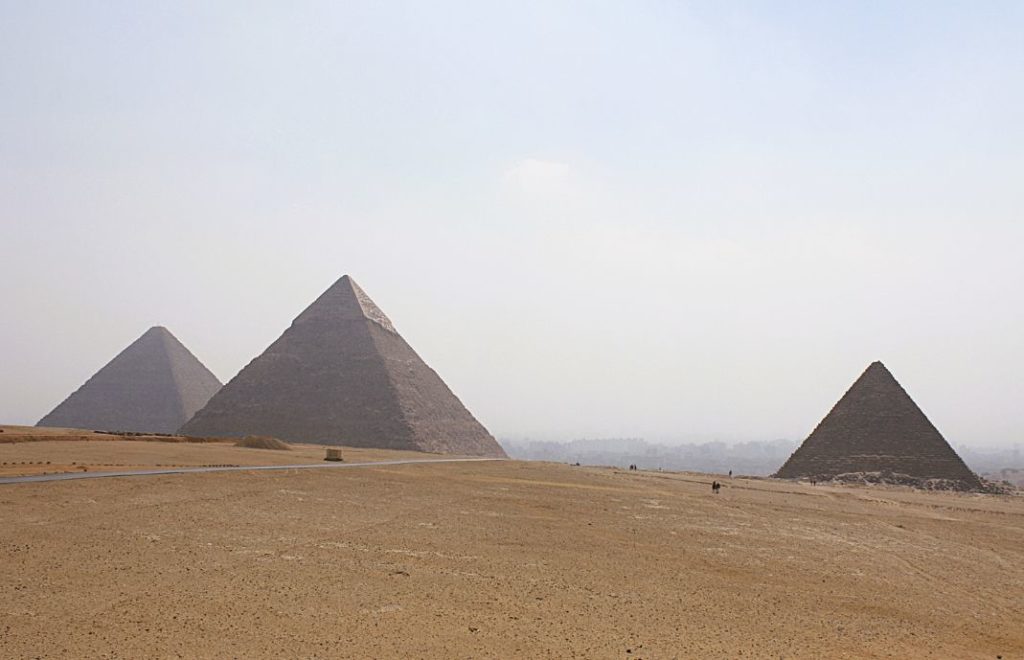
This view – this stark, surreal horizon – feels like the oldest sight line in the world. Here, the great pyramids of Khufu (Cheops), Khafre, and Menkaure stand as the final resting places of three generations of pharaohs, perfectly aligned with one another – and with the constellations above. A cosmic order carved into desert stone.
Every grain of sand whispers myths: treasures sealed away for eternity, workers cursed to silence, explorers who ignored the warnings carved in hieroglyphics. Legends speak of a curse that punishes those who dare disturb the eternal slumber of the pharaohs – a tale as haunting as it is irresistible.
And yet, here you are. Standing in the shadow of eternity, where the desert wind still hums secrets older than history itself.
The road to eternity
Cairo – a city that never exhales. Home to over ten million souls, it’s a symphony of sound and scent: the honking chaos of traffic, voices rising like waves in the heat, the mingling aromas of grilled meat and exhaust fumes thickening the air. It’s overwhelming, electric, and alive.
Yet, for most visitors, all roads lead to one thing: the pyramids.
I flag down a taxi, and soon we’re gliding across the Nile – a molten ribbon cutting through the heart of Egypt – before the highway carries us westward. And then, it happens: a flicker on the horizon. Three jagged silhouettes piercing the sky like eternal sentinels. The pyramids of Giza.
From this vantage point, they look almost unreal. Perfect triangles shimmering in the morning haze. I’m lucky. The air is clear today, a rare blessing in a city where smog often veils these wonders in a gray shroud. If you want this first, magical glimpse, take the outer approach road; otherwise, Cairo’s relentless sprawl – its concrete tide creeping toward the desert – swallows the drama.
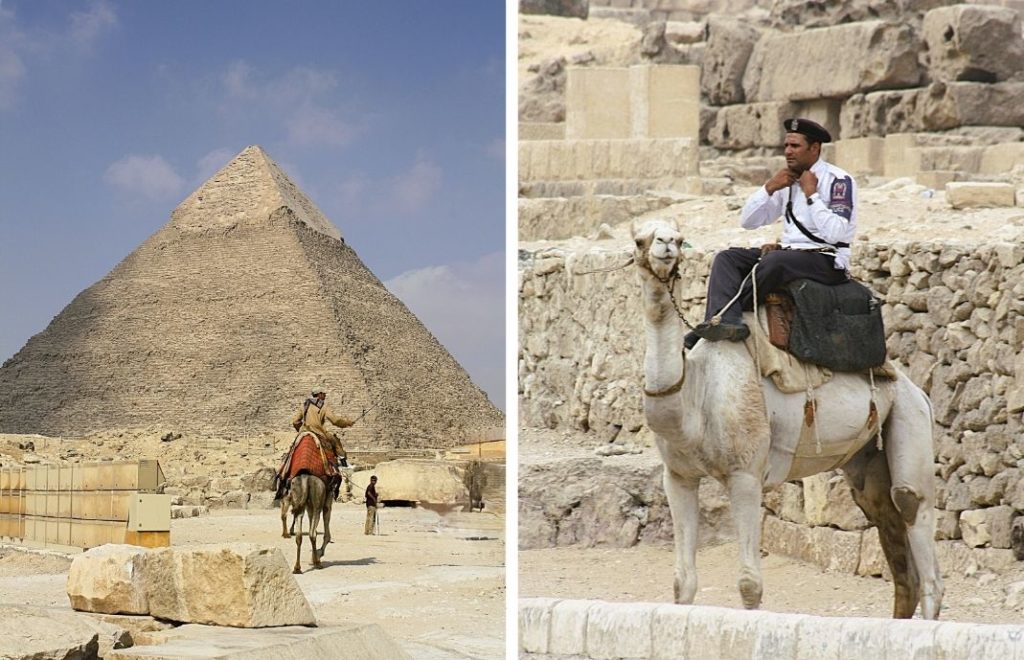
By the time we reach the plateau, the city feels like a distant memory. Here, space stretches wide. The pyramid complex sprawls across the desert like a broken chessboard, distances deceptive under the shimmering sun. You can walk between them if you’re patient, but there are options: horse-drawn carriages, camels swaying like desert ships, or the occasional taxi willing to navigate the dusty paths.
Today, I plan to linger. To stand in their shadow until the light changes and the whispers of history curl like incense in the dry air. Because these aren’t just monuments – they’re conversations with eternity.
The mighty Khufu – Journey into the heart of a pyramid
It’s early morning on the Giza Plateau, the air still cool before the desert sun begins its merciless climb. I’ve come at this hour for two reasons: to savor the silence before the tourist hordes descend – and to secure a golden ticket. Because entering the Great Pyramid of Khufu isn’t just a tour; it’s an initiation into the mysteries of the ancient world.
A man in a worn uniform glances at my ticket, then waves me forward into the dark maw of history. The entrance passage is cramped and steep, forcing me into an awkward crouch. The air is heavy, humid, and thick with the earthy scent of millennia. There’s no breeze here, no whisper of modern comfort – air conditioning was not part of the pharaoh’s blueprint. Sweat trickles down my spine, and I’ve barely set foot inside.
The passage I’m crawling through wasn’t meant for tourists – or even priests. It’s a grave robber’s tunnel, hacked open centuries ago, now serving as the only route to the inner sanctum. Then, suddenly, the tunnel yields to grandeur: the Grand Gallery, a soaring corridor eight meters high, its corbelled walls climbing toward shadow. For the first time, I can stand tall, dwarfed by stone and silence.
At the end of the gallery lies the King’s Chamber, its walls built from glowing pink granite, transported here from quarries hundreds of kilometers away. In its center rests Khufu’s sarcophagus – empty now, its treasures and secrets long plundered. Above it, five massive relieving chambers bear the unimaginable weight of the pyramid, an architectural masterstroke that has defied time and tremor for 4,500 years.
Inside, the stillness is almost physical, pressing against your ears like deep water. It’s hard not to feel small – smaller than you’ve ever felt – as you stand within this colossal tomb, knowing every block around you was laid by hand, every angle aligned with the stars.
But make no mistake: this journey isn’t for everyone. Claustrophobes, those with heart issues, or mobility problems should think twice. There’s nothing glamorous about crawling through stifling shafts – but the reward? A communion with eternity.

The last wonder of the ancient world
For 4,500 years, the pyramids have stolen the breath of every soul who has stood before them. They are not just monuments; they are riddles in stone, the kind that even modern science hasn’t fully solved. How did a civilization without cranes, engines, or steel conjure such perfection? Scholars scratch their heads, theories multiply – but the pyramids keep their secrets close, like jealous gods.
And then there’s the mystique – an aura as palpable as the desert heat. In antiquity, these giants gleamed in the sun, cloaked in smooth white limestone that reflected the light like a celestial beacon. Imagine that: three radiant mountains blazing under a sapphire sky, visible for miles, their tips almost kissing the heavens.
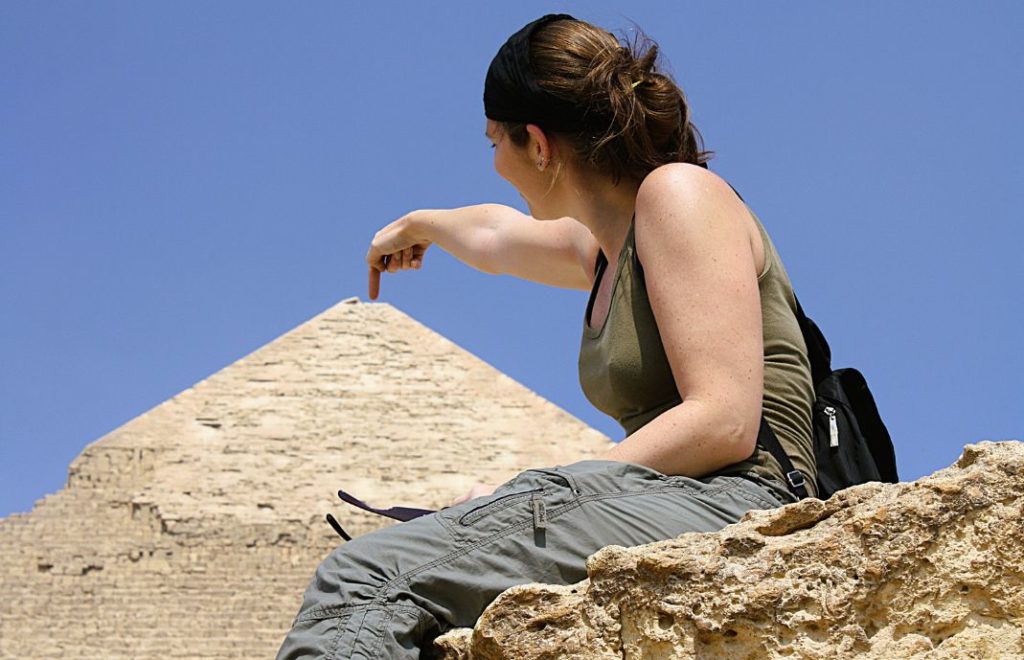
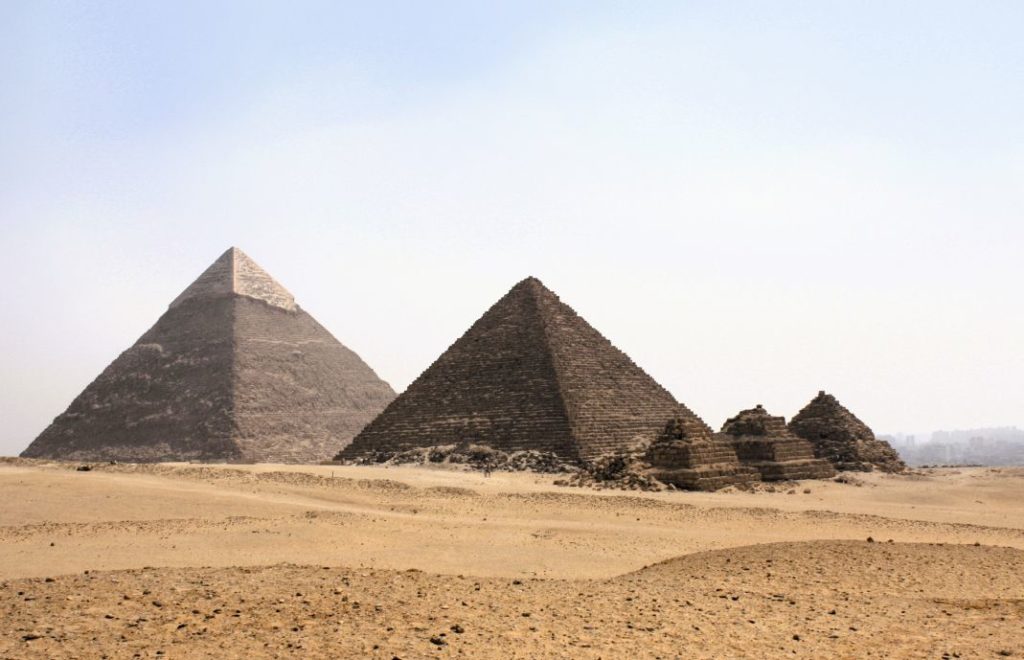
I find a quiet perch on a cluster of ancient stone blocks, a short walk from Khafre’s pyramid. From here, the panorama stretches like a dream: the Great Pyramid of Khufu, stoic and eternal, reigning as the last surviving wonder of the ancient world. At 137 meters, it only appears smaller than Khafre’s pyramid because its rival rests on higher ground. Look closer, though, and you’ll notice something extraordinary: at Khafre’s summit, fragments of the original limestone casing still cling on, like ghosts of its former brilliance.
I sit there for a long time, letting the desert wind wrap around me, and I can almost hear the whispers of laborers hauling blocks, priests chanting to Ra, and Pharaohs gazing at the stars. Time folds in on itself here. The world beyond this plateau seems trivial, fleeting – while these monuments, carved from eternity, simply endure.
The Sphinx – Guardian of eternity
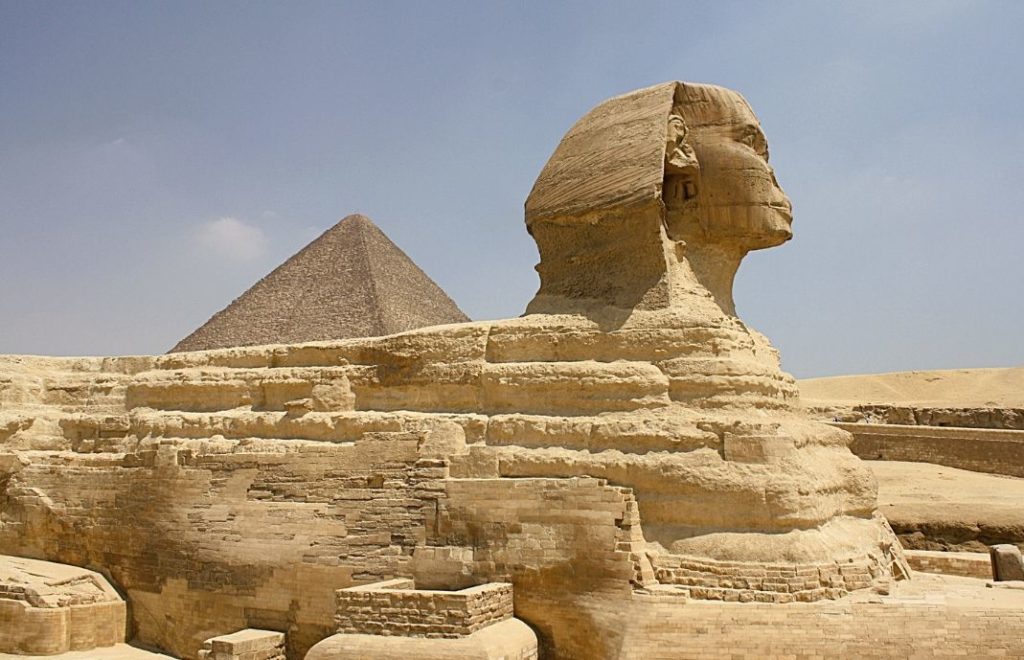
I turn my back on the pyramids and walk toward a figure that has haunted human imagination for millennia: the Great Sphinx of Giza. With the body of a lion and the head of a man, it has crouched on this plateau for more than 4,500 years, silent and unblinking, like a sentinel watching over eternity.
At 73 meters long and 20 meters high, the Sphinx is a giant born from a single limestone outcrop – a feat of artistry and engineering that boggles the mind even today. Its surface bears the scars of time, the erosion of sand and wind, and countless restorations. Yet, despite the wear and tear, its presence is majestic, magnetic. Those enigmatic eyes seem to gaze not only across the desert but deep into your soul.
Who carved it? Why? No one truly knows. Theories swirl like desert dust: the prevailing belief credits Pharaoh Khafre, whose pyramid looms behind, and many think the Sphinx’s face is his own – frozen forever in stoic glory. But others whisper of older secrets, lost dynasties, even civilizations predating Egypt itself. The truth lies locked within its weathered stone lips.
Beneath its paws rests the Dream Stele, an inscription that spins a tale as mystical as the Sphinx itself. It tells how Prince Thutmose IV, weary from hunting, fell asleep in the shadow of the statue. In his dream, the Sphinx spoke: “Clear the sand from my body, and you shall be king of Egypt.” Thutmose obeyed – and the prophecy came true. Whether myth or miracle, the story only adds to the Sphinx’s aura of eternal mystery.
Standing here, with the pyramids behind me and the Sphinx before me, I feel suspended between worlds: one foot in the present, the other stepping into a time when gods walked among men.

The curse of the Pharaohs
An English lady crouches near the sand, happily scooping stones into her handbag.
“They’ll look lovely in my garden,” she beams, while her husband shakes his head with that familiar married-for-50-years resignation.
I can’t resist.
“You do know there’s a curse on the plateau, don’t you? Anyone who takes home anything other than memories and photos is doomed to a lifetime of bad luck.”
Her jaw drops. The handbag slips from her hand and hits the ground with a thud, spilling its illicit contents.
“Is that true?” she stammers.
I keep my face grave.
“According to legend, yes. Every year, the Egyptian Museum receives hundreds of packages – stones sent back from all over the world. The letters all say the same thing: Ever since these rocks came home, misfortune has followed. Illness, accidents, financial ruin… The writers beg the museum to return the stones to Giza.”
I’m dead serious.
She looks like she’s seen a ghost. Her husband tries – and fails – to stifle a laugh as she frantically empties her bag.
We end up chatting about the sheer majesty of the pyramids and the Sphinx, and I suggest they book tickets for the Sound & Light Show that evening. It’s a dazzling spectacle where history is narrated under a starlit sky.
She nods, still peeking inside her bag to make sure every last pebble is gone.
As they walk away, I can’t help but grin. I may have nearly given an 80-year-old a heart attack… but here’s the kicker: the curse is real – or at least, the returns are. The museum truly gets those letters and stones every year.
Turns out, Khufu, Khafre, and Menkaure still wield power over their subjects – 4,500 years later.
The Great Pyramid of Khufu – By the numbers
Pharaoh: Khufu (Cheops)
Reign: 2551-2528 BC
Era: The Old Kingdom
Base area: 53,076.38 m²
Original height: 146.6 m
Current height: 137 m
Angle of inclination: 51° 50′
Number of stone blocks: 2.5 million
Average weight per block: 2.5 tons
Internal chambers: 3
Satellite (Queen’s) pyramids: 3
Boat pits: 5
These figures only deepen the awe. Every block was quarried, hauled, and placed 4,500 years ago, without modern machinery. A feat so monumental that even today, engineers marvel at its precision. The Great Pyramid is a structure aligned almost perfectly to the cardinal points, with margins of error so small they seem impossible for its time.
More inspiration to Egypt:
Cairo – Chaotic, exotic, and captivating
In the footsteps of the Pharaohs
The camel that staged a grand escape
A guide to Memphis
Saqqara – where it all began
