
If there is one museum you absolutely must visit in Kraków, it is Schindler’s Factory.
The story of the factory and its owner, Oskar Schindler, became world-renowned in 1993 with the release of Steven Spielberg’s film Schindler’s List. Since then, travelers from across the globe have flocked to Lipowa Street 4, eager to step into the very place where Schindler saved the lives of 1,200 Jews.
I hated the brutality, the sadism, and the insanity of Nazism. I just couldn’t stand by and see people destroyed. I did what I could, what I had to do, what my conscience told me I must do. That’s all there is to it. Really, nothing more.
Oskar Schindler
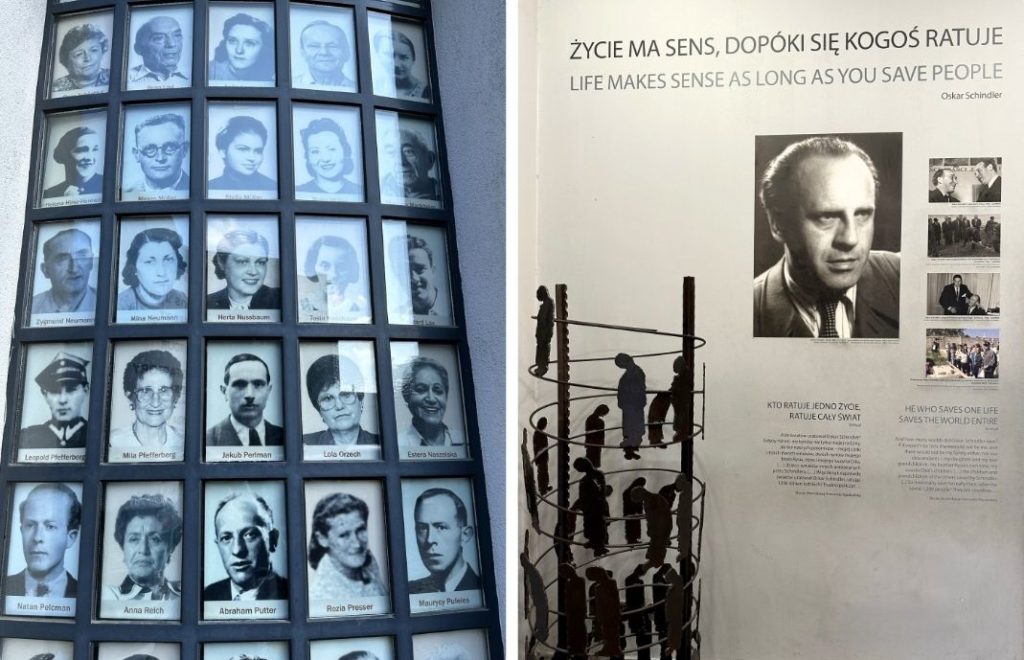
Oskar Schindler’s Factory
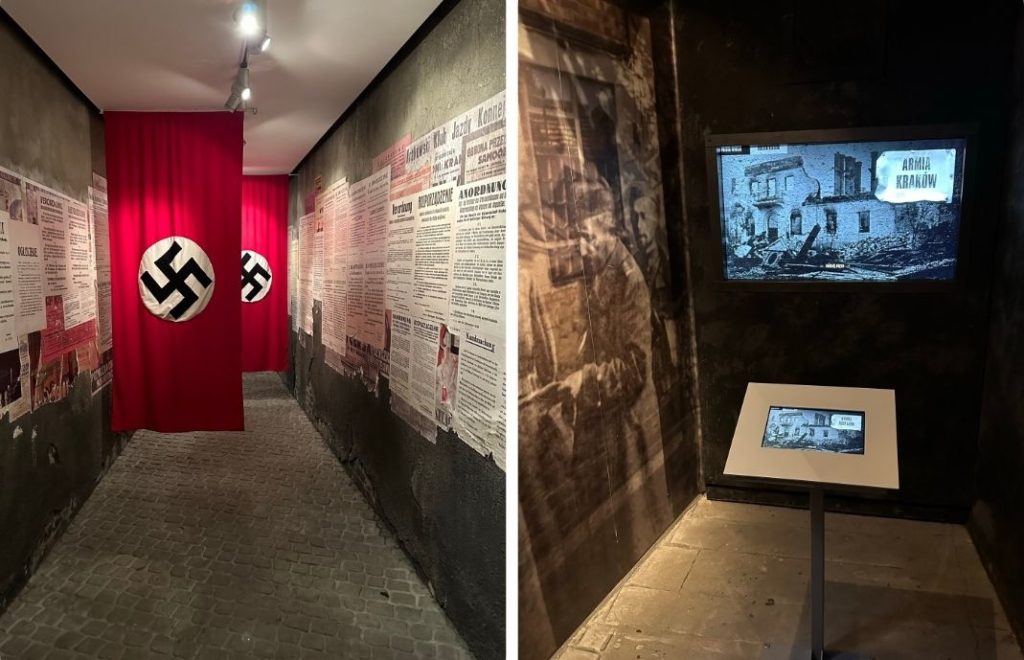
The museum is divided into two main exhibitions: Life in Kraków under German occupation (1939-1945) and Oskar Schindler himself.
It tells the moving story of Kraków during the Second World War – of its citizens living under Nazi rule, of the Jews forced into the ghetto, and of the countless victims of wartime atrocities. The curators have succeeded in capturing every layer of the hardships people endured, creating an experience that is both intimate and deeply affecting.
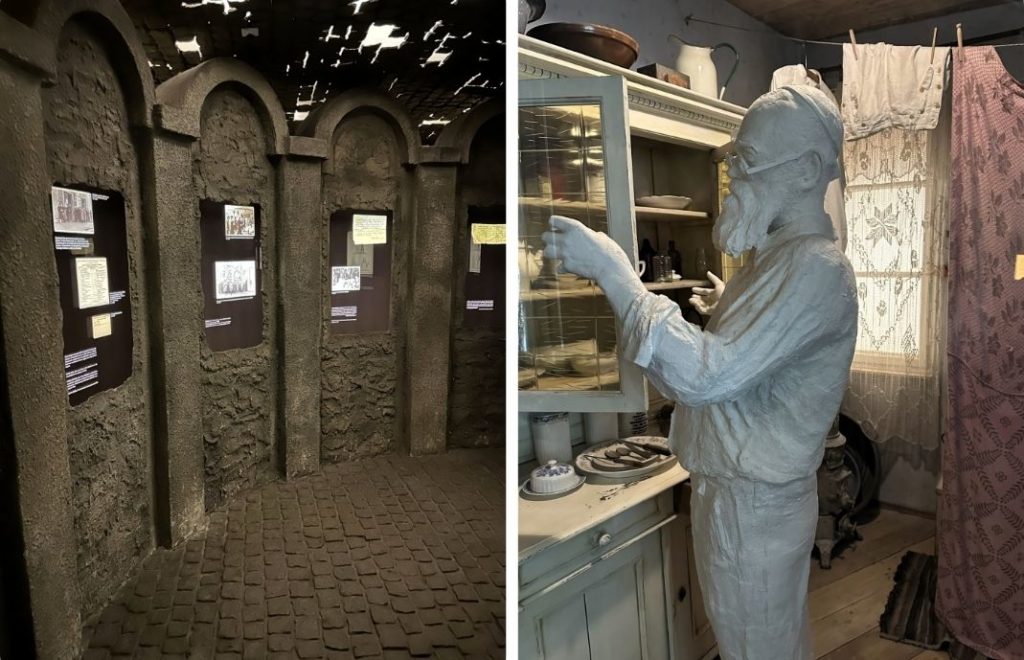
What makes the museum truly unique is its design. Each of the 45 rooms is meticulously staged to recreate a specific setting: a city street, a hair salon, a labor camp, a train station, a family living room, and many more. Walking through them, you feel immersed in the era, as if tracing the steps of Kraków’s residents during those dark years. It is history you can physically walk through.
The journey begins in Kraków in 1939 and unfolds chronologically until 1945, guiding visitors through daily life under occupation and the systematic persecution of the Jewish community.
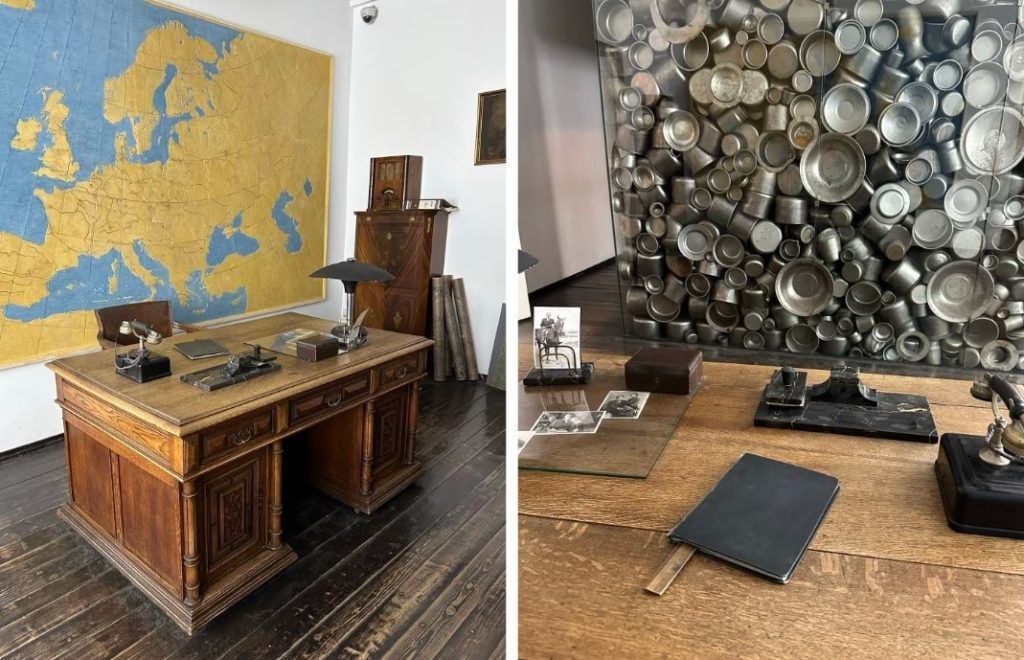
Perhaps most memorable is Oskar Schindler’s office, preserved exactly as it was during the war. His heroic efforts are presented with powerful emotion, culminating in “The Survivors’ Ark” – a chamber encircled by thousands of enameled pots and pans, identical to those produced by his Jewish workers. Inside the ark are inscribed the names of the 1,200 Jews whose lives he saved.
Practical information
- Schindler’s Factory is open daily, except for the first Tuesday of each month.
Opening hours may vary, so it’s wise to check the official website before your visit. - The last entry is 1.5 hours before closing.
- On average, visitors spend around 2.5 hours exploring the museum.
- You can discover the museum at your own pace or join a guided tour for a deeper insight.
- Groups of more than 15 people are required to book in advance.
- Tickets are in very high demand and often sell out well ahead of time – especially during the peak season – so securing your ticket early is strongly recommended.
The history of the factory
The factory was founded in 1937 under the name First Małopolska Factory of Enamelware and Tin Products Rekord. Its founders were three Jewish entrepreneurs: Michał Gutman, Izrael Kohn, and Wolf Luzer Glajtman.
After a series of ownership changes, the factory’s financial situation deteriorated, and it was declared bankrupt in June 1939.
On September 6, 1939, German troops marched into Kraków. Among them was Oskar Schindler, then a member of the Nazi Party (NSDAP). Ever the opportunist, he signed a lease for the enamel factory on January 15, 1940, renaming it Deutsche Emailwaren-Fabrik (German Enamelware Factory). He formally took ownership in 1942.
Not long after assuming control, Schindler began expanding the site. His investments were made possible through funds provided by Jewish businessmen, who in return received goods and employment for themselves or their families.
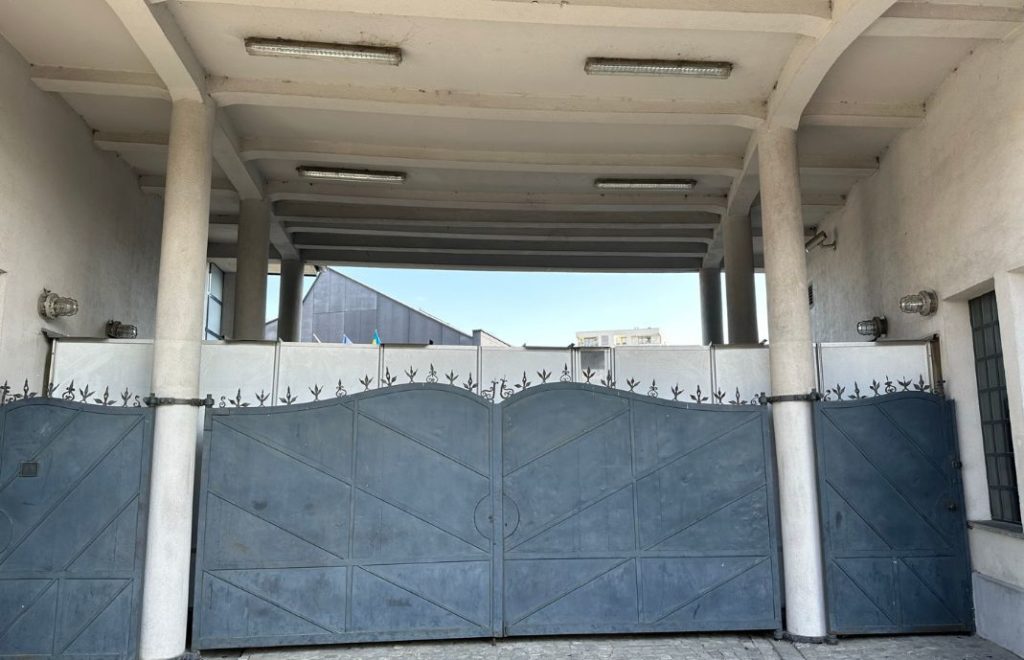
By 1940, the factory was already equipped with a payroll office, a medical and dental clinic, an infirmary, a cafeteria, stables, and garages. In 1942, the complex was enlarged to three floors, with added warehouses and office space. Two columns and a large gate were built at the entrance, giving the factory a more imposing presence.
At first, most of the workforce consisted of Poles, while Jews were recruited through the ghetto’s labor office between March 1941 and March 1943. During this time, most Poles were employed in administrative positions, while the number of Jewish workers grew steadily – from around 100 in 1940 to roughly 1,100 by 1944 (including those employed at the three adjacent factories).
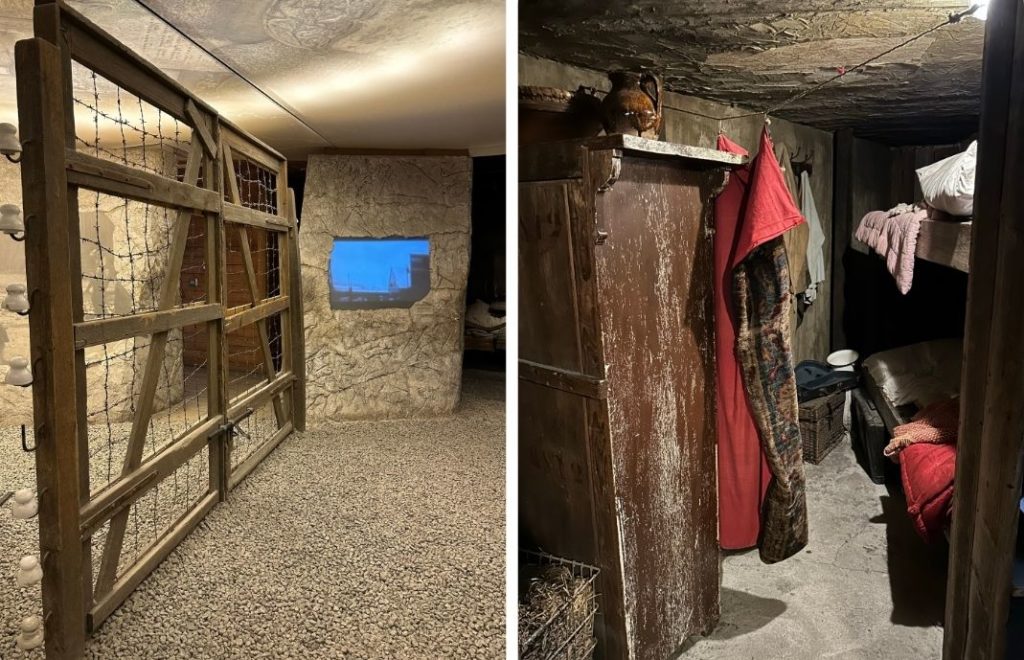
When the Podgórze ghetto was still in existence, Jewish workers were escorted to the factory each day by guards (Werkschutz). After the ghetto’s liquidation in 1943, those not deported to concentration camps were transferred to the Płaszów labor camp. Schindler, however, secured permission to establish a sub-camp on land he had purchased next to his factory. The barracks in Zabłocie housed not only his Jewish workers but also laborers from three neighboring factories producing goods for the German army.
After the Second World War
The sub-camp beside Schindler’s factory was enclosed by barbed wire, with guard towers and a parade ground between the barracks. Medical supplies were provided by the Jewish Social Self-Help (JUS). Thanks to cooperation with local Poles and contacts within Kraków, food here was far better than in the Płaszów camp.
Factory production and the camp itself were subject to frequent inspections, often by camp commandant Amon Göth. Yet, through Schindler’s efforts, these visits were not as oppressive for the workers as they might have been. That changed in January 1944, when Płaszów was converted into a concentration camp and the prisoners fell under direct SS control. Work shifts were long – first twelve hours across two shifts, later reduced to eight hours across three.
As the Eastern Front drew closer to Kraków, the Germans began liquidating camps and executing prisoners. To save his workers, Schindler decided to evacuate both the factory and its workforce to Brünnlitz in what was then Czechoslovakia. There, in a former textile factory, he established a new plant. Around 1,200 workers remained employed there until May 8, 1945, when they were liberated by the Red Army.
The move to Brünnlitz meant that the factory at Lipowa Street 4 was shut down. Two years after the war, in 1947, the buildings were nationalized. Between 1948 and 2002, they housed the Telecommunication Components Manufacturing Plant Telpod (later Telpod SA). The structures were adapted for industrial use, though the façade and gabled roof remained unchanged. Since 2005, the property has been owned by the City of Kraków.
After lengthy debate over the site’s future, a decision was finally made in 2007: the complex would be divided between two cultural institutions. The administrative building would become a historical museum, featuring an exhibition on Kraków under German occupation (1939-1945), while the former factory halls would be transformed into the Museum of Contemporary Art.
Oskar Schindler
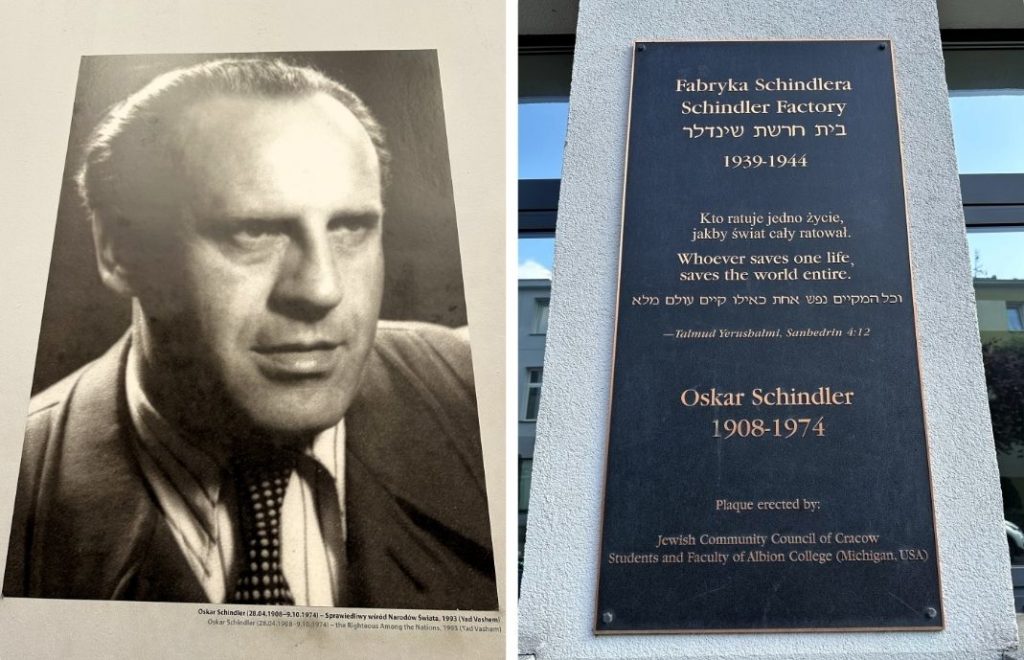
The man who etched his name into history by saving 1,200 Jews during the Second World War was born on April 28, 1908, in Zwittau, Moravia – then part of Austria-Hungary.
He came from a wealthy Sudeten German merchant family and was raised Catholic, though he distanced himself from religious practice at a young age. In 1928, he married Emilie Pelzl.
During the 1920s, Schindler held a variety of jobs, including working in his father’s factory. But the Great Depression dealt the family business a fatal blow, forcing it into bankruptcy in the 1930s. Around the same time, the National Socialist German Workers’ Party was rising in prominence across Germany, and Schindler joined in 1935.
Though a Czechoslovak citizen, he began working for the Abwehr, Germany’s military intelligence service, and was arrested by Czech authorities in July 1938. After the Munich Agreement, he was released that September.
In 1939, Schindler officially joined the Nazi Party (NSDAP). It is believed he continued his work with the Abwehr, aiding preparations for the German invasion of Poland.
An opportunistic businessman, Schindler was among many who sought to profit in occupied Poland after the invasion. He began by smuggling goods, which he used to bribe high-ranking German officers.
That same year, he took over the Pierwsza Małopolska Fabryka Naczyń Emaliowanych in Kraków, renaming it Deutsche Emailwaren-Fabrik (DEF). At first, access to workers was limited. But his Jewish accountant, Itzhak Stern, suggested turning to Kraków’s Jewish community for labor. Not only was this the cheapest available workforce, it also set in motion the extraordinary transformation of Schindler’s factory – from a profit-driven enterprise with just 45 employees into a lifeline for more than 1,700 souls.
A righteous man
In 1942, Schindler witnessed the horrors of the Nazi liquidation of Kraków’s Jewish ghetto. German soldiers deported its residents to the Płaszów concentration camp, and those who tried to hide were executed with brutal efficiency.
From that moment, Schindler began protecting his workers more actively. He claimed that even unskilled laborers were vital to the factory’s production, and threatened to demand compensation from the Nazis if any of his workers were harmed.
When a group of his Jewish employees – including his accountant, Itzhak Stern – were once taken to the train station for deportation to concentration camps, Schindler arrived just in time. He negotiated with the SS officers and secured their release, bringing them back to the factory. But everyone knew that further deportations were inevitable.
In 1944, when all Jews without exception were ordered to Auschwitz, Schindler petitioned the Nazis for permission to relocate his factory to the Sudetenland to continue producing war materials. Once permission was granted, he was asked to draw up a list of workers to bring with him. With Stern’s help, 1,200 Jews were chosen – each deemed “essential” to the factory’s operations. This list would later become one of history’s most famous symbols of survival.
By the war’s end, Schindler was financially ruined. His entire fortune had been spent on bribes, yet those sacrifices had saved 1,200 lives.
In 1949, he emigrated to Argentina. After going bankrupt there, he and his wife Emilie returned to Germany in 1958. His later business ventures all failed, and he survived largely thanks to donations from the very people he had saved – the Schindlerjuden – who supported him from around the world.
On October 9, 1974, at the age of 66, Oskar Schindler died. He was buried in the Catholic cemetery on Mount Zion in Jerusalem (Israel), the only member of the Nazi Party ever to be honored in this way.
Schindler is also remembered at Yad Vashem, Israel’s Holocaust memorial, where he is celebrated as Righteous Among the Nations.
What is there to say? They are my friends. I would do it again, over and over — for I hate cruelty and intolerance.
Oskar Schindler
More inspiration to visit Krakow:
8 great reasons to visit Kraków
3 days in Kraków
A guide to the Wieliczka Salt Mine
